



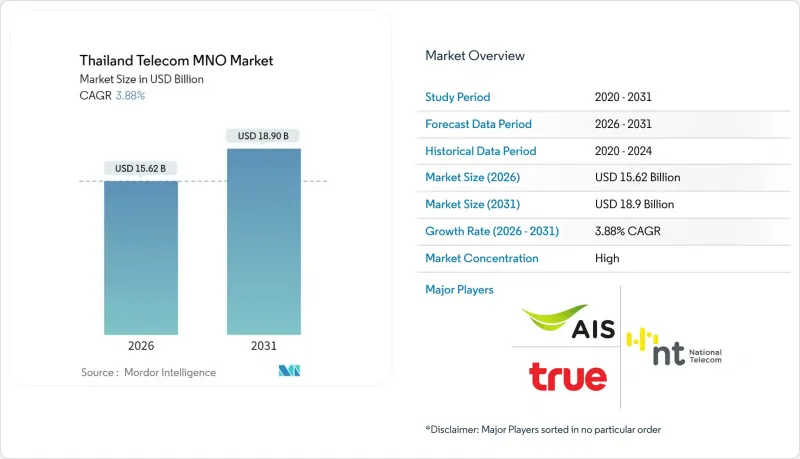
태국의 통신 MNO 시장은 2025년에 150억 4,000만 달러로 평가되었으며, 2026년 156억 2,000만 달러에서 2031년까지 189억 달러에 달할 것으로 예측됩니다.
예측 기간(2026-2031년) 동안 CAGR은 3.88%로 예상됩니다.
이러한 성장 궤적은 AIS, True, dtac의 양강 구도, 5G 확산 가속화, 기업주도형 사설망으로의 전환 등 구조적 변화 속에서도 꾸준한 매출 확대를 보여주고 있습니다. 데이터 및 인터넷 서비스는 이미 매출의 약 2/3를 차지하고 있으며, IoT 연결은 전국적인 NB-IoT 인프라를 통해 빠르게 확대되고 있습니다. 동시에 동부 경제회랑의 스마트 산업 프로젝트가 초저지연 연결에 대한 대규모 투자를 주도하고, 지방의 스마트폰 보급 확대는 잠재적 가입자 기반을 확대하고 있습니다. 규제 측면에서, 치솟는 주파수 가격이 사업자의 재정을 압박하는 반면, 디지털 경제 지원 목표와 보편적 서비스 의무 기금은 네트워크 확장의 새로운 길을 열어주고 있습니다. 따라서 경쟁 차별화는 단순한 가격 경쟁에서 기술 리더십, 서비스 품질, 기업용 솔루션의 깊이로 옮겨가고 있습니다.
2024년 기준 5G 네트워크는 태국 인구의 95%를 커버하며, 통신사업자에게 4G 대비 24배의 속도 향상을 실현할 수 있는 기반을 제공함과 동시에 프리미엄 가격대의 도입을 가능하게 합니다. AIS는 저-중-고주파 대역에서 총 1,460MHz 이상의 주파수 대역을 확보하여 국내 최고 속도 점수인 118.84를 달성하였습니다. 이 인프라는 소비자 eMBB 서비스 외에도 엣지 컴퓨팅 아키텍처를 지원하여 새로운 기업 수익원을 창출할 수 있습니다. 트루코퍼레이션은 2.6GHz 대역의 동적 스펙트럼 공유(Dynamic Spectrum Sharing)를 통해 스펙트럼 효율을 향상시키고 있으며, 이를 통해 4G와 5G의 트래픽을 동시에 유지하고 있습니다. 태국 미디아(Midea) 공장 등의 프라이빗 5G 도입은 15-20%의 효율성 향상과 30%의 운영비 절감 효과를 달성하여 보장된 처리량에 대한 기업의 지불 의지가 있음을 입증했습니다. 정부 예측에 따르면, 5G는 2035년까지 국내총생산(GDP)에 93억 달러를 창출할 수 있으며, 태국 통신사업자 시장을 데이터 기반 성장에 더욱 확고히 자리매김할 것으로 예상됩니다.
OTT 동영상과 클라우드 게임 플랫폼의 확산으로 모바일 데이터 소비가 급증하고, 도시 밀레니얼 세대를 중심으로 상위 요금제로의 전환이 진행되고 있습니다. 프리미엄 컨텐츠, QoS 보장, 무제한 데이터 통신을 결합한 요금제를 제공하는 사업자는 5G 사용자에서 4G 사용자 대비 10-15%의 ARPU 프리미엄을 관찰하고 있습니다. 클라우드 게이밍의 지연에 대한 민감성은 5G 독립형 슬라이스에 유리하게 작용하여 경쟁이 치열한 방콕의 후불 시장에서 고객 이탈률을 낮추는 차별화된 서비스 제공이 가능합니다. 아시아태평양 통신사업자의 55%가 2024년 ARPU 성장률을 기록할 것으로 예상되며, 태국 통신사들도 데이터 사용량 기반 단계별 요금제를 활용하여 이러한 추세를 따르고 있습니다. 풀 HD 및 4K 동영상 스트리밍은 가장 큰 트래픽 카테고리를 차지하고 있으며, 인구 밀집 지역에서의 무선 액세스 네트워크의 지속적인 고밀도화가 요구되고 있습니다.
태국의 2023년 주파수 경매에서 32억 달러가 조달되어 1인당 기준 세계 최고 수준의 주파수 사용료가 책정되었습니다. 경제 시뮬레이션에 따르면, 라이선스 비용이 2,000억 바트를 초과할 경우, 5년간 5G 보급률은 50%로 하락하여 저비용 시나리오의 70% 이하로 떨어질 것으로 예상됩니다. 트루코퍼레이션은 분기 손실을 보고했으며, 그 원인 중 하나로 주파수 관련 부채의 높은 이자 부담을 꼽고 있습니다. National Telecom이 700MHz 대역 확보에 투자한 343억 바트도 마찬가지로 현금 흐름을 압박하여 향후 네트워크 투자 예산에 대한 구조적 압박을 강조하고 있습니다. 높은 유지보수 비용은 지방에서의 5G 구축 지연과 고도의 독립형 기능을 위한 R&D 축소 위험을 수반합니다.
데이터 및 인터넷 수익은 2025년 기준 태국 통신 MNO 시장 점유율의 63.78%를 차지할 것으로 예상되며, 동영상 스트리밍, 클라우드 게임, 원격근무 애플리케이션의 증가로 2031년까지 선두를 유지할 것으로 전망됩니다. 음성 트래픽은 장기적인 감소 추세가 지속되고 있으며, 메시징 앱이 기존 SMS를 대체하면서 태국 통신 MNO 시장 규모의 10.00% 이하로 떨어졌습니다. IoT와 M2M은 현재 매출에서 차지하는 비중은 미미하지만, 전국적인 NB-IoT의 가용성과 예지보전, 물류 추적, 스마트 미터 도입을 가능하게 하는 산업용 5G SA 슬라이스에 힘입어 4.00%의 가장 빠른 CAGR을 기록할 것으로 예상됩니다. 통신사들은 커넥티드 서비스에 디바이스 관리 플랫폼과 분석 대시보드를 결합하여 기본 데이터 요금을 크게 상회하는 평균접속수익(ARPC)을 실현하고 있습니다. OTT 서비스와 유료 TV 서비스는 교차 판매 기회를 제공합니다: True는 자체 컨텐츠 라이브러리를 활용하고, AIS는 세계 스트리밍 브랜드와 제휴하여 제로 레이팅을 활용하여 데이터 요금제 업그레이드를 촉진하고 있습니다.
태국의 차별화된 주파수 대역 보유 현황이 서비스 형태의 경제성을 형성하고 있습니다. AIS의 추가 700MHz 대역은 데이터 서비스의 실내 커버리지를 개선하고, True의 2.6GHz DSS는 피크 용량을 향상시킵니다. 두 통신사는 네트워크 슬라이싱의 개념 증명을 시험 운영하고 있으며, 공장, 병원, AGV 차량 그룹을 대상으로 보증 지연을 판매하고 있습니다. 전 세계 예측에 따르면, 2029년까지 64억 개의 셀룰러 IoT 연결이 예상되며, 태국 통신 사업자들은 산업별 솔루션을 통해 이 시장에서 큰 점유율을 확보하고자 합니다. 부가가치 서비스(VAS)와 로밍 회선은 여전히 틈새 시장이지만, 태국이 관광 수요를 재개하면서 그 중요성이 커지고 있습니다. 지역 파트너와의 원활한 5G 로밍 계약을 통해 통신사들은 고소비층 관광객을 끌어들일 준비를 하고 있습니다.
태국 통신 MNO 시장은 서비스 유형별(음성 서비스, 데이터/인터넷 서비스, 메시징 서비스, IoT/M2M 서비스, OTT/유료 TV 서비스, 기타 서비스) 및 최종사용자(기업, 소비자)별로 세분화됩니다. 시장 예측은 금액(달러) 및 수량(가입자 수)으로 제공됩니다.
The Thailand Telecom MNO Market was valued at USD 15.04 billion in 2025 and estimated to grow from USD 15.62 billion in 2026 to reach USD 18.9 billion by 2031, at a CAGR of 3.88% during the forecast period (2026-2031).
That trajectory reflects measured topline expansion even as the sector undergoes deep structural change driven by the AIS-True-dtac duopoly, accelerated 5G rollouts, and an enterprise-led push toward private networks. Data and Internet services already account for almost two-thirds of revenue, while IoT connections scale quickly on nationwide NB-IoT infrastructure. At the same time, the Eastern Economic Corridor's smart-industry projects anchor large investments in ultra-low-latency connectivity, and rising rural smartphone adoption broadens the addressable subscriber base. On the regulatory front, high spectrum prices weigh on operator finances, yet supportive digital-economy targets and the Universal Service Obligation Fund open further network-expansion avenues. Competitive differentiation, therefore, shifts from pure price plays to technology leadership, quality of service, and enterprise solution depth.
5G networks covered 95% of Thailand's population in 2024, giving operators a platform for speed improvements 24 times faster than 4G and enabling premium pricing tiers . AIS holds more than 1,460 MHz across low-, mid-, and high-bands, translating into the country's highest Speed Score of 118.84 . Beyond consumer eMBB services, the same infrastructure supports edge-computing architectures that unlock new enterprise revenue streams. True Corporation improves spectral efficiency through Dynamic Spectrum Sharing on the 2.6 GHz band, a method that concurrently sustains 4G and 5G traffic. Private 5G deployments at factories like Midea Thailand delivered 15-20% efficiency gains and 30% opex savings, validating enterprise willingness to pay for guaranteed throughput. Government projections show 5G could inject USD 9.3 billion into national GDP by 2035, further anchoring the Thailand Telecom MNO market to data-driven growth .
Mobile data consumption surged as over-the-top video and cloud-gaming platforms gained traction, prompting a migration to higher-tier plans across urban millennials. Operators that bundle premium content, quality-of-service guarantees, and unlimited data observe ARPU premiums of 10-15% among 5G users versus 4G cohorts. Cloud gaming's sensitivity to latency favors 5G standalone slices, enabling differentiated offers that reduce churn in the highly contested Bangkok post-paid segment. Nationally, 55% of Asia-Pacific operators posted ARPU growth in 2024, and Thai carriers mirror this trend by leveraging data-usage-based pricing ladders. Video streaming in full-HD and 4K constitutes the single largest traffic category, compelling continued radio-access-network densification across populous corridors.
Thailand's 2023 auctions raised USD 3.2 billion, positioning its spectrum fees among the costliest worldwide on a per-capita basis. Economic simulations show that license costs above THB 200 billion reduce five-year 5G adoption to 50%, versus 70% under lower-cost scenarios . True Corporation reported quarterly losses attributable in part to elevated interest expenses on spectrum-related debt. National Telecom's THB 34.3 billion outlay for 700 MHz blocks similarly eroded cash flow, highlighting systemic pressure on future network-investment budgets. High carrying costs risk delaying rural 5G rollouts and curtailing R&D for advanced standalone capabilities.
Other drivers and restraints analyzed in the detailed report include:
For complete list of drivers and restraints, kindly check the Table Of Contents.
Data and Internet revenue represented 63.78% of Thailand Telecom MNO market share in 2025 and is projected to retain primacy through 2031 as video streaming, cloud gaming, and remote work applications multiply. Voice traffic continues its secular decline, falling below 10.00% of Thailand Telecom's MNO market size as messaging apps displace traditional SMS. IoT and M2M contribute a modest top-line share today but register the fastest 4.00% CAGR, driven by nationwide NB-IoT availability and industrial-grade 5G SA slices that enable predictive maintenance, logistics tracking, and smart-meter rollouts. Operators bundle connectivity with device-management platforms and analytics dashboards, broadening average revenue per connection well beyond basic data charges. OTT and Pay-TV services present cross-sell upside: True leverages its content library while AIS partners with global streaming brands, using zero-rating to spur data-plan upgrades.
Thailand's differentiated spectrum holdings shape service-type economics. AIS's additional 700 MHz blocks improve in-building coverage for data services, while True's 2.6 GHz DSS boosts peak capacity. Both carriers pilot network-slicing proofs-of-concept that sell guaranteed latency to factories, hospitals, and AGV fleets. Global forecasts place 6.4 billion cellular-IoT connections by 2029, and Thai operators seek an outsized slice of that volume through vertical-specific solutions. VAS and roaming lines remain niche but gain relevance as Thailand reopens tourism flows; seamless 5G roaming agreements with regional partners position carriers to capture high-spending visitors.
The Thailand Telecom MNO Market is Segmented by Service Type (Voice Services, Data and Internet Services, Messaging Services, Iot and M2M Services, OTT and PayTV Services, and Other Services), and End User (Enterprises, Consumer). The Market Forecasts are Provided in Terms of Value (USD) and Volume (Subscribers).