



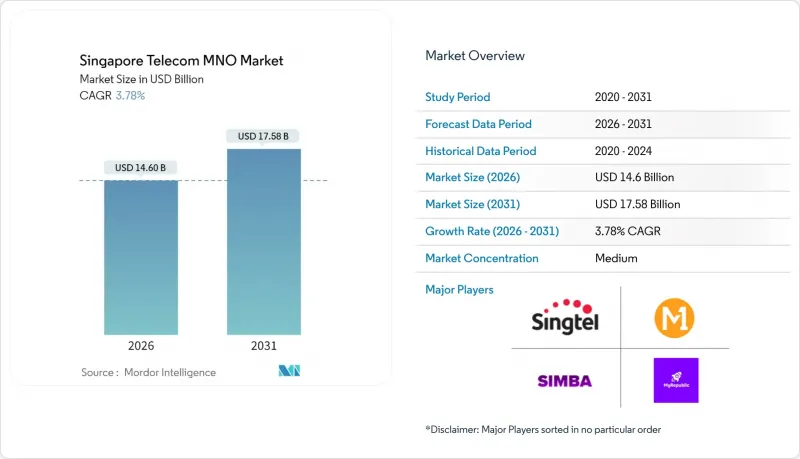
싱가포르의 이동통신 사업자(MNO) 시장은 2025년 140억 7,000만 달러에서 2026년에는 146억 달러로 성장하며, 2026-2031년에 CAGR 3.78%로 추이하며, 2031년까지 175억 8,000만 달러에 달할 것으로 예측됩니다.
가입자 수는 2025년 1,009만 명에서 2030년까지 1,169만 명으로 시장 규모가 확대될 것으로 예상되며, 예측 기간(2025-2030년) 동안 CAGR은 2.98% 미만으로 예측됩니다. 이러한 꾸준한 성장 궤적은 탄탄한 인프라 투자, 전국적인 5G 독립형 커버리지, 적극적인 클라우드 퍼스트 공공 구상이 결합되어 기업 수요를 늘리고 프리미엄 소비자 업그레이드를 유지하면서 기업 수요를 촉진하고 있음을 반영합니다. 가정용 광섬유 보급률은 100%에 달하며, 사업자는 기가비트급 광대역과 5G 모바일 요금제를 묶어 제공할 수 있으며, 이는월평균 50GB 이상의 모바일 데이터 소비량을 지원하고 있습니다. 정부 및 산업 분야의 디지털화가 가속화되면서 안전한 대용량 연결에 대한 수요가 증가하고 있으며, 통신사업자들은 미션 크리티컬 워크로드를 위한 네트워크 슬라이싱 제품 및 AI 기반 사이버 보안 번들로 이에 대응하고 있습니다. 심바 및 10개 이상의 MVNO 진입으로 인한 경쟁 심화로 데이터 통신 요금이 동남아시아 최저 수준으로 떨어졌지만, 신중한 설비투자 사이클과 새로운 기업용 수입원이 이익률 유지에 기여하고 있습니다. 싱가포르의 MNO 통신 시장은 해상 및 항만용 사설망 시범 운영과 적극적인 자금 투입을 통한 클라우드 엣지 구축으로 산업용 5G 이용 사례의 지역적 쇼케이스로 자리매김하고 있습니다.
싱가포르는 2025년 전 인구 밀집 지역을 5G 단독으로 커버하는 세계 최초의 국가가 되었습니다. 이를 통해 통신사업자는 지연에 민감한 트래픽을 위해 전용 슬라이스를 할당할 수 있는 아키텍처적 자유를 얻게 되었습니다. Singtel의 700MHz 대역은 실내 커버리지를 40% 향상시키는 동시에, 일반 모바일 요금제보다 훨씬 저렴한 비용으로 초저대역폭 IoT 슬라이스를 제공하여 대상 기업 이용 사례를 확대할 수 있습니다. 네트워크 슬라이싱은 피크 시간대 대역폭을 보장하는 프리미엄 소비자용 '5G+' 번들을 지원하며, 2025년 초기 도입 고객층에서 ARPU를 23% 향상시켰습니다.
2024년 말까지 대상 정부 시스템의 80% 이상이 상용 클라우드에서 운영될 것으로 예측됩니다. 이 기념비적인 사건으로 인해 정부 기관과 벤더들의 보안 연결에 대한 수요가 즉각적으로 증가했습니다. 2024년 12월에 도입된 '책임 분담 프레임워크'는 금융기관이 통신사와의 피싱 대응을 위한 공동 혁신을 더욱 촉진하고, 컴플라이언스 중심의 메시징 및 API 보안 분야에서 새로운 매출을 창출할 수 있는 기회를 제공합니다.
심바의 '10싱가포르달러에 50GB' 요금제는 소비자 가격 기대치를 재설정하고, 2024년까지 제4의 통신사업자가 가입자 점유율 10% 이상을 달성하는 데 일조했습니다. 10개 이상의 MVNO가 마이크로 부문을 공략하고 있는 가운데, 해지율이월1.7%를 넘어섰고, 무선 액세스 에너지 비용의 상승에도 불구하고 어떤 사업자도 정가를 인상할 여지가 제한되어 있습니다.
2025년 기준 데이터 제품은 싱가포르 MNO 시장의 52.64%를 차지할 것으로 예상되며, 이는 모바일 광대역 보급과 100% 가정용 광섬유 액세스를 반영하고 있습니다. IoT 및 M2M은 3.94%의 가장 높은 CAGR을 기록했으며, 초신뢰성 및 저지연 연결이 필요한 스마트 팩토리 시범사업과 도시 규모의 센서 네트워크가 주도했습니다. 음성 서비스는 19.74%를 차지했으나, OTT 서비스에 의한 침식이 지속되면서 성장세가 둔화되었습니다. OTT 및 유료방송은 10.08%를 차지했으며, 스트리밍 번들로 인해 완만한 성장세를 보였습니다. 관리형 보안 및 GPU-as-a-Service를 포함한 기타 부가가치 서비스는 사업자들이 수입원을 다각화하면서 3.88%의 성장률을 기록했습니다. 이러한 다양성은 싱가포르의 MNO 통신 시장 규모가 전통적 소비자 음성 서비스 동향이 아닌 기업의 디지털 전환 예산에 연동되는 경향이 강해지고 있음을 보여줍니다.
경쟁 환경은 서비스 융합을 촉진하고 있습니다. 통신사는 무제한 데이터 SIM 전용 요금제에 2Gbps 가정용 광대역과 클라우드 스토리지를 결합해 2019년 단품 가격과 동일한 수준으로 제공. 이를 통해 복수 제품 도입률은 65%를 넘어섰습니다. 투아스 항구의 무인운반차부터 창이 공항의 AR 가이드 항공기 점검까지 산업용 5G 이용 사례는 2031년까지 3억 4,000만 달러의 증분 서비스 매출을 창출할 것으로 예상되며, 고매출 플랫폼 서비스로의 구조적 전환을 강화하고 있습니다.
싱가포르 통신 MNO 시장은 서비스 유형(음성 서비스, 데이터/인터넷 서비스, 메시징 서비스, IoT/M2M 서비스, OTT/유료 TV 서비스, 기타 서비스) 및 최종사용자(기업, 소비자)에 따라 시장 세분화됩니다. 시장 예측은 금액(USD) 및 수량(가입자 수)으로 제공됩니다.
The Singapore Telecom MNO Market is expected to grow from USD 14.07 billion in 2025 to USD 14.6 billion in 2026 and is forecast to reach USD 17.58 billion by 2031 at 3.78% CAGR over 2026-2031.
In terms of subscriber volume, the market is expected to grow from 10.09 million units in 2025 to 11.69 million units by 2030, at a CAGR of less than 2.98% during the forecast period (2025-2030). This steady trajectory reflects resilient infrastructure investment, nationwide 5G standalone coverage, and aggressive cloud-first public initiatives that jointly lift enterprise demand while sustaining premium consumer upgrades. Household fiber penetration sits at 100%, enabling operators to bundle gigabit-class broadband with 5G mobile tiers, which in turn supports average monthly mobile data consumption above 50 GB. Intensifying digitalization across government and industry pushes demand for secure, high-capacity connectivity, and operators are responding with network-slicing products for mission-critical workloads and AI-enabled cybersecurity bundles. Competitive tension, sparked by the entry of Simba and more than ten MVNOs, has driven data prices to the lowest level in Southeast Asia, yet prudent capex cycles and new enterprise revenue streams help sustain margins. Maritime and port private-network pilots, plus aggressively funded cloud-edge rollouts, position the Singapore MNO telecom market as a regional showcase for industrial 5G use cases.
Singapore became the first country to blanket all populated areas with 5G standalone in 2025, giving operators the architectural freedom to allocate dedicated slices for latency-sensitive traffic. Singtel's 700 MHz layer lifted indoor coverage by 40% while permitting ultra-low-bandwidth IoT slices that cost only a fraction of regular mobile plans, expanding addressable enterprise use cases. Network slicing also underpins premium consumer "5G +" bundles that guarantee bandwidth during peak hours, generating a 23% ARPU uplift among early adopters in 2025
More than 80% of eligible government systems ran on the commercial cloud by late-2024, a milestone that immediately multiplied secure connectivity demand from agencies and their vendors. The Shared Responsibility Framework launched in December 2024 further compels financial institutions to co-innovate with telecom operators on anti-phishing defenses, spawning new compliance-driven messaging and API-security revenues.
Simba's SGD 10-for-50 GB plan re-anchored consumer price expectations and helped the fourth operator exceed 10% subscriber share by 2024. With more than ten MVNOs targeting micro-segments, churn has risen above 1.7% monthly, curbing the ability of any provider to push list prices upward despite rising radio-access energy costs.
Other drivers and restraints analyzed in the detailed report include:
For complete list of drivers and restraints, kindly check the Table Of Contents.
Data products commanded 52.64% of Singapore telecom MNO market share in 2025, reflecting ubiquitous mobile broadband adoption and 100% household fiber access. IoT and M2M posted the highest 3.94% CAGR, fueled by smart-factory pilots and city-wide sensor grids that demand ultrareliable low-latency connectivity. Voice held 19.74% yet lagged in growth as OTT erosion persisted. OTT and PayTV represented 10.08%, bolstered modestly by streaming bundles. Other value-added services including managed security and GPU-as-a-Service grew at 3.88% as operators diversified revenue. This breadth underscores how the Singapore MNO telecom market size increasingly tracks enterprise digital-transformation budgets rather than legacy consumer voice trends.
The competitive configuration encourages convergence. Operators package unlimited-data SIM-only plans with 2 Gbps home broadband and cloud storage at price points equal to 2019 single surfaces, driving multi-product take-rates above 65%. Industrial 5G use cases from automated guided vehicles at Tuas Port to AR-guided aircraft checks at Changi are projected to inject USD 340 million incremental service revenue by 2031, reinforcing the structural pivot toward high-margin platform services.
The Singapore Telecom MNO Market is Segmented by Service Type (Voice Services, Data and Internet Services, Messaging Services, Iot and M2M Services, OTT and PayTV Services, and Other Services), and End User (Enterprises, Consumer). The Market Forecasts are Provided in Terms of Value (USD) and Volume (Subscribers).