



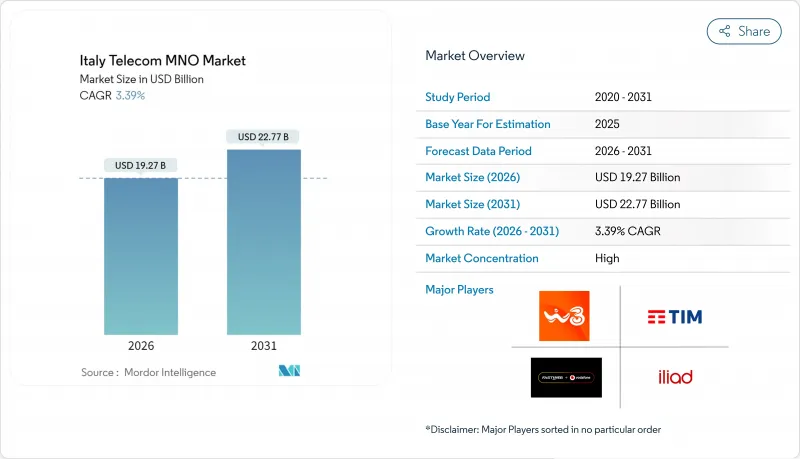
이탈리아의 MNO 시장의 규모는 2026년에 192억 7,000만 달러로 추정되고 있습니다.
이는 2025년 186억 4,000만 달러에서 성장한 수치이며, 2031년에는 227억 7,000만 달러에 달할 것으로 예측되고 있습니다. 2026년부터 2031년까지는 CAGR 3.39%로 성장할 것으로 전망되고 있습니다.
이러한 증가 추세는 데이터 소비 증가, 5G 커버리지 확대, 정부 지원을 통한 광섬유 배치, 고정 통신 및 이동 통신 융합 서비스로의 전환으로 인해 발생합니다. 특히 스위스컴사가 보다폰 이탈리아를 80억 유로(92억 2,000만 달러)에 인수한 사례와 KKR사가 188억 유로(216억 6,000만 달러)에 인수한 TIM사의 NetCo 부문 등, 통합의 움직임이 경쟁 구도를 재편하여 자본 효율을 높이고 사용자 1인당 평균 수익을 안정화하고 있습니다. 데이터 및 인터넷 서비스가 가장 큰 점유율을 차지하는 반면, IoT 연결과 기업의 디지털화는 성장을 이끌고 있습니다. 통신 사업자는 타워 공유 및 재생에너지 조달을 통해 전력 비용을 절감하고 급등하는 전기 요금으로 인한 압력을 완화하고 있습니다. 전체적으로 성숙하면서도 개혁이 진행되는 환경이 이탈리아의 MNO 시장을 꾸준한 가치 기반 확대로 이끌고 있습니다.
이탈리아는 5G의 인구 커버율이 이미 90%를 넘어 차세대 접근성에서 EU 국가의 최상위에 자리잡고 있습니다. TIM사는 2026년까지 옥외 5G 커버율을 95%로 끌어올려 4G 운용에 비해 기가바이트당 비용을 최대 50% 절감할 계획입니다. 국가 부흥 및 탄력성 계획(NRRP)이 투입한 20억 2,000만 유로(23억 3,000만 달러)의 자금은 21,900개의 무선 기지국으로 백홀 광섬유를 지원하여 상업적 수익이 약한 지역의 공백을 채우고 있습니다. 공장과 항만에서는 사설 5G 네트워크가 보급되어 데이터 집약도와 서비스 수익을 향상시키고 있습니다. 따라서 5G의 광범위한 채택으로 이탈리아의 MNO 시장은 높은 성장 궤도를 유지할 전망입니다.
고정 광대역, 모바일 서비스 및 컨텐츠를 번들로 제공함으로써 고객의 정착률이 향상되고, 특히 부유한 북부 주에서 평균 수익 수준을 지원합니다. 패스트웹사와 보다폰사의 제휴는 해약률을 낮추고 크로스셀의 촉진으로 이어지는 전국 규모의 컨버전트 제안을 약속하고 있습니다. 사업자는 광섬유망을 활용하여 프리미엄 모바일 데이터 플랜의 업셀을 도모해 요금의 침식을 억제하고 있습니다. 밀라노의 초기 성공 사례에서는 광섬유와 5G를 공동으로 추진할 경우 다중 계약률이 10포인트 상승한 것으로 나타났습니다. 이러한 움직임을 통해 이탈리아의 MNO 시장은 양이 아닌 가치를 기반으로 성장을 유지하고 있습니다.
2018년 일리아드의 시장 진입 이후 격렬한 수수료 경쟁으로 모바일 ARPU가 하락하고 해지율이 상승했습니다. 업계 개편으로 인해 직접적인 할인 경쟁은 줄어들고 있으며, 특히 선불 분야에서는 저렴한 가격의 서비스가 여전히 경쟁을 격화시키고 있습니다. 이에 비해 사업자는 컨텐츠 번들과 속도 계층화 등 업셀 전략으로 대응하고 있습니다. 따라서 단기적인 수익 압박으로 인해 가격 균형이 달성될 때까지 이탈리아의 MNO 시장의 CAGR은 약 1% 하락할 것으로 전망됩니다.
데이터 및 인터넷 서비스는 최대의 수익원이며, 2025년에는 이탈리아의 MNO 시장에서 42.65%의 점유율을 차지했습니다. IoT 및 M2M 솔루션은 절대적인 규모는 여전히 작지만 산업 자동화 및 스마트 시티 프로젝트를 배경으로 3.46%의 가장 높은 CAGR을 달성하고 있습니다. 스트리밍, 클라우드 게임, 재택 근무의 보급으로 기가바이트 규모의 사용이 증가함에 따라 데이터 중심 서비스 부문의 이탈리아의 MNO 시장 내 규모는 꾸준히 확대되고 있습니다. 음성 통화 및 SMS 사용 감소는 더 높은 부가가치 데이터 패키지 제공을 위해 네트워크 용량을 계속 높이는 반면, OTT 메시징은 기존 수익에 대한 압력을 강화하고 있습니다. 통신사는 속도계층형 5G 플랜과 Netflix, Amazon, DAZN과의 컨텐츠 제휴를 통해 트래픽 증가를 수익화하여 평균 지출 수준을 강화하고 있습니다. 고정 및 이동통신의 융합(FMC)은 광섬유 백홀과 5G 주파수 대역을 결합하여 데이터의 이점을 더욱 확고히 하며, 모든 디바이스에서 안정적인 사용자 경험을 보장합니다.
메시징 및 기존 음성 수익은 WhatsApp 및 Telegram과 같은 애플리케이션이 거의 추가 비용 없이 소비자의 대부분의 요구를 충족시키기 때문에 감소 경향이 계속되고 있습니다. 그러나 통신 사업자는 리치 커뮤니케이션 서비스(RCS)와 5G 독립형 기능을 활용하여 기업용 저지연 VoNR(New Radio 음성 통신)과 미션 크리티컬 푸시 투 토크를 도입하고 있습니다. 이탈리아의 MNO 시장의 규모는 IoT의 진전과 연동하여 광역 NB-IoT 커버리지가 경제적이고 배터리 효율적인 연결을 제공하는 물류, 스마트 농업, 유틸리티 등의 분야에서 성장이 예상됩니다. 전반적으로 데이터 에코시스템을 기반으로 한 서비스의 다양화는 기존 수익원의 축소를 뛰어넘고 균형잡힌 성장 구성을 보장할 것입니다.
이탈리아의 MNO 시장은 서비스 유형(음성 서비스, 데이터 및 인터넷 서비스, 메시징 서비스, IoT 및 M2M 서비스, OTT 및 유료 TV 서비스, 기타 서비스) 및 최종 사용자(기업, 소비자)별로 세분화됩니다. 시장 예측은 금액, 달러 및 수량(가입자 수)으로 제공됩니다.
Italy Telecom MNO Market size in 2026 is estimated at USD 19.27 billion, growing from 2025 value of USD 18.64 billion with 2031 projections showing USD 22.77 billion, growing at 3.39% CAGR over 2026-2031.
This uptrend stems from rising data consumption, expanding 5G coverage, government-backed fiber rollouts, and the shift toward converged fixed-mobile offerings. Consolidation moves, notably Swisscom's EUR 8 billion (USD 9.22 billion) purchase of Vodafone Italia and KKR's EUR 18.8 billion (USD 21.66 billion) acquisition of TIM's NetCo, are reshaping the competitive landscape, improving capital efficiency, and stabilizing average revenue per user. Data and Internet services command the largest revenue share, while IoT connections and enterprise digitalization propel incremental growth. Operators are trimming energy bills through tower sharing and renewable sourcing, easing pressure from high electricity prices. Overall, a maturing yet reforming environment positions the Italy Telecom MNO market for steady, value-focused expansion.
5G population coverage already exceeds 90%, placing Italy among the EU front-runners for next-generation access. TIM plans to raise outdoor 5G coverage to 95% by 2026, cutting cost per gigabyte by up to 50% compared with 4G operations. National Recovery and Resilience Plan (NRRP) funds worth EUR 2.02 billion (USD 2.33 billion) subsidize backhaul fiber to 21,900 radio sites, closing gaps where commercial returns are weak. Private 5G networks are gaining traction in factories and ports, raising data intensity and service revenues. Wider 5G adoption will therefore keep the Italy Telecom MNO market on a higher growth slope.
Bundling fixed broadband, mobile service, and content is lifting customer stickiness and supporting average revenue levels, particularly in affluent northern provinces. The Fastweb-Vodafone tie-up promises nationwide, converged propositions that reduce churn and spur cross-sell uptake. Operators leverage fiber footprints to upsell premium mobile data plans, limiting tariff erosion. Early success stories in Milan show a 10 percentage-point uplift in multi-play take-up when fiber and 5G are jointly promoted. Such dynamics keep the Italy Telecom MNO market on a value rather than volume footing.
Fierce tariff battles since Iliad's 2018 arrival sliced mobile ARPU and pushed churn upward. Although consolidation is reducing head-to-head discounts, entry-level offers remain aggressive, especially in prepaid segments. Operators respond with upsell tactics such as content bundles and speed tiers. Near-term profitability pressure, therefore, reduces the Italy Telecom MNO market CAGR by almost one percentage point until price equilibrium is reached.
Other drivers and restraints analyzed in the detailed report include:
For complete list of drivers and restraints, kindly check the Table Of Contents.
Data and Internet services represented the largest revenue slice, capturing 42.65% of Italy Telecom MNO market share in 2025. IoT and M2M solutions, while still small in absolute terms, deliver the highest 3.46% CAGR, underpinned by industrial automation and smart-city projects. The Italy Telecom MNO market size for data-centric services will expand steadily as streaming, cloud gaming, and remote work heighten gigabyte consumption. Declining voice and SMS uptake continues to free network capacity for richer data packages, while OTT messaging tightens pressure on legacy revenues. Operators monetize traffic growth through speed-tiered 5G plans and content tie-ups with Netflix, Amazon, and DAZN, strengthening average spending levels. Fixed-mobile convergence further cements data dominance by marrying fiber backhaul with 5G spectrum, ensuring robust user experience across devices.
Messaging and traditional voice revenues keep sliding because WhatsApp, Telegram, and similar applications meet most consumer needs at negligible incremental cost. Nonetheless, operators are leveraging rich communication services (RCS) and 5G standalone capabilities to introduce low-latency enterprise voice over New Radio (VoNR) and mission-critical push-to-talk. The Italy Telecom MNO market size, aligned with IoT gains, is expected to experience momentum in sectors such as logistics, smart agriculture, and utilities, where wide-area NB-IoT coverage provides economical and battery-efficient connectivity. Overall, service diversification based on data ecosystems will outweigh the contraction of legacy revenue lines and secure a balanced growth mix.
The Italy Telecom MNO Market is Segmented by Service Type (Voice Services, Data and Internet Services, Messaging Services, Iot and M2M Services, OTT and PayTV Services, and Other Services), and End User (Enterprises, Consumer). The Market Forecasts are Provided in Terms of Value (USD) and Volume (Subscribers).