영국의 전기자동차 배터리 재료 : 시장 점유율 분석, 산업 동향 및 통계, 성장 예측(2025-2030년)
United Kingdom Electric Vehicle Battery Materials - Market Share Analysis, Industry Trends & Statistics, Growth Forecasts (2025 - 2030)
상품코드:1636280
리서치사:Mordor Intelligence
발행일:2025년 01월
페이지 정보:영문
라이선스 & 가격 (부가세 별도)
ㅁ Add-on 가능: 고객의 요청에 따라 일정한 범위 내에서 Customization이 가능합니다. 자세한 사항은 문의해 주시기 바랍니다.
ㅁ 보고서에 따라 최신 정보로 업데이트하여 보내드립니다. 배송기일은 문의해 주시기 바랍니다.
한글목차
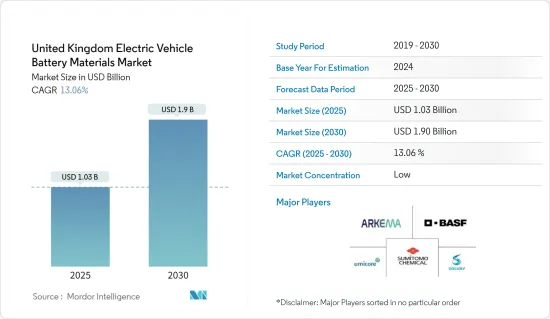
영국의 전기자동차 배터리 재료 시장 규모는 2025년 10억 3,000만 달러로 추정되며, 예측 기간(2025-2030년) 동안 13.06%의 CAGR로 2030년에는 19억 달러에 달할 것으로 예상됩니다.
주요 하이라이트
중기적으로는 전기자동차(EV) 판매량 증가와 정부의 지원정책 및 규제가 예측 기간 동안 전기자동차 배터리 재료의 수요를 견인할 것으로 예상됩니다.
한편, 원자재 매장량 부족은 전기자동차 배터리 재료 시장의 성장을 크게 억제할 수 있습니다.
에너지 밀도 향상, 충전 시간 단축, 안전성 향상, 수명 연장 등 배터리의 기술 발전은 가까운 미래에 전기자동차 배터리 재료 시장 진입 기업들에게 큰 비즈니스 기회를 제공할 것으로 예상됩니다.
영국의 전기자동차 배터리 재료 시장 동향
전기자동차(EV) 판매 증가가 시장을 견인
영국(영국)에서는 전기자동차(EV) 판매량 증가로 인해 전기자동차 배터리 재료에 대한 수요가 증가하고 있습니다. 영국에서는 전기자동차 보급에 따라 리튬, 코발트, 니켈, 흑연 등 주요 배터리 부품에 대한 수요가 급증하고 있습니다. 이러한 수요 증가는 현지 생산을 활성화할 뿐만 아니라 투자를 유치하여 영국의 배터리 재료 공급망을 강화하고 있습니다.
영국은 전기자동차를 중심으로 청정에너지로의 전환을 추진하고 있습니다. 최근 이 지역의 전기자동차 판매는 비약적인 성장세를 보이고 있습니다. 예를 들어, 국제에너지기구(IEA)의 보고서에 따르면, 2023년 영국의 전기자동차 판매량은 45만대로 2022년 대비 21.62% 증가할 것으로 예상했습니다. 영국 정부가 여러 가지 이니셔티브와 프로젝트를 시작함에 따라 전기자동차 판매량이 급증할 것으로 예상되며, 이에 따라 배터리 재료에 대한 수요도 증가할 것으로 예상됩니다.
영국 정부는 보조금, 세제 혜택, 엄격한 배기가스 규제를 통해 전기자동차 시장을 적극적으로 육성하고 있습니다. 이러한 이니셔티브는 배터리 재료 부문을 지원할 뿐만 아니라 EV에 대한 전국적인 수요를 증가시키고 있습니다. 정부는 야심찬 목표를 설정하고, 가까운 미래에 전기자동차 판매가 4배로 급증할 것으로 예상하고 있습니다.
그 약속의 증거로, 영국은 2023년 무공해 차량(ZEV) 의무화를 시행했습니다. 이 의무화에서는 2030년까지 신차의 80%, 신차 밴의 70%를 무공해 차량으로 전환하도록 규정하고 있으며, 2035년까지 완전 전환을 달성하도록 되어 있습니다. 또한, 2030년까지 가솔린 및 디젤 차량의 신차 판매를 중단하고, 2035년까지 모든 신차를 무공해 차량으로 전환하도록 의무화합니다. 이러한 조치로 인해 향후 몇 년 동안 전기자동차 생산과 배터리 재료에 대한 수요가 가속화될 것입니다.
또한, 경쟁 상황에 처한 영국의 EV는 배터리 기술 혁신을 촉진하고 있습니다. 현지 기업 및 연구기관은 에너지 밀도, 수명, 안전성 향상을 목표로 첨단 소재에 대한 투자를 진행하고 있습니다. 지역 주요 기업들 간의 공동 개발은 최첨단 배터리 솔루션 개발을 목표로 하고 있으며, 이는 향후 몇 년 동안 EV용 배터리에 대한 수요가 높을 것임을 시사합니다.
예를 들어, 2024년 1월 마이크로소프트는 미국 에너지부 산하 Pacific Northwest National Laboratory(PNNL)와 협력하여 획기적인 소재를 발표했습니다. 인공지능(AI)과 슈퍼컴퓨팅을 결합한 이 발견은 배터리의 리튬 소비량을 70%까지 줄일 수 있다고 합니다. 연구진은 특히 전기자동차(EV) 및 관련 분야에서 배터리의 효율을 크게 향상시킬 수 있는 가능성을 강조하고 있습니다. 이러한 발전은 정교한 EV 배터리에 대한 수요를 증가시켜 이 분야의 배터리 재료에 대한 수요를 증가시킬 것입니다.
이러한 발전 상황을 감안할 때 영국의 이니셔티브와 프로젝트는 EV 수요를 강화할 뿐만 아니라 당분간 EV용 배터리 재료의 수요를 크게 증가시킬 것이 분명합니다.
리튬이온 배터리가 시장을 독점
전기자동차(EV)용 리튬이온 배터리 생산이 확대되면서 배터리 재료 시장에 큰 영향을 미치고 있습니다. 이러한 리튬이온 배터리 생산의 급증은 리튬의 수요를 증가시켰고, 다양한 지역에서 발견되는 리튬은 원자재 비용에 직접적인 영향을 미치고 있습니다.
이러한 추세를 인식한 주요 시장 진입 기업들은 리튬 매장량과 연구개발에 대한 투자를 강화하고 있습니다. 그 목적은 리튬이온 배터리 생산을 강화하고 배터리 원료에 대한 수요 증가에 대응하는 것입니다. 새로운 매장량이 발견됨에 따라 리튬이온 배터리의 가격은 눈에 띄게 하락하고 있습니다.
예를 들어, 2023년 배터리 가격은 139달러/kWh로 크게 하락하여 13% 하락을 기록하였습니다. 전문가들은 기술 발전과 제조 효율성이 높아지면 2025년에는 113달러/kWh까지 떨어지고 2030년에는 80달러/kWh까지 떨어질 것으로 전망하고 있습니다.
영국 정부는 환경 문제의 증가를 배경으로 전기자동차의 리튬이온 배터리 생산을 적극적으로 추진하고 있습니다. 순 탄소 배출량 제로 목표에 중점을 두고, 이 지역의 증가하는 전기자동차 수요를 충족시키기 위해 정부는 리튬이온 배터리 생산을 촉진하기 위해 수많은 프로젝트를 추진하고 있습니다.
2023년 5월, 재규어 랜드로버의 소유주인 Tata Motors는 영국 남서부 서머셋(Somerset)에 최첨단 전기자동차 배터리 공장을 건설할 계획을 발표했으며, 투자 규모는 수십억 달러에 달합니다. 이러한 전략적 움직임은 매우 중요한 청정에너지원으로서 리튬이온 배터리의 채택을 가속화하고 예측 가능한 미래에 배터리 재료에 대한 수요를 증가시킬 것으로 보입니다.
최근 영국은 리튬이온 배터리의 첨단 배터리 재활용 기술 개발을 주도하고 있습니다. 기업과 연구기관들은 폐배터리에서 리튬, 코발트, 니켈과 같은 귀중한 물질을 회수하는 효율적인 방법을 혁신하고 있습니다.
2024년 3월, 영국의 지속가능한 배터리 폐기물 재활용 전문 업체인 Altilium은 Nissan과의 제휴를 발표했습니다. 이 제휴는 첨단 재활용 기술을 도입하여 영국산 신형 배터리의 탄소발자국을 줄이고 수입 원료에 대한 의존도를 낮추기 위한 것입니다. 이 이니셔티브는 Advanced Propulsion Centre(APC)의 3,000만 파운드(3,800만 달러) 프로젝트의 일환으로, Altilium은 1,500만 파운드(1,900만 달러)의 주목할 만한 보조금을 획득했습니다. 이러한 이니셔티브는 리튬 이온 원료의 생산을 가속화 할뿐만 아니라 미래의 EV 배터리 재료 생산을 강화할 것입니다.
이러한 발전과 이니셔티브를 감안할 때, 예측 기간 동안 EV용 배터리 재료에 대한 수요가 크게 증가할 것으로 예상됩니다.
영국의 전기자동차 배터리 재료 산업 개요
영국의 전기자동차 배터리 재료 시장은 반분할되어 있습니다. 주요 진입 기업(순서는 무관)으로는 Sumitomo Chemical, BASF SE, Arkema SA, Solvay SA, Umicore SA 등이 있습니다.
기타 혜택
엑셀 형식의 시장 예측(ME) 시트
3개월간 애널리스트 지원
목차
제1장 소개
조사 범위
시장 정의
조사 가정
제2장 주요 요약
제3장 조사 방법
제4장 시장 개요
소개
2029년까지 시장 규모와 수요 예측(단위 : 10억 달러)
최근 동향과 개발
정부 정책 및 규정
시장 역학
성장 촉진요인
전기자동차 판매 성장
정부 지원 정책 및 규정
성장 억제요인
원료 공급에 대한 의존
공급망 분석
PESTLE 분석
투자 분석
제5장 시장 세분화
배터리 유형
리튬이온 배터리
납축배터리
기타
재료
양극
음극
전해액
분리막
기타
제6장 경쟁 구도
M&A, 합작투자, 제휴, 협정
주요 기업의 전략
기업 개요
Sumitomo Chemical Co., Ltd.
BASF SE
Arkema SA
Solvay SA
Umicore SA
Mitsubishi Chemical Group Corporation
Fiamm Energy Technology
ENTEK International LLC
Johnson Matthey
Epsilon Adavnced Material
기타 저명한 기업 리스트
시장 순위/점유율 분석
제7장 시장 기회와 향후 동향
배터리 기술의 진보
ksm
영문 목차
영문목차
The United Kingdom Electric Vehicle Battery Materials Market size is estimated at USD 1.03 billion in 2025, and is expected to reach USD 1.90 billion by 2030, at a CAGR of 13.06% during the forecast period (2025-2030).
Key Highlights
Over the medium term, growing electric vehicle (EV) sales and supportive government policies and regulations are expected to drive the demand for electric vehicle battery materials during the forecast period.
On the other hand, the lack of raw material reserves can significantly restrain the growth of the electric vehicle battery materials market.
Nevertheless, technological advancements in batteries like higher energy density, faster charging times, improved safety, and longer lifespan are expected to create significant opportunities for electric vehicle battery materials market players in the near future.
United Kingdom Electric Vehicle Battery Materials Market Trends
Growing Electric Vehicle (EVs) Sales Drives the Market
In the United Kingdom (UK), rising electric vehicle (EV) sales are driving up the demand for EV battery materials. As the country embraces electric vehicles, the need for key battery components like lithium, cobalt, nickel, and graphite is surging. This heightened demand is not only stimulating local production but also attracting investments, thereby strengthening the UK's battery material supply chain.
The UK is making a concerted shift towards clean energy, with electric vehicles taking center stage. Over recent years, EV sales in the region have seen exponential growth. For instance, the International Energy Agency (IEA) reported that in 2023, the UK sold 450,000 electric vehicles, marking a 21.62% increase from 2022. With the UK government launching several initiatives and projects, EV sales are projected to soar, consequently driving up the demand for battery materials.
The UK government is actively nurturing the EV market through subsidies, tax incentives, and stringent emission regulations. These initiatives not only support the battery material sector but also elevate the nationwide demand for EVs. With ambitious targets set, the government envisions a fourfold surge in EV sales in the near future.
As a testament to its commitment, the UK rolled out a Zero-Emission Vehicle (ZEV) mandate in 2023. This mandate stipulates that by 2030, 80% of new cars and 70% of new vans should be zero-emission, achieving a complete transition by 2035. Additionally, the sale of new petrol and diesel vehicles will halt by 2030, with all new vehicles required to be zero-emission by 2035. Such measures are set to accelerate both EV production and the demand for battery materials in the coming years.
Furthermore, the UK's competitive EV landscape is driving innovations in battery technology. Local firms and research entities are investing in advanced materials, targeting improved energy density, longevity, and safety. Collaborations among major regional players aim to develop cutting-edge battery solutions, signaling a robust demand for EV batteries in the coming years.
For instance, in January 2024, Microsoft, in partnership with the Pacific Northwest National Laboratory (PNNL) under the US Department of Energy, introduced a revolutionary material. This discovery, made using a combination of artificial intelligence (AI) and supercomputing, could reduce lithium consumption in batteries by an impressive 70%. Researchers also emphasize its potential to significantly enhance battery efficiency, particularly for electric vehicles (EVs) and related domains. Such advancements are poised to boost the demand for sophisticated EV batteries and, in turn, elevate the need for battery materials in the region.
Given these developments, it's clear that the UK's initiatives and projects are set to not only bolster EV demand but also substantially increase the need for EV battery materials in the foreseeable future.
Lithium-Ion Battery Type Dominate the Market
The growing production of lithium-ion batteries for electric vehicles (EVs) has significantly influenced the battery materials market. This surge in lithium-ion battery manufacturing has driven up the demand for lithium, with its discovery in various regions directly impacting raw material costs.
Key market players, recognizing this trend, are ramping up investments in lithium reserves and R&D endeavors. Their goal is to bolster lithium-ion battery production and meet the escalating demand for battery raw materials. As new reserves are discovered, prices for lithium-ion batteries are notably declining.
For instance, in 2023, battery prices dropped significantly to USD 139/kWh, marking a 13% decrease. With ongoing technological advancements and manufacturing efficiencies, experts predict prices could dip to USD 113/kWh by 2025 and plummet further to USD 80/kWh by 2030.
Governments in the United Kingdom are actively promoting lithium-ion battery production for electric vehicles, driven by rising environmental concerns. With a strong focus on net-zero carbon emission targets, the government has launched numerous projects to boost lithium-ion battery production, aiming to meet the region's growing EV demand.
In May 2023, Tata Motors, the owner of Jaguar Land Rover, announced plans for a state-of-the-art electric car battery plant in Somerset, southwest England, with investments reaching billions. Such strategic moves are set to accelerate the adoption of lithium-ion batteries as a pivotal clean energy source, amplifying the demand for battery materials in the foreseeable future.
In recent years, the UK has been leading the charge in developing advanced battery recycling technologies for lithium-ion batteries. Companies and research institutions are innovating efficient methods to recover valuable materials like lithium, cobalt, and nickel from used batteries.
In March 2024, Altilium, a UK company specializing in sustainable battery waste recycling, announced a collaboration with Nissan. This partnership aims to implement advanced recycling technologies, targeting a reduction in the carbon footprint of new UK-made batteries and a decrease in reliance on imported raw materials. This initiative, part of the Advanced Propulsion Centre's (APC) GBP 30 million (USD 38 million) project, saw Altilium securing a notable grant of GBP 15 million (USD 19 million). Such initiatives not only accelerate the production of lithium-ion raw materials but also bolster the future production of EV battery materials.
Given these advancements and initiatives, a significant increase in the demand for EV battery materials is anticipated during the forecast period.
United Kingdom Electric Vehicle Battery Materials Industry Overview
United Kingdom's electric vehicle battery materials market is semi-fragmented. Some key players (not in particular order) are Sumitomo Chemical Co., Ltd., BASF SE, Arkema SA, Solvay SA, Umicore SA, among others.
Additional Benefits:
The market estimate (ME) sheet in Excel format
3 months of analyst support
TABLE OF CONTENTS
1 INTRODUCTION
1.1 Scope of the Study
1.2 Market Definition
1.3 Study Assumptions
2 EXECUTIVE SUMMARY
3 RESEARCH METHODOLOGY
4 MARKET OVERVIEW
4.1 Introduction
4.2 Market Size and Demand Forecast in USD billion, till 2029
4.3 Recent Trends and Developments
4.4 Government Policies and Regulations
4.5 Market Dynamics
4.5.1 Drivers
4.5.1.1 Growing Electric Vehicle Sales
4.5.1.2 Supportive Government Policies and Regulations
4.5.2 Restraints
4.5.2.1 Dependence on Raw Material Supply
4.6 Supply Chain Analysis
4.7 PESTLE Analysis
4.8 Investment Analysis
5 MARKET SEGMENTATION
5.1 Battery Type
5.1.1 Lithium-ion Battery
5.1.2 Lead-Acid Battery
5.1.3 Others
5.2 Material
5.2.1 Cathode
5.2.2 Anode
5.2.3 Electrolyte
5.2.4 Separator
5.2.5 Others
6 COMPETITIVE LANDSCAPE
6.1 Mergers and Acquisitions, Joint Ventures, Collaborations, and Agreements