항균(효소) 단백질 가수분해물 시장 : 시장 기회, 성장 요인, 업계 동향 분석 및 예측(2025-2034년)
Antimicrobial (Enzymatic) Protein Hydrolysates Market Opportunity, Growth Drivers, Industry Trend Analysis, and Forecast 2025 - 2034
상품코드:1876643
리서치사:Global Market Insights Inc.
발행일:2025년 11월
페이지 정보:영문 210 Pages
라이선스 & 가격 (부가세 별도)
ㅁ Add-on 가능: 고객의 요청에 따라 일정한 범위 내에서 Customization이 가능합니다. 자세한 사항은 문의해 주시기 바랍니다.
한글목차
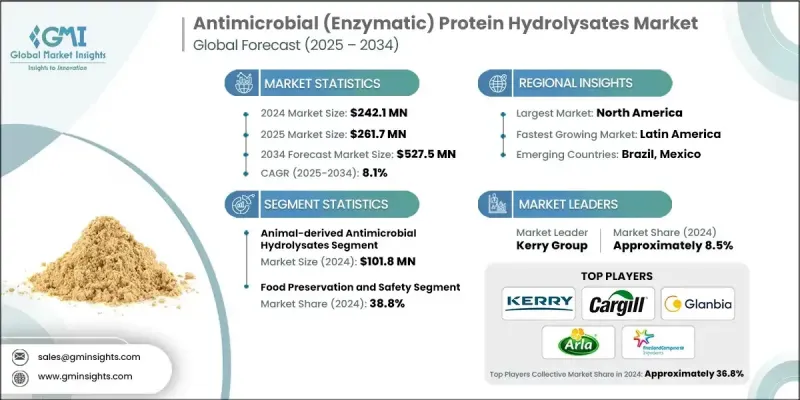
세계의 항균(효소) 단백질 가수분해물 시장은 2024년 2억 4,210만 달러로 평가되었고, 2034년까지 연평균 복합 성장률(CAGR) 8.1%로 성장할 전망이며, 5억 2,750만 달러에 이를 것으로 예측되고 있습니다.
식품 제조업체 및 소비자가 깨끗한 라벨에 대한 기대에 따라 천연 보존 솔루션으로 전환함에 따라 시장 기세가 커지고 있습니다. 효소 처리된 가수분해물은 영양가를 손상시키지 않고 제품의 신선도를 유지하기 때문에 합성 보존제의 대안으로 더 자주 선택됩니다. 이러한 추세는 항생제 내성에 대한 세계적인 우려 증가에 의해 지원되며 항생제 과도한 사용에 기여하지 않는 항균 도구의 필요성을 높이고 있습니다. 이러한 가수분해물은 식품 및 건강 관련 용도 분야에서 효과적인 미생물 제어를 제공하므로 진화하는 규제 요건 및 안전 기준에 강하게 적합합니다. 건강 및 웰니스에 대한 관심 증가도 수요를 뒷받침하고 있으며, 현대의 소비자는 기능성 및 생물활성 효과를 겸비한 원료를 요구하고 있어, 그 중요성은 기본적인 보존 효과를 넘어섭니다. 업계의 중점이 제품의 안전성과 품질을 향상시키는 천연 유래 솔루션으로 이행하는 중, 항균 단백질 가수분해물은 식품, 영양, 관련 분야 전체에서 강력한 보급이 예상됩니다.
시장 범위
시작 연도
2024년
예측 기간
2025-2034년
시작 시 가치
2억 4,210만 달러
예측 금액
5억 2,750만 달러
CAGR
8.1%
동물 유래 항균 가수분해물 부문은 2024년에 1억 180만 달러로 평가되었으며, 2025-2034년 7.8%의 연평균 복합 성장률(CAGR)로 성장할 것으로 예측되고 있습니다. 그 채용은 강력한 펩타이드 활성 및 유리한 규제 수용성으로 식품 보존, 임상 영양 및 보충제 제형에서 계속 증가하고 있습니다. 이러한 가수분해물은 일반적으로 우유, 고기, 계란 등의 단백질 공급원으로부터 제조되며, 안전성과 강화된 생물학적 활성이 모두 요구되는 고단백 제품 및 즉식 제품에서 항균성으로 높은 평가를 받고 있습니다.
식품 보존 및 안전 용도 부문은 2024년에 9,370만 달러 시장 규모를 기록했으며, 2034년까지 연평균 복합 성장률(CAGR)7.4%로 확대가 전망됩니다. 본 부문에서는 유제품, 가공 식품, 음료, 레토르트 식품에 있어서의 미생물 증식 억제에 단백질 가수분해물이 활용되고 있습니다. 합성 보존료를 천연 유래의 펩티드계 대체품으로 대체함으로써 보존 기간의 연장과 원료 표시의 투명성 유지를 실현하여 클린 라벨 요건의 달성을 지원합니다.
북미의 항균(효소) 단백질 가수분해물 시장은 2024년 8,470만 달러 규모를 기록했습니다. 깨끗한 라벨 보관에 대한 관심과 엄격한 식품 안전 규정 준수로 인해 이 지역의 채용이 증가하고 있습니다. 이 지역에서는 기능성 식품이나 영양 보조 식품 제조업체의 강한 존재감이 강점이 되고 있어 항균성과 영양 특성을 겸비한 생물활성 펩티드의 용도 확대를 지지하고 있습니다. 화학 보존료 사용 삭감을 위한 규제 압력도 식품 기업에 효소 가수분해물의 채용을 촉구하고 있으며, 바이오 테크놀로지나 단백질 가공 기술에 대한 투자가 계속됨으로써 식품 및 의료 산업 전체에 있어서 제품 품질의 향상, 프로파일링 정밀도의 개선, 확장성의 강화가 진행되고 있습니다.
항균(효소) 단백질 가수분해물 시장에 참가하는 주요 기업으로는 Cargill Inc., Glanbia plc, FrieslandCampina Ingredients, Arla Foods Ingredients, Kerry Group 등을 들 수 있습니다. 이 시장의 기업은 존재감을 강화하기 위해 여러 전략에 주력하고 있습니다. 많은 기업들이 펩티드의 순도, 효력, 안정성을 향상시키는 첨단 효소 처리 기술에 대한 투자를 추진하고 있습니다. 식품 제조업체, 뉴트라슈티컬 브랜드, 바이오 테크놀로지 파트너와의 협업을 확대해, 여러 분야에 있어서 용도 개발을 가속시키고 있습니다. 클린 라벨 배합 지원, 맞춤형 항균 솔루션, 기능 프로파일 강화에 중점을 두는 것은 여전히 핵심 우선순위입니다. 또한 우수한 항균 특성을 가진 신규의 생물활성 펩티드를 특정하기 위해 연구개발비의 증액도 진행하고 있습니다. 생산 능력 확대, 규제 대응 강화, 세계 유통 네트워크 확충은 경쟁력 강화에 기여하고 있습니다.
목차
제1장 조사 방법
시장 범위 및 정의
조사 설계
조사 접근
데이터 수집 방법
데이터 마이닝의 출처
세계
지역별 및 국가별
기본 추정치 및 계산
기준 연도 계산
시장 추정에서의 주요 동향
1차 조사 및 검증
1차 정보
예측 모델
조사의 전제조건 및 제한 사항
제2장 주요 요약
제3장 업계 인사이트
생태계 분석
공급자의 상황
이익률
각 단계에서의 부가가치
밸류체인에 영향을 주는 요인
혁신
업계에 미치는 영향요인
성장 촉진요인
천연 식품 보존료에 대한 수요 증가
항생제 내성에 대한 우려 증가
건강 및 웰빙에 대한 의식의 고조
기능성 식품에서의 용도 확대
업계의 잠재적 위험 및 과제
높은 생산 및 가공 비용
규제의 복잡성 및 승인 상 과제
보존 기간의 제한 및 안정성 과제
시장 기회
유업 폐수의 유효 이용
AI를 활용한 펩티드 탐색
화장품 분야에서의 신흥 용도
식물성 단백질원의 확대
성장 가능성 분석
규제 상황
북미
유럽
아시아태평양
라틴아메리카
중동 및 아프리카
Porter's Five Forces 분석
PESTEL 분석
가격 동향
지역별
제품별
장래 시장 동향
기술 및 혁신 동향
현재의 기술 동향
신흥 기술
특허 상황
무역 통계(주 : 무역 통계는 주요 국가에서만 제공됨)
주요 수입국
주요 수출국
지속가능성 및 환경적 측면
지속가능한 실천
폐기물 감축 전략
생산에 있어서 에너지 효율
환경에 배려한 대처
탄소발자국에 관한 고려 사항
제4장 경쟁 구도
서문
기업의 시장 점유율 분석
지역별
북미
유럽
아시아태평양
라틴아메리카
중동 및 아프리카
기업 매트릭스 분석
주요 시장 기업의 경쟁 분석
경쟁 포지셔닝 매트릭스
주요 발전
합병 및 인수
제휴 및 협력 관계
신제품 발매
사업 확대 계획
제5장 시장 추계 및 예측 : 제품 유형별(2021-2034년)
주요 동향
동물 유래 항균성 가수분해물
유단백질 가수분해물
유청 단백질 가수분해물
카제인 가수분해물
물고기 단백질 가수분해물
고기 단백질 가수분해물
계란 단백질 가수분해물
식물 유래 항균성 가수분해물
콩 단백질 가수분해물
밀 단백질 가수분해물
콩과 식물 단백질 가수분해물
곡물 단백질 가수분해물
종자 단백질 가수분해물
해양 유래 항균성 가수분해물
어제별 가수분해물
조류 단백질 가수분해물
해초 단백질 가수분해물
갑각류 껍질 가수분해물
미생물 유래 항균성 가수분해물
세균 발효 제품
진균 가수분해물
효모 유래 펩티드
제6장 시장 추계 및 예측 : 용도별(2021-2034년)
주요 동향
식품 보존 및 안전성
천연 보존료
항균 코팅
활성 포장 솔루션
보존 기간의 연장
영양보조식품
스포츠 영양
임상영양학
유아용 조제 분유
영양보조식품
기능성 식품
사료 및 반려동물 식품
성장 촉진제
항생제 대체품
소화기 건강 지원
면역체계 강화
의약품 및 헬스케어
치료용 펩티드
상처 케어 제품
구강 케어 용도
외용 항균제
화장품 및 퍼스널케어
항균제제
스킨케어 제품
헤어 케어 용도
안티 에이징 솔루션
제7장 시장 추계 및 예측 : 지역별(2021-2034년)
주요 동향
북미
미국
캐나다
유럽
독일
영국
프랑스
이탈리아
스페인
기타 유럽
아시아태평양
중국
인도
일본
호주
한국
기타 아시아태평양
라틴아메리카
브라질
멕시코
아르헨티나
기타 라틴아메리카
중동 및 아프리카
사우디아라비아
남아프리카
아랍에미리트(UAE)
기타 중동 및 아프리카
제8장 기업 프로파일
Kerry Group
Cargill Inc.
Glanbia plc
Arla Foods Ingredients
FrieslandCampina Ingredients
DSM-Firmenich
ADM(Archer Daniels Midland)
AMCO Proteins
Kemin Industries
Titan Biotech
BRF Ingredients
Constantino & C Spa
Crescent Biotech
Aker Biomarine
Biomega Group
Essentia Protein Solutions
AJY
영문 목차
영문목차
The Global Antimicrobial (Enzymatic) Protein Hydrolysates Market was valued at USD 242.1 million in 2024 and is estimated to grow at a CAGR of 8.1% to reach USD 527.5 million by 2034.
Market momentum is growing as food manufacturers and consumers shift toward natural preservation solutions that align with clean-label expectations. Enzyme-modified hydrolysates are being chosen more frequently as alternatives to synthetic preservatives because they help maintain product freshness without compromising nutritional integrity. This trend is supported by rising global concern surrounding antibiotic resistance, which has elevated the need for antimicrobial tools that do not contribute to antibiotic overuse. These hydrolysates provide effective microbial control in food and health-related applications, making them a strong fit for evolving regulatory and safety requirements. Increasing interest in health and wellness is also boosting demand, as today's consumers seek ingredients that offer both functional and bioactive benefits, expanding their relevance beyond basic preservation. With industry emphasis shifting toward naturally derived solutions that enhance product safety and quality, antimicrobial protein hydrolysates are poised for strong adoption across food, nutrition, and allied sectors.
Market Scope
Start Year
2024
Forecast Year
2025-2034
Start Value
$242.1 Million
Forecast Value
$527.5 Million
CAGR
8.1%
The animal-derived antimicrobial hydrolysates segment was valued at USD 101.8 million in 2024 and is expected to grow at a 7.8% CAGR from 2025 to 2034. Their uptake continues to increase across food preservation, clinical nutrition, and supplement formulations due to strong peptide activity and favorable regulatory acceptance. These hydrolysates are commonly produced from protein sources such as milk, meat, or eggs and are valued for their antimicrobial potential in high-protein and ready-to-eat products requiring both safety and enhanced bioactivity.
The food preservation and safety application segment generated USD 93.7 million in 2024 and will grow at a 7.4% CAGR through 2034. This segment relies on protein hydrolysates to help inhibit microbial growth in dairy items, processed foods, beverages, and convenience meals. Their use supports clean-label requirements as manufacturers replace synthetic preservatives with naturally sourced peptide-based alternatives that help extend shelf life and maintain transparency in ingredient listings.
North America Antimicrobial (Enzymatic) Protein Hydrolysates Market generated USD 84.7 million in 2024. Adoption is increasing in the region due to heightened emphasis on clean-label preservation and strict food safety compliance. The area benefits from a strong presence of functional food and nutraceutical producers, supporting expanded use of bioactive peptides that offer combined antimicrobial and nutritional properties. Regulatory pressure to reduce chemical preservative use is also prompting food companies to incorporate enzymatic hydrolysates, while investments in biotechnology and protein processing continue to refine product quality, improve profiling accuracy, and enhance scalability across food and healthcare industries.
Major companies participating in the Antimicrobial (Enzymatic) Protein Hydrolysates Market include Cargill Inc., Glanbia plc, FrieslandCampina Ingredients, Arla Foods Ingredients, Kerry Group, and others. Companies in the Antimicrobial (Enzymatic) Protein Hydrolysates Market are focusing on several strategies to strengthen their presence. Many are channeling investments into advanced enzymatic processing technologies to improve peptide purity, potency, and consistency. Firms are expanding collaborations with food manufacturers, nutraceutical brands, and biotechnology partners to accelerate application development across multiple sectors. Emphasis on clean-label formulation support, tailored antimicrobial solutions, and enhanced functional profiles remains a core priority. Companies are also increasing R&D spending to identify novel bioactive peptides with superior antimicrobial properties. Scaling production capabilities, improving regulatory alignment, and enhancing global distribution networks help reinforce competitiveness.
Table of Contents
Chapter 1 Methodology
1.1 Market scope and definition
1.2 Research design
1.2.1 Research approach
1.2.2 Data collection methods
1.3 Data mining sources
1.3.1 Global
1.3.2 Regional/Country
1.4 Base estimates and calculations
1.4.1 Base year calculation
1.4.2 Key trends for market estimation
1.5 Primary research and validation
1.5.1 Primary sources
1.6 Forecast model
1.7 Research assumptions and limitations
Chapter 2 Executive Summary
2.1 Industry 360° synopsis
2.2 Key market trends
2.2.1 Regional
2.2.2 Product Type
2.2.3 Application
2.3 TAM Analysis, 2025-2034
2.4 CXO perspectives: Strategic imperatives
2.4.1 Executive decision points
2.4.2 Critical success factors
2.5 Future Outlook and Strategic Recommendations
Chapter 3 Industry Insights
3.1 Industry ecosystem analysis
3.1.1 Supplier Landscape
3.1.2 Profit Margin
3.1.3 Value addition at each stage
3.1.4 Factor affecting the value chain
3.1.5 Disruptions
3.2 Industry impact forces
3.2.1 Growth drivers
3.2.1.1 Rising demand for natural food preservatives
3.2.1.2 Growing antibiotic resistance concerns
3.2.1.3 Increasing health and wellness awareness
3.2.1.4 Expanding applications in functional foods
3.2.2 Industry pitfalls and challenges
3.2.2.1 High production and processing costs
3.2.2.2 Regulatory complexity and approval challenges
3.2.2.3 Limited shelf life and stability issues
3.2.3 Market opportunities
3.2.3.1 Dairy wastewater valorization
3.2.3.2 AI-driven peptide discovery
3.2.3.3 Emerging applications in cosmetics
3.2.3.4 Plant-based protein sources expansion
3.3 Growth potential analysis
3.4 Regulatory landscape
3.4.1 North America
3.4.2 Europe
3.4.3 Asia Pacific
3.4.4 Latin America
3.4.5 Middle East & Africa
3.5 Porter's analysis
3.6 PESTEL analysis
3.7 Price trends
3.7.1 By region
3.7.2 By product
3.8 Future market trends
3.9 Technology and Innovation landscape
3.9.1 Current technological trends
3.9.2 Emerging technologies
3.10 Patent Landscape
3.11 Trade statistics (Note: the trade statistics will be provided for key countries only)
3.11.1 Major importing countries
3.11.2 Major exporting countries
3.12 Sustainability and Environmental Aspects
3.12.1 Sustainable Practices
3.12.2 Waste Reduction Strategies
3.12.3 Energy Efficiency in Production
3.12.4 Eco-friendly Initiatives
3.13 Carbon Footprint Considerations
Chapter 4 Competitive Landscape, 2024
4.1 Introduction
4.2 Company market share analysis
4.2.1 By region
4.2.1.1 North America
4.2.1.2 Europe
4.2.1.3 Asia Pacific
4.2.1.4 LATAM
4.2.1.5 MEA
4.3 Company matrix analysis
4.4 Competitive analysis of major market players
4.5 Competitive positioning matrix
4.6 Key developments
4.6.1 Mergers & acquisitions
4.6.2 Partnerships & collaborations
4.6.3 New Product Launches
4.6.4 Expansion Plans
Chapter 5 Market Estimates and Forecast, By Product Type, 2021 - 2034 (USD Million, Kilo Tons)
5.1 Key trends
5.2 Animal-derived antimicrobial hydrolysates
5.2.1 Milk protein hydrolysates
5.2.2 Whey protein hydrolysates
5.2.3 Casein hydrolysates
5.2.4 Fish protein hydrolysates
5.2.5 Meat protein hydrolysates
5.2.6 Egg protein hydrolysates
5.3 Plant-derived antimicrobial hydrolysates
5.3.1 Soy protein hydrolysates
5.3.2 Wheat protein hydrolysates
5.3.3 Legume protein hydrolysates
5.3.4 Cereal protein hydrolysates
5.3.5 Seed protein hydrolysates
5.4 Marine-derived antimicrobial hydrolysates
5.4.1 Fish by-product hydrolysates
5.4.2 Algae protein hydrolysates
5.4.3 Seaweed protein hydrolysates
5.4.4 Crustacean shell hydrolysates
5.5 Microbial-derived antimicrobial hydrolysates
5.5.1 Bacterial fermentation products
5.5.2 Fungal hydrolysates
5.5.3 Yeast-derived peptides
Chapter 6 Market Estimates and Forecast, By Application, 2021 - 2034 (USD Million, Kilo Tons)
6.1 Key trends
6.2 Food preservation and safety
6.2.1 Natural preservatives
6.2.2 Antimicrobial coatings
6.2.3 Active packaging solutions
6.2.4 Shelf-life extension
6.3 Nutritional supplements
6.3.1 Sports nutrition
6.3.2 Clinical nutrition
6.3.3 Infant formula
6.3.4 Dietary supplements
6.3.5 Functional foods
6.4 Animal feed and pet food
6.4.1 Growth promoters
6.4.2 Antibiotic alternatives
6.4.3 Digestive health support
6.4.4 Immune system enhancement
6.5 Pharmaceutical and healthcare
6.5.1 Therapeutic peptides
6.5.2 Wound care products
6.5.3 Oral care applications
6.5.4 Topical antimicrobials
6.6 Cosmetics and personal care
6.6.1 Antimicrobial formulations
6.6.2 Skin care products
6.6.3 Hair care applications
6.6.4 Anti-aging solutions
Chapter 7 Market Estimates and Forecast, By Region, 2021 - 2034 (USD Million, Kilo Tons)