



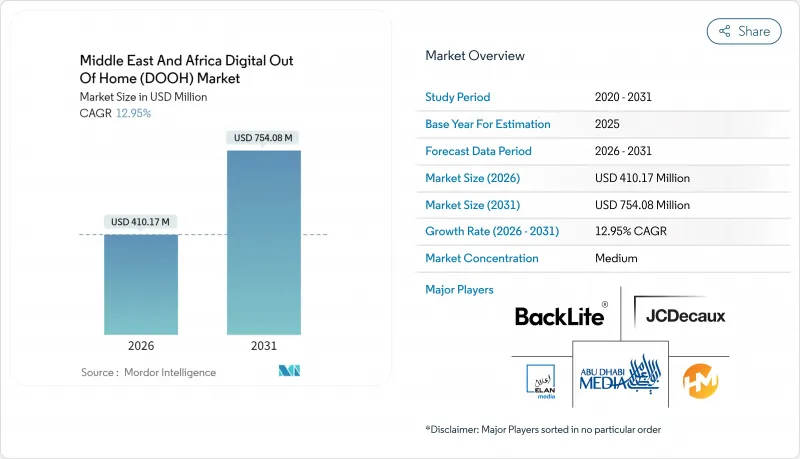
중동 및 아프리카의 디지털 옥외 광고(DOOH) 시장의 규모는 2026년 4억 1,000만 달러에 이를 것으로 예측되고 있습니다.
이는 2025년 3억 6,000만 달러에서 성장한 수치이며, 2031년에는 7억 5,000만 달러에 이를 전망입니다. 2026년부터 2031년까지 연평균 복합 성장률(CAGR)은 12.95%로 예측되고 있습니다.

이 확대는 NEOM에 의한 5,000억 달러 규모의 스마트 시티 인프라 정비, UAE의 거의 전국적인 5G망 보급, 이동, 소매 및 관광 네트워크에 옥외 스크린을 통합하는 각국 전체의 디지털 전환 계획의 통합을 반영하고 있습니다. 스마트폰 보급률 상승, 대중교통망 확충, 데이터 기반 공공서비스 규제 추진으로 중동 및 아프리카의 디지털 옥외 광고(DOOH) 시장은 스마트 시티의 핵심 인프라로서의 지위를 강화하고 있습니다. 기후 변화에 강한 하드웨어, 신재생에너지 구동 LED 어레이, AI 스케줄링이 환경규제와 일치하는 가운데 세계의 미디어 사업자들은 투자를 가속화하고 있습니다. 한편, 지역사업자는 문화에 관한 전문지식과 정부와의 파트너십을 활용하여 신규 참가자로부터 자사 재고를 보호함으로써 세계의 기술과 지역적인 인사이트를 동적으로 융합시키고 있습니다.
소셜 미디어 참여도가 높고 모바일 웹 트래픽이 전체의 80% 이상인 지역의 광고주는 정적 간판에서 데이터 중심 네트워크로 예산을 재분배합니다. 이집트의 ICT 부가가치는 2023년도에 15.2% 증가하여 측정 가능한 캠페인 수요를 견인하는 디지털 상거래의 광범위한 기세를 반영합니다. VIOOH 및 Broadsign과 같은 프로그래매틱 플랫폼은 온라인 구매 관행, 잠재고객 세분화, 동적 소재 및 기여를 도로 및 쇼핑몰 화면으로 이전합니다. 사우디 비전 2030과 UAE 비전 2021과 같은 국가 비전은 DOOH 재고를 전자 정부 앱과 공공 메시지를 연결하는 결합 조직으로 자리 매김하고 중동 및 아프리카의 디지털 옥외 광고(DOOH) 시장을 옴니 채널 커뮤니케이션의 필수 요소로 자리매김하고 있습니다. 광고 대행사는 디지털 버스정류장 패널에 노출된 이후 통근자의 스마트폰에 동기 광고를 게재하기 위해 교차 기기 식별자를 활용하여 기존 OOH에서는 정량화할 수 없었던 추가 도달범위를 입증합니다.
GCC 국가의 정부는 지하철, 트램, 버스 고속 운송 시스템(BRT) 프로젝트에 많은 투자를 하고 있으며, 신규 스크린 설치 장소와 고정 고객층을 창출하고 있습니다. 리야드 지하철, 두바이 노선 2020, 도하의 루사일 트램은 수백 개의 역을 증설하여 디지털 인벤토리를 설치할 예정입니다. 교통 당국은 디지털 형식을 선호하여 도입하고 있어 운행 스케줄, 안전 경보, 상업 컨텐츠를 동일한 디스플레이로 공유할 수 있으므로 승객 체험의 향상과 자산의 수익화를 도모할 수 있습니다. 예측 가능한 통근 인구는 미디어 사업자에게 확고한 노출수를 제공하고 세계 브랜드가 TV 광고 예산을 재분배하도록 촉구합니다. 2030년까지 대중교통 승객 수가 2배 증가할 것으로 예상되는 가운데 중동 및 아프리카의 디지털 옥외 광고(DOOH) 시장은 인프라 정비의 성장과 연동된 꾸준한 재고 확대를 전망하고 있습니다.
두바이의 2020년 법령 제06호에서는 모든 광고에 대한 사전 승인을 의무화하고 특정 문화 시설에서의 설치를 금지하고 있으며, 미디어 사업자는 복잡한 지방자치단체 및 연방규제의 규제망을 신중하게 회피할 필요가 있습니다. 아랍에미리트(UAE)의 국가 미디어 평의회는 또한 아랍어의 높은 사용과 종교적 가치관의 존중을 의무화하고 있습니다. 쿠웨이트의 라이선싱 방법은 애니메이션을 사용한 버스 래핑 광고에 추가 요금을 부과합니다. 이 가이드라인은 사회적 규범을 보호하는 한편, 캠페인 승인 사이클을 장기화하고, 창의적인 자유도를 제한하여 중동 및 아프리카의 디지털 옥외 광고(DOOH) 시장에서의 출시 속도를 구미의 동업계 타사와 비교해 저하시키고 있습니다.
2025년 시점에서 실내 스크린은 중동 및 아프리카의 디지털 옥외 광고(DOOH) 시장 규모의 27.35%를 차지하고 2031년까지 연평균 복합 성장률(CAGR) 13.6%를 보일 것으로 예측됩니다. 두바이, 리야드, 쿠웨이트 도심의 쇼핑몰에서는 아트리움에 인터랙티브한 8K 벽면을 도입하고, 한산한 시간대에는 아트 설치로서도 작동하여 임대료 이외의 수익원을 확대하고 있습니다. 두바이 공항과 같은 공항 운영 회사는 JCDecaux와의 장기 계약을 업그레이드하여 연간 8,600만 명의 승객에게 도달할 수 있는 데이터가 풍부한 프리미엄 인벤토리를 제공합니다. 몰 운영회사는 옴니채널 상거래를 위한 실내 네트워크를 중시하고 있으며, 토템에 설치된 QR코드가 쇼핑객을 로열티 앱으로 유도하여 체류시간과 구매액을 높이고 있습니다. 실내 시장의 성장은 기후 제어의 혜택을 받고 있으며, 사막의 열과 관련된 하드웨어의 수명 연장과 유지보수 비용의 억제로 이어지고 있습니다.
2025년 옥외 미디어는 중동 및 아프리카의 디지털 옥외 광고(DOOH) 시장에서 72.65%의 점유율을 유지했습니다. 아부다비의 셰이크 자이드 로드와 리야드의 북부 환상 도로 주변의 고속도로 디지털 간판은 통근자의 시선을 최대 90초간 확보하여 긴 컨텐츠의 전개를 가능하게 하고 있습니다. 정부의 도로 안전 규정은 공공 메시지에 최대 10%의 표시 시간을 할당하여 이 매체의 공공 유용성을 강화합니다. 설비 투자액은 높지만 옥외 사이트는 규모와 독점성이 뛰어난 CPM 프리미엄을 획득하고 있습니다. 스마트 시티의 마스터 플랜에서는 도로 옆의 철탑에 교통 센서를 통합하고 정체 관리를 위해 컨텐츠를 업그레이드하는 IoT 연계 유닛을 구축하여 광고와 공공 서비스 정보를 융합시키고 있습니다.
2025년 중동 및 아프리카의 디지털 옥외 광고(DOOH) 시장에서 52.10%의 점유율을 빌보드가 차지했습니다. 이는 이 지역의 자동차 중심 통근 패턴에 뒷받침되었습니다. 두바이의 E11 회랑을 따라 설치된 정지영상 및 동영상 광고는 주당 600만 노출을 달성하며 자동차 및 은행업계 광고주를 유치하고 있습니다. 그러나 교통 광고는 지하철 노선, 노면 전철 노선 및 BRT 전용 레인의 확충을 반영해 2031년까지 연평균 복합 성장률(CAGR) 14.05%로 다른 용도를 상회하는 성장이 예상됩니다. 예를 들어 리야드의 85개 지하철역에는 전용 존이 설치되어 모바일 티켓 앱과 연동하는 4K 스크린이 설치되어 6가지 언어에 대응하는 증강현실 맵을 제공합니다.
스마트 버스정류소나 디지털 안내 키오스크 등의 가로 설비는 광고와 무선 충전 및 대기질 센서를 조합한 지자체 입찰의 혜택을 받고 있습니다. 이 '스크린+유틸리티' 모델을 통해 운영자는 인벤토리와 데이터 분석 모두에서 수익을 창출할 수 있어 ROI를 향상시킬 수 있습니다. 스포츠 시설, 엔터테인먼트 지구, 박람회장은 틈새 시장에서 높은 수익 분야입니다. 사우디아라비아 트로제나 스키 리조트에서 개최되는 2028년 아시아 동계경기 대회에서는 몰입형 LED 터널이 도입되어 향후 이벤트에서의 체험형 기준을 확립할 전망입니다.
Middle East and Africa Digital Out-of-Home (DOOH) market size in 2026 is estimated at USD 0.41 billion, growing from 2025 value of USD 0.36 billion with 2031 projections showing USD 0.75 billion, growing at 12.95% CAGR over 2026-2031.
The expansion reflects the integration of NEOM's USD 500 billion smart-city infrastructure, the UAE's near-universal 5G coverage, and country-wide digital transformation agendas that embed out-of-home screens into mobility, retail, and tourism networks. Rising smartphone penetration, public-transit buildout, and a regulatory push toward data-driven public services reinforce the Middle East and Africa Digital Out-of-Home (DOOH) market's positioning as a core smart-city utility. International media owners are accelerating their investment because climate-resilient hardware, renewable-powered LED arrays, and AI scheduling now align with environmental mandates. Regional operators, meanwhile, utilize cultural expertise and government partnerships to safeguard their inventory from new entrants, thereby creating a dynamic blend of global technology and local insight.
Advertisers in the region are redirecting their budgets from static billboards to data-driven networks as social media engagement peaks and mobile web traffic surpasses 80% of overall browsing. Egypt's ICT value-added increased by 15.2% in FY 2023, reflecting a broader momentum in digital commerce that fuels demand for measurable campaigns. Programmatic platforms such as VIOOH or Broadsign have migrated online buying conventions, audience segments, dynamic creatives, and attribution to roadside and mall screens. National visions, such as Saudi Vision 2030 and UAE Vision 2021, view DOOH inventory as a connective tissue that links e-government apps with public messaging, making the Middle East and Africa Digital Out-of-Home (DOOH) market integral to omnichannel communication. Agencies leverage cross-device identifiers to serve synchronized ads to commuters' phones after exposure to digital bus-shelter panels, proving incremental reach that traditional OOH could not quantify.
GCC governments invest heavily in metro, tram, and bus rapid-transit projects, creating new screen real estate and captive audiences. Riyadh Metro, Dubai Route 2020, and Doha's Lusail tram collectively add hundreds of stations earmarked for digital concessions. Transit authorities prefer digital formats because schedules, safety alerts, and commercial content can be shared on the same display, improving the passenger experience and monetizing assets. The predictable footfall of commuters provides media owners with robust impression counts, encouraging global brands to reallocate their television budgets. With mass-transit passenger volume forecast to double by 2030, the Middle East and Africa Digital Out-of-Home (DOOH) market anticipates steady inventory growth tied to infrastructure milestones.
Dubai's 2020 Decree No. 06 requires prior approval for every advertisement and prohibits placements on certain cultural sites, forcing media owners to navigate a complex web of municipal and federal regulations. The UAE's National Media Council further mandates the prominence of the Arabic language and respect for religious values. Kuwait's licensing statutes impose extra fees on animated bus wraps. While the guidelines protect social norms, they prolong campaign approval cycles and limit creative latitude, reducing the speed-to-launch of the Middle East and Africa Digital Out-of-Home (DOOH) market compared to Western peers.
Other drivers and restraints analyzed in the detailed report include:
For complete list of drivers and restraints, kindly check the Table Of Contents.
Indoor screens accounted for 27.35% of the Middle East and Africa Digital Out-of-Home (DOOH) market size in 2025 and are projected to register a 13.6% CAGR through 2031. Shopping malls in Dubai, Riyadh, and Kuwait City retrofit atriums with interactive 8K walls that double as art installations during off-peak hours, expanding revenue beyond tenant rents. Airport operators, such as Dubai Airports, renewed long-term concessions with JCDecaux to deliver data-rich, premium inventory that reaches 86 million annual passengers. Mall operators value indoor networks for omnichannel commerce; QR codes on totems link shoppers to loyalty apps, increasing dwell time and basket size. Indoor growth also benefits from climate control, which extends hardware life and moderates maintenance costs associated with desert heat.
Outdoor media maintained a 72.65% share of the Middle East and Africa Digital Out-of-Home (DOOH) market size in 2025. Highway digital billboards around Abu Dhabi's Sheikh Zayed Road and Riyadh's Northern Ring Road capture commuter eyeballs for up to 90 seconds, enabling long-form storytelling. Government road-safety mandates allocate up to 10% of screen time for public messages, reinforcing the medium's civic utility. Although capex is higher, outdoor sites command superior CPM premiums due to scale and exclusivity. Smart-city master plans integrate roadside pylons with traffic sensors, creating IoT-linked units that update content to manage congestion, merging advertising with public-service information.
Billboards captured 52.10% of the Middle East and Africa Digital Out-of-Home (DOOH) market share in 2025, underpinned by the region's car-centric commuting patterns. Static and full-motion faces along Dubai's E 11 corridor deliver 6 million weekly impressions, attracting automotive and banking advertisers. Yet transit advertising is set to outpace all other uses with a 14.05% CAGR through 2031, reflecting expansion of metro lines, tram corridors, and BRT lanes. For example, the Riyadh Metro's 85 stations feature dedicated zones with 4K screens that sync with mobile ticketing apps and offer augmented-reality maps in six languages.
Street furniture, including smart bus shelters and digital way-finding kiosks, benefits from municipal tenders that bundle advertising with wireless charging and air-quality sensors. This "screen-plus-utility" model allows operators to monetize both ad inventory and data analytics, improving ROI. Sports venues, entertainment districts, and expo centers represent niche but high-yield segments; the 2028 Asian Winter Games in Saudi Arabia's Trojena ski resort will deploy immersive LED tunnels, setting experiential benchmarks for future events.
The Middle East and Africa Digital Out of Home (DOOH) Market is Segmented by Location (Indoor and Outdoor), Application (Billboard, Transit, and Other Applications), Sales Channel (Direct Buys, Programmatic Guaranteed, and Real-Time Bidding), Format Type (Digital Billboards, Digital Posters, and More), End-User (Commercial, Institutional, and More), and Country. The Market Forecasts are Provided in Terms of Value (USD).