유럽의 공장 자동화 및 산업 제어 : 시장 점유율 분석, 산업 동향 및 통계, 성장 예측(2025-2030년)
Europe Factory Automation and Industrial Controls - Market Share Analysis, Industry Trends & Statistics, Growth Forecasts (2025 - 2030)
상품코드:1627094
리서치사:Mordor Intelligence
발행일:2025년 01월
페이지 정보:영문
라이선스 & 가격 (부가세 별도)
ㅁ Add-on 가능: 고객의 요청에 따라 일정한 범위 내에서 Customization이 가능합니다. 자세한 사항은 문의해 주시기 바랍니다.
ㅁ 보고서에 따라 최신 정보로 업데이트하여 보내드립니다. 배송기일은 문의해 주시기 바랍니다.
한글목차
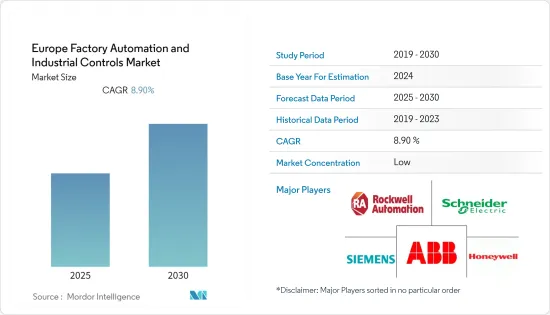
유럽의 공장 자동화 및 산업 제어 시장은 예측 기간 동안 8.9%의 연평균 복합 성장률(CAGR)을 나타낼 것으로 예상됩니다.
주요 하이라이트
경쟁이 치열해지고 최종 사용자의 요구가 진화함에 따라이 지역의 제조 부문은 비즈니스 프로세스를 최대한 효율적으로 만들기 위해 더 새로운 기술 혁신과 디지털 혁신 솔루션을 채택해야 합니다. 예를 들어, 모터 및 센서와 같은 현장 장치는 자동차 산업이 시장 요구에 신속하게 대응하고, 제조 다운타임을 줄이고, 공급망 효율성을 높이고, 생산성을 확대할 수 있는 기회를 제공합니다.
또한 이 지역은 다양한 산업에서 산업 자동화 도입이 진행되고 있으며, 주요 기업들이 산업 자동화 제품을 시장에 출시하고 있습니다. 예를 들어, 에너지 관리 및 자동화 디지털 혁신 분야의 선두주자인 슈나이더 일렉트릭(Schneider Electric)은 클라이마시스 스마트 환기 시스템(ClimaSys Smart Ventilation System)을 발표했습니다. 이 시스템은 신축 또는 개축 용도에서 여러 제어반 및 배전반의 공기 흐름을 필터링하고 관리하는 지능형 솔루션입니다.
OECD에 따르면 독일은 GDP의 2.88%를 제조업 혁신에 투자하고 있으며, 이는 OECD 평균 2.4%를 크게 상회하는 수치입니다. 독일 자동차 산업은 최근 몇 년동안 자동차 생산에서 세계적인 입지를 크게 확대했습니다. 또한, 제조 부문의 지속가능성은 조사 대상 시장의 주요 촉진요인이 될 것으로 예상됩니다.
또한, 에너지 산업에서는 스마트 그리드 등 송전 용량을 강화하기 위한 다양한 조치를 취하고 있습니다. 따라서 예측 기간 동안 산업용 제어 시스템의 사용이 확대될 가능성이 높습니다.
러시아 정부는 식품 생산의 수입 대체에 관심을 보이고 있습니다. 식품 수입 금지는 러시아 식품 산업의 발전과 확장으로 이어질 수 있으며, 가공 및 포장을 위한 현대 기술에 대한 추가 투자를 요구하고 있습니다. 또한, 정부는 'Pharma 2020 전략'을 계획하고 제약 산업 육성에 힘을 쏟고 있습니다. 이 전략의 목표는 러시아 경제의 수입 의약품 의존도를 낮추는 것이며, 이는 러시아 시장에 대한 투자를 촉진할 것으로 예상됩니다.
유럽의 공장 자동화 및 산업 제어 시장 동향
자동차 산업이 시장 성장 견인
자동차 산업은 전 세계 자동화 제조 설비에서 큰 비중을 차지하는 대표적인 분야 중 하나입니다. 다양한 자동차 제조업체의 생산 설비는 효율성을 유지하기 위해 자동화되고 있습니다. 기존 자동차를 EV로 대체하는 추세는 자동차 산업 수요를 더욱 확대할 것으로 예상됩니다.
자동차 산업의 가장 큰 관심사는 프로젝트 기간입니다. 따라서 저비용 자동화 및 비용 혁신과 결합된 신속한 투자 회수 프로젝트가 생산성 향상을 통해 제조업체의 경쟁력을 향상시키는 데 도움이 되고 있습니다. 제조 공정의 자동화 도입 확대, 디지털화 및 AI의 참여는 자동차 부문에서 산업용 로봇 수요를 촉진하는 주요 요인입니다.
UBS에 따르면 유럽의 전기차 판매량은 2025년까지 633만 대에 달할 것으로 예상되며, 중국이 484만 대로 그 뒤를 이을 것으로 전망됩니다. 유럽이 전기차 수요를 주도하고 있는 만큼 이 지역에서는 자동차 공장의 스마트화가 더욱 가속화될 것으로 예상됩니다.
유럽 자동차 산업에서 로봇과 자동화의 존재감이 높아짐에 따라 이 지역의 스마트 팩토리는 더욱 박차를 가할 것으로 예상됩니다. 또한 독일은 유럽에서 자동차 OEM 공장이 가장 많이 밀집된 국가이기도 합니다. 독일 내 OEM 공장의 추가 증가는 산업 제어 시스템에 대한 수요를 증가시킬 것으로 예상됩니다.
독일이 큰 시장 점유율을 차지합니다.
독일은 자동화 장비의 주요 소비국일 뿐만 아니라 유럽의 주요 자동화 장비 제조업체이기도 하며, Siemens, Schneider Electric, KUKA 등 자동화 및 제어 장비 대기업이 독일에 기반을 두고 있기 때문에 R&D 활동에 대한 투자가 활발합니다. D 활동에 대한 투자가 활발합니다.
이 나라에서 자동화 솔루션에 대한 수요가 빠르게 증가하고 있습니다. 예를 들어, 2019년 8월 KUKA는 자동차 관련 고객으로부터 22대의 KMP 1500을 수주했습니다. 이 지능형 자율 주행 차량은 로봇과 기계에 재료를 공급하고 생산 공정에 완벽한 타이밍을 맞출 수 있습니다. 또한 인더스트리 4.0 분야에서 인도와 독일의 협력 관계는 시장 성장을 증가시킬 것으로 예상됩니다.
국제로봇연맹(IFR)의 최근 추정에 따르면 독일의 로봇 밀도는 싱가포르, 한국에 이어 세계에서 세 번째로 높은 수준(근로자 1만 명당 338대)이며, IFR은 자동차 산업을 중심으로 다양한 산업에서 로봇에 대한 수요가 증가함에 따라 독일의 연간 공급량이 2018년까지 연평균 5% 이상 증가할 것으로 예상했습니다. 은 2018-2020년까지 연평균 5% 이상 증가할 것으로 전망하고 있습니다. 이러한 독일 내 산업용 로봇 공급 증가는 시장 연구를 촉진할 것으로 예상됩니다.
독일은 완전한 5G 생태계의 개발이 진행 중이며, 산업의 디지털화 속도가 더욱 가속화될 것으로 보입니다. 이는 국제 경쟁에서 독일의 입지를 강화할 것입니다. 최근 독일 통신사 Deutsche Telekom은 5G 기반 스마트 팩토리 생태계에 새로운 파트너를 추가했습니다. 새로운 파트너는 EK 오토메이션, 코니카 미놀타, 엔드레스하우저입니다.
유럽의 공장 자동화 및 산업 제어 산업 개요
유럽의 공장 자동화 및 산업 제어 시장은 여러 기업이 진입하여 경쟁이 치열합니다. 진출기업들은 제품 개발, 파트너십, 합병, 인수 등의 전략적 활동을 하고 있습니다.
2020년 8월 - 에너지 관리 및 자동화 분야의 디지털 혁신을 선도하는 슈나이더일렉트릭(한국지사 대표 김경록)이 ProLeiT AG 인수를 통해 포트폴리오를 확장하고 소프트웨어 지원 자동화를 위한 노력을 강화합니다. ProLeiT AG는 식음료, 화학 및 생명과학 부문을 포함한 소비재 시장에 최적화된 통합 제조 실행 시스템(MES) 기능을 갖춘 공정 제어 시스템(PCS)을 제공합니다.
2020년 3월 - 자율 로봇 피킹 솔루션 제공업체인 라이트핸드 로보틱스(RightHand Robotics, RHR)가 독일 프랑크푸르트에 영업 및 사업 개발 사무소를 설립하고 세계 사업 확장을 이어갑니다.
기타 혜택
엑셀 형식 시장 예측(ME) 시트
3개월간의 애널리스트 지원
목차
제1장 서론
조사의 전제조건과 시장 정의
조사 범위
제2장 조사 방법
제3장 주요 요약
제4장 시장 인사이트
시장 개요
산업 매력 - Porter의 Five Forces 분석
공급 기업의 교섭력
소비자의 교섭력
신규 진출업체의 위협
대체품의 위협
경쟁 기업간 경쟁 관계
산업 밸류체인 분석
COVID-19산업에 대한 영향 평가
제5장 시장 역학
시장 성장 촉진요인
시장 성장 억제요인
제6장 산업 표준과 규제
제7장 시장 세분화
제품별
산업 제어 시스템
Distributed Control System (DCS)
Programmable Logic Controller (PLC )
Supervisory Control and Data Acquisition (SCADA)
Product Lifecycle Management (PLM)
Human Machine Interface (HMI)
Manufacturing Execution System (MES)
Enterprise Resource Planning (ERP)
필드 기기
머신 비전 시스템
로봇 공학(산업용)
센서와 트랜스미터
모터&드라이브
기타 필드 디바이스
최종사용자 산업별
자동차
화학제품 및 석유화학제품
유틸리티
제약
식품 및 음료
석유 및 가스
기타
국가명
영국
독일
프랑스
스페인
기타 유럽
제8장 경쟁 구도
기업 개요
Schneider Electric SE
Rockwell Automation Inc.
Honeywell International Inc.
Emerson Electric Company
ABB Ltd
Mitsubishi Electric Corporation
Siemens AG
Omron Corporation
Robert Bosch GmbH
Yokogawa Electric Corporation
제9장 투자 분석
제10장 투자 분석 시장 전망
LSH
영문 목차
영문목차
The Europe Factory Automation and Industrial Controls Market is expected to register a CAGR of 8.9% during the forecast period.
Key Highlights
With a rapid increase in competition and evolving end-user requirements, manufacturing units in the region are being forced to adopt newer technological innovations and digital transformation solutions to make their business process as efficient as possible. For instance, field devices, like motors and sensors, among others, offer opportunities to the auto industry to react faster to market requirements, reduce manufacturing downtimes, and enhance the efficiency of supply chains, and expand productivity.
The region is also adopting industrial automation in various industries, with major firms launching industrial automation products in the market. For instance, Schneider Electric, a player in the digital transformation of energy management and automation, announced the ClimaSys smart ventilation system, which is an intelligent solution for filtering and managing the airflow for multiple control panels or electrical distribution cabinets in new or renovated applications.
According to OECD, Germany spends 2.88% of its GDP into manufacturing innovation, well ahead of the OECD average of 2.4%. The German automotive industry has extended its worldwide position in automotive production, significantly, over the past few years. Moreover, sustainability in the manufacturing sector is expected to be a major driver for the market studied.
Furthermore, various measures are being taken to boost power transmission capacity, such as smart grid, in the energy landscape The measures by the four national grid operators, to boost power transmission capacity, add up to a cost of EUR 50 billion. This is likely to escalate the usage of industrial control systems during the forecast period.
The Russian government is showing interest in import substitution of food production. The ban on imports of food could lead to the development and expansion of the country's food industry, further demanding investment in modern technology for processing and packaging. Also, the government is focused on creating its pharmaceutical industry by planning 'Pharma 2020 Strategy'. Its goal is to reduce the reliance on the Russian economy on imported pharmaceuticals, which is expected to drive investments in the market.
Europe Factory Automation & Industrial Controls Market Trends
Automotive Industry to Drive the Market Growth
The automotive industry is among the prominent sectors that hold a significant share of the world's automated manufacturing facilities. The production facilities of various automakers are automated to maintain efficiency. The growing trend of replacing conventional vehicles with EVs is expected to augment the automotive industry's demand further.
The primary concern of the automotive industry is the length of a project. Hence, quick return-on-investment projects, combined with low-cost automation and cost innovation, are helping the manufacturers improve competitiveness through productivity improvement. The growing adoption of automation in manufacturing processes and digitization and AI involvement are primary factors driving industrial robots' demand in the automotive sector.
According to UBS, the projected electric vehicle sales in Europe are expected to reach 6.33 million units by 2025, followed by China, with 4.84 million units. As Europe is leading the electric vehicles' demand, the region is anticipated to see an increase in smart automotive factories' implementation.
The growing presence of robots and automation in the European automotive industries is further expected to fuel the region's smart factory. Additionally, Germany also possesses the largest concentration of automotive OEM plants in Europe. A further increase in OEM sites in the country is expected to increase industrial control systems' demand.
Germany Holds Significant Market Share
Germany is not only a major consumer of automation equipment, but it is also a major manufacturer of automation equipment in Europe. Several major players of automation and control equipment, such as Siemens, Schneider Electric, KUKA, etc., are based out of Germany, thus driving a high investment flow toward R & D activities.
The country has been witnessing rapid growth in the demand for automation solutions. For instance, in August 2019, KUKA received an order for 22 KMP 1500s from an automotive customer. These intelligent, autonomous vehicles can supply materials to robots and machines, perfectly timing the production process. Additionally, a collaboration between India and Germany in Industry 4.0 is expected to augment the market growth.
According to the recent estimates from the International Federation of Robotics (IFR), Germany has the third most robot density in the world (338 units per 10,000 workers), after Singapore and South Korea. IFR estimates that the annual supply in Germany may continue to grow by at least 5% on average per year, between 2018 and 2020, due to the increasing demand for robots in various industries, with a focus on the automotive industry. This increasing supply of industrial robots in the country is expected to drive the market studied.
There is the development of a complete 5G ecosystem in the country, which will further accelerate the pace of digitization in the industry. This will strengthen Germany's position in global competition. Recently, Deutsche Telekom, a German telecommunications company, added new partners for its 5G-based smart factory ecosystem. The new partners are EK Automation, Konica Minolta, and Endress+Hauser.
Europe Factory Automation & Industrial Controls Industry Overview
The European factory automation and industrial controls market is competitive due to several players in the market. Players are involved in product development and strategic activities such as partnerships, mergers, and acquisitions.
August 2020 - Schneider Electric, the digital transformation leader of energy management and automation, is expanding its portfolio and reinforcing its commitment to holistic and software-supported automation through the acquisition of ProLeiT AG. ProLeiT AG provides Process Control Systems (PCS) with an integrated Manufacturing Execution System (MES) functions optimized for the Consumer Packed Goods marketplace, including the Food and Beverage, Chemicals, and Life Sciences segments
March 2020 - RightHand Robotics (RHR), a provider of autonomous robotic picking solutions, continues for its global expansion by establishing a sales and business development office in Frankfurt, Germany.
Additional Benefits:
The market estimate (ME) sheet in Excel format
3 months of analyst support
TABLE OF CONTENTS
1 INTRODUCTION
1.1 Study Assumptions and Market Definition
1.2 Scope of the Study
2 RESEARCH METHODOLOGY
3 EXECUTIVE SUMMARY
4 MARKET INSIGHTS
4.1 Market Overview
4.2 Industry Attractiveness - Porter's Five Forces Analysis
4.2.1 Bargaining Power of Suppliers
4.2.2 Bargaining Power of Consumers
4.2.3 Threat of New Entrants
4.2.4 Threat of Substitutes
4.2.5 Intensity of Competitive Rivalry
4.3 Industry Value Chain Analysis
4.4 An Assessment of Impact of COVID-19 on the Industry
5 MARKET DYNAMICS
5.1 Market Drivers
5.1.1 Growing Emphasis on Energy Efficiency and Cost Reduction
5.2 Market Restraints
5.2.1 Trade Tensions and Implementation Challenges
6 INDUSTRY STANDARDS AND REGULATIONS
7 MARKET SEGMENTATION
7.1 By Product
7.1.1 Industrial Control Systems
7.1.1.1 Distributed Control System (DCS)
7.1.1.2 Programmable Logic Controller (PLC )
7.1.1.3 Supervisory Control and Data Acquisition (SCADA)