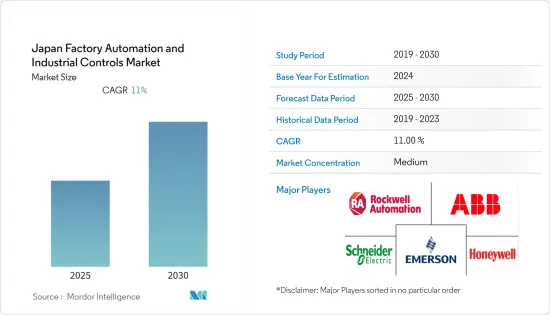
일본의 공장 자동화 및 산업 제어 기기 : 시장 점유율 분석, 산업 동향, 통계, 성장 예측(2025-2030년)
Japan Factory Automation and Industrial Controls - Market Share Analysis, Industry Trends & Statistics, Growth Forecasts (2025 - 2030)
상품코드:1626339
리서치사:Mordor Intelligence
발행일:2025년 01월
페이지 정보:영문
라이선스 & 가격 (부가세 별도)
ㅁ Add-on 가능: 고객의 요청에 따라 일정한 범위 내에서 Customization이 가능합니다. 자세한 사항은 문의해 주시기 바랍니다.
ㅁ 보고서에 따라 최신 정보로 업데이트하여 보내드립니다. 배송기일은 문의해 주시기 바랍니다.
한글목차
일본의 공장 자동화 및 산업 제어 장비 시장은 예측 기간 동안 11%의 연평균 복합 성장률(CAGR)을 나타낼 것으로 예상됩니다.
주요 하이라이트
제조 공정의 자동화는 모니터링 용이성, 폐기물 감소, 생산 속도 향상 등 여러 가지 이점을 제공합니다. 이 기술은 표준화를 통해 품질을 향상시키고 고객에게 적시에 저렴하고 신뢰할 수 있는 제품을 제공합니다.
산업 장비와 기계를 연결하고 실시간 데이터를 수집하는 것은 PLC 시스템, SCADA, HMI, 시각화를 제공하는 소프트웨어의 채택에 중요한 역할을 했습니다.
인더스트리얼 4.0과 사물인터넷(IIOT)은 스마트 공장 자동화로 알려진 전체 물류 체인의 개발, 생산 및 관리를 위한 새로운 기술 접근 방식의 핵심으로, 기계와 장치가 인터넷을 통해 연결되는 스마트 공장 자동화 산업 분야의 트렌드를 지배하고 있습니다.
또한, 인더스트리 4.0과 IoT의 수용으로 인한 제조업의 대규모 변화로 인해 기업은 자동화를 통해 인간의 노동력을 보완 및 확장하고 공정 실패로 인한 산업 사고를 줄이는 기술로 생산을 진행하기 위해 민첩하고 스마트한 혁신적 방법을 채택해야 합니다.
Zebra의 최신 Manufacturing Vision Study에 따르면, IoT 및 RFID 기반 스마트 자산 추적 솔루션은 2022년까지 기존의 스프레드시트 기반 방식을 추월할 것으로 예상됩니다. 산업용 IoT(IIoT) 기업 마이크로소프트(Microsoft)의 조사에 따르면, 85%의 기업이 최소 한 가지 이상의 IIoT 이용 사례 프로젝트를 진행하고 있는 것으로 나타났습니다. 응답자의 94%가 2021년까지 IIoT 전략을 도입할 것이라고 답한 것으로 보아 이 수치는 증가할 것으로 예상됩니다.
또한 일본은 자동화 산업 경제로의 전환의 선구자입니다. 산업 버전 4.0은 더 빠른 속도로 채택되고 있습니다. 일본은 공장 자동화 제품의 제조 기지로 성장하여 다른 아시아태평양 시장에 공급하고 있습니다. 또한 여러 자동차 제조업체, 전자 제품 제조 및 식품 가공 산업이 존재한다는 점도 일본을 중요한 시장으로 만들고 있습니다.
코로나19는 일본 제조업계에 많은 과제를 안겨주었고, 코로나19 사태로 인한 소비자 행동의 큰 변화는 자동화와 가상화의 발전으로 이어질 것으로 예상됩니다. 현재 사람이 감독해야 하는 중요한 기능을 원격으로 또는 최소한의 인원으로 모니터링할 수 있는 스마트한 공장과 사무실이 증가할 것으로 예상됩니다. 따라서 시장은 예측 기간 동안 성장할 것으로 예상되며, COVID-19로 대표되는 세계 경기 침체로 인해 일본 공장 자동화 시장은 2020년 상반기에 공급 측면의 영향과 수요 측면의 긍정적인 영향이 혼재되어 있음을 알 수 있습니다.
스마트팩토리 도입으로 제조업은 코로나19의 과제를 극복하고, 인력 감축, 특정 제품 판매 감소, 사회적 거리두기, 최종 사용자 산업(주로 제조업, 자동차 산업)의 대다수 기업이 운영 제한으로 인해 생산기지를 폐쇄함에 따라 운영비 절감에 대한 극도의 압박을 받는 등의 문제를 해결할 수 있었습니다. 운영비 절감에 대한 극심한 압박을 극복할 수 있었습니다.
일본 공장자동화 및 산업제어기기 시장 동향
일본 공장자동화 및 산업제어기기 시장 동향
분산형 제어 시스템, 큰 폭 시장 성장 예상
분산 제어 시스템(DCS)은 상호 연결된 센서, 액추에이터, 컨트롤러 및 터미널 네트워크에 의존하는 프로세스 지향 플랫폼으로, 시설의 생산 운영을위한 중앙 집중식 마스터 컨트롤러 역할을합니다. 결과적으로 DCS는 공정 제어 및 모니터링에 중점을 두어 설비 운영자가 모든 설비 운영을 한 곳에서 확인할 수 있도록 하며, DCS는 폐쇄 루프 제어 플랫폼에서 작동하기 때문에 고도의 공정 자동화 전략을 구현할 수 있습니다. 따라서 DCS는 단일 시설이나 공장의 운영을 제어하는 데 적합합니다. 또한 DCS는 시설의 일상적인 운영 프로세스에 대한 가시성을 극대화하는 데 매우 중요합니다.
제어 아키텍처에는 로컬 프로세스의 세부 사항을 제어할 책임이 있는 다중 통합 하위 시스템을 감독하는 감독 수준 제어가 포함됩니다. 이러한 서브시스템은 센서와 액추에이터에 연결되어 설정점 제어를 통해 플랜트 내 자재 흐름을 제어합니다.
DCS 시스템의 중요한 장점 중 하나는 워크스테이션, 분산 컨트롤러 및 기타 컴퓨팅 요소 간의 디지털 통신이 피어 투 피어 액세스 원칙을 따른다는 것입니다. 이러한 전제조건이 DCS의 채택을 촉진하고 있습니다. DCS는 PLC, 터보 기계 제어, 안전 시스템, 타사 제어, 기타 열교환기, 급수 가열기, 수질 등 다양한 플랜트 공정 제어를 통합할 수 있는 기능을 제공함으로써 운영의 복잡성, 프로젝트 위험 감소, 까다로운 용도에서 민첩한 제조를 위한 유연성 등 다양한 기능을 제공하기 때문입니다. 다양한 플랜트 및 공정 제어를 통합할 수 있다는 점이 에너지 분야에서 DCS의 채택을 더욱 촉진하고 있습니다.
일본의 에너지 수요 증가에 따라 향후 15-20년 동안 새로운 발전소 건설에 대한 관심이 높아지고 있습니다. 이에 따라 원자력 산업은 높은 건설량을 제공하는 것이 과제가 되고 있습니다. 이 과제에 대응하기 위한 주요 전략은 모듈식 건설, 높은 수준의 표준화, 수동적 안전 기능, 부품 수 감소, 입찰에서 건설까지의 기간을 단축할 수 있는 첨단 원자력 발전소 설계의 개발입니다. 그 결과, 연구 대상 시장의 성장에 유리한 기회를 제공합니다.
또한 원자력 발전소, 화학, 석유화학, 야금 플랜트 등에서는 문제 해결 최소화, 엔지니어링 시간 단축, 효율성 향상 등의 이유로 분산형 제어 시스템의 사용이 증가하고 있습니다. 이러한 추세는 조사 대상 시장의 성장을 크게 촉진할 것으로 예상됩니다.
분산형 제어 시스템은 플랜트의 안전하고 효율적인 운영을 유지하는 데 필요한 기능을 관리하는 효율적인 솔루션을 제공해 왔지만, 산업 공간에서 디지털 기술의 출현으로 인한 기대에 부응하기 위해 고군분투하고 있습니다. IIoT 기술을 활용한 스마트 계측 및 센서와 같은 일본의 개발은 제어 및 데이터에 대한 접근 가능성을 변화시키고 있지만, 분산형 제어 시스템에 통합하는 데 어려움이 있기 때문에 경우에 따라서는 그 잠재력이 거의 실현되지 않은 채로 남아있는 경우도 있습니다. 따라서 수많은 지역 생산 자산을 안정적이고 안전하게 제어하고 조정하는 본연의 역할을 손상시키지 않으면서도 혁신적이고 민첩한 DCS가 대량으로 요구되고 있습니다.
산업용 로봇이 주요 시장 점유율을 차지할 것으로 예상
일본은 로봇 및 공장 자동화 시스템 생산의 선두주자입니다. 잘 발달 된 로봇 부문과 자동화 기술로 일본은 생산 공정에 로봇 공학 및 자동화를 채택하는 세계 최고의 국가가되었습니다. 일본 통계청에 따르면 일본의 로봇 산업 매출은 2018년 101억 8,000만 달러에서 2024년 163억 5,000만 달러에 달할 전망입니다.
일본의 현재 로봇 공학 분야의 리더십은 제조업의 오랜 기술 리더십의 역사 위에 세워졌습니다. 현재 일본 자동화 기업들은 자사 제품에 대한 강력한 수요 증가의 혜택을 누리고 있습니다.
경제 전반에 걸쳐 수요가 증가함에 따라 제품 제조업체들은 반복적인 프로세스의 일부를 자동화하기 위해 로봇을 채택하고 있습니다. 산업용 로봇 시장은 스마트 팩토리 시스템의 도입이 증가함에 따라 지난 10년간 큰 수요를 보였습니다. 이러한 로봇은 중요한 역할을 하고 있습니다.
최신 산업 혁명인 인더스트리 4.0은 협동 로봇, AI 지원 로봇과 같은 새로운 기술의 진화를 촉진하여 기업이 로봇을 활용하여 많은 프로세스를 간소화하고 효율성을 높이며 오류를 제거하도록 촉진하고 있습니다. 작업장 안전이 향상되고 생산 능력이 향상됨에 따라 산업계는 로봇 시스템에 대한 투자를 더욱 촉진하고 있습니다.
또한, 산업용 로봇은 품질 저하 없이 소형화 및 저가화가 진행되어 최종 사용자 산업의 주요 기업들에게 매력적인 시장으로 부상하고 있습니다. 그러나 투자 증가가 시장 성장을 저해할 가능성도 있습니다. 일본의 산업용 로봇 수요 급증은 코로나19 관련 조업 중단으로 인한 인력 부족과 전통 산업의 업그레이드로 인해 촉발됐습니다.
일본의 공장자동화 및 산업제어기기 산업 개요
일본의 공장 자동화 및 산업 제어 장비 시장은 여러 기업이 각각 소규모 시장 지배력을 가지고 있는 비교적 통합된 시장입니다. 인더스트리 4.0과 각 지역의 디지털화 노력은 산업용 로봇 시장에 유리한 기회를 제공합니다.
2022년 3월 - 미쓰비시전기는 아이치현 오와리아사히시에 42,000평방미터의 부지를 취득하고, 2025년 4월부터 FA(공장자동화) 제어 시스템 제품을 제조하는 새로운 생산기지를 설립한다고 발표했습니다. 신공장에서는 5G 통신을 비롯한 다양한 첨단 기술을 도입해 기계, 무인운반차(AGV), 작업자가 동시에 연결돼 제조 업무를 수행하게 됩니다. 이와 동시에 공장 전체에서 실시간으로 데이터를 수집해 생산 주기의 모든 측면에 대한 데이터 세트를 인공지능 기반 분석에 제공함으로써 유연하고 안전한 생산 환경을 구현할 수 있습니다.
2022년 2월 야마하, 공장 자동화 판매망을 지원하기 위한 노력을 공개합니다. 야마하 모터 로보틱스 공장 자동화 사업부는 2022년 대리점 회의를 온라인으로 개최했습니다. 이 자리에서 대리점들이 부품 및 설정 정보에 쉽게 접근할 수 있도록 솔루션 통합과 고객 지원을 가속화할 수 있는 새로운 온라인 포털이 소개됐습니다. 또한, 야마하 산업용 로봇의 메인 웹사이트는 로봇의 설정, 프로그래밍 및 작동에 대한 특별 도움말을 제공하고 추적과 같은 기능을 추가할 것이라고 밝혔습니다.
기타 혜택 :
기타 혜택
엑셀 형식 시장 예측(ME) 시트
3개월간의 애널리스트 지원
목차
제1장 서론
조사 성과
조사 전제
제2장 조사 방법
제3장 주요 요약
제4장 시장 인사이트
시장 개요
산업 밸류체인 분석
업계의 매력 - Porter의 Five Forces 분석
공급 기업의 교섭력
소비자의 교섭력
신규 진출업체의 위협
대체품의 위협
경쟁 기업간 경쟁 관계
COVID-19의 업계에 대한 영향 평가
제5장 시장 역학
시장 성장 촉진요인
엄격한 에너지 효율 기준 개시와 현지 생산 추진?
시장이 해결해야 할 과제
무역마찰과 금융정책 긴축
기술 현황
제6장 시장 세분화
유형별
산업 제어 시스템
분산형 제어 시스템(DCS)
프로그래머블 로직 컨트롤러(PLC)
감시제어·데이터 수집(SCADA)
제품수명주기관리(PLM)
제조 실행 시스템(MES)
휴먼·머신·인터페이스(HMI)
기타 산업 제어 시스템
필드 기기별
머신 비전
산업용 로봇
센서와 트랜스미터
모터와 드라이브
안전 시스템
기타 필드 기기
최종사용자 산업별
석유 및 가스
화학제품 및 석유화학제품
전력 및 유틸리티
식품 및 음료
자동차 및 운송
기타 최종사용자 산업
제7장 경쟁 구도
기업 개요
Schneider Electric SE
Rockwell Automation Inc.
Honeywell International Inc.
Emerson Electric Company
ABB Ltd
Mitsubishi Electric Corporation
Siemens AG
Omron Corporation
Yokogawa Electric Corporation
Yasakawa Electric Corporation
Fanuc Corporation
Nidec Corporation
Fuji Electric Co. Ltd.
Seiko Epson Corporation
Shibaura Machine CO
제8장 투자 분석
제92장 시장의 미래
LSH
영문 목차
영문목차
The Japan Factory Automation and Industrial Controls Market is expected to register a CAGR of 11% during the forecast period.
Key Highlights
Automation of manufacturing processes has presented several benefits like effortless monitoring, waste reduction, and production speed. This technology offers customers improved quality with standardization and reliable products within time and at a cheaper cost.
Connecting the industrial equipment & machinery and acquiring real-time data have played a critical role in the adoption of PLC systems, SCADA, HMI, and software that offer visualization; thus, enabling decreasing the faults in the product, scheduling maintenance, reducing downtime, and switching from being in the reactive state to predictive and prescriptive stages for decision-making.
The Industrial 4.0 and the Industrial Internet of Things (IIOT) are at the center of new technological approaches for the development, production, and management of the entire logistics chain, otherwise known as smart factory automation, and are dominating trends in the industrial sector, with machinery and devices being connected via the internet.
Moreover, massive shifts in manufacturing due to industry 4.0 and the acceptance of IoT require enterprises to adopt agile, smarter, and innovative ways to advance production with technologies that complement and augment human labor with automation and reduce industrial accidents caused by process failure.
According to Zebra's latest Manufacturing Vision Study, smart asset tracking solutions based on IoT and RFID are envisioned to overtake traditional, spreadsheet-based methods by 2022. A study by Industrial IoT (IIoT) company, Microsoft Corporation, established that 85% of companies have at least one IIoT use case project. This number is foreseen to increase, as 94% of respondents said they would implement IIoT strategies by 2021.
Further, Japan has been a pioneer in transforming into an automated industrial economy. The Industrial version 4.0 is being adopted at a faster pace. The country has materialized as a manufacturing hub for factory automation products and supplies them to other Asian-Pacific regional markets. Also, the presence of multiple automobile manufacturers, the electronic products manufacturing industry, food processing industry makes Japan an important market.
The COVID-19 pandemic posed many challenges for the manufacturing industry in Japan. The profound change in consumer behavior because of the COVID-19 pandemic is expected to lead to more automation and virtualization. Smart factories and offices are expected to increase, allowing critical functions that currently need to be overseen in person to be monitored remotely or, at a minimum, by fewer people. Hence, the market is predicted to grow during the forecast period. Following the global economic recession led by COVID-19, the factory automation market in Japan noticed a mixed impact from the supply side and a positive effect from the demand side in 1st half of 2020.
Smart factory initiatives have helped manufacturers to overcome COVID-19 challenges and address issues such as workforce reductions, drops in sales for some specific products, social distancing, and extreme pressure to cut operational costs since most enterprises operating in the end-user industries (majorly manufacturing, automotive) had shuttered down their production sites due to lockdown restrictions.
Japan Factory Automation & Industrial Controls Market Trends
Distributed Control Systems are Expected to Witness a Significant Market Growth
Distributed Control Systems (DCS) are process-oriented platforms that rely on a network of interconnected sensors, actuators, and controllers, terminals to act as a centralized master controller for a facility's production operations. Resultantly, a DCS focuses on controlling and monitoring processes and allowing facility operators to see all facility operations in one place. DCS enables the implementation of advanced process automation strategies as it operates on a closed-loop control platform. Thus, DCS is suitable for controlling operations at a single facility or factory. Further, a DCS is crucial for maximizing the visibility of a facility's everyday operational processes.
The control architecture includes a supervisory level of control, overseeing multiply-integrated sub-systems, responsible for controlling the details of a localized process. They are connected to sensors and actuators and utilize setpoint control to control material flow through the plant.
One of the important benefits of the DCS systems is that the digital communication between workstations, distributed controllers, and other computing elements follows the peer-to-peer access principle. These prerequisites have driven the adoption of DCS, as these systems provide lower operational complexity, project risk, and functionalities like flexibility for agile manufacturing in highly-demanding applications. The ability of DCS to integrate PLCs, turbomachinery controls, safety systems, third-party controls, and various other plant process controls for heat exchangers, feedwater heaters, and water quality, among others, further drives the adoption of DCS in the energy sector.
With Japan's growing demand for energy, the interest in constructing new power plants over the next 15 to 20 years has increased. This has challenged the nuclear industry to provide a high construction volume. A key strategy to meet this challenge is developing an advanced nuclear power plant design that allows for modular construction, a high level of standardization, passive safety features, a reduced number of components, and a short bid-to-build time. Resultantly, it offers lucrative opportunities for the growth of the studied market.
There is also an increase in the usage of Distributed Control systems in nuclear power plants, chemical, petrochemical, metallurgical plants, etc., due to minimal troubleshooting requirements, engineering time, enhanced efficiency, etc. This trend is anticipated to drive the growth of the studied market significantly.
While Distributed Control Systems have delivered an efficient solution for managing the functions required to keep plants operating safely and efficiently, they are struggling to meet the expectations stemming from the emergence of digital technologies in the industrial space. While developments in Japan like smart instrumentation and sensors utilizing IIoT technologies are transforming possibilities for control and access to data, the hardships of integrating them into Distributed Control Systems have meant that, in some cases, their highest potential has remained predominantly unrealized. Therefore, there is a massive demand for innovative and agile DCS without compromising their primary role of reliably and safely controlling and coordinating large numbers of regional production assets.
Industrial Robots are Anticipated to Hold a Major Market Share
Japan is a major player in the production of robots and factory automation systems. With its well-developed robotic sector and automation technologies, Japan is one of the leading countries to employ robotics and automation in production processes globally. According to the Statistics Bureau of Japan, the industry revenue of robots in the country is likely to reach USD 16.35 billion in 2024 from USD 10.18 billion in 2018.
Japan's current leadership in robotics was built on a long history of technological leadership in manufacturing. Currently, Japanese automation companies are benefiting from strong growth in demand for their products.
With increased demand across economies, product manufacturers are adopting robots to automate some of the repetitive processes. The industrial robot market has witnessed a huge demand over the past decade, owing to the rising adoption of smart factory systems. These robots play a crucial part.
Industry 4.0, the most recent industrial revolution, has fueled the evolution of new technologies, like collaborative robots, AI-enabled robots, etc., and has facilitated enterprises to utilize robots to streamline many processes, improve efficiency, and eliminate errors. Augmented workplace safety and improved production capabilities have further driven industries to invest in robotic systems.
Additionally, industrial robots are becoming smaller and cheaper without compromising quality; the market is becoming attractive for key players in several end-user industries. However, higher investments may hamper the growth of the market. The upsurge in demand for industrial robots in Japan was triggered by a shortage of workers who remained off duty because of COVID-19-related lockdowns and an upgrade of traditional industries.
Japan Factory Automation & Industrial Controls Industry Overview
The Japan Factory Automation and Industrial Control Market is a moderately consolidated market with several firms in the market, each having a small level of market dominance. Industry 4.0 and digitalization initiatives across regions provide lucrative opportunities in the industrial robots market.
March 2022 - Mitsubishi Electric Corporation announced that it had acquired 42,000 square meters of land in OwariasahiCity, Aichi Prefecture, Japan, to establish a new production site to manufacture factory automation (FA) control system products from April 2025. The new factory would employ numerous advanced technologies like 5G communication, permitting simultaneous connection of machines, automatic guided vehicles (AGVs), and human workers as they perform their manufacturing duties. In parallel, real-time and high-speed data acquisition throughout the factory will deliver data sets on all facets of the production cycle for Artificial Intelligence based analysis to realize a flexible and safe production environment.
February 2022 - Yamaha Revealed Initiatives to Support Factory-automation Sales Network. Yamaha Motor Robotics Factory Automation section has held its 2022 annual distributor meeting online. Among new initiatives revealed during the meeting, a new online portal for agents was introduced that accelerates solution integration and customer support by easing access to parts and setup information. In addition, the main Yamaha industrial robots website is claimed to provide extra help to configure, program, and operate the robots and add capabilities like tracking.
Additional Benefits:
The market estimate (ME) sheet in Excel format
3 months of analyst support
TABLE OF CONTENTS
1 INTRODUCTION
1.1 Study Deliverables
1.2 Study Assumptions
2 RESEARCH METHODOLOGY
3 EXECUTIVE SUMMARY
4 MARKET INSIGHTS
4.1 Market Overview
4.2 Industry Value Chain Analysis
4.3 Industry Attractiveness - Porter's Five Forces Analysis
4.3.1 Bargaining Power of Suppliers
4.3.2 Bargaining Power of Consumers
4.3.3 Threat of New Entrants
4.3.4 Threat of Substitutes
4.3.5 Intensity of Competitive Rivalry
4.4 Assessment of Impact of Covid-19 on the Industry
5 MARKET DYNAMICS
5.1 Market Drivers
5.1.1 Launch of Stringent Energy Conservation Standards and Drive for Local Manufacturing?
5.2 Market Challenges
5.2.1 Trade Tensions and Monetary Policy Tightening
5.3 Technology Snapshot
6 MARKET SEGMENTATION
6.1 By Type
6.1.1 Industrial Control Systems
6.1.1.1 Distributed Control System (DCS)
6.1.1.2 Programable Logic Controller (PLC)
6.1.1.3 Supervisory Control and Data Acquisition (SCADA)