Lecithin Market Opportunity, Growth Drivers, Industry Trend Analysis, and Forecast 2026 - 2035
상품코드:1928892
리서치사:Global Market Insights Inc.
발행일:2026년 01월
페이지 정보:영문 210 Pages
라이선스 & 가격 (부가세 별도)
ㅁ Add-on 가능: 고객의 요청에 따라 일정한 범위 내에서 Customization이 가능합니다. 자세한 사항은 문의해 주시기 바랍니다.
한글목차
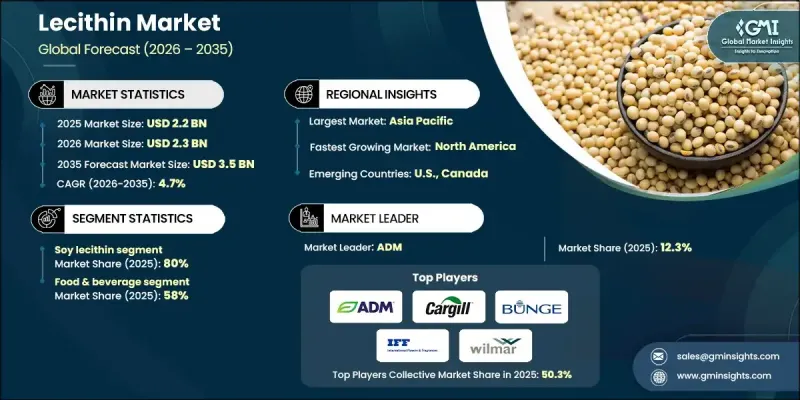
세계의 레시틴 시장은 2025년에 22억 달러로 평가되었으며, 2035년까지 CAGR 4.7%로 성장하여 35억 달러에 달할 것으로 예측됩니다.
식품, 건강기능식품, 제약, 퍼스널케어, 산업용 등 다양한 산업 분야의 수요에 힘입어 성장세를 보이고 있으며, 보다 고기능성 등급으로 전환하고 있습니다. 클린 라벨 제품에 대한 소비자 수요와 전달 시스템의 혁신으로 인해 시장은 전통적인 유동성 레시틴에서 탈유, 개질, 고포스파티딜콜린(PC) 분획으로 전환하고 있습니다. 공급량과 가격은 여전히 식량작물 수급 사이클의 영향을 받지만, 제품의 가치는 기능성, 품질, 추적가능성에 의해 결정되는 경향이 강해지고 있습니다. 화장품 및 퍼스널케어 제품에서 레시틴의 사용 증가(유화제, 보습제, 침투 촉진제 역할)가 레시틴의 채택을 촉진하고 있습니다. 천연 인지질, 특히 94-98%의 PC 분획은 생체적합성과 안정된 품질로 인해 리포솜과 비경구용 에멀전에 선호되고 있습니다. 유럽식품안전청(EFSA)의 동물 안전 승인과 미국 농무부(USDA)의 국가 유기농 프로그램 승인을 포함한 규제 프레임워크는 유기농 및 클린 라벨 제품 처방을 지원하고 세계 시장에서의 기회를 더욱 확대하고 있습니다.
시장 범위
시작 연도
2025년
예측 연도
2026-2035
개시시 가치
22억 달러
예측 금액
35억 달러
CAGR
4.7%
대두 레시틴 부문은 2025년 80%의 점유율을 차지했으며, 이는 대두 가공의 광범위한 보급과 석유 정제 시 인지질 껌의 회수를 반영합니다. 2024/25년 세계 대두 생산량은 약 4억 2,714만 톤으로 예측되며, 브라질은 약 1억 7,500만 톤, 미국은 1억 1,580만 톤을 생산할 것으로 예상됩니다. 조대두유에는 800-1,200ppm의 인이 함유되어 있으며, 중량 대비 2-3%의 상업용 레시틴이 생성됩니다. 그 구성은 주로 PC, PE, PI로 구성되어 있으며, 중성 오일과 항산화제 관리가 필요한 미량의 유화 성분을 함유하고 있습니다.
식음료 부문은 2025년 58%의 점유율을 차지했습니다. 각 제조사들은 베이커리 제품, 과자, 유제품, 식물 유래 제품, 클린 라벨 제품에 천연유화제를 적극 도입하고 있습니다. 레시틴은 식감 개선, 유화 안정성 확보, 유통기한 연장에 기여하며, 특히 아시아태평양의 급성장하는 소비자층을 중심으로 증가하는 가공식품 및 간편식 수요에 부합합니다.
북미 레시틴 시장은 미국 대두 생산량 1억 1,580만 톤, 캐나다 유채 생산량 1,880만 톤에 힘입어 27%의 점유율을 차지하고 있습니다. 유기농 및 비GMO 제품에 대한 소비자 선호도가 높아지면서 인증된 레시틴 등급에 대한 수요가 증가하고 있습니다. 유전자 변형 물질의 검출 가능성을 평가하는 '국가 바이오 엔지니어링 식품 공개 기준'에 따른 규제 명확화는 조달, 문서화, 가공에 대한 의사결정에 더 많은 영향을 미치고 있습니다.
목차
제1장 조사 방법과 범위
제2장 주요 요약
제3장 업계 인사이트
생태계 분석
공급업체 상황
이익률
각 단계의 부가가치
밸류체인에 영향을 미치는 요인
디스럽션
업계에 대한 영향요인
성장 촉진요인
업계의 잠재적 리스크와 과제
시장 기회
성장 가능성 분석
규제 상황
북미
유럽
아시아태평양
라틴아메리카
중동 및 아프리카
Porters 분석
PESTEL 분석
가격 동향
지역별
향후 시장 동향
기술과 혁신 동향
현재 기술 동향
신기술
특허 상황
무역 통계(HS 코드)(참고 : 무역 통계는 주요국에 대해서만 제공됩니다)
주요 수입국
주요 수출국
지속가능성과 환경면
지속가능한 대처
폐기물 절감 전략
생산의 에너지 효율
친환경적인 대처
탄소발자국에 관한 고려사항
제4장 경쟁 구도
소개
기업의 시장 점유율 분석
지역별
북미
유럽
아시아태평양
라틴아메리카
중동 및 아프리카
기업 매트릭스 분석
주요 시장 기업 경쟁 분석
경쟁 포지셔닝 매트릭스
주요 발전
인수합병
제휴·협업
신제품 발매
확대 계획
제5장 시장 규모 및 예측 : 소스별, 2022-2035
대두 레시틴
유전자 재조합 대두 레시틴
비유전자 변형 대두 레시틴
해바라기 레시틴
카놀라/유채 레시틴
난황 레시틴
기타
제6장 시장 규모 및 예측 : 형태별, 2022-2035
유동성/액체 레시틴
탈지 분말 레시틴
과립상 레시틴
제7장 시장 규모 및 예측 : 용도별, 2022-2035
식품 및 음료
베이커리 제품
제과·초콜릿
유아용 조제분유·이유식
유제품 및 유제품 대체품
기타
동물 사료
가금류 사료 용도
수산양식용 사료 용도
가축 사료 용도
의약품
고형·액제 제형
경피 흡수 시스템
기타
화장품·퍼스널케어
스킨케어 제제
헤어케어 제품
산업 용도
플라스틱·코팅
윤활유·이형제
기타
제8장 시장 규모 및 예측 : 지역별, 2022-2035
북미
미국
캐나다
유럽
영국
독일
프랑스
이탈리아
스페인
기타 유럽
아시아태평양
중국
인도
일본
한국
호주
기타 아시아태평양
라틴아메리카
브라질
멕시코
아르헨티나
기타 라틴아메리카
중동 및 아프리카
남아프리카공화국
사우디아라비아
아랍에미리트
기타 중동 및 아프리카
제9장 기업 개요
Archer Daniels Midland
Cargill
International Flavors & Fragrances
Bunge Limited
GIIAVA
Ruchi Soya
Wilmar International
Lipoid GmbH
American Lecithin Company
Thew Arnott
Sternchemie
Sodrugestvo
LEKITHOS
LECICO
SOYA International
KSM
영문 목차
영문목차
The Global Lecithin Market was valued at USD 2.2 billion in 2025 and is estimated to grow at a CAGR of 4.7% to reach USD 3.5 billion by 2035.
Growth is driven by demand across multiple industries, including food, nutraceuticals, pharmaceuticals, personal care, and industrial applications, with an increasing shift toward higher specification grades. Consumer demand for clean-label products and innovations in delivery systems is moving the market from traditional fluid lecithin toward deoiled, modified, and high-phosphatidylcholine (PC) fractions. While availability and pricing remain influenced by oilseed cycles, product value is increasingly determined by functionality, quality, and traceability. The rising use of lecithin in cosmetics and personal care products, where it acts as an emulsifier, moisturizer, and penetration enhancer, is boosting adoption. Natural phospholipids, especially 94-98% PC fractions, are preferred for liposomes and parenteral emulsions due to biocompatibility and consistent quality. Regulatory frameworks, including EFSA approvals for animal safety and USDA National Organic Program allowances, support organic and clean-label product formulations, further expanding opportunities across global markets.
Market Scope
Start Year
2025
Forecast Year
2026-2035
Start Value
$2.2 Billion
Forecast Value
$3.5 Billion
CAGR
4.7%
The soy lecithin segment held 80% share in 2025, reflecting extensive soybean processing and the recovery of phospholipid gums during oil refining. Global soybean production is projected at approximately 427.14 MMT in 2024/25, with Brazil producing around 175 MMT and the U.S. at 115.8 MMT. Crude soybean oil contains 800-1,200 ppm phosphorus, resulting in 2-3% commercial lecithin by weight, with its composition primarily of PC, PE, and PI, along with neutral oil and minor emulsifying components that require antioxidant management.
The food & beverage segment held 58% share in 2025. Manufacturers are increasingly incorporating natural emulsifiers into bakery, confectionery, dairy, plant-based, and clean-label products. Lecithin enhances texture, stabilizes emulsions, and extends shelf life, aligning with rising demand for processed and convenient foods, particularly among the fast-growing consumer base in the Asia-Pacific region.
North America Lecithin Market held 27% share supported by U.S. soybean production of 115.8 MMT and Canada's rapeseed output of 18.8 MMT. Rising consumer preference for organic and non-GMO products is increasing demand for certified lecithin grades. Regulatory clarity under the National Bioengineered Food Disclosure Standard, which assesses detectability of genetically modified material, further influences sourcing, documentation, and processing decisions.
Key players in the Global Lecithin Market include Wilmar International, Lipoid GmbH, American Lecithin Company, Archer Daniels Midland, Cargill, International Flavors & Fragrances, Bunge Limited, Thew Arnott, Ruchi Soya, Sternchemie, Sodrugestvo, LEKITHOS, LECICO, GIIAVA, and SOYA International. Market leaders strengthen their position by investing in research and development to create high-performance lecithin products with improved purity, functionality, and stability. Companies focus on expanding their certified organic and non-GMO product lines to meet consumer demand for clean-label offerings. Strategic partnerships with food, nutraceutical, and pharmaceutical manufacturers enable broader product adoption. Additionally, firms are enhancing supply chain traceability and documentation to comply with global regulatory requirements. Investments in global distribution networks, sustainability initiatives, and marketing campaigns highlighting functional benefits, versatility, and safety help companies consolidate market presence and foster long-term brand loyalty.
Table of Contents
Chapter 1 Methodology & Scope
1.1 Market scope and definition
1.2 Research design
1.2.1 Research approach
1.2.2 Data collection methods
1.3 Data mining sources
1.3.1 Global
1.3.2 Regional/Country
1.4 Base estimates and calculations
1.4.1 Base year calculation
1.4.2 Key trends for market estimation
1.5 Primary research and validation
1.5.1 Primary sources
1.6 Forecast model
1.7 Research assumptions and limitations
Chapter 2 Executive Summary
2.1 Industry 360° synopsis
2.2 Key market trends
2.2.1 Source
2.2.2 Form
2.2.3 Application
2.3 TAM analysis, 2026-2035
2.4 CXO perspectives: Strategic imperatives
2.4.1 Executive decision points
2.4.2 Critical success factors
2.5 Outlook and strategic recommendations
Chapter 3 Industry Insights
3.1 Industry ecosystem analysis
3.1.1 Supplier landscape
3.1.2 Profit margin
3.1.3 Value addition at each stage
3.1.4 Factor affecting the value chain
3.1.5 Disruptions
3.2 Industry impact forces
3.2.1 Growth drivers
3.2.2 Industry pitfalls and challenges
3.2.3 Market opportunities
3.3 Growth potential analysis
3.4 Regulatory landscape
3.4.1 North America
3.4.2 Europe
3.4.3 Asia Pacific
3.4.4 Latin America
3.4.5 Middle East & Africa
3.5 Porter';s analysis
3.6 PESTEL analysis
3.7 Price trends
3.7.1 By region
3.8 Future market trends
3.9 Technology and innovation landscape
3.9.1 Current technological trends
3.9.2 Emerging technologies
3.10 Patent landscape
3.11 Trade statistics (HS code) (Note: the trade statistics will be provided for key countries only)
3.11.1 Major importing countries
3.11.2 Major exporting countries
3.12 Sustainability and environmental aspects
3.12.1 Sustainable practices
3.12.2 Waste reduction strategies
3.12.3 Energy efficiency in production
3.12.4 Eco-friendly initiatives
3.13 Carbon footprint considerations
Chapter 4 Competitive Landscape, 2025
4.1 Introduction
4.2 Company market share analysis
4.2.1 By region
4.2.1.1 North America
4.2.1.2 Europe
4.2.1.3 Asia Pacific
4.2.1.4 Latin America
4.2.1.5 Middle East & Africa
4.3 Company matrix analysis
4.4 Competitive analysis of major market players
4.5 Competitive positioning matrix
4.6 Key developments
4.6.1 Mergers & acquisitions
4.6.2 Partnerships & collaborations
4.6.3 New product launches
4.6.4 Expansion plans
Chapter 5 Market Size and Forecast, By Source, 2022-2035 (USD Billion, Kilo Tons)
5.1 Key trends
5.2 Soy lecithin
5.2.1 GMO soy lecithin
5.2.2 Non-GMO soy lecithin
5.3 Sunflower lecithin
5.4 Canola/rapeseed lecithin
5.5 Egg yolk lecithin
5.6 Others
Chapter 6 Market Size and Forecast, By Form, 2022-2035 (USD Billion, Kilo Tons)
6.1 Key trends
6.2 Fluid/liquid lecithin
6.3 Deoiled powder lecithin
6.4 Granular lecithin
Chapter 7 Market Size and Forecast, By Application, 2022-2035 (USD Billion, Kilo Tons)
7.1 Key trends
7.2 Food & beverages
7.2.1 Bakery products
7.2.2 Confectionery & chocolate
7.2.3 Infant formula & baby foods
7.2.4 Dairy & dairy alternatives
7.2.5 Others
7.3 Animal feed
7.3.1 Poultry feed applications
7.3.2 Aquaculture feed applications
7.3.3 Livestock feed applications
7.4 Pharmaceuticals
7.4.1 Solid & liquid dosage forms
7.4.2 Transdermal delivery systems
7.4.3 Others
7.5 Cosmetics & personal care
7.5.1 Skin care formulations
7.5.2 Hair care products
7.6 Industrial applications
7.6.1 Plastics & coatings
7.6.2 Lubricants & release agents
7.6.3 Others
Chapter 8 Market Size and Forecast, By Region, 2022-2035 (USD Billion, Kilo Tons)