Dietary Fibers Market Opportunity, Growth Drivers, Industry Trend Analysis, and Forecast 2026 - 2035
상품코드:1892845
리서치사:Global Market Insights Inc.
발행일:2025년 12월
페이지 정보:영문 210 Pages
라이선스 & 가격 (부가세 별도)
ㅁ Add-on 가능: 고객의 요청에 따라 일정한 범위 내에서 Customization이 가능합니다. 자세한 사항은 문의해 주시기 바랍니다.
한글목차
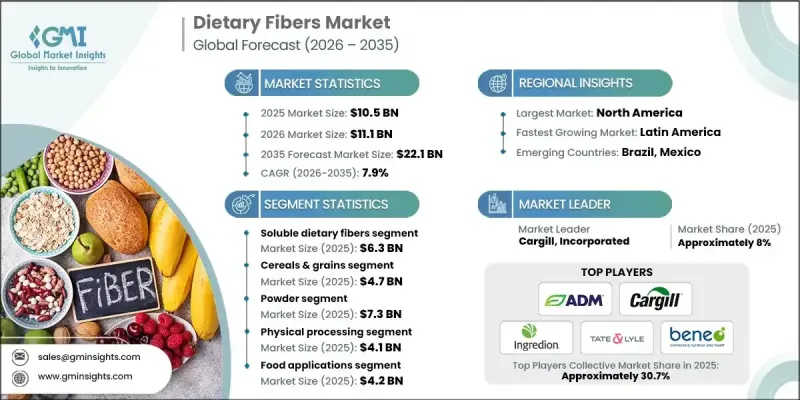
세계의 식이섬유 시장은 2025년에 105억 달러로 평가되었고, 2035년까지 연평균 복합 성장률(CAGR) 7.9%로 성장하여 221억 달러에 이를 것으로 예측됩니다.
이러한 시장 성장은 건강과 웰빙, 특히 장내 환경의 중요성과 전반적인 건강 유지에 대한 소비자의 인식이 높아짐에 따라 뒷받침되고 있습니다. 소비자들은 소화기능 개선과 비만, 당뇨, 심혈관질환 등 생활습관병 및 만성질환 예방법을 적극적으로 모색하고 있습니다. 이러한 예방적 영양에 대한 인식의 변화로 음료 및 식품 제조업체들은 건강을 중시하는 소비자의 요구에 부응하기 위해 식이섬유가 풍부한 제품의 혁신과 생산을 촉진하고 있습니다. 또한 식이섬유를 강화한 기능성 식품, 보충제, 음료에 대한 관심이 높아진 것도 시장의 급속한 확대에 기여하고 있습니다. 소비자들이 체중 관리, 혈당 조절, 만성질환 위험 감소를 위해 식이섬유가 풍부한 식단을 적극적으로 도입하는 경향이 높아지고 있기 때문입니다.
시장 범위
개시 연도
2025년
예측 연도
2026-2035년
개시 연도 시장 규모
105억 달러
예측 금액
221억 달러
CAGR
7.9%
수용성 식이섬유 부문은 2025년 63억 달러 규모에 달할 것으로 예상되며, 2026년부터 2035년까지 8.2%의 연평균 복합 성장률(CAGR)을 보일 것으로 전망됩니다. 수용성 식이섬유는 소화기 건강, 콜레스테롤 관리, 혈당 조절 등의 효능으로 주목받고 있습니다. 예방 영양에 대한 소비자의 관심이 높아지면서 기능성 식품, 음료, 건강보조식품에 수용성 식이섬유가 점점 더 많이 도입되고 있습니다.
곡물 부문은 2025년 47억 달러에 달할 것으로 예상되며, 2026년부터 2035년까지 연평균 8.1%의 성장률을 보일 것으로 예측됩니다. 곡물 유래 식이섬유는 베이커리 제품, 스낵, 음료에 광범위하게 사용되고 있으며, 제조업체는 기능성 영양 요구를 충족하는 다양한 강화 식품을 개발할 수 있습니다. 가공의 다재다능함은 여러 제품 카테고리에 걸쳐 혁신을 촉진하고 있습니다.
북미 식이섬유 시장은 2025년 31억 달러 규모에 달했습니다. 장 건강, 체중 관리, 예방적 영양에 대한 인식이 높아지면서 이 지역의 식이섬유 강화 기능성 식품, 음료, 건강기능식품에 대한 수요가 증가하고 있습니다. 잘 구축된 소매 인프라와 높은 소비자 건강 의식이 시장의 꾸준한 성장을 뒷받침하고 있습니다.
목차
제1장 조사 방법
시장 범위와 정의
조사 설계
조사 접근
데이터 수집 방법
데이터 마이닝 소스
세계
지역별/국가별
기본 추정치와 계산
기준연도 계산
시장 추정 주요 동향
1차 조사와 검증
1차 정보
예측 모델
조사의 전제조건과 제한 사항
제2장 주요 요약
제3장 업계 인사이트
생태계 분석
공급업체 상황
이익률
각 단계별 부가가치
밸류체인에 영향을 미치는 요인
파괴적 변화
업계에 대한 영향요인
성장 촉진요인
업계의 잠재적 리스크&과제
시장 기회
성장 가능성 분석
규제 상황
북미
유럽
아시아태평양
라틴아메리카
중동 및 아프리카
Porter's Five Forces 분석
PESTEL 분석
가격 동향
지역별
제품별
향후 시장 동향
기술과 혁신 동향
현재 기술 동향
신기술
특허 상황
무역 통계(주 : 무역 통계는 주요 국가에 한해 제공됩니다)
주요 수입국
주요 수출국
지속가능성과 환경적 측면
지속가능한 실천
폐기물 감축 전략
생산 에너지 효율
친환경 이니셔티브
탄소발자국에 관한 고려사항
제4장 경쟁 구도
서론
기업의 시장 점유율 분석
지역별
북미
유럽
아시아태평양
라틴아메리카
중동 및 아프리카
기업 매트릭스 분석
주요 시장 기업의 경쟁 분석
경쟁 포지셔닝 매트릭스
주요 발전
인수합병(M&A)
제휴 및 협업
신제품 발매
사업 확대 계획
제5장 시장 추산 및 예측 : 제품 유형별, 2022-2035
주요 동향
수용성 식이섬유
베타글루칸
귀리 베타글루칸
버리 베타글루칸
효모 베타글루칸
버섯 유래 베타글루칸
차전자피
이눌린 및 이눌린형 프럭탄
치커리 뿌리 이눌린
예루살렘 아티초크 이눌린
아가베 이눌린
펙틴
고메톡실 펙틴
저메톡실 펙틴
폴리덱스트로스
프락토올리고당(FOS)
갈락토올리고당(GOS)
내성 말토덱스트린/덱스트린
수용성 옥수수 섬유
구아검
로커스트빈 검
아카시아(아라비아검)
알긴산염
아라비녹실란
글루코만난
불용성 식이섬유
셀룰로오스
미결정 셀룰로오스(MCC)
분말 셀룰로오스
헤미세룰로오스
리그닌
난소화성 전분
RS1(물리적으로 이용 불가능)
RS2(입상 전분)
RS3(재결정화 전분)
RS4(화학적으로 변형된 전분)
RS5(아밀로스-지질 복합체)
키틴 및 키토산
밀기울/곡물기울
옥수수 기울
하이드록시 프로파일 메틸 셀룰로오스(HPMC)
혼합 식물 세포벽 섬유
사탕수수 섬유
사과 섬유
감귤 섬유
제6장 시장 추산 및 예측 : 소스별, 2022-2035
주요 동향
곡물 및 콩류
밀
귀리
버리
옥수수
쌀
호밀
과일 및 채소
감귤류
사과
바나나
근채류(치커리, 감자)
기타 과일(베리류, 구아바)
콩류
콩류
완두콩
렌틸콩
대두
견과류 유형 및 종자류
치아씨드
아마씨
실리염
아몬드
기타 공급원
해조 및 조류(Algae)
버섯류
효모
미생물 유래 및 발효 유래
제7장 시장 추산 및 예측 : 형태별, 2022-2035
주요 동향
분말
미세 분말/초미세 분말
조분
플레이버 분말
언플레이버 분말
액체/겔
액체 농축액
시럽
고형 제형
캡슐
Caplets/Tablets
구미
웨이퍼
편리한 형태
일회용 팩
휴대용 포맷
제8장 시장 추산 및 예측 : 가공 방법별, 2022-2035
주요 동향
물리적 처리
기계적 밀링/연삭
증기 폭발
압출 성형
단축 압출
2축 압출
블러스트 압출
고정수압 처리(HHP)
마이크로파 지원 추출
초미분쇄/초미세 분쇄
고압 균질화(HPH)
화학적 처리
산추출
알칼리 추출
산화
화학적 수식
효소 처리
셀룰라아제 처리
헤미셀룰라아제/자일라나제 처리
펙티나아제 처리
아밀라아제/프로테아제 처리
생물학적/발효 처리
유산균 발효
균류 발효
효모 발효
고체 발효(SSF)
하이브리드/복합 방법
발효 + 미세유동화
효소 + 초음파
압출 + 알칼리 처리
기타
제9장 시장 추산 및 예측 : 용도별, 2022-2035
주요 동향
식품 용도
베이커리
빵 및 롤빵
비스킷 및 쿠키
케이크 및 머핀
페이스트리
아침식사용 시리얼·스낵
즉석 시리얼
핫 시리얼
시리얼 바
영양 바
스낵 크래커
제과
초콜릿
캔디 및 구미
무가당 제과
유제품 및 유제품 대체품
요구르트
아이스크림 및 냉동 디저트
치즈 및 치즈 대체품
액체 우유 및 우유 대체품
식물 유래 유제품 대체품
육류 및 고기 대체품
소시지
가공 육류
식물 유래 고기 대체품
유아용 영양 식품
유아용 조제분유
이유식
유아전용 영양 제품
기타 식품 용도
파스타 및 면류
수프 및 소스류
드레싱 및 조미료
레디밀
음료 용도
기능성 음료
영양 쉐이크
스무디
탄산음료
주스 및 과즙 음료
분말 음료 믹스
의약품 용도
설사약
콜레스테롤 관리
당뇨병 관리
의료용 영양(경장영양/비경구 영양)
식이보충제
소화기 건강보조식품
체중 관리 보충제
프리바이오틱스 보충제
스포츠 영양
동물 영양
반려동물 사료
가축 사료
수산양식
기타 용도
퍼스널케어 및 화장품
생분해성 포장재료
제10장 시장 추산 및 예측 : 지역별, 2022-2035
주요 동향
북미
미국
캐나다
유럽
독일
영국
프랑스
이탈리아
스페인
기타 유럽
아시아태평양
중국
인도
일본
호주
한국
기타 아시아태평양
라틴아메리카
브라질
멕시코
아르헨티나
기타 라틴아메리카
중동 및 아프리카
사우디아라비아
남아프리카공화국
아랍에미리트(UAE)
기타 중동 및 아프리카
제11장 기업 개요
Archer Daniels Midland Company(ADM)
Cargill, Incorporated
Ingredion Incorporated
Tate &Lyle PLC
BENEO GmbH
Sudzucker Group
Roquette Freres
Kerry Group
J. Rettenmaier &Sohne GmbH &Co. KG
SunOpta, Inc.
Taiyo Kagaku Co., Ltd.
Nexira
Fiberstar, Inc.
Emsland Group
AGT Food and Ingredients
Shandong Minqiang Biotechnology Co., Ltd.
Grain Processing Corporation
Tereos Syral
Farbest-Tallman Foods Corporation
Cosucra Groupe Warcoing SA
LSH
영문 목차
영문목차
The Global Dietary Fibers Market was valued at USD 10.5 billion in 2025 and is estimated to grow at a CAGR of 7.9% to reach USD 22.1 billion by 2035.
The market growth is fueled by increasing consumer awareness about health and wellness, particularly the importance of gut health and overall well-being. Consumers are actively seeking ways to improve digestive function and prevent lifestyle-related and chronic diseases such as obesity, diabetes, and cardiovascular disorders. This shift toward preventive nutrition is driving food and beverage manufacturers to innovate and produce fiber-enriched products that meet the demands of health-conscious buyers. The rising interest in functional foods, supplements, and beverages fortified with dietary fibers is also contributing to the market's rapid expansion, as consumers increasingly adopt fiber-rich diets to manage weight, control blood sugar, and reduce the risk of chronic illnesses.
Market Scope
Start Year
2025
Forecast Year
2026-2035
Start Value
$10.5 Billion
Forecast Value
$22.1 Billion
CAGR
7.9%
The soluble dietary fibers segment was valued at USD 6.3 billion in 2025 and is expected to grow at a CAGR of 8.2% from 2026 to 2035. Soluble fibers are gaining traction due to their benefits in digestive health, cholesterol management, and glycemic control. Functional foods, beverages, and dietary supplements are increasingly incorporating soluble fibers as consumer interest in preventive nutrition grows.
The cereals and grains segment reached USD 4.7 billion in 2025 and is projected to grow at a CAGR of 8.1% during 2026-2035. Fibers from cereals and grains are widely used in bakery, snack, and beverage applications, allowing manufacturers to develop a variety of fortified foods that address functional nutrition needs. Their versatility in processing enables innovation across multiple product categories.
North America Dietary Fibers Market accounted for USD 3.1 billion in 2025. Increasing awareness of gut health, weight management, and preventive nutrition is driving the region's demand for fiber-enriched functional foods, beverages, and dietary supplements. A well-established retail infrastructure and high consumer health awareness are supporting steady market growth.
Key players in the Global Dietary Fibers Market include Tate & Lyle PLC, Archer Daniels Midland Company (ADM), Ingredion Incorporated, BENEO GmbH, and Cargill, Incorporated. Companies in the Global Dietary Fibers Market are employing strategies such as investing in research and development to create novel fiber types with enhanced functional properties and health benefits. They are expanding product portfolios to include ready-to-use functional ingredients for food and beverage applications. Strategic partnerships with food manufacturers and ingredient suppliers help broaden market reach, while acquisitions and collaborations strengthen regional presence. Companies are also focusing on consumer education campaigns, marketing fiber-rich solutions for weight management, digestive health, and chronic disease prevention.
Table of Contents
Chapter 1 Methodology
1.1 Market scope and definition
1.2 Research design
1.2.1 Research approach
1.2.2 Data collection methods
1.3 Data mining sources
1.3.1 Global
1.3.2 Regional/Country
1.4 Base estimates and calculations
1.4.1 Base year calculation
1.4.2 Key trends for market estimation
1.5 Primary research and validation
1.5.1 Primary sources
1.6 Forecast model
1.7 Research assumptions and limitations
Chapter 2 Executive Summary
2.1 Industry 360° synopsis
2.2 Key market trends
2.2.1 Regional
2.2.2 Product Type
2.2.3 Source
2.2.4 Form
2.2.5 Processing Method
2.2.6 Application
2.3 TAM Analysis, 2026-2035
2.4 CXO perspectives: Strategic imperatives
2.4.1 Executive decision points
2.4.2 Critical success factors
2.5 Future Outlook and Strategic Recommendations
Chapter 3 Industry Insights
3.1 Industry ecosystem analysis
3.1.1 Supplier Landscape
3.1.2 Profit Margin
3.1.3 Value addition at each stage
3.1.4 Factor affecting the value chain
3.1.5 Disruptions
3.2 Industry impact forces
3.2.1 Growth drivers
3.2.2 Industry pitfalls and challenges
3.2.3 Market opportunities
3.3 Growth potential analysis
3.4 Regulatory landscape
3.4.1 North America
3.4.2 Europe
3.4.3 Asia Pacific
3.4.4 Latin America
3.4.5 Middle East & Africa
3.5 Porter's analysis
3.6 PESTEL analysis
3.7 Price trends
3.7.1 By region
3.7.2 By product
3.8 Future market trends
3.9 Technology and Innovation landscape
3.9.1 Current technological trends
3.9.2 Emerging technologies
3.10 Patent Landscape
3.11 Trade statistics (Note: the trade statistics will be provided for key countries only)
3.11.1 Major importing countries
3.11.2 Major exporting countries
3.12 Sustainability and Environmental Aspects
3.12.1 Sustainable Practices
3.12.2 Waste Reduction Strategies
3.12.3 Energy Efficiency in Production
3.12.4 Eco-friendly Initiatives
3.13 Carbon Footprint Considerations
Chapter 4 Competitive Landscape, 2025
4.1 Introduction
4.2 Company market share analysis
4.2.1 By region
4.2.1.1 North America
4.2.1.2 Europe
4.2.1.3 Asia Pacific
4.2.1.4 LATAM
4.2.1.5 MEA
4.3 Company matrix analysis
4.4 Competitive analysis of major market players
4.5 Competitive positioning matrix
4.6 Key developments
4.6.1 Mergers & acquisitions
4.6.2 Partnerships & collaborations
4.6.3 New Product Launches
4.6.4 Expansion Plans
Chapter 5 Market Estimates and Forecast, By Product Type, 2022 - 2035 (USD Billion, Kilo Tons)
5.1 Key trends
5.2 Soluble Dietary Fibers
5.2.1 Beta-Glucan
5.2.1.1 Oat Beta-Glucan
5.2.1.2 Barley Beta-Glucan
5.2.1.3 Yeast Beta-Glucan
5.2.1.4 Mushroom Beta-Glucan
5.2.2 Psyllium Husk
5.2.3 Inulin & Inulin-Type Fructans
5.2.3.1 Chicory Root Inulin
5.2.3.2 Jerusalem Artichoke Inulin
5.2.3.3 Agave Inulin
5.2.4 Pectin
5.2.4.1 High-Methoxyl Pectin
5.2.4.2 Low-Methoxyl Pectin
5.2.5 Polydextrose
5.2.6 Fructooligosaccharides (FOS)
5.2.7 Galactooligosaccharides (GOS)
5.2.8 Resistant Maltodextrin/Dextrin
5.2.9 Soluble Corn Fiber
5.2.10 Guar Gum
5.2.11 Locust Bean Gum
5.2.12 Acacia (Gum Arabic)
5.2.13 Alginate
5.2.14 Arabinoxylan
5.2.15 Glucomannan
5.3 Insoluble Dietary Fibers
5.3.1 Cellulose
5.3.1.1 Microcrystalline Cellulose (MCC)
5.3.1.2 Powdered Cellulose
5.3.2 Hemicellulose
5.3.3 Lignin
5.3.4 Resistant Starch
5.3.4.1 RS1 (Physically Inaccessible)
5.3.4.2 RS2 (Granular Starch)
5.3.4.3 RS3 (Retrograded Starch)
5.3.4.4 RS4 (Chemically Modified)
5.3.4.5 RS5 (Amylose-Lipid Complex)
5.3.5 Chitin & Chitosan
5.3.6 Wheat Bran/Cereal Bran
5.3.7 Corn Bran
5.3.8 Hydroxypropylmethylcellulose (HPMC)
5.3.9 Mixed Plant Cell Wall Fibers
5.3.9.1 Sugar Cane Fiber
5.3.9.2 Apple Fiber
5.3.9.3 Citrus Fiber
Chapter 6 Market Estimates and Forecast, By Source, 2022 - 2035 (USD Billion, Kilo Tons)
6.1 Key trends
6.2 Cereals & Grains
6.2.1 Wheat
6.2.2 Oats
6.2.3 Barley
6.2.4 Corn
6.2.5 Rice
6.2.6 Rye
6.3 Fruits & Vegetables
6.3.1 Citrus
6.3.2 Apple
6.3.3 Banana
6.3.4 Root Vegetables (Chicory, Potato)
6.3.5 Other Fruits (Berries, Guava)
6.4 Legumes
6.4.1 Beans
6.4.2 Peas
6.4.3 Lentils
6.4.4 Soybeans
6.5 Nuts & Seeds
6.5.1 Chia Seeds
6.5.2 Flaxseed
6.5.3 Psyllium
6.5.4 Almonds
6.6 Other Sources
6.6.1 Seaweed/Algae
6.6.2 Fungi/Mushrooms
6.6.3 Yeast
6.6.4 Microbial/Fermentation-Derived
Chapter 7 Market Estimates and Forecast, By Form, 2022 - 2035 (USD Billion, Kilo Tons)
7.1 Key trends
7.2 Powder
7.2.1 Fine/Ultrafine Powder
7.2.2 Coarse Powder
7.2.3 Flavored Powder
7.2.4 Unflavored Powder
7.3 Liquid/Gel
7.3.1 Liquid Concentrate
7.3.2 Syrup
7.4 Solid Dosage Forms
7.4.1 Capsules
7.4.2 Caplets/Tablets
7.4.3 Gummies
7.4.4 Wafers
7.5 Convenience Formats
7.5.1 Single-Serve Packets
7.5.2 On-the-Go Formats
Chapter 8 Market Estimates and Forecast, By Processing Method, 2022 - 2035 (USD Billion, Kilo Tons)
8.1 Key trends
8.2 Physical Processing
8.2.1 Mechanical Milling/Grinding
8.2.2 Steam Explosion
8.2.3 Extrusion
8.2.3.1 Single-Screw Extrusion
8.2.3.2 Twin-Screw Extrusion
8.2.3.3 Blasting Extrusion
8.2.4 High Hydrostatic Pressure (HHP)
8.2.5 Microwave-Assisted Extraction
8.2.6 Ultrafine/Superfine Grinding
8.2.7 High-Pressure Homogenization (HPH)
8.3 Chemical Processing
8.3.1 Acid Extraction
8.3.2 Alkaline Extraction
8.3.3 Oxidation
8.3.4 Chemical Modification
8.4 Enzymatic Processing
8.4.1 Cellulase Treatment
8.4.2 Hemicellulase/Xylanase Treatment
8.4.3 Pectinase Treatment
8.4.4 Amylase/Protease Treatment
8.5 Biological/Fermentation Processing
8.5.1 Lactic Acid Bacteria Fermentation
8.5.2 Fungal Fermentation
8.5.3 Yeast Fermentation
8.5.4 Solid-State Fermentation (SSF)
8.6 Hybrid/Combined Methods
8.6.1 Fermentation + Microfluidization
8.6.2 Enzymatic + Ultrasound
8.6.3 Extrusion + Alkaline Treatment
8.7 Others
Chapter 9 Market Estimates and Forecast, By Application, 2022 - 2035 (USD Billion, Kilo Tons)
9.1 Key trends
9.2 Food Applications
9.2.1 Bakery
9.2.1.1 Bread & Rolls
9.2.1.2 Biscuits & Cookies
9.2.1.3 Cakes & Muffins
9.2.1.4 Pastries
9.2.2 Breakfast Cereals & Snacks
9.2.2.1 Ready-to-Eat Cereals
9.2.2.2 Hot Cereals
9.2.2.3 Cereal Bars
9.2.2.4 Nutrition Bars
9.2.2.5 Snack Crackers
9.2.3 Confectionery
9.2.3.1 Chocolate
9.2.3.2 Candies & Gummies
9.2.3.3 Sugar-Free Confectionery
9.2.4 Dairy & Dairy Alternatives
9.2.4.1 Yogurt
9.2.4.2 Ice Cream & Frozen Desserts
9.2.4.3 Cheese & Cheese Alternatives
9.2.4.4 Fluid Milk & Milk Alternatives
9.2.4.5 Plant-Based Dairy Alternatives
9.2.5 Meat & Meat Alternatives
9.2.5.1 Sausages
9.2.5.2 Processed Meat Products
9.2.5.3 Plant-Based Meat Alternatives
9.2.6 Infant & Toddler Nutrition
9.2.6.1 Infant Formula
9.2.6.2 Baby Food
9.2.6.3 Toddler Nutrition Products
9.2.7 Other Food Applications
9.2.7.1 Pasta & Noodles
9.2.7.2 Soups & Sauces
9.2.7.3 Dressings & Condiments
9.2.7.4 Ready Meals
9.3 Beverage Applications
9.3.1 Functional Beverages
9.3.2 Nutrition Shakes
9.3.3 Smoothies
9.3.4 Carbonated Beverages
9.3.5 Juice & Juice Drinks
9.3.6 Powdered Beverage Mixes
9.4 Pharmaceutical Applications
9.4.1 Laxatives
9.4.2 Cholesterol Management
9.4.3 Diabetes Management
9.4.4 Medical Nutrition (Enteral/Parenteral)
9.5 Dietary Supplements
9.5.1 Digestive Health Supplements
9.5.2 Weight Management Supplements
9.5.3 Prebiotic Supplements
9.5.4 Sports Nutrition
9.6 Animal Nutrition
9.6.1 Companion Animal (Pet Food)
9.6.2 Livestock Feed
9.6.3 Aquaculture
9.7 Other Applications
9.7.1 Personal Care & Cosmetics
9.7.2 Biodegradable Packaging Materials
Chapter 10 Market Estimates and Forecast, By Region, 2022 - 2035 (USD Billion, Kilo Tons)