


세계 화학 보일러 시장은 2024년 29억 달러에 달했으며, 2025년부터 2034년까지 CAGR 3.6%의 꾸준한 성장이 예상됩니다.
이러한 확장에는 산업 인프라의 지속적인 발전, 에너지 절약 이니셔티브의 증가, 다양한 부문에서 보다 효율적인 난방 기술에 대한 수요 증가가 기여하고 있습니다. 전 세계 산업계가 지속가능성에 대한 관심이 높아짐에 따라 세계 환경 목표에 부합하는 저배출 난방 시스템으로의 전환이 두드러지게 나타나고 있습니다. 노후화된 기존 시스템을 최신의 효율적인 모델로 교체해야 할 필요성이 화학 보일러의 채택을 더욱 촉진하고 있습니다. 산업계가 환경에 미치는 영향에 대한 인식이 높아짐에 따라 에너지 효율 및 탄소 배출과 관련된 엄격한 정부 규제를 충족하는 보일러에 대한 수요가 증가하고 있습니다.
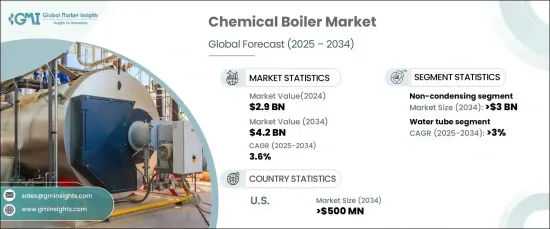
비응축식 화학 보일러 분야는 2034년까지 30억 달러를 넘어설 것으로 예상됩니다. 화학 부문의 성장과 함께 온실가스 배출을 줄여야 한다는 정부의 압력이 높아지면서 이러한 유형의 보일러에 대한 수요가 증폭되고 있습니다. 비응축식 화학 보일러는 스마트 제어 및 원격 모니터링과 같은 기능 향상으로 인해 인기가 높아지고 있습니다. 이러한 개선으로 비응축 보일러는 고성능, 저배출 가스 난방 솔루션이 필요한 현대 산업 응용 분야에 필수적인 구성요소로 자리 잡았습니다. 이러한 첨단 기술을 채택하는 산업이 늘어남에 따라 이 분야는 크게 확대될 것으로 예상됩니다.
| 시장 범위 | |
|---|---|
| 시작 연도 | 2024년 |
| 예측 연도 | 2025-2034년 |
| 시작 금액 | 29억 달러 |
| 예상 금액 | 42억 달러 |
| CAGR | 3.6% |
수관식 화학 보일러 시장은 2034년까지 3%의 CAGR로 안정적인 성장세를 보일 것으로 예상됩니다. 에너지 효율은 계속해서 가장 중요한 이슈이며, 제조업체들은 열 전달을 극대화하고 에너지 손실을 최소화하는 혁신적인 설계에 집중하고 있습니다. 단열 성능 향상, 첨단 연소 시스템, 열 회수 솔루션과 같은 기술 발전은 수관식 화학 보일러의 채택에 새로운 기회를 열어주며 상황을 변화시키고 있습니다. 산업계가 운영 효율을 개선하고 에너지 비용을 절감하기 위해 노력하는 가운데, 수관식 화학 보일러 시장은 견조한 성장이 예상됩니다.
미국 내 화학 보일러 시장은 2034년까지 5억 달러 규모의 시장을 형성할 것으로 예상됩니다. 이러한 성장의 원동력은 환경 의식의 증가와 각 주에서 시행되고 있는 엄격한 배출 규제에 기인합니다. 법률이 더 엄격한 기준을 채택함에 따라 저배출 및 초저배출 보일러 시스템에 대한 수요가 급증하고 있으며, IoT 지원 제어와 같은 스마트 기술의 통합은 화학 보일러의 운영 효율성과 신뢰성을 더욱 향상시켜 국가 에너지 및 환경 목표를 달성하는 데 필수적인 요소로 작용하고 있습니다.
아시아태평양에서는 화학 산업의 호황과 노후화된 인프라를 현대화하려는 노력으로 화학 보일러 시장이 급성장하고 있습니다. 각국 정부는 지속가능한 에너지 솔루션에 중점을 두고 청정 대체 연료의 채택을 장려하고 있습니다. 또한, 친환경 바이오 기반 화학 공정에 대한 연구 개발도 시장 확대에 기여하고 있습니다. 그 결과, 이 지역은 세계 화학 보일러 시장에서 중요한 역할을 할 것이며, 보다 지속가능하고 효율적인 난방 솔루션으로 전환하는 데 있어 선두주자로 자리매김할 것으로 예상됩니다.
The Global Chemical Boiler Market reached USD 2.9 billion in 2024 and is expected to experience steady growth, with a projected CAGR of 3.6% from 2025 to 2034. This expansion is fueled by ongoing advancements in industrial infrastructure, growing energy-saving initiatives, and the rising demand for more efficient heating technologies across various sectors. As industries worldwide increasingly focus on sustainability, there is a notable shift toward low-emission heating systems that align with global environmental goals. The need to replace outdated, conventional systems with modern, more efficient models is further driving the adoption of chemical boilers. With industries becoming more conscious of their environmental impact, the demand for boilers that meet stringent government regulations related to energy efficiency and carbon emissions is intensifying.
The non-condensing chemical boiler segment is expected to surpass USD 3 billion by 2034. The chemical sector's growth, paired with rising government pressure to reduce greenhouse gas emissions, is amplifying the need for these types of boilers. Non-condensing chemical boilers are becoming more popular due to their enhanced functionality, driven by features like smart controls and remote monitoring. These improvements are making non-condensing boilers a vital component in modern industrial applications, where high-performance, low-emission heating solutions are in demand. As more industries embrace these advanced technologies, the segment is set to see significant expansion.
| Market Scope | |
|---|---|
| Start Year | 2024 |
| Forecast Year | 2025-2034 |
| Start Value | $2.9 Billion |
| Forecast Value | $4.2 Billion |
| CAGR | 3.6% |
The water tube chemical boiler market is predicted to grow at a steady pace, registering a CAGR of 3% through 2034. Energy efficiency continues to be a top priority, with manufacturers focusing on innovative designs that maximize heat transfer and minimize energy losses. Technological advancements, such as improved insulation, advanced combustion systems, and heat recovery solutions, are reshaping the landscape, opening up new opportunities for the adoption of water tube chemical boilers. As industries seek ways to improve operational efficiency and lower energy costs, the market for these boilers is expected to grow steadily.
In the U.S., the chemical boiler market is poised to generate USD 500 million by 2034. This growth is driven by increasing environmental awareness, as well as the implementation of stricter emission regulations across various states. As lawmakers adopt more stringent standards, the demand for low-emission and ultra-low-emission boiler systems is growing rapidly. The integration of smart technologies, such as IoT-enabled controls, is further enhancing the operational efficiency and reliability of chemical boilers, making them an essential component in meeting the nation's energy and environmental goals.
In the Asia Pacific region, the chemical boiler market is experiencing rapid expansion, driven by the region's booming chemical industry and efforts to modernize aging infrastructure. Governments are emphasizing sustainable energy solutions and encouraging the adoption of cleaner fuel alternatives. Research and development in eco-friendly, bio-based chemical processes are also contributing to market growth. As a result, the region is set to play a key role in the global chemical boiler market, positioning itself as a leader in the transition to more sustainable and efficient heating solutions.