유전체학용 AI 시장(-2040년) : 컴포넌트 유형별, 기술 유형별, 기능성 유형별, 용도 유형별, 최종 사용자 유형별, 기업 규모별, 주요 지역별, 산업 동향 및 예측
AI in Genomics Market, till 2040: Distribution by Type of Component, Type of Technology, Type of Functionality, Type of Application, Type of End User, Company Size and Key Geographical Regions: Industry Trends and Global Forecasts
상품코드:1919788
리서치사:Roots Analysis
발행일:On Demand Report
페이지 정보:영문 165 Pages
라이선스 & 가격 (부가세 별도)
한글목차
유전체학용 AI 시장 전망
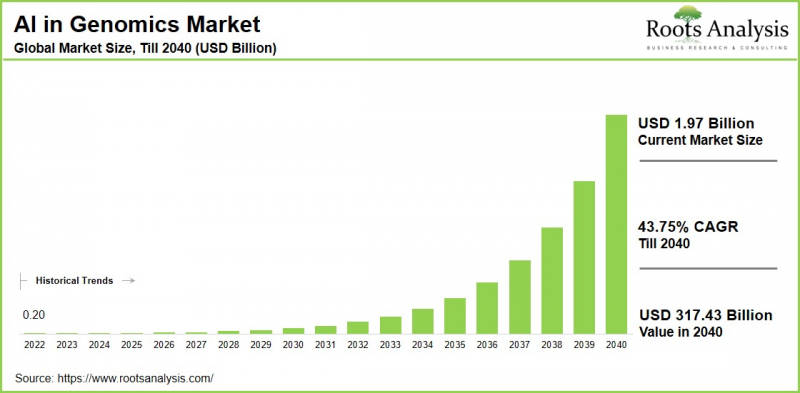
세계의 유전체학용 AI 시장 규모는 현재 19억 7,000만 달러에서 2040년까지 3,174억 달러로 성장할 것으로 추정되며, 2040년까지 예측 기간 중 CAGR 43.75%의 성장이 전망되고 있습니다.
인공지능은 DNA 시퀀싱에서 얻은 엄청난 데이터 세트를 처리하고 기존 기술에서 간과되었던 지식을 밝혀 유전체학 분야를 변화시키고 있습니다. 차세대 시퀀싱과 같은 첨단 기술은 광범위한 유전 데이터를 생성합니다. 머신러닝 및 심층 학습과 같은 AI 용도는 질병 위험 예측, 단백질 구조 결정, 유전자 발현 분석, 맞춤형 의료에 사용되는 멀티오믹스 정보의 통합에 탁월합니다. 이를 통해 신속한 의약품, CRISPR을 통한 정확한 유전자 편집 및 개인의 유전 설계도에 맞게 맞춤화된 치료가 촉진됩니다.
차세대 시퀀싱 기술에 의한 유전체 데이터 급증은 기존의 분석법을 능가하고 AI의 패턴 인식 능력을 필요로 하기 때문에 유전체학용 AI 시장은 대폭적인 성장이 예상됩니다.
고위 경영진에 대한 전략적 지식
신약과 유전체 연구에서 AI의 변혁적 역할
인공지능은 효율성, 정확성 및 의사 결정 향상을 통해 창약과 유전체 연구의 혁신에서 변혁적인 역할을 수행합니다. 전통적으로 의약품 개발은 장기적이고 비용이 많이 드는 과정이었으며 종종 수년과 많은 투자가 필요했습니다. 하지만 AI 구동 도구를 사용하면 엄청난 바이오메디컬 데이터 세트를 신속하게 분석할 수 있습니다. 의약품에서 AI 알고리즘은 분자간 상호작용 예측, 리드 화합물 최적화, 보다 정밀한 잠재적 약물 후보 식별을 실현합니다.
유전체 연구에서는 AI가 복잡한 유전체 데이터의 해석을 촉진하여 질병 관련 유전자의 식별과 약물 반응에 영향을 미치는 유전적 변이의 이해를 가능하게 하고 있습니다. 이러한 진보는 표적 치료와 맞춤형 의료의 개발을 가속화하고 있습니다. 또한 AI의 응용은 환자 선택의 개선과 치료 결과의 예측을 통해 보다 효율적인 임상시험 설계를 지원합니다. 전반적으로, AI의 의약품과 유전체 연구 통합은 의료 상황을 재구성하고 혁신을 촉진하고 정밀의료로의 세계적인 전환을 추진하고 있습니다.
유전체학용 AI 시장 주요 성장 촉진요인
유전체학용 AI 시장의 성장은 유전체 연구와 의약품의 효율성과 정확성을 높이는 여러 요인에 의해 촉진되고 있습니다. 차세대 시퀀싱 기술에 의해 생성되는 유전체 데이터의 급격한 증가는 복잡한 데이터 세트를 관리하고 분석할 수 있는 AI 기반 툴에 대한 강한 수요를 창출하고 있습니다. 머신러닝 알고리즘은 유전적 패턴의 신속한 식별, 질병 예측 및 약물 표적의 발견을 가능하게 함으로써 연구 개발의 비용과 시간을 크게 줄여줍니다.
개인화 의료에 대한 관심의 확대도 큰 촉진요인이며, 인공지능은 개별 유전자 프로파일의 해석을 지원하고 표적을 좁힌보다 효과적인 치료 전략을 개발할 수 있습니다. 게다가 계산비용 저하와 데이터 처리 인프라의 진보로 AI 기술의 보급이 진행되고 있습니다. 주요 기술 기업으로부터 다액의 투자와, 제약 및 바이오테크놀러지 기업과 AI 기업의 연계 강화가 이 분야의 혁신을 더욱 가속화하고 있습니다.
정밀 의료에서 AI의 새로운 용도
AI는 데이터를 통한 의료 개인화를 실현함으로써 정밀의료에서 중요한 진보를 촉진하고 있습니다. 정밀의료는 개인의 유전자 프로파일, 생활 습관, 환경 요인에 따라 진단 및 치료 전략을 개별화하는 것입니다. AI 기술은 유전체 시퀀싱, 전자 건강 기록, 의료 이미지, 웨어러블 디바이스 등에서 얻은 대규모 데이터를 효율적으로 처리 및 해석함으로써 이 접근법을 지원합니다. 머신러닝 알고리즘을 통해 AI는 복잡한 패턴과 상관관계를 밝히고 조기 질환 발견 지침을 제공하고 치료 반응을 예측하며 표적 치료 계획을 수립할 수 있도록 지원합니다. 예를 들어, 종양학에서 AI 모델은 종양 거동 예측, 약물 선택 최적화, 개인화 치료법의 설계에 활용됩니다. 또한 AI는 변이체의 해석 정밀도 향상과 임상적으로 유용한 바이오마커의 식별에 의해 유전체 데이터의 분석을 가속화합니다. 또한 방사선학이나 병리학에서의 화상 해석 기술을 통해 진단 정밀도를 높입니다. 이러한 용도로 AI는 정밀의료의 중요한 인에이블러가 되어 임상 판단의 개선, 시행착오에 의한 치료의 삭감, 궁극적으로는 환자의 치료 성과 향상에 기여하고 있습니다.
이 보고서는 세계의 유전체학용 AI 시장을 조사했으며, 시장 규모 추계와 기회 분석, 경쟁 구도, 기업 프로파일 등의 정보를 제공합니다.
목차
섹션 1 보고서 개요
제1장 서문
제2장 조사 방법
제3장 시장 역학
제4장 거시경제 지표
섹션 2 질적 지식
제5장 주요 요약
제6장 소개
제7장 규제 시나리오
섹션 3 시장 개요
제8장 주요 기업의 종합적인 데이터베이스
제9장 경쟁 구도
제10장 화이트 스페이스 분석
제11장 기업의 경쟁력 분석
제12장 유전체학용 AI 시장에서의 스타트업 에코시스템
섹션 4 기업 프로파일
제13장 기업 프로파일
장 개요
23andMe
Cradle Bio
Deep Genomics
DNAnexus
DNAnexus
Fabric Genomics
Gencove
Google DeepMind
IBM Watson Health
Immunai
Recursion Pharmaceuticals
Sophia Genetics
Tempus AI
Zebra Medical Vision
섹션 5 시장 동향
제14장 메가트렌드 분석
제15장 특허 분석
제16장 최근의 발전
섹션 6 시장 기회 분석
제17장 세계의 유전체학용 AI 시장
제18장 시장 기회 : 컴포넌트 유형별
제19장 시장 기회 : 기술 유형별
제20장 시장 기회 : 기능성 유형별
제21장 시장 기회 : 용도 유형별
제22장 시장 기회 : 최종 사용자 유형별
제23장 북미의 유전체학용 AI 시장 기회
제24장 유럽의 유전체학용 AI 시장 기회
제25장 아시아의 유전체학용 AI 시장 기회
제26장 중동 및 북아프리카(MENA)의 유전체학용 AI 시장 기회
제27장 라틴아메리카의 유전체학용 AI 시장 기회
제28장 기타 지역의 유전체학용 AI 시장 기회
제29장 시장 집중 분석 : 주요 기업별
제30장 인접 시장 분석
섹션 7 전략적 도구
제31장 중요한 성공 전략
제32장 Porter's Five Forces 분석
제33장 SWOT 분석
제34장 Roots의 전략적 제안
섹션 8 기타 독점적 발견
제35장 1차 조사의 인사이트
제36장 보고서 결론
섹션 9 부록
JHS
영문 목차
영문목차
Ai in Genomics Market Outlook
As per Roots Analysis, the global AI in genomics market size is estimated to grow from USD 1.97 billion in the current year to USD 317.4 billion by 2040, at a CAGR of 43.75% during the forecast period, till 2040. The new study provides market size, growth scenarios, industry trend and future forecast.
Artificial intelligence is transforming the field of genomics by processing huge datasets from DNA sequencing to reveal insights that conventional techniques overlook. Advanced technologies like next-generation sequencing produce extensive genetic data. AI applications such as machine learning and deep learning are proficient at forecasting disease risks, determining protein structures, analyzing gene expressions, and synthesizing multi-omics information for personalized medicine. This fosters quicker drug discovery, accurate genome editing through CRISPR, and customized treatments tailored to individual genetic blueprints.
The market for AI in genomics is expected to grow significantly due to the massive increase in genomic data from next-generation sequencing technologies, which outpaces traditional analysis methods and requires AI's pattern recognition capabilities.
Strategic Insights for Senior Leaders
Transformative Role of Artificial Intelligence in Drug Discovery and Genomic Research
Artificial Intelligence (AI) is playing a transformative role in revolutionizing drug discovery and genomic research by enhancing efficiency, accuracy, and decision-making. Traditionally, drug development has been a lengthy and costly process, often taking several years and substantial investment; however, AI-driven tools now enable rapid analysis of vast biomedical datasets. In drug discovery, AI algorithms can predict molecular interactions, optimize lead compounds, and identify potential drug candidates with higher precision.
Within genomic research, AI facilitates the interpretation of complex genomic data, enabling the identification of disease-associated genes and the understanding of genetic variations influencing drug response. These advancements are accelerating the development of targeted and personalized therapies. Furthermore, AI applications support the design of more efficient clinical trials by improving patient selection and predicting therapeutic outcomes. Overall, the integration of AI into drug discovery and genomics is reshaping the healthcare landscape, expediting innovation, and advancing the global shift toward precision medicine.
Key Drivers Propelling Growth of AI in genomics Market
The growth of artificial intelligence (AI) in genomics market is being driven by several key factors enhancing the efficiency and accuracy of genomic research and drug discovery. The rapid increase in genomic data generated by next-generation sequencing technologies has created a strong demand for AI-based tools capable of managing and analyzing complex datasets. Machine learning algorithms are enabling faster identification of genetic patterns, disease prediction, and drug target discovery, thereby significantly reducing both cost and time in research and development.
The expanding focus on personalized medicine is another major driver, as AI supports the interpretation of individual genetic profiles to develop targeted and more effective treatment strategies. Additionally, decreasing computational costs, coupled with advancements in data processing infrastructure, have made AI technologies more accessible. Substantial investments from major technology companies and growing collaborations between pharmaceutical, biotechnology, and AI firms are further accelerating innovation in this field.
Emerging Applications of Artificial Intelligence in Precision Medicine
Artificial Intelligence (AI) is driving significant advancements in precision medicine by enabling data-driven personalization of healthcare. Precision medicine aims to tailor diagnosis and treatment strategies based on an individual's genetic profile, lifestyle, and environmental factors. AI technologies facilitate this approach by efficiently processing and interpreting large-scale data from genomic sequencing, electronic health records, medical imaging, and wearable devices. Through machine learning algorithms, AI can uncover complex patterns and correlations that inform early disease detection, predict therapeutic responses, and assist in developing targeted treatment plans. In oncology, for instance, AI models are being utilized to predict tumor behavior, optimize drug selection, and design personalized interventions. Furthermore, AI accelerates genomic data analysis by improving variant interpretation and identifying clinically relevant biomarkers. It also enhances diagnostic accuracy through image-based analytics in radiology and pathology. Collectively, these applications position AI as a key enabler of precision medicine, improving clinical decision-making, reducing trial-and-error treatments, and ultimately enhancing patient outcomes.
AI in genomics Evolution: Emerging Trends in the Industry
Artificial intelligence is revolutionizing genomics by making it faster and more accurate to analyze large genetic datasets. One major trend is multi-omics integration, where AI combines data from genomics, proteomics, and other biological sources to better understand how genes influence diseases and to identify new drug targets. Generative AI models, such as those that predict protein structures or create synthetic gene sequences, help scientists design new therapies and speed up drug discovery. Another growing area is AI-powered CRISPR, where advanced algorithms like CRISPR-GPT make gene editing safer and more precise by predicting and avoiding unwanted effects. Overall, AI is enabling more personalized treatments, improving disease prediction, and transforming how genetic research is done.
Key Market Challenges
The AI in genomics market faces several critical challenges that hinder its full-scale adoption. These include data quality and standardization issues, as genomic datasets often originate from heterogeneous sources, leading to inconsistencies and biases in model performance. Data privacy and compliance with stringent regulations, such as GDPR and HIPAA remain significant concerns due to the sensitive nature of genetic information. Additionally, the high computational costs, limited availability of skilled AI professionals, and the lack of model interpretability ("black box" problem) restrict clinical trust and integration. Collectively, these barriers continue to slow commercialization despite strong market potential.
AI In Genomics Market: Key Market Segmentation
Type of Component
Hardware
Software
Services
Type of Technology
Machine Learning
Computer Vision
Natural Language Processing
Others
Type of Functionality
Genome Sequencing
Gene Editing
Clinical Workflow Analysis
Predictive Genetic Testing
Others
Type of Application
Drug Discovery & Development
Precision Medicine
Diagnostics / Prognostics
Agriculture / Animal Genetics
Others
Type of End-User
Pharmaceutical & Biotechnology Companies
Healthcare Providers / Hospitals
Research & Academia / Government
CROs
Others
Geographical Regions
North America
US
Canada
Mexico
Other North American countries
Europe
Austria
Belgium
Denmark
France
Germany
Ireland
Italy
Netherlands
Norway
Russia
Spain
Sweden
Switzerland
UK
Other European countries
Asia
China
India
Japan
Singapore
South Korea
Other Asian countries
Latin America
Brazil
Chile
Colombia
Venezuela
Other Latin American countries
Middle East and North Africa
Egypt
Iran
Iraq
Israel
Kuwait
Saudi Arabia
UAE
Other MENA countries
Rest of the World
Australia
New Zealand
Other countries
Example Players in AI in Genomics Market
23andMe
Cradle Bio
Deep Genomics
DNAnexus
Fabric Genomics
Gencove
Google DeepMind
IBM Watson Health
Illumina
Immunai
Lila Sciences
Owkin
Recursion Pharmaceuticals
Sophia Genetics
Tempus AI
AI In Genomics Market: Report Coverage
The report on the Ai in genomics market features insights on various sections, including:
Market Sizing and Opportunity Analysis: An in-depth analysis of the AI in genomics market, focusing on key market segments, including [A] type of component, [B] type of technology, [C] type of functionality, [D] type of application, [E] type of end user, [F] company size, and [G] key geographical regions
Competitive Landscape: A comprehensive analysis of the companies engaged in the AI in genomics market, based on several relevant parameters, such as [A] year of establishment, [B] company size, [C] location of headquarters and [D] ownership structure.
Company Profiles: Elaborate profiles of prominent players engaged in the AI in genomics market, providing details on [A] location of headquarters, [B] company size, [C] company mission, [D] company footprint, [E] management team, [F] contact details, [G] financial information, [H] operating business segments, [I] portfolio, [J] recent developments, and an informed future outlook.
Megatrends: An evaluation of ongoing megatrends in the Ai in genomics industry.
Patent Analysis: An insightful analysis of patents filed / granted in the AI in genomics domain, based on relevant parameters, including [A] type of patent, [B] patent publication year, [C] patent age and [D] leading players.
Recent Developments: An overview of the recent developments made in the AI in genomics market, along with analysis based on relevant parameters, including [A] year of initiative, [B] type of initiative, [C] geographical distribution and [D] most active players.
Porter's Five Forces Analysis: An analysis of five competitive forces prevailing in the AI in genomics market, including threats of new entrants, bargaining power of buyers, bargaining power of suppliers, threats of substitute products and rivalry among existing competitors.
SWOT Analysis: An insightful SWOT framework, highlighting the strengths, weaknesses, opportunities and threats in the domain. Additionally, it provides Harvey ball analysis, highlighting the relative impact of each SWOT parameter.
Key Questions Answered in this Report
What is the current and future market size?
Who are the leading companies in this market?
What are the growth drivers that are likely to influence the evolution of this market?
What are the key partnership and funding trends shaping this industry?
Which region is likely to grow at higher CAGR till 2040?
How is the current and future market opportunity likely to be distributed across key market segments?
Reasons to Buy this Report
Detailed Market Analysis: The report provides a comprehensive market analysis, offering detailed revenue projections of the overall market and its specific sub-segments. This information is valuable to both established market leaders and emerging entrants.
In-depth Analysis of Trends: Stakeholders can leverage the report to gain a deeper understanding of the competitive dynamics within the market. Each report maps ecosystem activity across partnerships, funding, and patent landscapes to reveal growth hotspots and white spaces in the industry.
Opinion of Industry Experts: The report features extensive interviews and surveys with key opinion leaders and industry experts to validate market trends mentioned in the report.
Decision-ready Deliverables: The report offers stakeholders with strategic frameworks (Porter's Five Forces, value chain, SWOT), and complimentary Excel / slide packs with customization support.
Additional Benefits
Complimentary Dynamic Excel Dashboards for Analytical Modules
Exclusive 15% Free Content Customization
Personalized Interactive Report Walkthrough with Our Expert Research Team
Free Report Updates for Versions Older than 6-12 Months
TABLE OF CONTENTS
SECTION I: REPORT OVERVIEW
1. PREFACE
1.1. Introduction
1.2. Market Share Insights
1.3. Key Market Insights
1.4. Report Coverage
1.5. Key Questions Answered
1.6. Chapter Outlines
2. RESEARCH METHODOLOGY
2.1. Chapter Overview
2.2. Research Assumptions
2.3. Database Building
2.3.1. Data Collection
2.3.2. Data Validation
2.3.3. Data Analysis
2.4. Project Methodology
2.4.1. Secondary Research
2.4.1.1. Annual Reports
2.4.1.2. Academic Research Papers
2.4.1.3. Company Websites
2.4.1.4. Investor Presentations
2.4.1.5. Regulatory Filings
2.4.1.6. White Papers
2.4.1.7. Industry Publications
2.4.1.8. Conferences and Seminars
2.4.1.9. Government Portals
2.4.1.10. Media and Press Releases
2.4.1.11. Newsletters
2.4.1.12. Industry Databases
2.4.1.13. Roots Proprietary Databases
2.4.1.14. Paid Databases and Sources
2.4.1.15. Social Media Portals
2.4.1.16. Other Secondary Sources
2.4.2. Primary Research
2.4.2.1. Introduction
2.4.2.2. Types
2.4.2.2.1. Qualitative
2.4.2.2.2. Quantitative
2.4.2.3. Advantages
2.4.2.4. Techniques
2.4.2.4.1. Interviews
2.4.2.4.2. Surveys
2.4.2.4.3. Focus Groups
2.4.2.4.4. Observational Research
2.4.2.4.5. Social Media Interactions
2.4.2.5. Stakeholders
2.4.2.5.1. Company Executives (CXOs)
2.4.2.5.2. Board of Directors
2.4.2.5.3. Company Presidents and Vice Presidents
2.4.2.5.4. Key Opinion Leaders
2.4.2.5.5. Research and Development Heads
2.4.2.5.6. Technical Experts
2.4.2.5.7. Subject Matter Experts
2.4.2.5.8. Scientists
2.4.2.5.9. Doctors and Other Healthcare Providers
2.4.2.6. Ethics and Integrity
2.4.2.6.1. Research Ethics
2.4.2.6.2. Data Integrity
2.4.3. Analytical Tools and Databases
3. MARKET DYNAMICS
3.1. Forecast Methodology
3.1.1. Top-Down Approach
3.1.2. Bottom-Up Approach
3.1.3. Hybrid Approach
3.2. Market Assessment Framework
3.2.1. Total Addressable Market (TAM)
3.2.2. Serviceable Addressable Market (SAM)
3.2.3. Serviceable Obtainable Market (SOM)
3.2.4. Currently Acquired Market (CAM)
3.3. Forecasting Tools and Techniques
3.3.1. Qualitative Forecasting
3.3.2. Correlation
3.3.3. Regression
3.3.4. Time Series Analysis
3.3.5. Extrapolation
3.3.6. Convergence
3.3.7. Forecast Error Analysis
3.3.8. Data Visualization
3.3.9. Scenario Planning
3.3.10. Sensitivity Analysis
3.4. Key Considerations
3.4.1. Demographics
3.4.2. Market Access
3.4.3. Reimbursement Scenarios
3.4.4. Industry Consolidation
3.5. Robust Quality Control
3.6. Key Market Segmentations
3.7. Limitations
4. MACRO-ECONOMIC INDICATORS
4.1. Chapter Overview
4.2. Market Dynamics
4.2.1. Time Period
4.2.1.1. Historical Trends
4.2.1.2. Current and Forecasted Estimates
4.2.2. Currency Coverage
4.2.2.1. Overview of Major Currencies Affecting the Market
4.2.2.2. Impact of Currency Fluctuations on the Industry
4.2.3. Foreign Exchange Impact
4.2.3.1. Evaluation of Foreign Exchange Rates and Their Impact on Market
4.2.3.2. Strategies for Mitigating Foreign Exchange Risk
4.2.4. Recession
4.2.4.1. Historical Analysis of Past Recessions and Lessons Learnt
4.2.4.2. Assessment of Current Economic Conditions and Potential Impact on the Market
4.2.5. Inflation
4.2.5.1. Measurement and Analysis of Inflationary Pressures in the Economy
4.2.5.2. Potential Impact of Inflation on the Market Evolution
4.2.6. Interest Rates
4.2.6.1. Overview of Interest Rates and Their Impact on the Market
4.2.6.2. Strategies for Managing Interest Rate Risk
4.2.7. Commodity Flow Analysis
4.2.7.1. Type of Commodity
4.2.7.2. Origins and Destinations
4.2.7.3. Values and Weights
4.2.7.4. Modes of Transportation
4.2.8. Global Trade Dynamics
4.2.8.1. Import Scenario
4.2.8.2. Export Scenario
4.2.9. War Impact Analysis
4.2.9.1. Russian-Ukraine War
4.2.9.2. Israel-Hamas War
4.2.10. COVID Impact / Related Factors
4.2.10.1. Global Economic Impact
4.2.10.2. Industry-specific Impact
4.2.10.3. Government Response and Stimulus Measures
4.2.10.4. Future Outlook and Adaptation Strategies
4.2.11. Other Indicators
4.2.11.1. Fiscal Policy
4.2.11.2. Consumer Spending
4.2.11.3. Gross Domestic Product (GDP)
4.2.11.4. Employment
4.2.11.5. Taxes
4.2.11.6. R&D Innovation
4.2.11.7. Stock Market Performance
4.2.11.8. Supply Chain
4.2.11.9. Cross-Border Dynamics
SECTION II: QUALITATIVE INSIGHTS
5. EXECUTIVE SUMMARY
6. INTRODUCTION
6.1. Chapter Overview
6.2. Overview of AI in Genomics Market
6.2.1. Historical Evolution
6.2.2. Key Applications
6.2.3. Impact on Healthcare
6.3. Future Perspective
7. REGULATORY SCENARIO
SECTION III: MARKET OVERVIEW
8. COMPREHENSIVE DATABASE OF LEADING PLAYERS
9. COMPETITIVE LANDSCAPE
9.1. Chapter Overview
9.2. AI in Genomics Market: Overall Market Landscape
9.2.1. Analysis by Year of Establishment
9.2.2. Analysis by Company Size
9.2.3. Analysis by Location of Headquarters
9.2.4. Analysis by Ownership Structure
10. WHITE SPACE ANALYSIS
11. COMPANY COMPETITIVENESS ANALYSIS
12. STARTUP ECOSYSTEM IN THE AI IN GENOMICS MARKET
12.1. AI in Genomics Market: Market Landscape of Startups
12.1.1. Analysis by Year of Establishment
12.1.2. Analysis by Company Size
12.1.3. Analysis by Company Size and Year of Establishment
12.1.4. Analysis by Location of Headquarters
12.1.5. Analysis by Company Size and Location of Headquarters
12.1.6. Analysis by Ownership Structure
12.2. Key Findings
SECTION IV: COMPANY PROFILES
13. COMPANY PROFILES
13.1. Chapter Overview
13.2. 23andMe*
13.2.1. Company Overview
13.2.2. Company Mission
13.2.3. Company Footprint
13.2.4. Management Team
13.2.5. Contact Details
13.2.6. Financial Performance
13.2.7. Operating Business Segments
13.2.8. Service / Product Portfolio (project specific)
13.2.9. MOAT Analysis
13.2.10. Recent Developments and Future Outlook
13.3. Cradle Bio
13.4. Deep Genomics
13.5. DNAnexus
13.6. DNAnexus
13.7. Fabric Genomics
13.8. Gencove
13.9. Google DeepMind
13.10. IBM Watson Health
13.11. Immunai
13.12. Recursion Pharmaceuticals
13.13. Sophia Genetics
13.14. Tempus AI
13.15. Zebra Medical Vision
SECTION V: MARKET TRENDS
14. MEGA TRENDS ANALYSIS
15. PATENT ANALYSIS
16. RECENT DEVELOPMENTS
16.1. Chapter Overview
16.2. Recent Funding
16.3. Recent Partnerships
16.4. Other Recent Initiatives
SECTION VI: MARKET OPPORTUNITY ANALYSIS
17. GLOBAL AI IN GENOMICS MARKET
17.1. Chapter Overview
17.2. Key Assumptions and Methodology
17.3. Trends Disruption Impacting Market
17.4. Demand Side Trends
17.5. Supply Side Trends
17.6. Global AI in Genomics Market, Historical Trends (Since 2020) and Forecasted Estimates (Till 2040)
17.7. Multivariate Scenario Analysis
17.7.1. Conservative Scenario
17.7.2. Optimistic Scenario
17.8. Investment Feasibility Index
17.9. Key Market Segmentations
18. MARKET OPPORTUNITIES BASED ON TYPE OF COMPONENT
18.1. Chapter Overview
18.2. Key Assumptions and Methodology
18.3. Revenue Shift Analysis
18.4. Market Movement Analysis
18.5. Penetration-Growth (P-G) Matrix
18.6. AI in Genomics Market for Software: Historical Trends (Since 2020) and Forecasted Estimates (Till 2040)
18.7. AI in Genomics Market for Hardware: Historical Trends (Since 2020) and Forecasted Estimates (Till 2040)
18.8. AI in Genomics Market for Services: Historical Trends (Since 2020) and Forecasted Estimates (Till 2040)
18.9. Data Triangulation and Validation
18.9.1. Secondary Sources
18.9.2. Primary Sources
18.9.3. Statistical Modeling
19. MARKET OPPORTUNITIES BASED ON TYPE OF TECHNOLOGY
19.1. Chapter Overview
19.2. Key Assumptions and Methodology
19.3. Revenue Shift Analysis
19.4. Market Movement Analysis
19.5. Penetration-Growth (P-G) Matrix
19.6. AI in Genomics Market for Machine Learning: Historical Trends (Since 2020) and Forecasted Estimates (Till 2040)
19.7. AI in Genomics Market for Computer Vision: Historical Trends (Since 2020) and Forecasted Estimates (Till 2040)
19.8. AI in Genomics Market for Natural Language Processing: Historical Trends (Since 2020) and Forecasted Estimates (Till 2040)
19.9. AI in Genomics Market for Others: Historical Trends (Since 2020) and Forecasted Estimates (Till 2040)
19.10. Data Triangulation and Validation
19.10.1. Secondary Sources
19.10.2. Primary Sources
19.10.3. Statistical Modeling
20. MARKET OPPORTUNITIES BASED ON TYPE OF FUNCTIONALITY
20.1. Chapter Overview
20.2. Key Assumptions and Methodology
20.3. Revenue Shift Analysis
20.4. Market Movement Analysis
20.5. Penetration-Growth (P-G) Matrix
20.6. AI in Genomics Market for Genome Sequencing: Historical Trends (Since 2020) and Forecasted Estimates (Till 2040)
20.7. AI in Genomics Market for Gene Editing: Historical Trends (Since 2020) and Forecasted Estimates (Till 2040)
20.8. AI in Genomics Market for Clinical Workflow Analysis: Historical Trends (Since 2020) and Forecasted Estimates (Till 2040)
20.8. AI in Genomics Market for Predictive Genetic Testing: Historical Trends (Since 2020) and Forecasted Estimates (Till 2040)
20.8. AI in Genomics Market for Others: Historical Trends (Since 2020) and Forecasted Estimates (Till 2040)
20.9. Data Triangulation and Validation
20.9.1. Secondary Sources
20.9.2. Primary Sources
20.9.3. Statistical Modeling
21. MARKET OPPORTUNITIES BASED ON TYPE OF APPLICATION
21.1. Chapter Overview
21.2. Key Assumptions and Methodology
21.3. Revenue Shift Analysis
21.4. Market Movement Analysis
21.5. Penetration-Growth (P-G) Matrix
21.6. AI in Genomics Market for Drug Discovery & Development: Historical Trends (Since 2020) and Forecasted Estimates (Till 2040)
21.7. AI in Genomics Market for Precision Medicine: Historical Trends (Since 2020) and Forecasted Estimates (Till 2040)
21.8. AI in Genomics Market for Diagnostics / Prognostics: Historical Trends (Since 2020) and Forecasted Estimates (Till 2040)
21.9. AI in Genomics Market for Agriculture / Animal Genetics: Historical Trends (Since 2020) and Forecasted Estimates (Till 2040)
21.10. AI in Genomics Market for Others: Historical Trends (Since 2020) and Forecasted Estimates (Till 2040)
21.11. Data Triangulation and Validation
21.11.1. Secondary Sources
21.11.2. Primary Sources
21.11.3. Statistical Modeling
22. MARKET OPPORTUNITIES BASED ON TYPE OF END-USER
22.1. Chapter Overview
22.2. Key Assumptions and Methodology
22.3. Revenue Shift Analysis
22.4. Market Movement Analysis
22.5. Penetration-Growth (P-G) Matrix
22.6. AI in Genomics Market for Pharmaceutical & Biotechnology Companies: Historical Trends (Since 2020) and Forecasted Estimates (Till 2040)
22.7. AI in Genomics Market for Healthcare Providers / Hospitals: Historical Trends (Since 2020) and Forecasted Estimates (Till 2040)
22.8. AI in Genomics Market for Research & Academia / Government: Historical Trends (Since 2020) and Forecasted Estimates (Till 2040)
22.9. AI in Genomics Market for CROs: Historical Trends (Since 2020) and Forecasted Estimates (Till 2040)
22.10. AI in Genomics Market for Others: Historical Trends (Since 2020) and Forecasted Estimates (Till 2040)
22.11. Data Triangulation and Validation
22.11.1. Secondary Sources
22.11.2. Primary Sources
22.11.3. Statistical Modeling
23. MARKET OPPORTUNITIES FOR AI IN GENOMICS MARKET IN NORTH AMERICA
23.1. Chapter Overview
23.2. Key Assumptions and Methodology
23.3. Revenue Shift Analysis
23.4. Market Movement Analysis
23.5. Penetration-Growth (P-G) Matrix
23.6. AI in Genomics Market in North America: Historical Trends (Since 2020) and Forecasted Estimates (Till 2040)
23.6.1. AI in Genomics Market in the US: Historical Trends (Since 2020) and Forecasted Estimates (Till 2040)
23.6.2. AI in Genomics Market in Canada: Historical Trends (Since 2020) and Forecasted Estimates (Till 2040)
23.6.3. AI in Genomics Market in Mexico: Historical Trends (Since 2020) and Forecasted Estimates (Till 2040)
23.6.4. AI in Genomics Market in Other North American Countries: Historical Trends (Since 2020) and Forecasted Estimates (Till 2040)
23.7. Data Triangulation and Validation
24. MARKET OPPORTUNITIES FOR AI IN GENOMICS MARKET IN EUROPE
24.1. Chapter Overview
24.2. Key Assumptions and Methodology
24.3. Revenue Shift Analysis
24.4. Market Movement Analysis
24.5. Penetration-Growth (P-G) Matrix
24.6. AI in Genomics Market in Europe: Historical Trends (Since 2020) and Forecasted Estimates (Till 2040)
24.6.1. AI in Genomics Market in Austria: Historical Trends (Since 2020) and Forecasted Estimates (Till 2040)
24.6.2. AI in Genomics Market in Belgium: Historical Trends (Since 2020) and Forecasted Estimates (Till 2040)
24.6.3. AI in Genomics Market in Denmark: Historical Trends (Since 2020) and Forecasted Estimates (Till 2040)
24.6.4. AI in Genomics Market in France: Historical Trends (Since 2020) and Forecasted Estimates (Till 2040)
24.6.5. AI in Genomics Market in Germany: Historical Trends (Since 2020) and Forecasted Estimates (Till 2040)
24.6.6. AI in Genomics Market in Ireland: Historical Trends (Since 2020) and Forecasted Estimates (Till 2040)
24.6.7. AI in Genomics Market in Italy: Historical Trends (Since 2020) and Forecasted Estimates (Till 2040)
24.6.8. AI in Genomics Market in Netherlands: Historical Trends (Since 2020) and Forecasted Estimates (Till 2040)
24.6.9. AI in Genomics Market in Norway: Historical Trends (Since 2020) and Forecasted Estimates (Till 2040)
24.6.10. AI in Genomics Market in Russia: Historical Trends (Since 2020) and Forecasted Estimates (Till 2040)
24.6.11. AI in Genomics Market in Spain: Historical Trends (Since 2020) and Forecasted Estimates (Till 2040)
24.6.12. AI in Genomics Market in Sweden: Historical Trends (Since 2020) and Forecasted Estimates (Till 2040)
24.6.13. AI in Genomics Market in Switzerland: Historical Trends (Since 2020) and Forecasted Estimates (Till 2040)
24.6.14. AI in Genomics Market in the UK: Historical Trends (Since 2020) and Forecasted Estimates (Till 2040)
24.6.15. AI in Genomics Market in Other European Countries: Historical Trends (Since 2020) and Forecasted Estimates (Till 2040)
24.7. Data Triangulation and Validation
25. MARKET OPPORTUNITIES FOR AI IN GENOMICS MARKET IN ASIA
25.1. Chapter Overview
25.2. Key Assumptions and Methodology
25.3. Revenue Shift Analysis
25.4. Market Movement Analysis
25.5. Penetration-Growth (P-G) Matrix
25.6. AI in Genomics Market in Asia: Historical Trends (Since 2020) and Forecasted Estimates (Till 2040)
25.6.1. AI in Genomics Market in China: Historical Trends (Since 2020) and Forecasted Estimates (Till 2040)
25.6.2. AI in Genomics Market in India: Historical Trends (Since 2020) and Forecasted Estimates (Till 2040)
25.6.3. AI in Genomics Market in Japan: Historical Trends (Since 2020) and Forecasted Estimates (Till 2040)
25.6.4. AI in Genomics Market in Singapore: Historical Trends (Since 2020) and Forecasted Estimates (Till 2040)
25.6.5. AI in Genomics Market in South Korea: Historical Trends (Since 2020) and Forecasted Estimates (Till 2040)
25.6.6. AI in Genomics Market in Other Asian Countries: Historical Trends (Since 2020) and Forecasted Estimates (Till 2040)
25.7. Data Triangulation and Validation
26. MARKET OPPORTUNITIES FOR AI IN GENOMICS MARKET IN MIDDLE EAST AND NORTH AFRICA (MENA)
26.1. Chapter Overview
26.2. Key Assumptions and Methodology
26.3. Revenue Shift Analysis
26.4. Market Movement Analysis
26.5. Penetration-Growth (P-G) Matrix
26.6. AI in Genomics Market in Middle East and North Africa (MENA): Historical Trends (Since 2020) and Forecasted Estimates (Till 2040)
26.6.1. AI in Genomics Market in Egypt: Historical Trends (Since 2020) and Forecasted Estimates (Till 205)
26.6.2. AI in Genomics Market in Iran: Historical Trends (Since 2020) and Forecasted Estimates (Till 2040)
26.6.3. AI in Genomics Market in Iraq: Historical Trends (Since 2020) and Forecasted Estimates (Till 2040)
26.6.4. AI in Genomics Market in Israel: Historical Trends (Since 2020) and Forecasted Estimates (Till 2040)
26.6.5. AI in Genomics Market in Kuwait: Historical Trends (Since 2020) and Forecasted Estimates (Till 2040)
26.6.6. AI in Genomics Market in Saudi Arabia: Historical Trends (Since 2020) and Forecasted Estimates (Till 2040)
26.6.7. AI in Genomics Market in United Arab Emirates (UAE): Historical Trends (Since 2020) and Forecasted Estimates (Till 2040)
26.6.8. AI in Genomics Market in Other MENA Countries: Historical Trends (Since 2020) and Forecasted Estimates (Till 2040)
26.7. Data Triangulation and Validation
27. MARKET OPPORTUNITIES FOR AI IN GENOMICS MARKET IN LATIN AMERICA
27.1. Chapter Overview
27.2. Key Assumptions and Methodology
27.3. Revenue Shift Analysis
27.4. Market Movement Analysis
27.5. Penetration-Growth (P-G) Matrix
27.6. AI in Genomics Market in Latin America: Historical Trends (Since 2020) and Forecasted Estimates (Till 2040)
27.6.1. AI in Genomics Market in Argentina: Historical Trends (Since 2020) and Forecasted Estimates (Till 2040)
27.6.2. AI in Genomics Market in Brazil: Historical Trends (Since 2020) and Forecasted Estimates (Till 2040)
27.6.3. AI in Genomics Market in Chile: Historical Trends (Since 2020) and Forecasted Estimates (Till 2040)
27.6.4. AI in Genomics Market in Colombia Historical Trends (Since 2020) and Forecasted Estimates (Till 2040)
27.6.5. AI in Genomics Market in Venezuela: Historical Trends (Since 2020) and Forecasted Estimates (Till 2040)
27.6.6. AI in Genomics Market in Other Latin American Countries: Historical Trends (Since 2020) and Forecasted Estimates (Till 2040)
27.7. Data Triangulation and Validation
28. MARKET OPPORTUNITIES FOR AI IN GENOMICS MARKET IN REST OF THE WORLD
28.1. Chapter Overview
28.2. Key Assumptions and Methodology
28.3. Revenue Shift Analysis
28.4. Market Movement Analysis
28.5. Penetration-Growth (P-G) Matrix
28.6. AI in Genomics Market in Rest of the World: Historical Trends (Since 2020) and Forecasted Estimates (Till 2040)
28.6.1. AI in Genomics Market in Australia: Historical Trends (Since 2020) and Forecasted Estimates (Till 2040)
28.6.2. AI in Genomics Market in New Zealand: Historical Trends (Since 2020) and Forecasted Estimates (Till 2040)
28.6.3. AI in Genomics Market in Other Countries
28.7. Data Triangulation and Validation
29. MARKET CONCENTRATION ANALYSIS: DISTRIBUTION BY LEADING PLAYERS