


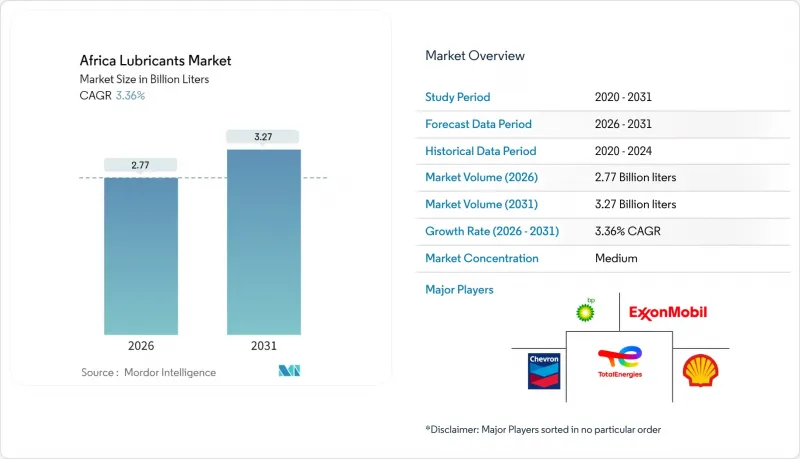
아프리카의 윤활유 시장은 2025년 26억 8,000만 리터에서 2026년에는 27억 7,000만 리터로 성장할 것으로 예상되며, 2026년부터 2031년까지 CAGR 3.36%를 기록하며 2031년까지 32억 7,000만 리터에 달할 것으로 예측됩니다.
탄탄한 인프라 구축 계획, 광산 생산량 증가, 지역 내 차량 보유량의 급격한 증가가 이러한 물량 성장을 뒷받침하고 있습니다. 도로, 철도, 에너지 자산에 대한 민관 투자가 건설기계용 윤활유 수요 확대를 지속적으로 견인하고 있으며, 카이로에서 라고스까지 도시 지역의 자동차 보급률 증가는 자동차 엔진 오일의 지속적인 소비를 뒷받침하고 있습니다. 현지 정유공장의 설비 업데이트, 특히 나이지리아의 신규 생산능력에서 공급되는 기유 스트림은 지역의 공급 내성을 강화하고 수입 의존도를 완화하고 있습니다. OEM 업체들의 교체 주기 연장 요청은 특히 유로4 및 유로5 배출가스 규제가 시행되고 있는 시장에서 합성유 등급으로 구매자의 전환을 촉진하고 있으며, 이러한 전환 추세는 이집트, 남아프리카공화국, 모로코에서 가장 두드러지게 나타나고 있습니다. 경쟁의 강도는 여전히 중간 정도이며, 국제 대기업은 브랜드 가치와 기술 노하우를 활용하고 있지만, 지역 기반 공급업체는 연포장 크기, 가격 경쟁력 있는 미네랄 오일 기반 배합, 현지 장비 서비스를 제공함으로써 입지를 다지고 있습니다.
주요 대도시권에서는 인구 증가율을 상회하는 속도로 자동차 보유대수가 증가하고 있으며, 엔진오일, 변속기 오일, 브레이크액에 대한 수요가 꾸준히 증가하고 있습니다. 라고스와 요하네스버그의 상업용 트럭 차량은 가혹한 사용 주기에 직면하고 있으며, 오일 교환 간격이 짧아지고 소비량이 증가하고 있습니다. 북아프리카 전역의 국내 조립공장에서는 공장 출고 시 충전량과 안정적인 애프터마켓 공급이 요구되고 있으며, 현지 조달 규제가 국내 블렌딩을 촉진하고 있습니다. 현대 엔진의 보급과 함께 운전자는 점차 단일 점도 오일에서 다점도 오일로 전환하고 있으며, 소형 패키지 크기에 대한 선호는 개인 자동차 소유자의 구매력과 일치합니다. OEM 서비스 네트워크는 유로5 배출가스 규제를 충족하는 승인된 제품을 권장하고 있으며, 이로 인해 중합성 SAPs 합성 블렌드의 보급이 가속화되고 있습니다.
남아프리카공화국, 잠비아, 모로코에서는 구리, 인산염, 중요 광물 프로젝트가 확대되고 있으며, 모두 중장비 로더와 컨베이어를 많이 사용하고 있습니다. 먼지와 고부하를 견딜 수 있는 프리미엄 유압유 또는 극압 기어 오일이 필요합니다. 이집트와 나이지리아에서는 도로, 항만, 철도의 동시 다발적인 개선 공사가 진행 중이며, 대형 토목 기계 및 발전 세트에 사용되는 그리스 및 터빈 오일에 대한 수요가 지속되고 있습니다. 원격지에 대량 공급이 가능한 공급업체가 계약을 따내는 한편, 오일 분석 및 상태 모니터링 서비스를 제공하는 업체는 장기적인 거래 관계를 구축하여 제품 판매량을 확보하고 있습니다. 건설 컨소시엄의 예측 가능한 가동 일정은 승용차 소비가 계절적으로 감소하는 시기에도 블렌더 가동률을 안정적으로 유지할 수 있는 기반이 되는 주문을 창출하고 있습니다.
보조금의 갑작스런 폐지 또는 부활은 펌프 가격을 변동시키고, 운송업체가 주행거리 및 유지보수 예산을 재검토하여 윤활유 수요에 간접적으로 영향을 미칩니다. 급격한 비용 상승으로 인해 운영자는 오일 교환 주기를 연장하거나 저렴한 단일 점도 오일로 전환하는 것을 고려하기 때문에 프리미엄 부문의 판매량이 감소할 것입니다. 수입업체는 환율과 보조금 수준이 연동하여 변화할 경우, 착륙비용 예측이 어려워지고 재고관리 판단이 복잡해집니다. 정책의 불확실성은 블렌딩 플랜트 및 저장 시설에 대한 대규모 자본 투자를 억제하고, 위탁 블렌딩 및 제3자 물류에 대한 의존도를 장기화할 수 있습니다.
2025년 기준, 자동차 엔진 오일은 아프리카 윤활유 시장의 36.05%를 차지했습니다. 이는 까다로운 운영 환경 속에서 노후화된 대륙 전역의 차량이 뒷받침된 결과입니다. 상업용 트럭이 오일 소비의 대부분을 차지하며, 잦은 오일 교환으로 인해 연간 총 소비량이 증가하고 있습니다. 이집트와 나이지리아의 산업 다각화 프로그램으로 인해 고무, 섬유, 석유화학 플랜트용 공정유는 전체 제품군 중 가장 높은 4.25%의 CAGR로 성장할 것으로 예상됩니다. 기어 오일은 가혹한 충격 하중에서 작동하는 지하 광산기계용이며, 변속기 오일은 상용차에서 자동변속기의 보급과 함께 그 중요성이 더욱 커지고 있습니다. 유압작동유는 서아프리카 및 북아프리카 전역의 대규모 건설 현장에서 운영되는 백호 및 크레인에서 안정적인 수요가 있습니다. 금속가공유는 국내 부품 제조의 발전, 특히 최근 모로코에 설립된 브레이크 패드 및 필터 공장의 동향과 연동되어 있습니다.
그리스 수요는 노천광산과 선박 추진기에서 증가하고 있으며, 내수성이 우수한 리튬 복합 제품이 선호되고 있습니다. 브레이크액은 신차 조립 대수에 비례하여 선형적인 성장세를 보이고 있지만, 전기자동차로의 전환이 장기적으로 확대를 억제할 가능성이 있습니다. 터빈유는 국가 전력화 계획에 따라 가동되는 복합화력 가스발전소의 수요를 확보하고, 변압기유는 빠르게 도시화되는 지역에 전력을 공급하는 송전망 강화 프로젝트의 수혜를 받고 있습니다. 다양한 제품 라인업이 결합되어 아프리카 윤활유 시장의 회복력을 뒷받침하고 있습니다. 특정 최종 용도 분야에서 경기가 둔화되더라도 다른 분야의 성장이 이를 보완하는 형태로 나타나고 있습니다.
아프리카 윤활유 시장 보고서는 제품 유형별(자동차 엔진오일, 산업용 엔진오일 등), 최종사용자 산업별(자동차, 선박, 항공우주, 중장비, 산업), 기유 유형별(광유 기반, 합성, 반합성, 바이오 기반), 지역별(나이지리아, 남아프리카, 이집트, 이집트, 알제리, 모로코, 기타 아프리카 국가)로 분류됩니다. 알제리, 모로코, 기타 아프리카 국가)로 분류되어 있습니다. 시장 예측은 리터 단위로 제공됩니다.
The Africa Lubricants Market is expected to grow from 2.68 billion liters in 2025 to 2.77 billion liters in 2026 and is forecast to reach 3.27 billion liters by 2031 at 3.36% CAGR over 2026-2031.
Robust infrastructure programs, accelerating mining output, and the rapid expansion of regional vehicle fleets underpin this volume growth. Public and private investments in road, rail, and energy assets continue to drive higher demand for construction machinery lubricants, while rising motorization rates in cities, from Cairo to Lagos, support sustained consumption of automotive engine oils. Local refinery upgrades, notably the base-oil streams emerging from new Nigerian capacity, strengthen regional supply resilience and temper import dependence. OEM mandates for extended drain intervals are nudging buyers toward synthetic grades, especially in markets now enforcing Euro 4 and Euro 5 emission norms, and this transition is most evident in Egypt, South Africa, and Morocco. Competitive intensity remains moderate; international majors leverage brand equity and technical know-how, yet regionally rooted suppliers gain ground by offering flexible pack sizes, price-competitive mineral formulations, and on-site equipment services.
Vehicle ownership is rising faster than population growth in major urban centers, creating a steady pull for engine oils, transmission fluids, and brake fluids. Commercial truck fleets in Lagos and Johannesburg experience arduous duty cycles, which shorten oil change intervals and increase consumption. National assembly plants across North Africa now require factory-fill volumes and consistent aftermarket supply, with local content regulations encouraging in-country blending. Motorists are gradually shifting from monograde to multigrade formulations as modern engines become more prevalent, and the preference for smaller pack sizes aligns with the purchasing power of individual car owners. OEM service networks champion licensed products that meet Euro 5 emission requirements, thereby accelerating the uptake of mid-SAPs synthetic blends.
Copper, phosphate, and critical mineral projects are expanding in South Africa, Zambia, and Morocco, each utilizing heavy mechanical loaders and conveyors that require premium hydraulic fluids and EP gear oils capable of withstanding dust and high loads. Concurrent road, port, and rail upgrades across Egypt and Nigeria sustain demand for greases and turbine oils used in large earth-moving equipment and power generation sets. Suppliers able to deliver bulk volumes to remote sites win contracts, while those offering oil analysis and condition monitoring services secure long-term relationships that lock in product offtake. The predictable operating schedules of construction consortia create baseline orders that stabilize blender capacity utilization even during seasonal dips in passenger car consumption.
Abrupt subsidy removals or reinstatements shift pump prices and indirectly influence lubricant demand, as transporters recalibrate mileage and maintenance budgets. Sudden cost spikes prompt operators to stretch drain intervals or down-trade to cheaper monograde oils, eroding premium segment volumes. Importers struggle to forecast landed costs when exchange rates and subsidy levels change in tandem, complicating inventory decisions. Policy uncertainty discourages heavy capital investment in blending plants and storage, prolonging reliance on toll blending and third-party logistics.
Other drivers and restraints analyzed in the detailed report include:
For complete list of drivers and restraints, kindly check the Table Of Contents.
Automotive engine oil held 36.05% of Africa's lubricants market share in 2025, supported by a continent-wide vehicle fleet that continues to age under challenging operating conditions. Commercial trucks account for a sizable portion of sump volumes, and frequent oil changes increase the total liters consumed each year. Process oils, serving rubber, textile, and petrochemical plants, are forecast to grow at a 4.25% CAGR, the fastest among all product lines, thanks to industrial diversification programs in Egypt and Nigeria. Gear oils cater to underground mining machines that operate under extreme shock loads, while transmission fluids gain prominence as automatic gearboxes become more prevalent in commercial fleets. Hydraulic fluids experience steady demand from backhoes and cranes operating on large construction sites throughout West and North Africa. Metalworking fluids track the evolution of domestic component manufacturing, particularly the brake pad and filter plants that have recently been established in Morocco.
Demand for greases is rising in surface mining and marine thrusters, with lithium-complex products preferred for their water resistance. Brake fluids show linear growth in line with new vehicle assemblies, though the shift toward electric cars may curb long-term expansion. Turbine oils secure slots in combined-cycle gas plants commissioned under national electrification agendas, and transformer oils benefit from grid reinforcement projects feeding rapidly urbanizing regions. Collectively, the diversified product slate anchors the resilience of the Africa lubricants market, balancing cyclical softness in any single end-use with momentum in others.
The Africa Lubricants Market Report is Segmented by Product Type (Automotive Engine Oil, Industrial Engine Oil, and More), End-User Industry (Automotive, Marine, Aerospace, Heavy Equipment, and Industrial), Base Stock Type (Mineral Oil-Based, Synthetic, Semi-Synthetic, and Bio-Based), and Geography (Nigeria, South Africa, Egypt, Algeria, Morocco, and Rest of Africa). The Market Forecasts are Provided in Terms of Volume (Liters).