



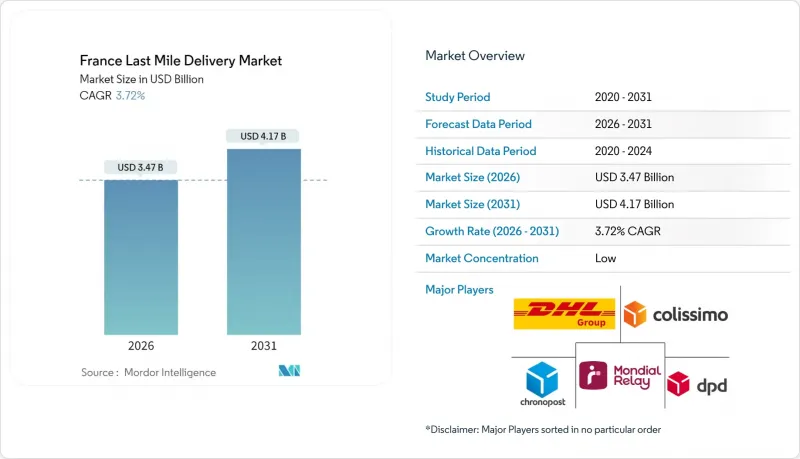
프랑스의 라스트 마일 배송 시장은 2025년 33억 5,000만 달러에서 2026년에는 34억 7,000만 달러로 성장하며, 2026-2031년에 CAGR 3.72%로 추이하며, 2031년까지 41억 7,000만 달러에 달할 것으로 예측됩니다.
E-Commerce량 증가, 택배 보관함 네트워크의 밀집도 증가, 차량 전동화 가속화를 위한 정부 인센티브에 따라 수요가 확대되고 있습니다. 세계 통합 사업자, 지역 택배 전문업체, 디지털 플랫폼이 배송 경로의 밀집도와 로커에 대한 접근성을 놓고 경쟁하면서 경쟁이 심화되고 있으며, 사업자들은 저가의 국경 간 소포에 대응하기 위해 요금 체계를 조정해야 하는 상황에 처해 있습니다. 도심의 교통체증, 배달원 부족, 마이크로 허브용 부동산 부족이 성장을 억제하는 반면, 다크스토어 제휴와 온도관리 물류에 대한 투자는 프리미엄 서비스 분야를 계속 개발하고 있습니다. 수익성은 현재 자동 분류, 픽업-드롭-오프(PUDO)의 다양화, 무공해 차량 도입에 의존하고 있으며, 이는 모두 규제가 심한 도심에서 점진적인 비용 절감과 접근성 우위를 가져다 줄 수 있습니다.
프랑스 우정공사(La Poste)의 콜리시모(Colissimo)는 2024년에 수백만 개의 소포를 처리했습니다. 주문 밀도 증가는 네트워크 확장을 촉진하고 있으며, 지오포스트(Geopost)가 2024년 자동 분류기 및 배송 센터에 대한 자본 투자를 단행한 것이 그 증거입니다. 그러나 수익성은 양극화되어 있습니다. Shein이나 Temu와 같은 플랫폼의 경량화물은 총 취급량은 증가하지만, 매출은 극히 미미합니다. 사업자는 추적 서비스 포함, 지정 배송, 탄소 중립 등 프리미엄 요금이 책정된 옵션 업셀링으로 이익률 하락에 대응하고 있습니다.
라 포스트는 128,000개의 수령 거점과 락커를 운영하며 유럽에서 가장 고밀도 네트워크를 구축했습니다. 이를 통해 배송 실패 비용을 절감하고 고객 만족도 점수를 향상시키고 있습니다. 인포스트 산하 몽디알릴레이는 이용률이 낮은 소매 대리점을 정리하면서 2025년까지 자동 사물함 수를 7,000개까지 늘릴 계획입니다. 2024년 3분기 기준, Mondial Relay가 취급한 6,230만 개의 소포 중 약 30%가 로커를 통해 유통되고 있으며, 이는 유연하고 비접촉식 수령 방식에 대한 소비자의 선호도를 보여줍니다. 운송 사업자의 경우, 사물함의 밀도 증가는 여러 배송지를 하나의 거점으로 통합하여 라스트 마일 단가를 크게 낮추고, 운전자의 생산성을 높이고 탄소 집약도를 낮출 수 있습니다.
파리는 유럽에서 세 손가락 안에 드는 교통 체증 지역으로, 도심의 평균 주행 속도는 시속 13km를 밑돌고, 배달원 1인당 정차 시간이 길어지고 있습니다. 시영 주차 요금과 배송 시간 단축으로 배송 능력이 압박을 받고 있으며, 교대제 근무로 인해 인건비가 상승하고 있습니다. 이에 대해 개발업체들은 SEGRO사의 '레 고블랑'과 같은 도시형 집적화 센터를 제안하고 있습니다. 파리 중심부에서 15분 거리에 위치한 1,600평방미터 규모의 허브입니다. 이러한 마이크로 허브는 최종 배송 거리를 평균 1.3km 단축할 수 있지만, 산업지구 지정 부지 부족이 보급의 걸림돌로 작용하고 있습니다.
표준 배송은 기존 우체국, 장거리 간선 운송, 비용 효율적인 일괄 분류를 활용하여 2025년 프랑스 라스트마일 배송 시장의 42.55%를 차지했습니다. 이 부문은 예측 가능한 작업량을 공급하고, 허브 앤 스포크 인프라를 최적화하여 교외 및 지방 노선에서 양호한 배송 밀도 경제성을 유지하고 있습니다. 소비자들이 중요 품목에서 더 빠른 서비스 수준으로 전환하는 가운데, 취급량에서의 우위는 지속되고 있습니다. 당일 배송 서비스는 3.78%의 연평균 복합 성장률(CAGR)로 성장하고 있으며, 도시 지역 쇼핑객들이 원하는 즉시성과 소매업체들의 '오후 1시까지 주문하면 당일 배송'이라는 약속을 바탕으로 성장하고 있습니다. 사업자는 프리미엄 요금과 탄소중립 인증을 결합하여 이익률을 유지하고 있습니다. 익스프레스은 시간 지정 B2B 화물에서 기업 고객의 표준 서비스로 안정적이며, 경제성과 당일 배송 사이 수요를 충족시키고 있습니다.
성장률의 차이는 편의성을 중시하는 SKU가 빠른 유통경로를 통해 유통되는 반면, 부피가 큰 저가의 상품은 이코노미 라인으로 유통되는 양극화된 미래를 암시합니다. 소매업체들은 하이브리드형 장바구니 결제를 확대하여 쇼핑객들이 당일배송 신선식품과 무료배송 일반상품을 별도로 구매할 수 있도록 하고 있습니다. 이러한 유연성은 네트워크 과부하를 방지하면서 매출 증가를 지원하고 있습니다. 운송 사업자에게 있으며, 단일 경로 내에서 여러 속도의 배송을 조정하는 것은 동적 배차와 실시간 수송력 가시성을 필요로 하는 주요 최적화 과제입니다.
The France Last Mile Delivery market is expected to grow from USD 3.35 billion in 2025 to USD 3.47 billion in 2026 and is forecast to reach USD 4.17 billion by 2031 at 3.72% CAGR over 2026-2031.
Demand scales with e-commerce volume growth, the densification of parcel-locker networks, and government incentives that accelerate fleet electrification. Competitive intensity has risen as global integrators, regional parcel specialists, and digital platforms jostle for route density and locker access, forcing operators to adjust tariffs in response to low-value cross-border parcels. Urban congestion, courier shortages, and scarce micro-hub real estate temper growth, yet investment in dark-store partnerships and temperature-controlled logistics continues to open premium service niches. Profitability now hinges on automated sortation, pickup-drop-off (PUDO) diversification, and zero-emission vehicle deployment, each delivering incremental cost and access advantages in heavily regulated urban cores.
La Poste's Colissimo processed millions of parcels in 2024. Higher order density fuels network expansion, evidenced by Geopost's capital spend on automated sorters and depots in 2024. Yet profitability diverges: lightweight shipments from platforms such as Shein and Temu carry wafer-thin yields even as they lift headline volumes. Operators counter margin pressure by upselling tracked, scheduled, or carbon-neutral options that command premium fees.
La Poste hosts 128,000 pickup points and lockers-the densest network in Europe, cutting failed-delivery costs and lifting customer satisfaction scores. InPost-owned Mondial Relay raised its automated locker count to 7,000 by 2025 while pruning low-traffic retail agents. Nearly 30% of Mondial Relay's 62.3 million Q3-2024 parcels flowed through lockers, signaling shopper preference for flexible, contactless retrieval. For carriers, locker density collapses last-mile unit cost by consolidating multiple drop-offs into a single location, improving driver productivity and shrinking carbon intensity.
Paris ranks among Europe's top three congestion hot spots, pushing average urban route speed below 13 km/h and inflating driver hours per stop. Municipal curb fees and reduced delivery windows squeeze capacity, forcing split-shift scheduling that raises labor requirements. Developers respond with urban consolidation centers like SEGRO's Les Gobelins, a 1,600-m2 hub fifteen minutes from central Paris. Such micro-hubs shave 1.3 km off average last-leg distance, yet the limited availability of industrial-zoned plots curtails widespread replication.
Other drivers and restraints analyzed in the detailed report include:
For complete list of drivers and restraints, kindly check the Table Of Contents.
Standard Delivery captured 42.55% of the France last mile delivery market share in 2025 by leveraging established postal depots, long-haul line-hauls, and cost-efficient batch sorting. The segment supplies predictable workloads that optimize hub-and-spoke infrastructure, sustaining favorable drop-density economics across suburban and rural routes. Volume leadership persists even as consumers upgrade to faster tiers for mission-critical items. Same-day services, advancing at a 3.78% CAGR, ride urban shopper expectations for immediacy and retailer promises of "order-by-1 pm-receive-today." Operators bundle premium fees with carbon-neutral badges to preserve margin. Express Delivery holds steady as a business account staple for time-definite B2B shipments, filling the gap between economy and same-day.
Growth differentials hint at a bifurcated future where convenience-led SKUs flow through rapid-cycle channels, while bulkier, lower-value items continue in economy lanes. Retailers increasingly offer hybrid cart checkout, letting shoppers split baskets between same-day perishables and slower, free-shipping lines. That elasticity underpins incremental revenue while preventing network overload. For carriers, orchestrating multi-speed promises within a single route remains the primary optimization frontier, demanding dynamic dispatching and real-time capacity visibility.
The France Last Mile Delivery Market Report is Segmented by Service (Standard Delivery, Same-Day, and Express Delivery), Business Model (Business-To-Business (B2B), Business-To-Consumer (B2C), and Customer-To-Consumer (C2C)), End-User Industry (E-Commerce Retail, Fashion & Lifestyle, Beauty, and More), Region (Hauts-De-France, Nouvelle-Aquitaine, Occitanie, and More). The Market Forecasts are Provided in Terms of Value (USD).