



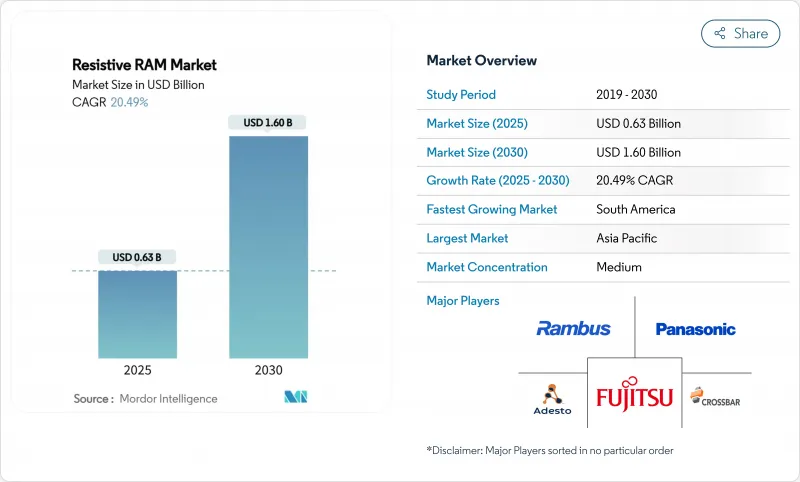
저항성 RAM 시장 규모는 2025년에 6억 3,000만 달러로, 2030년에는 16억 달러에 이르며, 2025-2030년의 CAGR은 20.49%를 나타낼 것으로 예측되고 있습니다.
이 급성장은 여러 요인에 의해 야기되었습니다. 1012 사이클을 넘는 양산 등급의 내구성은 미션 크리티컬하고 쓰기 빈도가 높은 워크로드를 해제하고, 1V 미만의 스위칭이 배터리 구동 에지 디바이스의 헤드룸을 만들어 냈습니다. 아시아태평양의 파운드리 기반은 28nm 이하의 임베디드 ReRAM의 테이프 아웃을 가속화, 차량 탑재 ADAS 프로그램은 기존의 플래시에서는 대응할 수 없었던 고온 비휘발성 옵션 수요를 높였습니다. 뉴로모픽 컴퓨팅의 신흥 기업에 대한 벤처 캐피탈의 자금 조달도 기세를 늘렸습니다. 이러한 추세는 ReRAM이 실험실 개념 증명에서 주류 양산 채용으로 전환하고 있음을 보여줍니다.
1012 사이클 이상의 내구성으로 인해 ReRAM은 쓰기 집중식 엔터프라이즈 워크로드에서 플래시를 대체하는 현실적인 제품으로 자리매김했습니다. 학술팀은 분극을 유지하면서 101° 사이클까지 지속되는 질화알루미늄 스칸듐 강유전체 스택을 보고했습니다. Webit Nano는 차내 테스트에서 150°C에서 10만 프로그램 사이클을 검증했습니다. 이 내구성을 통해 스토리지 공급업체는 DRAM이 기본값이었던 핫 티어 캐싱에 ReRAM을 사용하는 것을 고려할 수 있습니다.
버지니아 대학의 조사에 따르면, 0.6V 전도성 브리지 ReRAM 매크로는 차지 펌프 오버헤드를 제거하고 쓰기 당 8pJ를 소비합니다. 인텔은 22FFL 노드에서 FinFET 기반 임베디드 ReRAM을 입증하여 1V 이하의 동작이 가능함을 보여주었습니다. 웨어러블, 센서 노드, 스마트 미터는 배터리 수명을 향상시키는 것이 중요합니다.
도전 패스의 편차가 고신뢰성 생산시의 수율을 저해합니다. Ta2O5 디바이스의 연구에서 전압 의존성 노이즈는 신경 어레이의 중량 분해능의 열화로 이어졌습니다. 크로스바 스케일의 열 상호작용은 불확실성을 증가시켰습니다. Al2O3 스택의 웨이크 업 사이클링은 완화 조치를 제공했지만 공정 흐름이 길어졌습니다.
산화물 기반 디바이스는 2024년 저항성 RAM 시장에서 46.3%의 점유율을 유지했습니다. HfO2 스택과 Al2O3 스택은 이미 주류 CMOS 흐름에 통합되어 채용 위험이 떨어졌습니다. 구리 기반 전도성 브릿지는 1V 이하의 전압으로 쓰기가 가능하며 웨어러블 및 마이크로 파워 노드에 적합하기 때문에 CAGR은 26.2%를 나타낼 전망입니다. 전도성 브리지 디바이스의 저항성 RAM 시장 규모는 2030년까지 4억 9,000만 달러에 달할 것으로 예상됩니다. 나노메탈 필라멘트 접근법은 극단적인 소형화와 높은 내방사선성이 요구되는 틈새 수요를 받아들였습니다. 하이브리드 카본 필라멘트는 37nm에서 107 사이클 이상의 포밍 프리 동작을 입증했습니다.
산화물 기반 공급업체는 사이클 당 편차를 줄이는 공극층에 의해 내구성을 높임으로써 이에 대응했습니다. 캐스팅 라이브러리는 현재 산화물 기반 ReRAM 매크로를 로직 IP와 함께 번들링하여 MCU 테이프 아웃을 단순화합니다. 반대로, 전도성 브리지 지지파는 낮은 프로그래밍 전류를 활용하여 배터리 수명을 향상시켰습니다. 두 진영 모두 AI 가속기를 활용하기 위해 신경망 아날로그 가중치 스토리지의 실증 실험에 투자했습니다.
시스템 온 칩 설계자가 다이 공간 절약과 BOM 간소화를 평가했기 때문에 임베디드 솔루션은 2024년 매출의 55.4%를 차지했습니다. MCU 공급업체는 보안 코드 스토리지, 펌웨어 업데이트 및 인스턴트 온 기능을 위해 1-4M비트 매크로를 통합했습니다. 임베디드 기기의 저항성 RAM 시장 점유율은 독립형 집적도가 상승하더라도 2030년까지 50% 이상을 유지할 것으로 예측됩니다.
AI와 HPC 고객이 맞춤형 메모리 모듈을 찾고 있기 때문에 독립형 ReRAM의 CAGR 예측은 25.2%를 나타낼 전망입니다. 설계자는 로직 제약 없이 어레이의 모양과 선택기 스택을 조정할 수 있어 병렬 아날로그 곱셈 누적을 위한 더 큰 워드 라인이 가능합니다. 8비트 정밀도의 4M비트 컴퓨트 인 메모리 매크로는 마이크로 줄의 에너지 레벨에서 추론을 입증했습니다. 클라우드 공급업체는 이 독립형 칩을 현장에서 가중치를 업데이트함으로써 혜택을 받는 교육 워크로드를 위한 DRAM 캐시 보완으로 평가했습니다.
저항성 RAM은 재료 유형(산화물 기반, 전도성 브리지, 나노메탈 필라멘트), 폼 팩터(임베디드 ReRAM, 독립형 ReRAM), 용도(인메모리) 컴퓨팅, 영구 스토리지, 고속 부트/코드 스토리지), 최종 사용자(산업 및 IoT 장치, 자동차 및 이동성 등), 지역(북미, 남미, 유럽, 아시아태평양, 중동 및 아프리카)으로 구분됩니다.
아시아태평양은 2024년 41.3%의 매출을 획득했습니다. Samsung, SK Hynix, Kioxia에 의한 대규모 주조 투자가 28nm 이하의 임베디드 ReRAM 설계 키트를 확대. 한국은 2028년까지 선진 메모리 용량에 750억 달러를 할당해 고대역폭과 차세대 NVM 라인에 자금을 투입했습니다. 일본은 AI 엣지 디바이스용 ReRAM으로 670억 달러의 반도체 르네상스 계획을 추진하고 있습니다.
남미는 CAGR 22.2%로 성장을 지속하고, 가장 급성장하는 클러스터로 부상했습니다. 브라질은 ReRAM과 DRAM 패키지 모두를 대상으로 하는 밀봉 및 테스트를 현지화하기 위해 아티바이아와 마나우스에 6억 5,000만 레알(1억 3,000만 달러)의 확장 자금을 제공했습니다. 지역 정부는 또한 산화막을 위한 희토류 광물공급을 촉진했습니다. 이 때문에 남미의 저항성 RAM 시장은 수직 통합의 혜택을 받았습니다.
북미는 방사선경화를 필요로 하는 자동차와 항공우주 이용 사례를 활용해 설계의 주도권을 유지했습니다. 미국과 캐나다의 저항성 RAM 시장 규모는 ADAS 메모리 믹스의 이동과 함께 상승할 것으로 예측됩니다. 유럽에서는 실시간 분석을 위해 컴퓨트 인 메모리 매크로를 통합하는 산업 제어 공급업체에 주목을 받았습니다. 중동 및 아프리카에서는 저전력 지속 메모리가 유지 보수 사이클을 단축하는 스마트 시티 센서 그리드에 일찍 채택되었습니다.
The resistive random access memory market size stood at USD 0.63 billion in 2025 and is forecast to reach USD 1.60 billion by 2030, expanding at a 20.49% CAGR over 2025-2030.
Multiple factors drove this steep climb. Production-grade endurance above 1012 cycles unlocked mission-critical and high-write-frequency workloads, while sub-1V switching created headroom for battery-powered edge devices. Asia-Pacific's deep foundry base accelerated embedded ReRAM tape-outs below 28 nm, and automotive ADAS programs raised demand for high-temperature non-volatile options that conventional flash could not meet. Venture capital funding for neuromorphic compute start-ups also added momentum. Together, these trends signaled that ReRAM was moving from laboratory proof-of-concept to mainstream volume adoption.
Endurance exceeding 1012 cycles positioned ReRAM as a realistic flash replacement for write-intensive enterprise workloads. Academic teams reported aluminum-scandium nitride ferroelectric stacks persisting through 101° cycles while retaining polarization.Weebit Nano later validated 100,000 program cycles at 150 °C during automotive tests. This durability lets storage vendors contemplate using ReRAM for hot-tier caching that had previously defaulted to DRAM.
Research from the University of Virginia showed a 0.6 V conductive-bridge ReRAM macro consuming 8 pJ per write, eliminating charge-pump overhead. Intel echoed the feasibility of sub-1V operation when it demonstrated FinFET-based embedded ReRAM on 22FFL nodes. Battery life gains mattered across wearables, sensor nodes, and smart meters.
Variability in conductive paths hampered yield during high-reliability production. Studies on Ta2O5 devices linked voltage-dependent noise to degraded weight resolution in neural arrays. Crossbar-scale thermal interactions added uncertainty. Wake-up cycling in Al2O3 stacks offered mitigation but lengthened process flows.
Other drivers and restraints analyzed in the detailed report include:
For complete list of drivers and restraints, kindly check the Table Of Contents.
Oxide-based devices retained 46.3% share of the resistive random access memory market in 2024. HfO2 and Al2O3 stacks were already part of mainstream CMOS flows, which lowered adoption risk. Conductive-bridge variants, often copper-based, registered a 26.2% CAGR outlook because their sub-1V write capability aligned with wearables and micro-power nodes. The resistive random access memory market size for conductive-bridge devices is projected to reach USD 0.49 billion by 2030, reflecting designers' preference for energy headroom in edge architectures. Nanometal filament approaches captured niche demand where extreme miniaturization or high radiation tolerance mattered. Hybrid carbon filaments demonstrated forming-free operation at 37 nm with >107 cycles.
Oxide-based suppliers responded by enhancing endurance through vacancy-engineered layers that reduced cycle-to-cycle variability. Foundry libraries now bundle oxide-based ReRAM macros alongside logic IP, simplifying MCU tape-outs. Conversely, conductive-bridge proponents leveraged lower programming currents to market battery-life gains. Both camps invested in neural-network analog weight storage demonstrations to tap AI accelerators.
Embedded solutions held 55.4% of revenue in 2024 because system-on-chip designers valued die-space savings and simplified bills of materials. MCU vendors embedded 1-4 Mbit macros for secure code storage, firmware updates, and instant-on features. The resistive random access memory market share of embedded devices is expected to remain above 50% through 2030, even as stand-alone density rises.
Stand-alone ReRAM recorded a 25.2% CAGR projection as AI and HPC customers sought bespoke memory modules. Designers could tune array geometry and selector stacks without logic constraints, enabling larger word lines for parallel analog multiply-accumulate. A 4 Mbit compute-in-memory macro with 8-bit precision demonstrated inference at micro-joule energy levels. Cloud vendors evaluated these stand-alone chips as DRAM cache complements for training workloads that benefit from in-situ weight updates.
Resistive Random Access Memory (ReRAM) is Segmented by Material Type (Oxide-Based, Conductive-Bridge, and Nanometal Filament), Form Factor (Embedded ReRAM, and Stand-Alone ReRAM), Application (In-Memory Computing, Persistent Storage, and Fast Boot/Code Storage), End-User (Industrial and IoT Devices, Automotive and Mobility, and More), and Geography (North America, South America, Europe, Asia-Pacific, and Middle East and Africa).
Asia-Pacific commanded 41.3% revenue in 2024. Massive foundry investments by Samsung, SK Hynix, and Kioxia expanded embedded ReRAM design kits below 28 nm. South Korea allocated USD 75 billion for advanced memory capacity through 2028, funneling funds into high-bandwidth and next-generation NVM lines. Japan pursued a USD 67 billion semiconductor renaissance plan with ReRAM earmarked for AI edge devices.
South America emerged as the fastest-growing cluster, posting 22.2% CAGR. Brazil funded a R$650 million (USD 130 million) expansion in Atibaia and Manaus to localize encapsulation and test, targeting both ReRAM and DRAM packaging. Regional governments also facilitated the rare-earth mineral supply for oxide films. The resistive random access memory market in South America, therefore, benefited from vertical integration incentives.
North America retained design leadership, leveraging automotive and aerospace use cases that demand radiation hardening. The resistive random access memory market size for the US and Canada is forecast to climb alongside ADAS memory mix shifts. Europe focused on industrial control vendors integrating compute-in-memory macros for real-time analytics. The Middle East and Africa saw early traction in smart-city sensor grids where low-power persistent memory reduced maintenance cycles.