


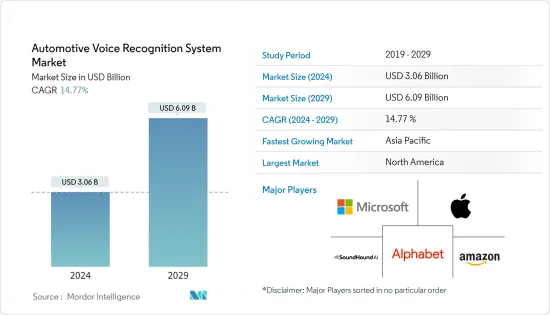
세계 자동차용 음성 인식 시스템 시장 규모는 2024년 30억 6,000만 달러에 달하고, 2024-2029년 예측 기간 동안 연평균 14.77% 성장하여 2029년에는 60억 9,000만 달러에 달할 것으로 예상됩니다.
자동차 생산 및 판매량 증가, 전 세계 대부분의 지역에서 소비자들의 소득 수준이 높아져 편안하고 고급스러운 서비스에 더 많은 지출을 할 수 있게 된 점, 운전자에게 안전과 편안함을 제공하는 인포테인먼트 및 기술 서비스 개발, 최신 커넥티비티 및 AI 기능을 갖춘 자동차에 대한 젊은 층의 선호도 증가 등이 시장 성장의 주요 요인으로 꼽힙니다. 커넥티비티 및 AI 기능이 탑재된 자동차에 대한 젊은 층의 선호도 증가 등을 꼽을 수 있습니다.
*국제자동차산업협회(OICA)에 따르면 2021년 소형 상용차 신차 판매량은 1,860만 대, 2022년에는 1,980만 대에 달해 전년 대비 7%의 큰 폭의 성장세를 기록할 것으로 전망됩니다.
또한, 자율주행차 및 커넥티드카 기술의 급속한 발전은 ADAS(첨단 운전자 보조 시스템)의 수요를 촉진하는 요인으로 작용할 것으로 예상되며, ADAS(첨단 운전자 보조 시스템)가 핸즈프리 경험을 제공하는 데 도움을 줄 것으로 보입니다. 또한, 전 세계 전기자동차의 보급 확대도 자동차용 음성 인식 시스템 수요 확대에 크게 기여하고 있습니다.
*국제에너지기구(IEA)에 따르면, 세계 배터리 전기자동차 판매량은 2021년 460만 대에서 2022년 730만 대에 달해 전년 대비 58.6%의 성장률을 기록할 것으로 전망됐습니다.
이 시장의 주요 기업들은 주요 자동차 제조업체(OEM)와 제휴하여 음성 인식 기술을 OEM 차량에 탑재하여 서비스를 확장하고 있습니다.
*2023년 8월, SoundHound AI Inc.는 혁신적인 Edge Cloud 연결, 다국어 기능, 맞춤형 브랜드 음성 비서를 포함한 고급 AI 기술을 발표하여 터키의 모빌리티 제공 업체인 Togg의 새로운 스마트카 라인에 통합했습니다. 또한, 토그의 차량용 AI 기반 음성 어시스턴트는 사용자가 말을 마치기도 전에 실시간으로 음성 맥락을 추적하고 이해할 수 있으며, SoundHound의 독자적인 Speech-to-Meaning(R) 및 Deep Meaning(R) 기술을 통해 음성 문맥을 추적하고 이해할 수 있다고 밝혔습니다. Understanding(R) 기술을 사용하여 여러 질문에 대응하고 결과를 필터링할 수도 있습니다.
*2022년 9월, BMW 그룹은 최신 버전의 BMW 지능형 개인 비서(IPA)에 통합할 새로운 음성 및 AI 기반 음성 비서 개발을 위해 마이크로소프트(Microsoft Corp.)의 자회사 Cerence Inc. 를 선정했다고 발표했습니다. 이 기능은 신형 BMW 7시리즈와 BMW i7에 탑재될 예정입니다.
아시아태평양은 커넥티드카 판매량이 많고, 젊은 자동차 구매자들이 음성 인식 기술과 같은 최신 커넥티드 기능에 대한 선호도가 높으며, 자동차 제조업체들의 존재감이 커서 가장 빠르게 성장하는 지역이 될 것으로 예상됩니다. 유럽과 북미는 음성 인식과 같은 새로운 시대의 기술과 자동차 구매자의 친밀도가 높고, 커넥티드카 판매량이 많기 때문에 두 번째로 큰 시장으로 꼽힙니다.
고객들은 파워나 토크 수치보다 운전의 편안함과 편리함을 추구하기 때문에 자동차의 기계적인 사양보다 고도의 커넥티비티 기능을 갖춘 자동차 구매를 선호하고 있습니다. 이러한 추세는 전 세계 주요 자동차 시장에서 점점 더 많이 나타나고 있으며, 자동차용 음성 인식 시스템과 같은 기능에 대한 수요가 증가하고 있습니다.
또한, 커넥티드카와 자율주행차의 판매량 증가로 음성 인식 시스템에 대한 수요는 더욱 가속화되고 있습니다. 커넥티드카뿐만 아니라 자율주행차에도 음성 인식 기술이 표준으로 탑재되고 있습니다. 음성 인식 시스템은 운전자가 기본적인 정형화된 작업에서 벗어나 운전에만 전념할 수 있도록함으로써 자동차 사고 발생을 감소시킬 것으로 예상되며, 메르세데스, BMW, 아우디 등 다양한 자동차 제조사가 제공하는 고급차 및 프리미엄 승용차는 업계에서 경쟁 우위를 확보하기 위해 첨단 음성 인식 시스템을 도입하고 있습니다. 경쟁 우위를 확보하기 위해 첨단 음성 인식 시스템을 빠르게 차량에 탑재하고 있으며, 이는 이 부문의 수요 급증에 긍정적인 영향을 미치고 있습니다.
이러한 커넥티드카 및 자율주행차 판매 증가, 자동차의 안전성 향상 추세, 패밀리 세단 및 소형 SUV와 같은 중저가 차량에 음성 인식 시스템이 탑재되는 추세 등은 예측 기간 동안 시장을 견인할 것으로 예상되는 요인 중 일부입니다.
아시아태평양은 북미, 유럽에 이어 두 번째로 빠르게 성장할 것으로 예상되는 지역 시장입니다. 아시아태평양은 거대한 승용차 시장입니다. 인도와 중국은 세계 최대 규모의 승용차 시장으로 전 세계 승용차 판매량의 약 30%를 차지하고 있어, 아시아태평양은 자동차용 음성 인식 시스템에 가장 유리한 지역 시장입니다.
아시아태평양의 주요 자동차 제조업체들은 고객의 편의성을 높이기 위해 자동차에 첨단 솔루션을 탑재하는 것을 점점 더 선호하고 있습니다. 인공지능 및 가상 비서 지원 음성 인식 시스템을 차량에 탑재하는 것은 이들 업체들이 의존하고 있는 혁신적인 기술 중 하나입니다. 주요 자동차 제조업체들은 음성 인식 시스템 공급업체와 장기적인 파트너십을 맺고, 증가하는 수요에 대응할 수 있는 고급 음성 인식 시스템 개발에 많은 투자를 하고 있습니다.
이러한 분야의 급속한 발전과 혁신으로 인해 자동차용 음성 인식 시스템 시장은 예측 기간 동안 아시아태평양의 상용차 및 승용차 부문에서 모두 성장할 것으로 예상됩니다.
자동차용 음성 인식 시스템 시장은 다양한 기존 기업과 신규 진입 플레이어가 생태계에서 사업을 전개하고 있기 때문에 파편화되어 있고 경쟁이 치열합니다. 이 시장은 주요 자동차 제조업체와 제휴를 맺은 상당히 큰 규모의 플레이어가 존재한다는 특징이 있습니다. 또한, 이들 업체들은 브랜드 포트폴리오를 확장하고 시장에서의 입지를 강화하기 위해 합작 투자, 인수 합병, 신제품 출시, 제품 개발 등을 진행하고 있습니다. 예를 들어,
향후 몇 년 동안 자동차용 음성 인식 시스템에 인공지능, 알렉사(Alexa)와 같은 가상 비서 등 첨단 기술이 통합될 것으로 예상됩니다.
The Automotive Voice Recognition System Market size is estimated at USD 3.06 billion in 2024, and is expected to reach USD 6.09 billion by 2029, growing at a CAGR of 14.77% during the forecast period (2024-2029).
Over the forecast period, the market is expected to be driven by several factors, including increasing automobile production and sales, higher income levels of consumers in most parts of the world, enabling them to spend more on comfort and luxury services, development of infotainment and technology services to provide safety and comfort to the driver as well as the growing preference of young customers for automobiles equipped with the latest connectivity and AI features.
* According to the International Organization of Motor Vehicle Manufacturers (OICA), new light commercial vehicle sales touched 19.8 million units in 2022 compared to 18.6 million units in 2021 worldwide, recording a substantial Y-o-Y growth of 7%.
Moreover, rapid enhancement in autonomous vehicles and connected vehicle technology will fuel the demand for advanced automotive voice recognition systems as they assist in providing a hands-free experience to drivers. Coupled with that, the increasing penetration of electric vehicles worldwide is also a major contributor to the rising demand for automotive voice recognition systems.
* According to the International Energy Agency (IEA), battery electric vehicle sales worldwide touched 7.3 million units in 2022 compared to 4.6 million units in 2021, representing a Y-o-Y growth of 58.6%.
Key players in the market are expanding their services by tying up with major automobile original equipment manufacturers (OEMs) to integrate their voice recognition technologies into OEMs' vehicles. For instance,
* In August 2023, SoundHound AI Inc. launched its advanced AI technology, including innovative Edge+Cloud connectivity, multiple language capabilities, and a custom-branded voice assistant to be integrated into a new line of smart vehicles from Turkish mobility provider Togg. Further, the company stated that Togg's in-vehicle AI-powered voice assistant can track and understand speech context in real-time (in instances even before the user has finished speaking). Using SoundHound's proprietary Speech-to-Meaning(R) and Deep Meaning Understanding(R) technologies, it can also address multiple questions and filter results.
* In September 2022, BMW Group announced that it had selected Cerence Inc., a Microsoft Corp. subsidiary, for developing a new voice and AI-powered voice assistant for integration into the latest version of BMW Intelligent Personal Assistant (IPA). These features would be available in the new BMW 7 Series and BMW i7.
Asia-Pacific is expected to become the fastest-growing regional market due to large sales of connected vehicles, young automobile buyers' willingness to opt for the latest connectivity features like voice recognition technology, and a large presence of automakers. Europe and North America are the next largest markets because of the close affinity of car buyers to new-age technologies like voice recognition and high sales of connected vehicles.
Customers increasingly prefer to purchase a car with advanced connectivity features rather than the mechanical specifications of the vehicle because they demand driving comfort and convenience more than the outright power or torque figures. This trend is increasingly observed in major automotive markets worldwide, which has led to an increase in the demand for features like in-vehicle voice recognition systems.
Further, the demand for voice recognition systems is being accelerated by the rising sales of connected cars and autonomous vehicles. Both connected as well as autonomous vehicles have voice recognition technology as a standard feature. Voice recognition systems have been seen to reduce the number of vehicle accidents since they free drivers from basic, routine tasks so they can fully concentrate on driving. Luxury and premium passenger cars offered by various automakers, such as Mercedes, BMW, and Audi, are rapidly integrating advanced voice recognition systems in their vehicles to gain a competitive edge in the industry, which, in turn, is positively impacting the surging demand for this segment of the market.
Thus, increasing sales of connected and autonomous vehicles, the trend toward greater vehicle safety, and the availability of voice recognition systems in mid-priced vehicles like family sedans and compact SUVs are some of the factors anticipated to drive the market in the forecast period.
The Asia-Pacific is expected to be the fastest-growing regional market, followed by North America and Europe. Asia-Pacific is a huge market for passenger vehicles. India and China are some of the largest markets for passenger vehicles in the world, contributing to almost 30% of the global passenger vehicle sales, thus making Asia-Pacific the most lucrative regional market for automotive voice recognition systems.
Major auto manufacturers in Asia-Pacific countries are increasingly preferring to integrate advanced solutions in their vehicles to enhance customers' convenience. The incorporation of artificial intelligence and virtual assistant-enabled voice recognition systems in their vehicle fleets is among the innovative technological features that these players are relying on. Major automakers are forming long-term partnerships with voice recognition system suppliers and are investing hefty sums in the development of advanced voice recognition systems that can cater to the increasing demand. For instance,
Thus, with rapid advancements and innovations in this segment, the market for automotive voice recognition systems is expected to grow over the forecast period for both the commercial and passenger vehicles segment across Asia-Pacific countries.
The automotive voice recognition system market is fragmented and highly competitive due to various incumbent players and new entrants operating in the ecosystem. The market is characterized by the presence of considerably large players who have entered into collaborations with major auto manufacturers. These players also engage in joint ventures, mergers and acquisitions, new product launches, and product development to expand their brand portfolios and cement their market positions. For instance,
The market is anticipated to witness the integration of advanced technologies such as artificial intelligence and virtual assistants like Alexa in automotive voice recognition systems over the coming years.