자율 이동 로봇(AMR) 시장(-2032년) : 내비게이션별(레이저/LiDAR, 시각 유도, SLAM, RFID 태그, 자기 센서, 관성 센서), 유형별(상품 전달 AMR, 팔레트 취급 AMR), 적재량(100kg 미만, 100-500kg, 500kg 초과)
Autonomous Mobile Robots (AMR) Market by Navigation (Laser/LiDAR, Vision Guidance, SLAM, RFID Tags, Magnetic Sensors, Inertial Sensors), Type (Goods-to-person AMR, Pallet-handling AMR), Payload (<100 kg, 100-500 kg, >500 kg) - Global Forecast to 2032
상품코드:1937992
리서치사:MarketsandMarkets
발행일:2026년 02월
페이지 정보:영문 313 Pages
라이선스 & 가격 (부가세 별도)
ㅁ Add-on 가능: 고객의 요청에 따라 일정한 범위 내에서 Customization이 가능합니다. 자세한 사항은 문의해 주시기 바랍니다.
한글목차
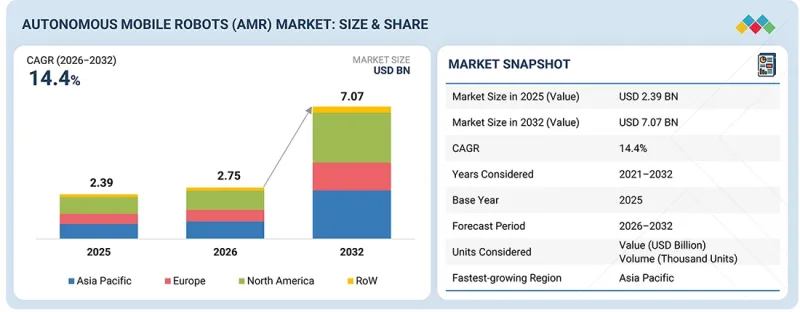
세계의 자율 이동 로봇(AMR) 시장 규모는 2026년 27억 5,000만 달러에서 2032년까지 70억 7,000만 달러로 성장하여 CAGR 14.4%를 나타낼 것으로 예측됩니다.
이 성장은 창고, 제조 공장, 유통 센터에서 AMR의 도입 확대에 견인되고 있습니다. 조직이 유연한 자재 흐름, 노동력 최적화, 일관된 업무 성과를 우선시함에 따라 기업은 적응성과 안전성이 필수적인 동적 환경에서 피킹, 팔레트 운송, 라인 공급, 반복적인 내부 물류 업무를 지원하기 위해 AMR의 도입을 증가시키고 있습니다.
조사 범위
조사 대상 기간
2021-2032년
기준 연도
2024년
예측 기간
2026-2032년
단위
금액(달러)
부문
적재량별, 산업별, 지역별
대상 지역
북미, 유럽, 아시아태평양 및 기타 지역
고급 네비게이션, 실시간 장애물 회피, 높은 처리량 운영에서 안정적인 성능을 제공하는 AMR 플랫폼에 대한 수요가 증가하고 있습니다. 기업이 대규모, 효율화 및 미래를 내다보는 자동화 전략을 추구하는 가운데 창고 자동화, EC 풀필먼트 인프라, 스마트 팩토리 구상에 대한 지속적인 투자가 시장 확대를 더욱 추진하고 있습니다.
"2032년에는 하드웨어 부문이 시장 점유율의 대부분을 차지할 전망"
하드웨어 부문은 AMR의 기능과 성능을 좌우하는 중요한 역할을 담당하기 때문에 시장에서 큰 점유율을 획득할 전망입니다. 하드웨어 부문에는 센서, 액추에이터, 모바일 시스템, 전원 등 AMR의 운영에 필수적인 구성 요소가 포함됩니다. 센서는 네비게이션 및 장애물 회피를 위한 실시간 환경 정보를 제공하며, 액추에이터는 로봇 이동 및 물체 조작을 가능하게 합니다. 산업 분야에서 자재 운반, 재고 관리, 물류 등의 용도로 AMR의 도입이 증가함에 따라 고품질의 하드웨어 부품에 대한 수요가 높아지고 있습니다. 또한 기술이 발전함에 따라 첨단 하드웨어 솔루션이 개발되어 다양한 분야에서 AMR의 능력이 확대되고 있습니다. 배터리 기술의 발전과 센서 정밀도의 향상은 하드웨어 부문의 성장을 가속하고 AMR 시장 전체의 확대에 핵심이 될 것으로 기대됩니다.
"적재량에서는 100-500kg의 AMR이 2032년에 큰 시장 점유율을 획득"
100-500kg의 AMR은 적재 능력, 유연성, 비용 효율의 균형이 뛰어나 2032년에 큰 시장 점유율을 획득할 것으로 예측됩니다. 이 적재 용량은 자재, 부품, 카톤 및 팔레트의 지속적인 이동이 요구되는 제조 공장, 창고, 물류 시설 등 폭넓은 산업용도에 최적입니다. 이 카테고리의 AMR은 기동성을 손상시키지 않고 원활한 자재 흐름을 실현하여 좁은 통로와 혼합 교통 환경 모두에서 효과를 발휘합니다. 내부 운송, 재고 이동, 라인 공급, 주문 이행과 같은 작업을 처리하는 능력으로 안전 기준을 유지하면서 업무 효율을 향상시킵니다. 산업 분야에서 중량급 자재 운반을 위한 경제적인 자동화 솔루션에 대한 수요가 높아지는 가운데 100-500kg 대응의 AMR에 대한 수요가 가속화되고 있습니다. 이러한 로봇은 수작업과 대형 자동화 시스템을 대체할 수 있는 매력적인 옵션을 제공하며 AMR 시장의 지속적인 성장을 지원하는 핵심 분야로 자리매김하고 있습니다.
"아시아태평양이 2026년부터 2032년까지 최고 CAGR을 기록할 전망"
이것은 급속한 산업 확대, 대규모 창고 개발, 제조 및 물류 분야에서의 자동화의 가속이 주된 요인입니다. 자동차, 반도체 및 전자기기, 전자상거래 및 소매, 식품 및 음료, 물류 및 3PL 부문의 강한 수요가, 내부의 자재 플로우 개선, 수작업의 삭감, 고볼륨 환경에서의 일관된 처리량 유지를 목적으로 한 AMR의 도입을 추진하고 있습니다. 제조업체는 노동력 부족, 임금 상승, 공간 제약에 대응하기 위해 피킹, 분류, 팔레트 이동, 라인 공급에서 AMR의 도입을 확대하고 있습니다. 중국, 일본, 한국, 인도에서는 스마트 제조, 디지털 팩토리, 산업 근대화를 추진하는 정부 시책이 도입을 지속적으로 추진하고 있습니다. 이 지역은 견고한 생산 기반, 비용 효율적인 제조, AMR 공급업체, 통합업체 및 기술 파트너로 구성된 성장 에코시스템의 이점을 가지고 있습니다. 그린필드 및 브라운필드 시설에서 창고의 현대화, 안전성 향상, 유연한 자동화에 대한 지속적인 투자가 도입을 가속화하고 있습니다. 아시아태평양은 앞으로도 AMR 시장에서 가장 빠르게 성장하는 지역이 될 것으로 예측됩니다.
본 보고서에서는 세계의 자율 이동 로봇(AMR) 시장을 조사했으며, 시장 개요, 시장 성장 영향요인 분석, 기술 및 특허 동향, 법규제 환경, 사례 연구, 시장 규모 추이와 예측, 각종 구분, 지역 및 주요 국가별 상세 분석, 경쟁 구도, 주요기업 프로파일 등을 정리했습니다.
목차
제1장 서론
제2장 주요 요약
제3장 중요 인사이트
제4장 시장 개요
시장 역학
성장 촉진요인
억제요인
기회
과제
미충족 요구와 화이트 스페이스
관련 시장 및 이업종과의 분야 횡단적 기회
Tier 1/2/3 기업의 전략적 움직임
제5장 업계 동향
Porter's Five Forces 분석
거시경제 전망
밸류체인 분석
생태계 분석
가격 분석
무역 분석
2026년 주요 컨퍼런스 및 이벤트
고객의 사업에 영향을 주는 동향 및 혁신
투자 및 자금조달 시나리오
사례 연구 분석
2025년 미국 관세의 영향 - AMR 시장
제6장 기술의 진보, AI에 의한 영향, 특허, 혁신
주요 기술
동시 위치 지정과 매핑
LIDAR와 3D 매핑
보완적 기술
기술 로드맵
특허 분석
AI/생성형 AI가 AMR 시장에 미치는 영향
제7장 규제 상황
지역 규제 및 규정 준수
제8장 고객 정세와 구매 행동
의사결정 프로세스
구매 프로세스에 참여하는 주요 이해관계자와 그 평가 기준
채용 장벽과 내부 과제
다양한 업계의 미충족 요구
제9장 자율 이동 로봇(AMR)의 용도
정렬
운송
조립
재고 관리
기타 용도
제10장 자율 이동 로봇(AMR)에 사용되는 배터리의 유형
납 배터리
리튬 이온 배터리
니켈계 전지
고체 배터리
제11장 자율 이동 로봇(AMR)의 주요 유형
상품 전달 로봇
팔레트 취급 로봇
자율주행 지게차
자율형 재고 로봇
제12장 자율 이동 로봇(AMR) 시장 : 제공 구분별
하드웨어
배터리
센서
액추에이터
기타
소프트웨어 및 서비스
제13장 자율 이동 로봇(AMR) 시장 : 네비게이션 기술별
레이저/LiDAR
시각 유도
기타
제14장 자율 이동 로봇(AMR) 시장 : 적재량별
100kg 미만
100-500kg
500kg 이상
제15장 자율 이동 로봇(AMR) 시장 : 산업별
전자상거래 및 소매
자동차
화학약품
반도체 및 일렉트로닉스
항공
펄프 및 종이
의약품
식품 및 음료
의료
물류 및 3PL
금속 및 중기
기타
제16장 자율 이동 로봇(AMR) 시장 : 지역별
북미
미국
캐나다
멕시코
유럽
독일
영국
프랑스
이탈리아
스페인
기타
아시아태평양
중국
한국
일본
인도
기타
행
남미
아프리카
중동
제17장 경쟁 구도
개요
주요 기업의 경쟁 전략/유력 기업
수익 분석
시장 점유율 분석
기업평가와 재무지표
브랜드/제품 비교
기업 평가 매트릭스 : 주요 기업
기업평가 매트릭스 : 스타트업/중소기업
경쟁 시나리오
제18장 기업 프로파일
주요 기업
ABB
KUKA SE & CO. KGAA
OMRON CORPORATION
GEEKPLUS TECHNOLOGY CO., LTD.
MOBILE INDUSTRIAL ROBOTS
OCEANEERING INTERNATIONAL, INC.
ZEBRA TECHNOLOGIES CORP.
ADDVERB TECHNOLOGIES LIMITED
KNAPP AG
JUNGHEINRICH AG
KION GROUP AG
SSI SCHAEFER
OCADO GROUP PLC.
OTTO MOTORS
LOCUS ROBOTICS
기타 기업
BOSTON DYNAMICS
EIRATECH ROBOTICS LTD.
GREYORANGE
ONWARD ROBOTICS
MILVUS ROBOTICS
MOVE ROBOTIC SDN. BHD.
WUXI QUICKTRON INTELLIGENT TECHNOLOGY CO., LTD.
ROBOTNIK
SCALLOG
SEEGRID
SESTO ROBOTICS
VECNA ROBOTICS
NOVUS HI-TECH ROBOTIC SYSTEMZ
AETHON, INC.
INVIA ROBOTICS, INC.
제19장 조사 방법
제20장 부록
JHS
영문 목차
영문목차
The global autonomous mobile robots market is projected to grow from USD 2.75 billion in 2026 to USD 7.07 billion by 2032, registering a CAGR of 14.4%. Growth is driven by the rising adoption of AMRs across warehouses, manufacturing plants, and distribution centers as organizations prioritize flexible material flow, labor optimization, and consistent operational performance. Companies are increasingly deploying AMRs to support picking, pallet transport, line feeding, and repetitive intralogistics tasks in dynamic environments where adaptability and safety are essential.
Scope of the Report
Years Considered for the Study
2021-2032
Base Year
2024
Forecast Period
2026-2032
Units Considered
Value (USD Billion)
Segments
By Payload, Industry and Region
Regions covered
North America, Europe, APAC, RoW
Demand is rising for AMR platforms that offer advanced navigation, real-time obstacle avoidance, and reliable performance in high-throughput operations. Continued investment in warehouse automation, e-commerce fulfillment infrastructure, and smart factory initiatives is further supporting market expansion as enterprises pursue scalable, efficient, and future-ready automation strategies.
"Hardware segment to capture significant market share in 2032"
The hardware segment is likely to capture a significant share of the autonomous mobile robots market, as it plays a vital role in making these robots function and perform well. The hardware segment includes critical components for AMR operation, such as sensors, actuators, mobility systems, and power sources. Sensors provide real-time environmental information for navigation and obstacle avoidance, while actuators enable the robot to move and manipulate objects. As industries increasingly adopt AMRs for applications such as material handling, inventory management, and logistics, demand for high-quality hardware components is rising. In addition, as technology advances, more advanced hardware solutions have been developed, thereby expanding AMR capabilities across various sectors. Further advancements in battery technology and increased sensor precision are expected to drive growth in the hardware segment, making it a mainstay in the expansion of the overall autonomous mobile robots market.
"AMRs with 100-500 kg payload capacity to capture substantial market share in 2032"
AMRs with 100-500 kg payload capacity are expected to capture a significant market share in 2032, driven by their balance of load capability, flexibility, and cost efficiency. This payload range is well-suited for a wide range of industrial applications, including manufacturing plants, warehouses, and logistics facilities, where consistent movement of materials, components, cartons, and pallets is required. AMRs in this category support smooth material flow without compromising maneuverability, making them effective in both narrow aisles and mixed traffic environments. Their ability to handle internal transport, inventory movement, line feeding, and order fulfillment tasks enhances operational efficiency while maintaining safety standards. As industries increasingly seek economical automation solutions for medium-duty material handling, demand for 100-500 kg AMRs is accelerating. These robots offer an attractive alternative to manual handling and heavier automation systems, positioning this segment as a core contributor to sustained growth in the autonomous mobile robots market.
"Asia Pacific to record highest CAGR in autonomous mobile robots market from 2026 to 2032"
Asia Pacific is expected to register the highest growth rate in the autonomous mobile robots market during the forecast period, driven by rapid industrial expansion, large-scale warehouse development, and accelerating automation across manufacturing and logistics. Strong demand from the automotive, semiconductor & electronics, e-commerce & retail, food & beverages, and logistics/3PL sectors is driving the adoption of AMRs to improve internal material flow, reduce manual handling, and sustain consistent throughput in high-volume environments. Manufacturers are increasingly deploying AMRs for picking, sorting, pallet movement, and line feeding as they respond to labor shortages, rising wages, and space constraints. Government initiatives promoting smart manufacturing, digital factories, and industrial modernization continue to strengthen adoption across China, Japan, South Korea, and India. The region benefits from a strong production base, cost-efficient manufacturing, and a growing ecosystem of AMR suppliers, integrators, and technology partners. Ongoing investments in warehouse modernization, safety enhancement, and flexible automation across greenfield and brownfield facilities are accelerating deployment. Asia Pacific is expected to remain the fastest-growing market for AMRs.
Breakdown of primaries
A variety of executives from key organizations in the autonomous mobile robots market were interviewed in depth, including CEOs, marketing directors, and innovation and technology directors.
By Company Type: Tier 1 - 45%, Tier 2 - 30%, and Tier 3 - 25%
By Designation: C-level Executives - 35%, Directors - 45%, and Others - 20%
By Region: North America - 30%, Europe - 25%, Asia Pacific - 35%, and RoW - 10%
Note: The RoW region includes the Middle East, Africa, and South America. Other designations include product, sales, and marketing managers. Three tiers of companies have been defined based on their total revenues as of 2024: tier 3: revenue less than USD 100 million; tier 2: revenue between USD 100 million and USD 1 billion; and tier 1: revenue more than USD 1 billion.
Major players profiled in this report are as follows: Major players operating in the autonomous mobile robots market include ABB (Switzerland), KUKA SE & Co. KGaA (Germany), OMRON Global (Japan), Mobile Industrial Robots (Denmark), and Geekplus Technology Co., Ltd. (China), Zebra Technologies Corp. (US), OTTO Motors (Canada), Locus Robotics (US), Oceaneering International, Inc. (US), Wuxi Quicktron Intelligent Technology Co., Ltd. (China), SSI SCHAEFER (Germany), KNAPP AG (Austria), Jungheinrich AG (Germany), Ocado Group plc (UK), and Addverb Technologies Limited (India).
These companies compete by expanding AMR product portfolios, enhancing navigation accuracy, payload flexibility, and system reliability, and supporting deployments across warehouses, manufacturing plants, and distribution centers. Strategic focus areas include scalable AMR platforms, mixed fleet compatibility, compliance with safety standards, and seamless integration with warehouse and fulfillment operations. Continued investment in robotics innovation, facility automation, and logistics optimization is expected to sustain competition and support steady advancement across the global autonomous mobile robots market.
The study provides a detailed competitive analysis of these key players in the autonomous mobile robots market, presenting their company profiles, most recent developments, and key market strategies.
Research Coverage
This report on the autonomous mobile robots market provides a detailed analysis by offering, payload capacity, navigation technology, industry, and region. By offering, the market is segmented into hardware and software & services, reflecting the combined role of physical robots and enabling software layers. By payload capacity, the market is classified into AMRs with payloads of less than 100 kg, 100-500 kg, and above 500 kg to address diverse material-handling requirements. In terms of navigation technology, the analysis covers laser or LiDAR, vision guidance, and other technologies such as QR codes, fiducials, magnetic or RFID tags, and inertial sensors. By industry, the market includes e-commerce and retail, automotive, chemicals, semiconductor & electronics, aviation, pulp & paper, pharmaceuticals, food & beverages, healthcare, logistics/3PL, metals & heavy machinery, and other industries, including hospitality, agriculture, printing, and textiles. The regional analysis covers North America, Europe, Asia Pacific, and Rest of the World (RoW), supporting evaluation of adoption patterns, growth drivers, and technology trends shaping the global autonomous mobile robots market.
Reasons to buy the Report
The report will help leaders/new entrants in this market by providing information on the closest approximations of overall market revenue and its subsegments. This report will help stakeholders understand the competitive landscape and gain deeper insights to position their businesses better and plan suitable go-to-market strategies. The report also helps stakeholders understand the pulse of the autonomous mobile robots market and provides information on key drivers, restraints, challenges, and opportunities.
Key Benefits of Buying the Report
Analysis of key drivers (Accelerated progress in robotics and Al, increasing focus on warehouse automation, and elevating adoption of edge computing and loT technologies), restraints (High upfront implementation costs, rising exposure to cybersecurity threats, limited availability of skilled labor), opportunities (Rising demand for efficient last-mile delivery services, growing demand for AMRs that provide customizable hardware configurations and programmable software capabilities, and shift toward smart factories and Industry 4.0), and challenges (Data integration complexities and system compatibility issues, interoperability constraints arising from non-standardized protocols, interfaces, and data formats, technical limitations affecting AMR performance in dynamic operating environments) influencing the growth of the autonomous mobile robots market
Product Development/Innovation: Detailed insights on upcoming technologies, research and development activities, and product launches in the autonomous mobile robots market
Market Development: Comprehensive information about lucrative markets by analyzing the autonomous mobile robots market across varied regions
Market Diversification: Exhaustive information about new products/services, untapped geographies, recent developments, and investments in the autonomous mobile robots market
Competitive Assessment: In-depth assessment of market shares, growth strategies, and service offerings of leading players such as ABB (Switzerland), KUKA SE & CO. KGAA (Germany), OMRON Corporation (Japan), Mobile Industrial Robots (Denmark), and Geekplus Technology Co., Ltd. (China)
TABLE OF CONTENTS
1 INTRODUCTION
1.1 STUDY OBJECTIVES
1.2 MARKET DEFINITION
1.3 MARKET SCOPE
1.3.1 MARKET SEGMENTATION AND REGIONAL SCOPE
1.3.2 YEARS CONSIDERED
1.3.3 INCLUSIONS AND EXCLUSIONS
1.4 CURRENCY CONSIDERED
1.5 UNIT CONSIDERED
1.6 STAKEHOLDERS
1.7 SUMMARY OF CHANGES
2 EXECUTIVE SUMMARY
2.1 MARKET HIGHLIGHTS AND KEY INSIGHTS
2.2 KEY MARKET PARTICIPANTS: MAPPING OF STRATEGIC DEVELOPMENTS
2.3 DISRUPTIVE TRENDS IN AUTONOMOUS MOBILE ROBOTS MARKET
2.4 HIGH-GROWTH SEGMENTS
2.5 REGIONAL SNAPSHOT: MARKET SIZE, GROWTH RATE, AND FORECAST
3 PREMIUM INSIGHTS
3.1 ATTRACTIVE OPPORTUNITIES FOR PLAYERS OPERATING IN AUTONOMOUS MOBILE ROBOTS MARKET
3.2 AUTONOMOUS MOBILE ROBOTS MARKET, BY OFFERING
3.3 AUTONOMOUS MOBILE ROBOTS MARKET, BY NAVIGATION TECHNOLOGY
3.4 AUTONOMOUS MOBILE ROBOTS MARKET, BY PAYLOAD CAPACITY
3.5 AUTONOMOUS MOBILE ROBOTS MARKET, BY INDUSTRY
3.6 AUTONOMOUS MOBILE ROBOTS MARKET IN ASIA PACIFIC, BY INDUSTRY AND COUNTRY
3.7 AUTONOMOUS MOBILE ROBOTS MARKET, BY COUNTRY
4 MARKET OVERVIEW
4.1 INTRODUCTION
4.2 MARKET DYNAMICS
4.2.1 DRIVERS
4.2.1.1 Accelerated progress in robotics and AI
4.2.1.2 Increasing focus on warehouse automation
4.2.1.3 Increasing adoption of edge computing and IoT technologies
4.2.2 RESTRAINTS
4.2.2.1 High upfront implementation costs
4.2.2.2 Rising exposure to cybersecurity threats
4.2.2.3 Limited availability of skilled labor
4.2.3 OPPORTUNITIES
4.2.3.1 Rising demand for efficient last-mile delivery services
4.2.3.2 Growing demand for AMRs offering customizable hardware and programmable software
4.2.3.3 Shift toward smart factories and Industry 4.0
4.2.4 CHALLENGES
4.2.4.1 Data integration complexities and system compatibility issues
4.2.4.2 Interoperability constraints arising from non-standardized protocols, interfaces, and data formats
4.2.4.3 Technical limitations affecting AMR performance in dynamic operating environments
4.3 UNMET NEEDS AND WHITE SPACES
4.3.1 UNMET NEEDS IN AUTONOMOUS MOBILE ROBOTS MARKET
4.3.2 WHITE SPACE OPPORTUNITIES
4.4 INTERCONNECTED MARKETS AND CROSS-SECTOR OPPORTUNITIES
4.5 STRATEGIC MOVES BY TIER-1/2/3 PLAYERS
5 INDUSTRY TRENDS
5.1 PORTER'S FIVE FORCES ANALYSIS
5.2 MACROECONOMIC OUTLOOK
5.2.1 INTRODUCTION
5.2.2 GDP TRENDS AND FORECAST
5.2.3 TRENDS IN GLOBAL E-COMMERCE INDUSTRY
5.2.4 TRENDS IN AUTOMOTIVE INDUSTRY
5.3 VALUE CHAIN ANALYSIS
5.4 ECOSYSTEM ANALYSIS
5.5 PRICING ANALYSIS
5.5.1 PRICING RANGE OF AUTONOMOUS MOBILE ROBOTS WITH DIFFERENT PAYLOAD CAPACITIES, BY KEY PLAYER, 2025
5.5.2 AVERAGE SELLING PRICE TREND OF AUTONOMOUS MOBILE ROBOTS, BY PAYLOAD CAPACITY, 2021-2025
5.5.3 AVERAGE SELLING PRICE TREND OF AUTONOMOUS MOBILE ROBOTS WITH PAYLOAD CAPACITY OF <100 KG, BY REGION, 2021-2025
5.6 TRADE ANALYSIS
5.6.1 IMPORT SCENARIO (HS CODE 847950)
5.6.2 EXPORT SCENARIO (HS CODE 847950)
5.7 KEY CONFERENCES AND EVENTS, 2026
5.8 TRENDS/DISRUPTIONS IMPACTING CUSTOMER BUSINESS
5.9 INVESTMENT AND FUNDING SCENARIO
5.10 CASE STUDY ANALYSIS
5.10.1 OL-450S AMR BOOSTS FACILITY OUTPUT BY 30% WITH AUTOMATED ROLL CAGE HANDLING
5.10.2 SENGKANG GENERAL HOSPITAL ENHANCES HEALTHCARE LOGISTICS WITH MIR AMRS
5.11 IMPACT OF 2025 US TARIFFS-AUTONOMOUS MOBILE ROBOTS MARKET
5.11.1 INTRODUCTION
5.11.2 KEY TARIFF RATES
5.11.3 PRICE IMPACT ANALYSIS
5.11.4 IMPACT ON COUNTRIES/REGIONS
5.11.4.1 US
5.11.4.2 Europe
5.11.4.3 Asia Pacific
5.11.5 IMPACT ON INDUSTRIES
6 TECHNOLOGICAL ADVANCEMENTS, AI-DRIVEN IMPACT, PATENTS, AND INNOVATIONS
6.1 KEY TECHNOLOGIES
6.1.1 SIMULTANEOUS LOCALIZATION AND MAPPING
6.1.2 LIDAR AND 3D MAPPING
6.2 COMPLEMENTARY TECHNOLOGIES
6.2.1 HUMAN-ROBOT INTERACTION
6.2.2 WIRELESS COMMUNICATION
6.2.3 INDUSTRY 4.0
6.3 TECHNOLOGY ROADMAP
6.4 PATENT ANALYSIS
6.5 IMPACT OF AI/GEN AI ON AUTONOMOUS MOBILE ROBOTS MARKET
6.5.1 TOP USE CASES AND MARKET POTENTIAL
6.5.2 BEST PRACTICES FOLLOWED BY MANUFACTURERS IN AUTONOMOUS MOBILE ROBOTS MARKET
6.5.3 CASE STUDIES RELATED TO AI IMPLEMENTATION IN AUTONOMOUS MOBILE ROBOTS MARKET
6.5.4 INTERCONNECTED ECOSYSTEM AND IMPACT ON MARKET PLAYERS
6.5.5 CLIENTS' READINESS TO ADOPT AI IN AUTONOMOUS MOBILE ROBOTS MARKET
7 REGULATORY LANDSCAPE
7.1 REGIONAL REGULATIONS AND COMPLIANCE
7.1.1 REGULATORY BODIES, GOVERNMENT AGENCIES, AND OTHER ORGANIZATIONS
7.1.2 INDUSTRY STANDARDS
8 CUSTOMER LANDSCAPE AND BUYER BEHAVIOR
8.1 DECISION-MAKING PROCESS
8.2 KEY STAKEHOLDERS INVOLVED IN BUYING PROCESS AND THEIR EVALUATION CRITERIA
8.2.1 KEY STAKEHOLDERS IN BUYING PROCESS
8.2.2 BUYING CRITERIA
8.3 ADOPTION BARRIERS AND INTERNAL CHALLENGES
8.4 UNMET NEEDS OF VARIOUS INDUSTRIES
9 APPLICATIONS OF AUTONOMOUS MOBILE ROBOTS
9.1 INTRODUCTION
9.2 SORTING
9.3 TRANSPORTATION
9.4 ASSEMBLY
9.5 INVENTORY MANAGEMENT
9.6 OTHER APPLICATIONS
10 BATTERY TYPES USED IN AUTONOMOUS MOBILE ROBOTS
10.1 INTRODUCTION
10.2 LEAD-BASED BATTERIES
10.3 LI-ION BATTERIES
10.4 NICKEL-BASED BATTERIES
10.5 SOLID-STATE BATTERIES
11 MAJOR TYPES OF AUTONOMOUS MOBILE ROBOTS
11.1 INTRODUCTION
11.2 GOODS-TO-PERSON ROBOTS
11.3 PALLET-HANDLING ROBOTS
11.4 SELF-DRIVING FORKLIFTS
11.5 AUTONOMOUS INVENTORY ROBOTS
12 AUTONOMOUS MOBILE ROBOTS MARKET, BY OFFERING
12.1 INTRODUCTION
12.2 HARDWARE
12.2.1 ESSENTIAL FUNCTION OF AMR HARDWARE IN ENABLING AUTONOMOUS OPERATIONS TO DRIVE DEMAND
12.2.2 BATTERIES
12.2.3 SENSORS
12.2.4 ACTUATORS
12.2.5 OTHER HARDWARE COMPONENTS
12.3 SOFTWARE & SERVICES
12.3.1 USE OF ADVANCED ALGORITHMS TO ENSURE SMOOTH AMR FUNCTIONING AND SUPPORT MARKET GROWTH
13 AUTONOMOUS MOBILE ROBOTS MARKET, BY NAVIGATION TECHNOLOGY
13.1 INTRODUCTION
13.2 LASER/LIDAR
13.2.1 GROWING USE OF AUTONOMOUS MOBILE ROBOTS IN DETECTION AND IDENTIFICATION APPLICATIONS TO DRIVE MARKET
13.3 VISION GUIDANCE
13.3.1 ENHANCED VISION GUIDANCE IMPROVING AMR NAVIGATION TO SUPPORT GROWING DEMAND
13.4 OTHER NAVIGATION TECHNOLOGIES
14 AUTONOMOUS MOBILE ROBOTS MARKET, BY PAYLOAD CAPACITY
14.1 INTRODUCTION
14.2 <100 KG
14.2.1 INCREASING USE IN WAREHOUSING AND LOGISTICS OPERATIONS TO SUPPORT MARKET GROWTH
14.3 100-500 KG
14.3.1 GROWING DEPLOYMENT IN MANUFACTURING AND HEALTHCARE APPLICATIONS TO BOOST MARKET GROWTH
14.4 >500 KG
14.4.1 RISING REQUIREMENT TO TRANSPORT HEAVY-DUTY LOADS IN MANUFACTURING FACILITIES TO DRIVE MARKET
15 AUTONOMOUS MOBILE ROBOTS MARKET, BY INDUSTRY
15.1 INTRODUCTION
15.2 E-COMMERCE & RETAIL
15.2.1 INCREASING USE OF AMRS IN ONLINE RETAIL AND E-COMMERCE TO SUPPORT MARKET EXPANSION
15.3 AUTOMOTIVE
15.3.1 GROWING ADOPTION OF AMRS IN AUTOMOTIVE MANUFACTURING TO SUPPORT MARKET GROWTH
15.4 CHEMICALS
15.4.1 EXPANDING USE OF AMRS TO ENHANCE SAFETY AND PROCESS RELIABILITY IN CHEMICAL OPERATIONS TO BOOST DEMAND
15.5 SEMICONDUCTOR & ELECTRONICS
15.5.1 RISING FOCUS ON AUTOMATION AND PRECISION MANUFACTURING TO ACCELERATE AMR ADOPTION
15.6 AVIATION
15.6.1 ENHANCED AMR NAVIGATION AND INSPECTION FUNCTIONS TO SUPPORT MARKET GROWTH
15.7 PULP & PAPER
15.7.1 GROWING FOCUS ON BOOSTING MANUFACTURING EFFICIENCY AND SAFETY TO DRIVE MARKET EXPANSION
15.8 PHARMACEUTICALS
15.8.1 PRESSING NEED FOR AUTOMATION AND SAFETY COMPLIANCE TO SUPPORT MARKET GROWTH
15.9 FOOD & BEVERAGES
15.9.1 RISING EMPHASIS ON QUALITY CONTROL AND REGULATORY COMPLIANCE TO FUEL MARKET GROWTH
15.10 HEALTHCARE
15.10.1 INCREASING FOCUS ON AUTOMATION AND SAFETY COMPLIANCE TO FOSTER MARKET GROWTH
15.11 LOGISTICS/3PL
15.11.1 GROWING EMPHASIS ON INVENTORY ACCURACY IN LOGISTICS/3PL TO PROPEL MARKET
15.12 METALS & HEAVY MACHINERY
15.12.1 GROWING NEED FOR AUTOMATED MATERIAL MOVEMENT IN METALS AND HEAVY MACHINERY TO SUPPORT MARKET GROWTH
15.13 OTHER INDUSTRIES
16 AUTONOMOUS MOBILE ROBOTS MARKET, BY REGION
16.1 INTRODUCTION
16.2 NORTH AMERICA
16.2.1 US
16.2.1.1 Growing integration of AI-powered robots in warehouses to accelerate market growth
16.2.2 CANADA
16.2.2.1 Intensifying labor shortages to strengthen demand
16.2.3 MEXICO
16.2.3.1 Booming logistics and food & beverages industries to support market growth
16.3 EUROPE
16.3.1 GERMANY
16.3.1.1 Rising adoption of automation solutions in automotive industry to drive market
16.3.2 UK
16.3.2.1 Strengthening e-commerce and retail expansion to accelerate market growth
16.3.3 FRANCE
16.3.3.1 Increasing investment in industrial digitalization to foster market growth
16.3.4 ITALY
16.3.4.1 Surging use of AMRs across industrial and logistics sectors to drive market
16.3.5 SPAIN
16.3.5.1 Rising demand from automotive and logistics sectors to create market opportunities
16.3.6 REST OF EUROPE
16.4 ASIA PACIFIC
16.4.1 CHINA
16.4.1.1 Rapid expansion of e-commerce industry to augment market growth
16.4.2 SOUTH KOREA
16.4.2.1 Growing adoption of service robots to enhance manufacturing efficiency to contribute to market growth
16.4.3 JAPAN
16.4.3.1 Elevating adoption of automation in manufacturing and robotics-driven industries to support market growth
16.4.4 INDIA
16.4.4.1 Increasing adoption across e-commerce and logistics sectors to drive market
16.4.5 REST OF ASIA PACIFIC
16.5 ROW
16.5.1 SOUTH AMERICA
16.5.1.1 Growing automation in food & beverages sector to support demand
16.5.2 AFRICA
16.5.2.1 Rising focus of manufacturing firms on streamlining workflows and strengthening product quality to create opportunities
16.5.3 MIDDLE EAST
16.5.3.1 GCC
16.5.3.2 Rest of Middle East
17 COMPETITIVE LANDSCAPE
17.1 OVERVIEW
17.2 KEY PLAYER COMPETITIVE STRATEGIES/RIGHT TO WIN, 2021-2025
17.3 REVENUE ANALYSIS, 2021-2024
17.4 MARKET SHARE ANALYSIS, 2025
17.5 COMPANY VALUATION AND FINANCIAL METRICS
17.6 BRAND/PRODUCT COMPARISON
17.6.1 ABB (SWITZERLAND)
17.6.2 OMRON CORPORATION (JAPAN)
17.6.3 MOBILE INDUSTRIAL ROBOTS (DENMARK)
17.6.4 GEEKPLUS TECHNOLOGY CO., LTD. (CHINA)
17.6.5 KUKA SE & CO. KGAA (GERMANY)
17.7 COMPANY EVALUATION MATRIX: KEY PLAYERS, 2025
17.7.1 STARS
17.7.2 EMERGING LEADERS
17.7.3 PERVASIVE PLAYERS
17.7.4 PARTICIPANTS
17.7.5 COMPANY FOOTPRINT: KEY PLAYERS, 2025
17.7.5.1 Company footprint
17.7.5.2 Region footprint
17.7.5.3 Navigation technology footprint
17.7.5.4 Payload capacity footprint
17.7.5.5 Industry footprint
17.8 COMPANY EVALUATION MATRIX: STARTUPS/SMES, 2025