Autonomous Mobile Robots (AMR) Market Opportunity, Growth Drivers, Industry Trend Analysis, and Forecast 2026 - 2035
상품코드:1928973
리서치사:Global Market Insights Inc.
발행일:2026년 01월
페이지 정보:영문 190 Pages
라이선스 & 가격 (부가세 별도)
ㅁ Add-on 가능: 고객의 요청에 따라 일정한 범위 내에서 Customization이 가능합니다. 자세한 사항은 문의해 주시기 바랍니다.
한글목차
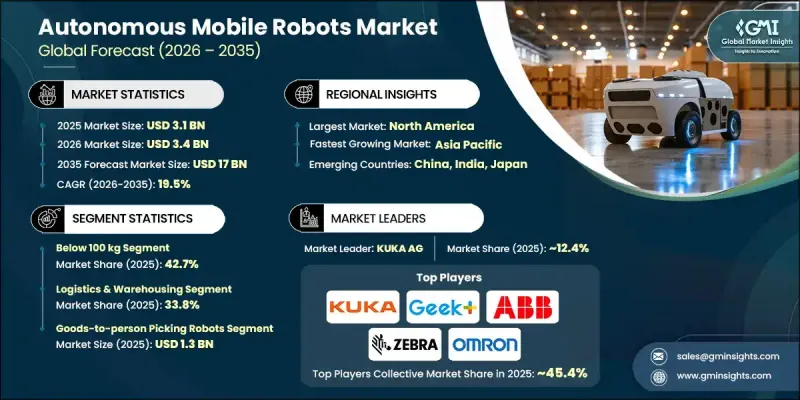
세계의 자율 이동 로봇(AMR) 시장은 2025년에 31억 달러로 평가되었고, 2035년까지 연평균 복합 성장률(CAGR) 19.5%로 성장하여 170억 달러에 이를 것으로 예측됩니다.
이러한 시장 성장은 물류, 제조, 의료, 서비스 지향적 환경에서의 자동화 수요 증가를 반영합니다. 조직은 작업장 안전성 향상, 업무 효율성 강화, 인력 의존도 감소를 목적으로 자율 이동 로봇의 도입을 확대하고 있습니다. 자동화 이니셔티브가 확대되고 업무가 복잡해짐에 따라 지능형 로봇 솔루션에 대한 수요는 계속 증가하고 있습니다. 적재 능력의 발전으로 로봇은 더 큰 적재량을 관리할 수 있게 되어 작업 주기를 단축하고 전체 시설의 워크플로우 효율을 향상시키고 있습니다. 인공지능(AI)과 머신러닝은 현재 자율 주행 시스템의 핵심 구성 요소로, 적응형 내비게이션, 실시간 의사결정, 고도화된 데이터 처리를 가능하게 합니다. 이러한 기능을 통해 로봇은 역동적인 환경에서 효과적으로 작동할 수 있으며, 동시에 정확도와 신뢰성을 향상시킬 수 있습니다. 전 세계적으로 디지털 전환이 가속화되고 있는 가운데, 자율 이동 로봇은 여러 산업 분야에서 현대적 업무 전략의 필수적인 요소로 자리 잡고 있습니다.
시장 범위
개시 연도
2025년
예측 연도
2026-2035년
개시 연도 가치
31억 달러
예측 금액
170억 달러
CAGR
19.5%
2025년에는 100kg 미만의 페이로드 카테고리가 42.7%의 점유율을 차지할 것으로 예측됩니다. 이 부문의 로봇은 경량 작업용으로 설계되었으며, 에너지 효율, 정밀한 탐색, 소형 폼 팩터에 최적화되어 있습니다. 제조업체는 이 페이로드 범위 내에서 다양한 운영 요구 사항을 충족시키기 위해 배터리 수명 연장, 정확한 동작 제어, 안전한 페이로드 처리, 비용 효율적인 확장성을 중요시합니다.
전자기기 및 반도체 부문은 2026년부터 2035년까지 연평균 복합 성장률(CAGR) 20.8%를 나타낼 것으로 예측됩니다. 이러한 성장은 자동화 요구 증가, 제조 정확도 향상에 대한 요구, 생산 주기의 가속화, 엄격한 품질 기준에 의해 뒷받침되고 있습니다. 지속적인 기술 혁신, 유연한 생산 능력, 연구개발에 대한 지속적인 투자는 이 분야에 진출하는 제조업체에게 여전히 중요합니다.
북미 자율이동로봇(AMR) 시장은 2025년 33.5%의 점유율을 차지했습니다. 이 지역의 성장은 첨단 제조 기술 채택, 자동화 물류 솔루션에 대한 수요 증가, 인건비 상승, 로봇 기술 혁신에 대한 강력한 투자에 의해 주도되고 있습니다. 스마트 제조 기술과 유연한 자동화 시스템의 통합은 이 지역 시장 리더십을 지속적으로 강화하고 있습니다.
목차
제1장 조사 방법과 범위
제2장 주요 요약
제3장 업계 인사이트
생태계 분석
공급업체 상황
이익률
비용 구조
각 단계 부가가치
밸류체인에 영향을 미치는 요인
파괴적 변화
생태계 분석
업계에 대한 영향요인
성장 촉진요인
전자상거래와 창고 자동화 성장
의료 및 제약 분야 자율 이동 로봇 확대
농업 및 식품 가공 분야 자율 이동 로봇(AMR) 도입
산업 및 물류 업무 안전성·효율성 향상
호스피탈리티 업계 자율 이동 로봇(AMR) 응용 확대
과제와 곤란
자율 이동 로봇에 관련된 고비용
자율 이동 로봇 기술(AMR) 통합과 도입 과제
시장 기회
라스트 마일 배송 확대
스마트 공장과의 통합
성장 가능성 분석
규제 상황
북미
유럽
아시아태평양
라틴아메리카
중동 및 아프리카
Porter의 Five Forces 분석
PESTEL 분석
기술과 혁신 동향
현재 기술 동향
신기술
신흥 비즈니스 모델
컴플라이언스 요건
지속가능성 대책
소비자 심리분석
특허 및 지적재산 분석
지정학적·무역 동향
제4장 경쟁 구도
서론
기업의 시장 점유율 분석
지역별
북미
유럽
아시아태평양
라틴아메리카
중동 및 아프리카
시장 집중도 분석
주요 기업의 경쟁 벤치마킹
재무 실적 비교
매출
이익률
연구개발
제품 포트폴리오 비교
제품 라인 넓이
기술
혁신
지역 존재감 비교
세계 전개 분석
서비스 네트워크 커버율
지역별 시장 침투율
경쟁 포지셔닝 매트릭스
리더 기업
챌린저
팔로워
니치 기업
전략적 전망 매트릭스
주요 발전, 2021-2024
인수합병(M&A)
제휴 및 공동 사업
기술적 진보
확대와 투자 전략
지속가능성 이니셔티브
디지털 전환 대처
신흥/스타트업 경쟁 동향
제5장 시장 추산·예측 : 컴포넌트별, 2022-2035
하드웨어
소프트웨어 및 서비스
제6장 시장 추산·예측 : 유형별, 2022-2035
상품 반송형 피킹 로봇
자율주행 지게차
자율형 재고 관리 로봇
무인항공기
제7장 시장 추산·예측 : 적재량별, 2022-2035
100kg 미만
100 kg-500kg
500kg 이상
제8장 시장 추산·예측 : 내비게이션 기술별, 2022-2035
레이저/라이더
비전 가이던스
기타
제9장 시장 추산·예측 : 배터리 유형별, 2022-2035
납축전지
리튬 이온 배터리
니켈계 배터리
기타
제10장 시장 추산·예측 : 용도별, 2022-2035
선별
운송
조립
재고 관리
기타
제11장 시장 추산·예측 : 최종 이용 산업별, 2022-2035
물류 및 창고업
소매
자동차
전자기기 및 반도체
의약품 및 헬스케어
식품 및 음료
항공우주 및 방위
호스피탈리티
기타
제12장 시장 추산·예측 : 지역별, 2022-2035
북미
미국
캐나다
유럽
독일
영국
프랑스
스페인
이탈리아
네덜란드
아시아태평양
중국
인도
일본
호주
한국
라틴아메리카
브라질
멕시코
아르헨티나
중동 및 아프리카
남아프리카공화국
사우디아라비아
아랍에미리트(UAE)
제13장 기업 개요
세계의 주요 기업
ABB Ltd.
KUKA AG
Omron Corporation
Zebra Technologies Corp.
지역별 주요 기업
북미
Aethon, Inc.
Vecna Robotics
ForwardX Robotics
Mobile Industrial Robots
아시아태평양
Geekplus Technology Co., Ltd.
YUJIN ROBOT Co., Ltd.
Honda Motor Co., Ltd.
유럽
Fanuc
GreyOrange
Locus Robotics
Murata Machinery, Ltd.
니치 기업/디스럽터
Balyo
Boston Dynamics
Onward Robotics
Seegrid
Teradyne Inc.
JBT
LSH
영문 목차
영문목차
The Global Autonomous Mobile Robots (AMR) Market was valued at USD 3.1 billion in 2025 and is estimated to grow at a CAGR of 19.5% to reach USD 17 billion by 2035.
Market growth reflects the rising need for automation across logistics, manufacturing, healthcare, and service-oriented environments. Organizations are increasingly deploying autonomous mobile robots to improve workplace safety, enhance operational efficiency, and reduce dependency on manual labor. Expanding automation initiatives, combined with rising operational complexity, continue to strengthen demand for intelligent robotic solutions. Advances in load-handling capabilities allow robots to manage larger payloads, reducing task cycles and improving workflow efficiency across facilities. Artificial intelligence and machine learning are now core components of autonomous systems, enabling adaptive navigation, real-time decision-making, and advanced data processing. These capabilities allow robots to function effectively in dynamic settings while improving precision and reliability. As digital transformation accelerates globally, autonomous mobile robots are becoming an essential part of modern operational strategies across multiple industries.
Market Scope
Start Year
2025
Forecast Year
2026-2035
Start Value
$3.1 Billion
Forecast Value
$17 Billion
CAGR
19.5%
The below 100 kg payload category accounted for 42.7% share in 2025. Robots in this segment are designed for lightweight operations and are optimized for energy efficiency, precise navigation, and compact form factors. Manufacturers emphasize extended battery life, accurate movement control, secure payload handling, and cost-effective scalability to meet diverse operational requirements within this payload range.
The electronics and semiconductor segment is expected to grow at a CAGR of 20.8% during 2026-2035. Growth is supported by increasing automation requirements, demand for higher manufacturing precision, faster production cycles, and strict quality standards. Continuous innovation, flexible production capabilities, and sustained investment in research and development remain critical for manufacturers serving this segment.
North America Autonomous Mobile Robots (AMR) Market held a 33.5% share in 2025. Regional growth is driven by advanced manufacturing adoption, rising demand for automated logistics solutions, increasing labor costs, and strong investment in robotics innovation. The integration of smart manufacturing technologies and flexible automation systems continues to reinforce market leadership in the region.
Key companies operating in the Global Autonomous Mobile Robots (AMR) Market include ABB Ltd., Boston Dynamics, KUKA AG, Fanuc, Omron Corporation, Locus Robotics, Geekplus Technology Co., Ltd., GreyOrange, Mobile Industrial Robots, Zebra Technologies Corp., Teradyne Inc., Honda Motor Co., Ltd., Murata Machinery Ltd., ForwardX Robotics, Seegrid, Vecna Robotics, Aethon, Inc., JBT, Balyo, Onward Robotics, and YUJIN ROBOT Co., Ltd. Companies in the Global Autonomous Mobile Robots (AMR) Market strengthen their market position through continuous technological advancement, product diversification, and strategic partnerships. Investment in artificial intelligence, navigation software, and sensor integration enhances robot autonomy and adaptability. Manufacturers focus on modular and scalable platforms to address varied operational needs across industries. Geographic expansion and collaboration with logistics, manufacturing, and technology providers support broader market penetration.
Table of Contents
Chapter 1 Methodology and Scope
1.1 Market scope and definition
1.2 Research design
1.2.1 Research approach
1.2.2 Data collection methods
1.3 Data mining sources
1.3.1 Global
1.3.2 Regional/Country
1.4 Base estimates and calculations
1.4.1 Base year calculation
1.4.2 Key trends for market estimation
1.5 Primary research and validation
1.5.1 Primary sources
1.6 Forecast model
1.7 Research assumptions and limitations
Chapter 2 Executive summary
2.1 Industry 360° synopsis
2.2 Key market trends
2.2.1 Component trends
2.2.2 Type trends
2.2.3 Payload capacity trends
2.2.4 Navigation technology trends
2.2.5 Battery type trends
2.2.6 Application trends
2.2.7 End use industry trends
2.2.8 Regional trends
2.3 TAM Analysis, 2026-2035 (USD Million)
2.4 CXO perspectives: Strategic imperatives
2.4.1 Executive decision points
2.4.2 critical success factors
2.5 Future outlook and strategic recommendations
Chapter 3 Industry insights
3.1 Industry ecosystem analysis
3.1.1 Supplier landscape
3.1.2 Profit margin
3.1.3 Cost structure
3.1.4 Value addition at each stage
3.1.5 Factor affecting the value chain
3.1.6 Disruptions
3.2 Industry ecosystem analysis
3.3 Industry impact forces
3.3.1 Growth drivers
3.3.1.1 Growth of e-commerce and warehouse automation
3.3.1.2 Expansion of AMRs in healthcare and pharmaceuticals
3.3.1.3 Adoption of AMRs in agriculture and food processing
3.3.1.4 Enhanced safety and efficiency in industrial and logistics operations
3.3.1.5 Increasing application of AMRs in the hospitality industry
3.3.2 Pitfalls and challenges
3.3.2.1 High cost associated with autonomous mobile robots
3.3.2.2 Challenges in integration and deployment of AMR technologies
3.3.3 Market opportunities
3.3.3.1 Expansion in last-mile delivery
3.3.3.2 Integration with smart factories
3.4 Growth potential analysis
3.5 Regulatory landscape
3.5.1 North America
3.5.2 Europe
3.5.3 Asia Pacific
3.5.4 Latin America
3.5.5 Middle East & Africa
3.6 Porter';s analysis
3.7 PESTEL analysis
3.8 Technology and Innovation landscape
3.8.1 Current technological trends
3.8.2 Emerging technologies
3.9 Emerging Business Models
3.10 Compliance Requirements
3.11 Sustainability Measures
3.12 Consumer Sentiment Analysis
3.13 Patent and IP analysis
3.14 Geopolitical and trade dynamics
Chapter 4 Competitive landscape, 2025
4.1 Introduction
4.2 Company market share analysis
4.2.1 By region
4.2.1.1 North America
4.2.1.2 Europe
4.2.1.3 Asia Pacific
4.2.1.4 Latin America
4.2.1.5 Middle East & Africa
4.2.2 Market concentration analysis
4.3 Competitive benchmarking of key players
4.3.1 Financial performance comparison
4.3.1.1 Revenue
4.3.1.2 Profit margin
4.3.1.3 R&D
4.3.2 Product portfolio comparison
4.3.2.1 Product range breadth
4.3.2.2 Technology
4.3.2.3 Innovation
4.3.3 Geographic presence comparison
4.3.3.1 Global footprint analysis
4.3.3.2 Service network coverage
4.3.3.3 Market penetration by region
4.3.4 Competitive positioning matrix
4.3.4.1 Leaders
4.3.4.2 Challengers
4.3.4.3 Followers
4.3.4.4 Niche players
4.3.5 Strategic outlook matrix
4.4 Key developments, 2021-2024
4.4.1 Mergers and acquisitions
4.4.2 Partnerships and collaborations
4.4.3 Technological advancements
4.4.4 Expansion and investment strategies
4.4.5 Sustainability initiatives
4.4.6 Digital transformation initiatives
4.5 Emerging/ startup competitors landscape
Chapter 5 Market Estimates and Forecast, By Component, 2022 - 2035 (USD Million & Units)
5.1 Key trends
5.2 Hardware
5.3 Software & services
Chapter 6 Market Estimates and Forecast, By Type, 2022 - 2035 (USD Million & Units)
6.1 Key trends
6.2 Goods-to-person picking robots
6.3 Self-driving forklifts
6.4 Autonomous inventory robots
6.5 Unmanned aerial vehicles
Chapter 7 Market Estimates and Forecast, By Payload Capacity, 2022 - 2035 (USD Million & Units)
7.1 Key trends
7.2 Below 100 kg
7.3 100 kg - 500 kg
7.4 More than 500 kg
Chapter 8 Market Estimates and Forecast, By Navigation Technology, 2022 - 2035 (USD Million & Units)
8.1 Key trends
8.2 Laser/lidar
8.3 Vision guidance
8.4 Others
Chapter 9 Market Estimates and Forecast, By Battery Type, 2022 - 2035 (USD Million & Units)
9.1 Key trends
9.2 Lead battery
9.3 Lithium-ion battery
9.4 Nickel-based battery
9.5 Others
Chapter 10 Market Estimates and Forecast, By Application, 2022 - 2035 (USD Million & Units)
10.1 Key trends
10.2 Sorting
10.3 Transportation
10.4 Assembly
10.5 Inventory management
10.6 Others
Chapter 11 Market Estimates and Forecast, By End Use Industry, 2022 - 2035 (USD Million & Units)
11.1 Key trends
11.2 Logistics & warehousing
11.3 Retail
11.4 Automotive
11.5 Electronics & semiconductor
11.6 Pharmaceuticals & healthcare
11.7 Food & beverage
11.8 Aerospace & defense
11.9 Hospitality
11.10 Others
Chapter 12 Market Estimates and Forecast, By Region, 2022 - 2035 (USD Million & Units)