반도체 제조 장비 시장 : 리소그래피, 웨이퍼 표면 처리, 웨이퍼 세정, 증착, 조립, 패키징, 다이싱, 계측, 본딩, 웨이퍼 검사, IC 검사, 메모리, 로직, 디스크리트, 아날로그별, 예측(-2032년)
Semiconductor Manufacturing Equipment Market by Lithography, Wafer Surface Conditioning, Wafer Cleaning, Deposition, Assembly & Packaging, Dicing, Metrology, Bonding, Wafer Testing/IC Testing, Memory, Logic, Discrete, Analog - Global Forecast to 2032
상품코드:1881235
리서치사:MarketsandMarkets
발행일:2025년 11월
페이지 정보:영문 316 Pages
라이선스 & 가격 (부가세 별도)
ㅁ Add-on 가능: 고객의 요청에 따라 일정한 범위 내에서 Customization이 가능합니다. 자세한 사항은 문의해 주시기 바랍니다.
한글목차
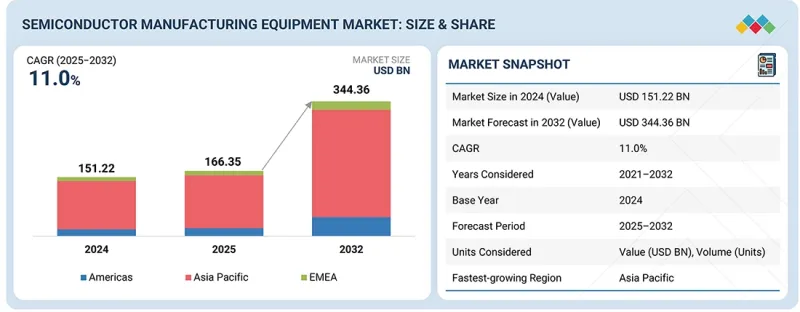
세계 반도체 제조장비 시장 규모는 2025년 1,663억 5,000만 달러, 2032년까지 3,443억 6,000만 달러에 이를 것으로 예측되며, CAGR은 11.0%를 나타낼 전망입니다.
자동차용 반도체 부문의 급속한 성장은 2025년 반도체 제조 장비 시장의 주요 촉진요인으로 부상하고 있습니다. 자동차 산업이 전기, 자율주행, 첨단 연결성, 소프트웨어 정의 아키텍처로 전환하는 동안 마이크로컨트롤러, PMIC, 센서, ADAS 프로세서를 포함한 고신뢰성 반도체 부품에 대한 수요는 급격히 증가하고 있습니다.
조사 범위
조사 기간
2021-2032년
기준 연도
2024년
예측 기간
2025-2032년
단위
10억 달러
부문
제조 공정, 최종 사용자, 전 공정 장비, 후 공정 장비, 지역
대상 지역
북미, 유럽, 아시아태평양 및 기타 지역
전기자동차(EV)로의 급속한 전환과 1대당 반도체 탑재량 증가로 인해 트랙션 인버터, 배터리 관리 시스템, 파워 일렉트로닉스, 센싱 모듈, ADAS 플랫폼 등에 사용되는 첨단 칩 수요가 대폭 증가하고 있습니다. 자동차 제조업체와 Tier 1 공급업체는 자동차 등급 반도체 생산을 위해 팹 생산 능력을 확대하고 기존 라인을 업그레이드하고 있으며, 리소그래피, 증착, 에칭, 측정 및 검사 도구와 같은 중요한 장비에 대한 투자를 직접 촉진하고 있습니다. 자동차 응용 분야에서 엄격한 성능, 신뢰성 및 추적성 요구 사항을 바탕으로 이 부문은 정밀 제조와 견고한 품질 관리를 중시하며 자동차 인증 툴 세트를 갖춘 반도체 제조 장비 공급업체에게 혜택을 제공합니다.
"OSAT 기업이 예측 기간에 최고의 CAGR을 기록할 전망입니다."
OSAT 기업은 업계가 첨단 패키징 및 고밀도 검사 요건으로 빠르게 전환하는 핵심에 있기 때문에 예측 기간에 가장 높은 CAGR을 나타낼 것으로 예측됩니다. 칩 설계가 AI/ML, HPC, 5G, 자율주행, 이기종 통합을 지원하는 방향으로 진화함에 따라 2.5D/3D 패키징, 팬아웃 웨이퍼 레벨 패키징, 시스템 임패키징(SiP), 고성능 자동검사장비(ATE) 등 선진 후공정에 대한 수요는 계속 급증하고 있습니다.
팹리스 기업은 비용 절감과 시장 투입의 가속을 목적으로 조립·검사 공정의 아웃소싱을 증가시키고 있으며, 이에 따라 OSAT 기업은 생산 능력의 확대와 첨단 장비의 채택을 강요받고 있습니다. 또한, 미세화의 진행, 칩렛 기반 아키텍처의 채택, 패키징 주도의 성능 향상으로의 전환이 OSAT 투자를 크게 밀어 올리고 있습니다. 이러한 요인으로 인해 최종 사용자별로는 OSAT 기업이 반도체 제조장비 시장에서 가장 성장이 빠른 부문이 되고 있습니다.
"검사장비가 2024년 반도체 제조후 공정장비 시장을 견인했습니다."
검사 장비는 반도체 제조 후 공정 장비 시장에서 가장 큰 점유율을 차지합니다. 이는 모든 반도체 장비가 출하 전에 기능 정확도, 성능 신뢰성 및 결함 없는 동작을 보장하기 위해 여러 검사 단계를 거쳐야 하기 때문입니다. I/O 수 증가, 미세화, 칩렛 아키텍처, 첨단 패키징 형식 등에 의해 칩의 복잡화가 진행됨에 따라 종합적인 전기적 검사, 기능 검사, 번인 검사, 시스템 레벨 검사에 대한 요구가 크게 증가하고 있습니다.
게다가 AI 가속기, 자동차 전자, 산업 자동화, 5G 등의 용도의 상승은 매우 높은 신뢰성과 안전 기준을 요구하고 검사 강도와 범위 요구 사항을 더욱 높여줍니다. 디바이스 고장에 드는 비용이 급격히 상승했기 때문에 엄격한 검사는 반도체 제조업체에게 필수적인 공정이 되고 있습니다. 결과적으로 OSAT, IDM, 팹리스 기업은 첨단 자동검사장비(ATE), 프로빙시스템, 검사기술에 대한 투자를 지속적으로 하고 있으며, 이로써 반도체 제조후 공정장비 시장에서 검사장비의 주도적 지위가 확고해집니다.
이 보고서는 세계 반도체 제조 장비 시장에 대한 조사 분석을 통해 주요 촉진요인 및 억제요인, 경쟁 구도, 미래 동향 등의 정보를 제공합니다.
목차
제1장 서론
제2장 주요 요약
제3장 중요한 지견
반도체 제조 장비 시장 : 기업에게 매력적인 기회
반도체 제조 장비 시장 : 최종사용자별
반도체 제조 장비 시장 : 전공정장비별
반도체 제조 장비 시장 : 지역별
제4장 시장 개요
소개
시장 역학
성장 촉진요인
억제요인
기회
과제
언멧 요구와 화이트 스페이스
연계 시장 및 교차 산업 기회
Tier 1/2/3 기업의 전략적 움직임
제5장 업계 동향
Porter's Five Forces 분석
거시경제지표
소개
GDP의 동향과 예측
세계의 파운드리 업계 동향
세계의 IDM 업계 동향
세계의 OSAT 업계 동향
밸류체인 분석
생태계 분석
가격 설정 분석
주요 기업이 제공하는 전 공정 리소그래피 장비의 평균 판매 가격의 동향 : 유형별(2021년-2024년)
표준 리소그래피 장비의 평균 판매 가격의 동향 : 지역별(2021년-2024년)
무역 분석
수입 시나리오(HS 코드 848620)
수출 시나리오(HS 코드 848620)
주요 컨퍼런스 및 이벤트(2025년-2026년)
고객사업에 영향을 주는 동향/혼란
투자 및 자금조달 시나리오
사례 연구 분석
반도체 제조장비 시장에 대한 2025년 미국 관세의 영향
소개
주요 관세율
가격의 영향 분석
국가/지역에 미치는 영향
최종 사용자에게 미치는 영향
제6장 기술의 진보, AI에 의한 영향, 특허, 혁신 및 미래의 용도
주요 신기술
극단 자외선(EUV) 리소그래피
웨이퍼 본딩
보완 기술
기술/제품 로드맵
특허 분석
반도체 제조장비 시장에 대한 AI/생성형 AI의 영향
주요 이용 사례와 시장의 장래성
반도체 제조 장비 시장에서의 OEM 모범 사례
반도체 제조 장비 시장에서의 AI 도입에 관한 사례 연구
상호 연결된 생태계와 시장 기업에 미치는 영향
AI/생성형 AI 통합 반도체 제조 장비의 채택에 대한 고객의 준비 상황
제7장 지역의 정세, 지속가능성에 관한 대처
지역 규제 및 규정 준수
규제기관, 정부기관, 기타 조직
업계 표준
지속가능성에 대한 노력
지속가능성 대처에 대한 규제정책의 영향
인증, 라벨, 환경 기준
제8장 고객정세와 구매행동
의사결정 프로세스
구매 프로세스에 참여하는 주요 이해관계자와 그 평가 기준
구매 프로세스의 주요 이해 관계자
구입 기준
채택 장벽과 내부 과제
다양한 최종 사용자의 언멧 요구
시장의 수익성
제9장 반도체 제조 장비에 있어서의 웨이퍼의 유형의 개관
소개
실리콘(SI)
실리콘 카바이드(SIC)
질화갈륨(GAN)
비소갈륨(GAAS)
기타 웨이퍼 유형
제10장 반도체 제조 장비의 최종 제품
소개
메모리
논리 디바이스
MPU
CPU
GPU
DSP
기타
이산 소자
아날로그 IC
기타 최종 제품
제11장 반도체 제조 장비에 있어서의 다양한 IC의 차원
소개
2D IC
2.5D IC
3D IC
제12장 반도체 제조 장비로 처리되는 웨이퍼의 사이즈
소개
150mm 이하
200mm
300mm
제13장 반도체 제조 장비 시장 : 제조 공정별
소개
전공정
후공정
기타 공정
제14장 반도체 제조 장비 시장 : 전공정 장비별
소개
리소그래피 장비
증착 장비
웨이퍼 표면 처리 장비
웨이퍼 세정 장비
계측·검사 장비
기타 전공정 장비
제15장 반도체 제조 장비 시장 : 후공정 장비별
소개
포장
다이싱
본딩
웨이퍼 검사/IC 검사
제16장 반도체 제조 장비 시장 : 최종 사용자별
소개
파운드리
IDMS
OSAT기업
기타 최종 사용자
제17장 반도체 제조 장비 시장 : 지역별
소개
아메리카
미국
기타 아메리카
아시아태평양
중국
일본
한국
대만
인도
기타 아시아태평양
유럽·중동 및 아프리카
유럽
중동 및 아프리카
제18장 경쟁 구도
개요
주요 참가 기업의 전략/강점(2024년-2025년)
수익 분석(2020년-2024년)
시장 점유율 분석(2024년)
기업 평가 및 재무 지표
제품 비교
기업 평가 매트릭스: 주요 기업(2024년)
기업의 평가 매트릭스: 스타트업/중소기업(2024년)
경쟁 시나리오
제19장 기업 프로파일
소개
주요 기업
APPLIED MATERIALS, INC.
ASML
TOKYO ELECTRON LIMITED
LAM RESEARCH CORPORATION
KLA CORPORATION
SCREEN HOLDINGS CO., LTD.
TERADYNE INC.
ZEISS GROUP
ADVANTEST CORPORATION
HITACHI HIGH-TECH CORPORATION
PLASMA-THERM
기타 기업
ASM INTERNATIONAL
EV GROUP(EVG)
ONTO INNOVATION
NORDSON CORPORATION
ADT-ADVANCED DICING TECHNOLOGIES
BENEQ
CVD EQUIPMENT CORPORATION
EUGENE TECHNOLOGY CO. LTD.
NIKON CORPORATION
SEMICONDUCTOR EQUIPMENT CORP.
SENTECH INSTRUMENTS GMBH
CANON INC.
KOKUSAI ELECTRIC CORPORATION
SEMES
FORMFACTOR
최종 사용자
FOUNDRIES
IDM FIRMS
OSAT COMPANIES
제20장 조사 방법
제21장 부록
SHW
영문 목차
영문목차
The global semiconductor manufacturing equipment market is projected to grow from USD 166.35 billion in 2025 to USD 344.36 billion by 2032, at a CAGR of 11.0%. The rapid acceleration of the automotive semiconductor sector is emerging as a major driver of the semiconductor manufacturing equipment market in 2025. As the automotive industry transitions toward electrification, autonomous driving, enhanced connectivity, and software-defined architectures, demand for high-reliability semiconductor components, including microcontrollers, power-management ICs, sensors, and ADAS processors, continues to rise sharply.
Scope of the Report
Years Considered for the Study
2021-2032
Base Year
2024
Forecast Period
2025-2032
Units Considered
Value (USD Billion)
Segments
By Manufacturing Phase, End User, Front-end Equipment, Back-end Equipment and Region
Regions covered
North America, Europe, APAC, RoW
The rapid shift toward EVs and higher semiconductor content per vehicle is substantially increasing demand for advanced chips used in traction inverters, battery-management systems, power electronics, sensing modules, and ADAS platforms. Automakers and tier-one suppliers are expanding fab capacity and upgrading existing lines to produce automotive-grade semiconductors, directly boosting investments in critical equipment such as lithography, deposition, etch, metrology, and inspection tools. Given the stringent performance, reliability, and traceability requirements in automotive applications, the segment places strong emphasis on precision manufacturing and robust quality control, benefiting semiconductor manufacturing equipment suppliers with automotive-qualified toolsets.
"OSAT Companies to Record Highest CAGR During Forecast Period"
OSAT companies are expected to record the highest CAGR during the forecast period because they are at the center of the industry's rapid shift toward advanced packaging and high-density testing requirements. As chip designs evolve to support AI/ML, HPC, 5G, automotive autonomy, and heterogeneous integration, the demand for sophisticated backend processes such as 2.5D/3D packaging, fan-out wafer-level packaging, system-in-package (SiP), and high-performance automated test equipment continues to surge.
Fabless companies are increasingly outsourcing assembly and testing to reduce costs and accelerate time-to-market, prompting OSATs to expand their capacity and adopt more advanced equipment. Furthermore, increased miniaturization, the adoption of chiplet-based architectures, and the transition toward packaging-driven performance improvements are significantly boosting OSAT investments. Collectively, these factors position OSAT companies as the fastest-growing segment in the semiconductor manufacturing equipment market based on end users.
"Testing Equipment Led Semiconductor Manufacturing Back-end Equipment Market in 2024"
Testing equipment holds the largest share of the back-end semiconductor manufacturing equipment market because every semiconductor device must undergo multiple mandatory test stages to ensure functional accuracy, performance reliability, and defect-free operation before shipment. As chips become more complex, with higher I/O counts, smaller geometries, chiplet architectures, and advanced packaging formats, the need for comprehensive electrical, functional, burn-in, and system-level testing increases significantly.
Moreover, the rise of applications such as AI accelerators, automotive electronics, industrial automation, and 5G requires extremely high reliability and safety standards, further increasing the intensity and coverage requirements of testing. The cost of device failure has risen sharply, making robust testing a non-negotiable step for semiconductor manufacturers. As a result, OSATs, IDMs, and fabless companies consistently invest in advanced automated test equipment (ATE), probing systems, and inspection technologies, thereby solidifying the leading position of testing equipment in the back-end semiconductor manufacturing equipment market.
"China to Dominate Asia Pacific Semiconductor Manufacturing Equipment Market throughout Forecast Period"
China holds the largest share of the semiconductor manufacturing equipment market due to its aggressive national push to expand domestic semiconductor production capacity and reduce dependence on foreign chip suppliers. The country has been investing heavily in new fabs, equipment procurement, and advanced manufacturing infrastructure as part of government-led initiatives, such as "Made in China 2025" and successive Five-year Plans, which prioritize semiconductor self-sufficiency.
China also hosts one of the world's fastest-growing ecosystems of foundries, memory manufacturers, and OSAT companies, such as JCET and Tongfu Microelectronics, driving continuous equipment purchases for capacity expansion and technology upgrades. Additionally, supply-chain localization efforts, coupled with increased government subsidies, tax incentives, and capital investments, have significantly boosted demand for equipment across lithography, etch, deposition, and backend packaging segments.
Breakdown of Primaries
Various executives from key organizations operating in the semiconductor manufacturing equipment market were interviewed in-depth, including CEOs, marketing directors, and innovation and technology directors.
By Company Type: Tier 1 - 25%, Tier 2 - 35%, and Tier 3 - 40%
By Designation: C-level Executives - 40%, Directors - 30%, and Others - 30%
By Region: Asia Pacific - 45%, Americas - 35%, EMEA - 20%
The semiconductor manufacturing equipment market is dominated by globally established players, such as
Applied Materials, Inc. (US), ASML (Netherlands), Tokyo Electron Limited (Japan), LAM RESEARCH CORPORATION (US), KLA Corporation (US), SCREEN Holdings Co., Ltd. (Japan), Teradyne Inc. (US), ADVANTEST CORPORATION (Japan), Hitachi High-Tech Corporation (Japan), Plasma-Therm (US), ASM International N.V. (Netherlands), EV Group (EVG) (Austria), Onto Innovation (US), Nordson Corporation (US), ADT - Advanced Dicing Technologies (Israel), Beneq (Finland), CVD Equipment Corporation (US), Eugenus, Inc. (South Korea), Nikon Corporation (Japan), Semiconductor Equipment Corp. (US), SENTECH Instruments GmbH (Germany), Canon Inc. (Japan), KOKUSAI ELECTRIC CORPORATION (Japan), SEMES (South Korea), and FormFactor (US). The study includes an in-depth competitive analysis of these key players in the semiconductor manufacturing equipment market, with their company profiles, recent developments, and key market strategies.
Study Coverage
The report segments the semiconductor manufacturing equipment market by manufacturing phase, including front-end equipment and back-end equipment, end user, and region. The report also examines the key drivers, restraints, opportunities, and challenges influencing the market. It provides a detailed view of the market across three main regions: the Americas, Asia Pacific, and EMEA. The report includes a value chain analysis of the key players and their competitive analysis of the semiconductor manufacturing equipment ecosystem.
Key benefits of buying the report are as follows:
Analysis of key drivers (rising miniaturization and advanced node adoption), restraints (high capital and operational costs), opportunities (rising adoption of advanced packaging technologies), and challenges (stringent regulatory compliance) influencing the growth of the semiconductor manufacturing equipment market
Products/Solution/Service Development/Innovation: Detailed insights into upcoming technologies, research, and development activities in the semiconductor manufacturing equipment market
Market Development: Comprehensive information about lucrative markets, provided by analyzing the semiconductor manufacturing equipment market across varied regions
Market Diversification: Exhaustive information about new semiconductor manufacturing equipment in untapped geographies, recent developments, and investments in the semiconductor manufacturing equipment market
Competitive Assessment: In-depth assessment of market shares and growth strategies and offerings of leading players, such as Applied Materials, Inc. (US), ASML (Netherlands), LAM RESEARCH CORPORATION (US), Tokyo Electron Limited (Japan), and KLA Corporation (US)
TABLE OF CONTENTS
1 INTRODUCTION
1.1 STUDY OBJECTIVES
1.2 MARKET DEFINITION
1.3 STUDY SCOPE
1.3.1 MARKETS COVERED AND REGIONAL SCOPE
1.3.2 INCLUSIONS AND EXCLUSIONS
1.3.3 YEARS CONSIDERED
1.4 CURRENCY CONSIDERED
1.5 UNIT CONSIDERED
1.6 LIMITATIONS
1.7 STAKEHOLDERS
1.8 SUMMARY OF CHANGES
2 EXECUTIVE SUMMARY
2.1 MARKET HIGHLIGHTS AND KEY INSIGHTS
2.2 KEY MARKET PARTICIPANTS: MAPPING OF STRATEGIC DEVELOPMENTS
2.3 DISRUPTIVE TRENDS IN SEMICONDUCTOR MANUFACTURING EQUIPMENT MARKET
2.4 HIGH-GROWTH SEGMENTS
2.5 SNAPSHOT: GLOBAL MARKET SIZE, GROWTH RATE, AND FORECAST
3 PREMIUM INSIGHTS
3.1 ATTRACTIVE OPPORTUNITIES FOR PLAYERS IN SEMICONDUCTOR MANUFACTURING EQUIPMENT MARKET
3.2 SEMICONDUCTOR MANUFACTURING EQUIPMENT MARKET, BY END USER
3.3 SEMICONDUCTOR MANUFACTURING EQUIPMENT MARKET, BY FRONT-END EQUIPMENT
3.4 SEMICONDUCTOR MANUFACTURING EQUIPMENT MARKET, BY REGION
4 MARKET OVERVIEW
4.1 INTRODUCTION
4.2 MARKET DYNAMICS
4.2.1 DRIVERS
4.2.1.1 Increasing miniaturization and advanced node adoption
4.2.1.2 Rising autonomous vehicle adoption and digitalization
4.2.1.3 Rapid expansion of semiconductor fabrication capacity
4.2.1.4 Proliferation of AI, HPC, and data-centric workloads
4.2.2 RESTRAINTS
4.2.2.1 High capital and operational costs
4.2.2.2 Rising complexity of semiconductor manufacturing processes
4.2.3 OPPORTUNITIES
4.2.3.1 Mounting adoption of advanced packaging technologies
4.2.3.2 Government-led initiatives to strengthen semiconductor manufacturing
4.2.4 CHALLENGES
4.2.4.1 Complexities associated with transitioning to smaller geometries and higher transistor densities
4.2.4.2 Rising implementation of stringent environmental norms
4.3 UNMET NEEDS AND WHITE SPACES
4.4 INTERCONNECTED MARKETS AND CROSS-SECTOR OPPORTUNITIES
4.5 STRATEGIC MOVES BY TIER 1/2/3 PLAYERS
5 INDUSTRY TRENDS
5.1 PORTER'S FIVE FORCES ANALYSIS
5.1.1 INTENSITY OF COMPETITIVE RIVALRY
5.1.2 BARGAINING POWER OF SUPPLIERS
5.1.3 BARGAINING POWER OF BUYERS
5.1.4 THREAT OF SUBSTITUTES
5.1.5 THREAT OF NEW ENTRANTS
5.2 MACROECONOMICS INDICATORS
5.2.1 INTRODUCTION
5.2.2 GDP TRENDS AND FORECAST
5.2.3 TRENDS IN GLOBAL FOUNDRY INDUSTRY
5.2.4 TRENDS IN GLOBAL IDM INDUSTRY
5.2.5 TRENDS IN GLOBAL OSAT INDUSTRY
5.3 VALUE CHAIN ANALYSIS
5.4 ECOSYSTEM ANALYSIS
5.5 PRICING ANALYSIS
5.5.1 AVERAGE SELLING PRICE TREND OF FRONT-END LITHOGRAPHY EQUIPMENT OFFERED BY KEY PLAYERS, BY TYPE, 2021-2024
5.5.2 AVERAGE SELLING PRICE TREND OF STANDARD LITHOGRAPHY EQUIPMENT, BY REGION, 2021-2024
5.6 TRADE ANALYSIS
5.6.1 IMPORT SCENARIO (HS CODE 848620)
5.6.2 EXPORT SCENARIO (HS CODE 848620)
5.7 KEY CONFERENCES AND EVENTS, 2025-2026
5.8 TRENDS/DISRUPTIONS IMPACTING CUSTOMER BUSINESS
5.9 INVESTMENT AND FUNDING SCENARIO
5.10 CASE STUDY ANALYSIS
5.10.1 HCL AND FOXCONN COLLABORATE TO ESTABLISH OSAT FACILITY IN INDIA TO NAVIGATE REGULATORY COMPLEXITIES
5.10.2 SYNOVA SA IMPLEMENTS LASER MICROJET TECHNOLOGY TO ACHIEVE PRECISE AND HIGH-QUALITY WAFER DICING AND DIE SINGULATION
5.10.3 INTEL SECURES ASML'S HIGH-NA EUV MACHINES TO PRODUCE ADVANCED CHIPS WITH GREATER PRECISION AND EFFICIENCY
5.11 IMPACT OF 2025 US TARIFF ON SEMICONDUCTOR MANUFACTURING EQUIPMENT MARKET
5.11.1 INTRODUCTION
5.11.2 KEY TARIFF RATES
5.11.3 PRICE IMPACT ANALYSIS
5.11.4 IMPACT ON COUNTRIES/REGIONS
5.11.4.1 US
5.11.4.2 Europe
5.11.4.3 Asia Pacific
5.11.5 IMPACT ON END USERS
6 TECHNOLOGICAL ADVANCEMENTS, AI-DRIVEN IMPACTS, PATENTS, INNOVATIONS, AND FUTURE APPLICATIONS
6.1 KEY EMERGING TECHNOLOGIES
6.1.1 EXTREME ULTRAVIOLET (EUV) LITHOGRAPHY
6.1.2 WAFER BONDING
6.2 COMPLEMENTARY TECHNOLOGIES
6.2.1 FLIP CHIP
6.3 TECHNOLOGY/PRODUCT ROADMAP
6.4 PATENT ANALYSIS
6.5 IMPACT OF AI/GEN AI ON SEMICONDUCTOR MANUFACTURING EQUIPMENT MARKET
6.5.1 TOP USE CASES AND MARKET POTENTIAL
6.5.2 BEST PRACTICES FOLLOWED BY OEMS IN SEMICONDUCTOR MANUFACTURING EQUIPMENT MARKET
6.5.3 CASE STUDIES RELATED TO AI IMPLEMENTATION IN SEMICONDUCTOR MANUFACTURING EQUIPMENT MARKET
6.5.4 INTERCONNECTED ECOSYSTEM AND IMPACT ON MARKET PLAYERS
6.5.5 CLIENTS' READINESS TO ADOPT AI/GEN AI-INTEGRATED SEMICONDUCTOR MANUFACTURING EQUIPMENT
7 REGIONAL LANDSCAPE AND SUSTAINABILITY INITIATIVES
7.1 REGIONAL REGULATIONS AND COMPLIANCE
7.1.1 REGULATORY BODIES, GOVERNMENT AGENCIES, AND OTHER ORGANIZATIONS
7.1.2 INDUSTRY STANDARDS
7.2 SUSTAINABILITY INITIATIVES
7.2.1 CARBON IMPACT AND ECO-APPLICATION FOR SEMICONDUCTOR MANUFACTURING EQUIPMENT
7.3 IMPACT OF REGULATORY POLICIES ON SUSTAINABILITY INITIATIVES
7.4 CERTIFICATIONS, LABELING, AND ECO-STANDARDS
8 CUSTOMER LANDSCAPE AND BUYER BEHAVIOR
8.1 DECISION-MAKING PROCESS
8.2 KEY STAKEHOLDERS INVOLVED IN BUYING PROCESS AND THEIR EVALUATION CRITERIA
8.2.1 KEY STAKEHOLDERS IN BUYING PROCESS
8.2.2 BUYING CRITERIA
8.3 ADOPTION BARRIERS AND INTERNAL CHALLENGES
8.4 UNMET NEEDS OF VARIOUS END USERS
8.5 MARKET PROFITABILITY
9 OVERVIEW OF WAFER TYPES IN SEMICONDUCTOR MANUFACTURING EQUIPMENT
9.1 INTRODUCTION
9.2 SILICON (SI)
9.3 SILICON CARBIDE (SIC)
9.4 GALLIUM NITRIDE (GAN)
9.5 GALLIUM ARSENIDE (GAAS)
9.6 OTHER WAFER TYPES
10 END PRODUCTS OF SEMICONDUCTOR MANUFACTURING EQUIPMENT
10.1 INTRODUCTION
10.2 MEMORY
10.3 LOGIC DEVICES
10.3.1 MPU
10.3.2 CPU
10.3.3 GPU
10.3.4 DSP
10.3.5 OTHERS
10.4 DISCRETE DEVICES
10.5 ANALOG ICS
10.6 OTHER END PRODUCTS
11 VARIED IC DIMENSIONS WITHIN SEMICONDUCTOR MANUFACTURING EQUIPMENT
11.1 INTRODUCTION
11.2 2D ICS
11.3 2.5D ICS
11.4 3D ICS
12 WAFER SIZES PROCESSED BY SEMICONDUCTOR MANUFACTURING EQUIPMENT
12.1 INTRODUCTION
12.2 <=150 MM
12.3 200 MM
12.4 300 MM
13 SEMICONDUCTOR MANUFACTURING EQUIPMENT MARKET, BY MANUFACTURING PHASE
13.1 INTRODUCTION
13.2 FRONT-END
13.2.1 EMPHASIS ON ENERGY EFFICIENCY, DEFECT REDUCTION, AND SUSTAINABILITY TO FOSTER SEGMENTAL GROWTH
13.3 BACK-END
13.3.1 ADVANCES IN WAFER-LEVEL FAN-OUT PACKAGING AND FOCUS ON TEST OPTIMIZATION TO EXPEDITE SEGMENTAL GROWTH
13.4 OTHER PHASES
14 SEMICONDUCTOR MANUFACTURING EQUIPMENT MARKET, BY FRONT-END EQUIPMENT
14.1 INTRODUCTION
14.2 LITHOGRAPHY EQUIPMENT
14.2.1 FOCUS ON OPTICAL PRECISION AND OVERLAY ACCURACY TO SUPPORT NEXT-GENERATION FABRICATION TO DRIVE MARKET
14.2.2 PHOTOLITHOGRAPHY
14.2.2.1 Deep ultraviolet (DUV)
14.2.2.2 Extreme ultraviolet (EUV)
14.2.3 ELECTRON BEAM LITHOGRAPHY
14.2.4 ION BEAM LITHOGRAPHY
14.2.5 NANOIMPRINT LITHOGRAPHY
14.2.6 OTHER LITHOGRAPHY EQUIPMENT
14.3 DEPOSITION EQUIPMENT
14.3.1 EVOLUTION OF DEVICE SCALING AND 3D INTEGRATION TO CONTRIBUTE TO SEGMENTAL GROWTH
14.3.2 CVD
14.3.3 PVD
14.4 WAFER SURFACE CONDITIONING EQUIPMENT
14.4.1 ETCHING EQUIPMENT
14.4.1.1 Ability to achieve precise dimensional control, high aspect ratios, and minimal defect generation to boost segmental growth
14.4.2 CMP EQUIPMENT
14.4.2.1 Use to enable accurate photolithography alignment, reliable interconnect formation, and optimal device performance to drive market
14.5 WAFER CLEANING EQUIPMENT
14.5.1 FOCUS ON ENSURING DEFECT-FREE DEVICE FABRICATION TO ACCELERATE SEGMENTAL GROWTH
14.6 METROLOGY & INSPECTION EQUIPMENT
14.6.1 ABILITY TO HELP MEET DESIGN AND RELIABILITY SPECIFICATIONS TO BOLSTER SEGMENTAL GROWTH
14.6.2 WAFER/SUBSTRATE INSPECTION
14.6.3 EPITAXIAL LAYER METROLOGY
14.6.4 IN-LINE PROCESS METROLOGY
14.6.5 ELECTRICAL & WAFER TEST METROLOGY
14.6.6 DEFECT REVIEW & CLASSIFICATION
14.7 OTHER FRONT-END EQUIPMENT
15 SEMICONDUCTOR MANUFACTURING EQUIPMENT MARKET, BY BACK-END EQUIPMENT
15.1 INTRODUCTION
15.2 PACKAGING
15.2.1 EMPHASIS ON HETEROGENEOUS INTEGRATION AND CHIPLET-BASED ARCHITECTURES IN SEMICONDUCTOR DEVICES TO FUEL SEGMENTAL GROWTH
15.3 DICING
15.3.1 MOUNTING DEMAND FOR HIGH-PRECISION SEMICONDUCTOR DEVICES TO SUPPORT SEGMENTAL GROWTH
15.3.1.1 Blade dicing
15.3.1.2 Laser dicing
15.3.1.3 Stealth dicing
15.3.1.4 Scribing & breaking tools
15.4 BONDING
15.4.1 DEVELOPMENT OF ADVANCED SEMICONDUCTOR PACKAGING TECHNOLOGY TO CONTRIBUTE TO SEGMENTAL GROWTH
15.4.2 DIE ATTACH
15.4.3 WIRE BONDING
15.4.4 FLIP-CHIP BONDING
15.4.5 HYBRID BONDING
15.5 WAFER TESTING/IC TESTING
15.5.1 ABILITY TO ENSURE FUNCTIONALITY, RELIABILITY, AND PERFORMANCE OF SEMICONDUCTOR DEVICES TO FOSTER SEGMENTAL GROWTH
16 SEMICONDUCTOR MANUFACTURING EQUIPMENT MARKET, BY END USER
16.1 INTRODUCTION
16.2 FOUNDRIES
16.2.1 CAPACITY EXPANSION AND INVESTMENT IN SMALL PROCESS NODES TO BOLSTER SEGMENTAL GROWTH
16.3 IDMS
16.3.1 ADOPTION OF ADVANCED PACKAGING TECHNIQUES TO CONTRIBUTE TO SEGMENTAL GROWTH
16.4 OSAT COMPANIES
16.4.1 FOCUS ON ADVANCED ASSEMBLY, BONDING, AND INSPECTION OF SEMICONDUCTOR DEVICES TO FOSTER SEGMENTAL GROWTH
16.5 OTHER END USERS
17 SEMICONDUCTOR MANUFACTURING EQUIPMENT MARKET, BY REGION
17.1 INTRODUCTION
17.2 AMERICAS
17.2.1 US
17.2.1.1 Surge in fab construction to accelerate market growth
17.2.2 REST OF AMERICAS
17.3 ASIA PACIFIC
17.3.1 CHINA
17.3.1.1 Government initiatives to strengthen semiconductor equipment supply chain to boost market growth
17.3.2 JAPAN
17.3.2.1 High expertise in precision engineering and materials science to augment market growth
17.3.3 SOUTH KOREA
17.3.3.1 Escalating memory chip production to contribute to market growth
17.3.4 TAIWAN
17.3.4.1 Increasing investment in cleanroom equipment to foster market growth
17.3.5 INDIA
17.3.5.1 Evolving semiconductor supply-chain ecosystem to accelerate market growth
17.3.6 REST OF ASIA PACIFIC
17.4 EMEA
17.4.1 EUROPE
17.4.1.1 Increasing investment in semiconductor facility construction to fuel market growth
17.4.2 MIDDLE EAST & AFRICA
17.4.2.1 Strong focus on localizing advanced manufacturing capabilities to bolster market growth
18 COMPETITIVE LANDSCAPE
18.1 OVERVIEW
18.2 KEY PLAYER STRATEGIES/RIGHT TO WIN, 2024-2025
18.3 REVENUE ANALYSIS, 2020-2024
18.4 MARKET SHARE ANALYSIS, 2024
18.5 COMPANY VALUATION AND FINANCIAL METRICS
18.6 PRODUCT COMPARISON
18.7 COMPANY EVALUATION MATRIX: KEY PLAYERS, 2024
18.7.1 STARS
18.7.2 EMERGING LEADERS
18.7.3 PERVASIVE PLAYERS
18.7.4 PARTICIPANTS
18.7.5 COMPANY FOOTPRINT: KEY PLAYERS, 2024
18.7.5.1 Company footprint
18.7.5.2 Region footprint
18.7.5.3 Manufacturing phase footprint
18.7.5.4 Front-end equipment footprint
18.7.5.5 Back-end equipment footprint
18.7.5.6 End user footprint
18.8 COMPANY EVALUATION MATRIX: STARTUPS/SMES, 2024