올리브 및 올리브 파생물 시장 기회, 성장 촉진요인, 업계 동향 분석 및 예측(2026-2035년)
Olive and Olive Derivatives Market Opportunity, Growth Drivers, Industry Trend Analysis, and Forecast 2026 - 2035
상품코드:1936554
리서치사:Global Market Insights Inc.
발행일:2026년 01월
페이지 정보:영문 190 Pages
라이선스 & 가격 (부가세 별도)
ㅁ Add-on 가능: 고객의 요청에 따라 일정한 범위 내에서 Customization이 가능합니다. 자세한 사항은 문의해 주시기 바랍니다.
한글목차
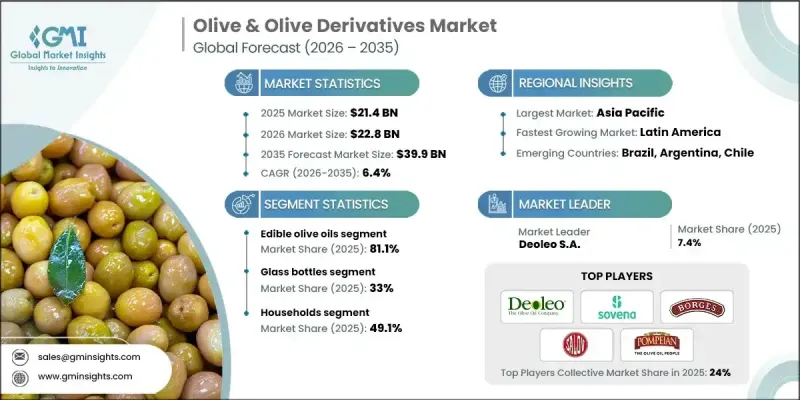
세계의 올리브 및 올리브 파생물 시장은 2025년에 214억 달러로 평가되었으며, 2035년까지 CAGR 6.4%로 성장하여 399억 달러에 달할 것으로 예측됩니다.
올리브 제품의 건강 효과에 대한 인식 증가, 지중해식 식단의 보급 확대, 식품 가공의 지속적인 기술 혁신이 이러한 성장을 견인하고 있습니다. 특히 엑스트라 버진 올리브 오일(EVOO)은 높은 폴리페놀 함량과 유익한 지방산이 종합적인 영양 상태와 심장 건강에 기여하는 것으로 점점 더 인정받고 있습니다. 이러한 효능을 뒷받침하는 과학적 연구는 전 세계 소비자들이 EVOO를 일상 식단에 포함시키도록 독려하고 있습니다. 이와 함께 식물 유래 클린 라벨 제품 및 강화된 파생상품에 대한 수요가 증가하면서 새로운 비즈니스 기회가 창출되고 있습니다. 콜드 프레스, 고액 분리, 개선된 추출 방법 등 식품 가공 기술의 발전으로 생산자는 같은 양의 올리브에서 더 높은 품질의 오일을 추출할 수 있게 되었으며, 폐기물을 최소화하면서 더 많은 양의 오일을 추출할 수 있게 되었습니다. 이러한 요인들이 복합적으로 작용하여 올리브 오일과 그 파생상품 세계 시장 환경을 형성하고 있습니다.
시장 범위
시작 연도
2025년
예측 연도
2026-2035년
개시 금액
214억 달러
예측 금액
399억 달러
CAGR
6.4%
식용 올리브 오일 부문은 2025년 81.1%의 점유율을 차지했으며, 2035년까지 연평균 6%의 성장률을 기록할 것으로 예상됩니다. 소비자의 관심은 콜드 프레스 공법, 유기농 재배, 향이 첨가된 올리브 오일 등 다양한 제품 혁신에 의해 주도되고 있습니다. 생산자들은 허브와 향신료가 함유된 미식가 오일을 도입하고 있으며, 자외선 차단 병과 스프레이 디스펜서 등 첨단 포장 솔루션은 오일의 보존성을 높이고 편의성을 향상시켜 소비를 더욱 촉진하고 있습니다.
가정용 부문은 2025년 49.1%의 점유율을 차지했으며, 2026년부터 2035년까지 CAGR 5%로 성장할 것으로 전망됩니다. 건강상의 이점으로 인해 올리브 오일을 가정 요리에 사용하는 가구가 증가하고 있으며, 버터나 식물성 기름과 같은 전통적인 기름과 지방을 대체하고 있습니다. 건강한 식생활에 대한 소비자 선호도 증가와 올리브 오일의 심혈관질환 예방 및 항산화 효과에 대한 인식 확대가 이러한 추세를 주도하고 있습니다. 엑스트라 버진 오일과 정제된 오일 모두 현재 전 세계 많은 가정에서 필수 주방 용품으로 여겨지고 있습니다.
북미 올리브 및 올리브 파생상품 시장은 2025년 14.2%의 점유율을 차지했습니다. 이 지역의 소비자들은 특히 엑스트라 버진 올리브 오일(EVOO)의 건강 효과에 대한 인식이 높아지고 있습니다. 고품질 콜드 프레스 공법과 유기농 인증을 받은 오일에 대한 수요가 꾸준히 증가하고 있으며, 이는 건강한 식습관으로의 전환과 일상 식단에 대한 관심이 높아지고 있음을 반영하고 있습니다. 이러한 추세는 지역 시장의 성장과 세계 올리브 및 올리브 파생상품 산업 전반의 확대에 크게 기여하고 있습니다.
목차
제1장 조사 방법과 범위
제2장 주요 요약
제3장 업계 인사이트
제4장 경쟁 구도
제5장 시장 추정 및 예측 : 제품 유형별, 2022-2035년
제6장 시장 추정 및 예측 : 포장 유형별, 2022-2035년
제7장 시장 추정 및 예측 : 용도별, 2022-2035년
제8장 시장 추정 및 예측 : 지역별, 2022-2035년
제9장 기업 개요
KSM
영문 목차
영문목차
The Global Olive & Olive Derivatives Market was valued at USD 21.4 billion in 2025 and is estimated to grow at a CAGR of 6.4% to reach USD 39.9 billion by 2035.
Rising awareness about the health benefits of olive products, growing adoption of Mediterranean diets, and continuous innovations in food processing are driving this growth. Extra-virgin olive oil (EVOO) is increasingly recognized for its high polyphenol content and beneficial fatty acids, which contribute to overall nutrition and heart health. Scientific studies supporting these benefits are influencing consumers worldwide to incorporate EVOO into their daily diets. Alongside this, the demand for plant-based, clean-label products and fortified derivatives has created new business opportunities. Technological advancements in food processing, including cold pressing, solid-liquid separation, and improved extraction methods, are enabling producers to extract higher-quality oil from the same quantity of olives while minimizing waste. These factors collectively are shaping the global landscape for olive oils and their derivatives.
Market Scope
Start Year
2025
Forecast Year
2026-2035
Start Value
$21.4 Billion
Forecast Value
$39.9 Billion
CAGR
6.4%
The edible olive oils segment held an 81.1% share in 2025 and is expected to grow at a CAGR of 6% through 2035. Consumer interest is being driven by diverse product innovations, such as cold-pressed, organic, and flavored olive oils. Producers are introducing gourmet-infused oils with herbs and spices, while advanced packaging solutions, including ultraviolet-protective bottles and spray dispensers, are enhancing oil longevity and adding convenience, further encouraging consumption.
The household segment held 49.1% share in 2025 and is anticipated to grow at a CAGR of 5% from 2026 to 2035. Households are increasingly choosing olive oil for home cooking due to its health advantages, replacing traditional fats like butter or vegetable oils. Growing consumer preference for healthier meals, combined with rising awareness of the cardiovascular and antioxidant benefits of olive oil, is driving this trend. Both extra-virgin and refined oils are now considered essential kitchen staples in many homes worldwide.
North America Olive & Olive Derivatives Market held a 14.2% share in 2025. Consumers in the region are demonstrating rising awareness of the health benefits of olive oils, particularly EVOO. Premium-quality, cold-pressed, and organically certified oils are seeing strong demand, reflecting a shift toward healthier cooking habits and daily incorporation into diets. This trend is contributing significantly to regional market growth and the overall expansion of the global olive and olive derivatives industry.
Key players operating in the Olive & Olive Derivatives Market include Deoleo S.A., Borges International Group, Luque Ecological, Sovena Group, and Pompeian, Inc. Companies in the olive and olive derivatives market are employing multiple strategies to reinforce their presence and expand their market share. They are investing in product innovation, introducing new oil varieties, infused flavors, and fortified derivatives to cater to evolving consumer preferences. Strategic branding and packaging upgrades, including eco-friendly and UV-protective containers, enhance product appeal and shelf life. Firms are also expanding their geographic reach through partnerships with distributors, e-commerce platforms, and retail chains to penetrate new markets. Marketing campaigns highlighting health benefits and quality certifications, such as organic or non-GMO, are strengthening brand credibility.
Table of Contents
Chapter 1 Methodology & Scope
1.1 Market scope and definition
1.2 Research design
1.2.1 Research approach
1.2.2 Data collection methods
1.3 Data mining sources
1.3.1 Global
1.3.2 Regional/Country
1.4 Base estimates and calculations
1.4.1 Base year calculation
1.4.2 Key trends for market estimation
1.5 Primary research and validation
1.5.1 Primary sources
1.6 Forecast model
1.7 Research assumptions and limitations
Chapter 2 Executive Summary
2.1 Industry 3600 synopsis
2.2 Key market trends
2.2.1 Regional
2.2.2 Product type
2.2.3 Packaging type
2.2.4 Application
2.3 TAM Analysis, 2026-2035
2.4 CXO perspectives: Strategic imperatives
2.4.1 Executive decision points
2.4.2 Critical success factors
2.5 Future outlook and strategic recommendations
Chapter 3 Industry Insights
3.1 Industry ecosystem analysis
3.1.1 Supplier landscape
3.1.2 Profit margin
3.1.3 Value addition at each stage
3.1.4 Factor affecting the value chain
3.1.5 Disruptions
3.2 Industry impact forces
3.2.1 Growth drivers
3.2.2 Industry pitfalls and challenges
3.2.3 Market opportunities
3.3 Growth potential analysis
3.4 Regulatory landscape
3.4.1 North America
3.4.2 Europe
3.4.3 Asia Pacific
3.4.4 Latin America
3.4.5 Middle East & Africa
3.5 Porter's analysis
3.6 PESTEL analysis
3.7 Price trends
3.7.1 By region
3.7.2 By product type
3.8 Future market trends
3.9 Technology and Innovation landscape
3.9.1 Current technological trends
3.9.2 Emerging technologies
3.10 Patent Landscape
3.11 Trade statistics (HS code) ( Note: the trade statistics will be provided for key countries only)
3.11.1 Major importing countries
3.11.2 Major exporting countries
3.12 Sustainability and environmental aspects
3.12.1 Sustainable practices
3.12.2 Waste reduction strategies
3.12.3 Energy efficiency in production
3.12.4 Eco-friendly initiatives
3.13 Carbon footprint consideration
Chapter 4 Competitive Landscape, 2025
4.1 Introduction
4.2 Company market share analysis
4.2.1 By region
4.2.1.1 North America
4.2.1.2 Europe
4.2.1.3 Asia Pacific
4.2.1.4 LATAM
4.2.1.5 MEA
4.3 Company matrix analysis
4.4 Competitive analysis of major market players
4.5 Competitive positioning matrix
4.6 Key developments
4.6.1 Mergers & acquisitions
4.6.2 Partnerships & collaborations
4.6.3 New Product Launches
4.6.4 Expansion Plans
Chapter 5 Market Estimates and Forecast, By Product Type, 2022-2035 (USD Billion) (Kilo Tons)
5.1 Key trends
5.2 Edible Olive Oils
5.2.1 Extra Virgin Olive Oil
5.2.2 Virgin Olive Oil
5.2.3 Refined Olive Oil
5.2.4 Olive Oil (Pure/Blended)
5.2.5 Olive Pomace Oil
5.3 Olive Derivatives
5.3.1 Oleochemicals
5.3.2 Bioactive Compounds
5.3.3 Olive By-Product Extracts
Chapter 6 Market Estimates and Forecast, By Packaging Type, 2022-2035 (USD Billion) (Kilo Tons)
6.1 Key trends
6.2 Glass Bottles
6.3 Plastic Bottles/Containers
6.4 Metal Cans/Tins
6.5 Bag-in-Box
6.6 Bulk Containers
Chapter 7 Market Estimates and Forecast, By Application, 2022-2035 (USD Billion) (Kilo Tons)
7.1 Key trends
7.2 Households
7.2.1 Salad Dressings & Cold Dishes
7.2.2 Cooking & Frying
7.2.3 Baking Applications
7.2.4 Home Wellness & Personal Care
7.3 Foodservice / HoReCa
7.3.1 Full-Service Restaurants
7.3.2 Quick Service Restaurants (QSR)
7.3.3 Hotels & Resorts
7.3.4 Catering Services
7.4 Food Manufacturing
7.4.1 Sauces, Dressings & Condiments
7.4.2 Ready-to-Eat & Convenience Foods
7.4.3 Bakery & Confectionery Products
7.4.4 Canned Fish & Preserved Foods
7.5 Cosmetics & Personal Care
7.5.1 Skin Care Products
7.5.2 Hair Care Products
7.5.3 Soap & Bath Products
7.5.4 Natural & Organic Cosmetics
7.6 Pharmaceuticals & Nutraceuticals
7.6.1 Dietary Supplements
7.6.2 Cardiovascular Health Products
7.6.3 Anti-Inflammatory & Antioxidant Supplements
7.6.4 Pharmaceutical Excipients
7.7 Industrial Applications
7.7.1 Oleochemicals & Surfactants
7.7.2 Soap & Detergent Manufacturing
7.7.3 Bio-Based Lubricants
7.7.4 Biofuel & Energy Production
Chapter 8 Market Estimates and Forecast, By Region, 2022-2035 (USD Billion) (Kilo Tons)