Electric Two-wheeler Market Opportunity, Growth Drivers, Industry Trend Analysis, and Forecast 2026 - 2035
상품코드:1928948
리서치사:Global Market Insights Inc.
발행일:2026년 01월
페이지 정보:영문 250 Pages
라이선스 & 가격 (부가세 별도)
ㅁ Add-on 가능: 고객의 요청에 따라 일정한 범위 내에서 Customization이 가능합니다. 자세한 사항은 문의해 주시기 바랍니다.
한글목차
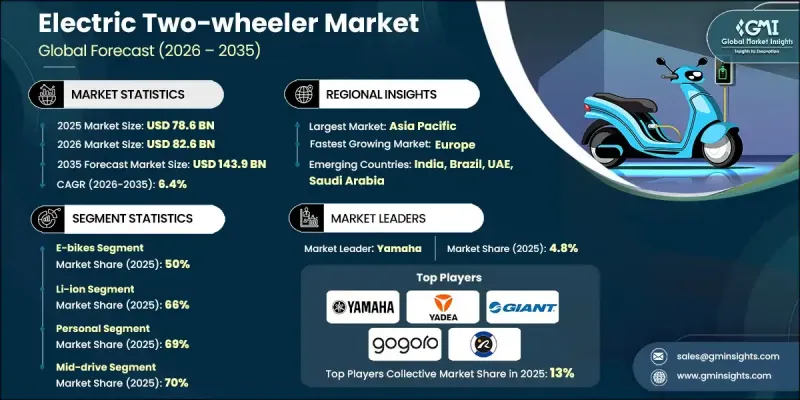
세계의 전기 이륜차 시장은 2025년에 786억 달러로 평가되었고, 2035년까지 연평균 복합 성장률(CAGR) 6.4%로 성장하여 1,439억 달러에 이를 것으로 예측됩니다.
대기오염의 악화와 기후 변화에 대한 인식이 높아지면서 소비자들은 더 깨끗한 이동수단으로의 전환을 촉진하고 있습니다. 배기가스를 배출하지 않는 전기 이륜차는 개인의 탄소 배출량을 줄이는 현실적인 수단으로 점점 더 많은 주목을 받고 있으며, 선진국과 신흥국 모두에서 지속가능성 목표 달성을 돕고 있습니다. 정부의 재정적 인센티브를 통해 초기 비용을 절감하고 저렴한 가격을 실현함으로써 공공 정책은 보급 촉진에 중요한 역할을 계속하고 있습니다. 배터리 시스템의 지속적인 혁신으로 에너지 밀도 향상, 충전 시간 단축, 내구성 개선을 통해 차량 효율이 향상되고 있습니다. 지능형 연결 기능 및 첨단 브레이크 시스템을 포함한 추가 기술 업그레이드를 통해 전반적인 사용 편의성을 향상시켰습니다. 이러한 복합적인 요인으로 인해 소비자의 신뢰가 높아지고, 대상 고객층이 확대되고 있으며, 전기 이륜차는 기존 연료 구동 차량에 대한 현실적인 대안으로 자리매김하고 있습니다.
시장 범위
개시 연도
2025년
예측 연도
2026-2035년
개시 연도 가치
786억 달러
예측 금액
1,439억 달러
CAGR
6.4%
전기 자전거 부문은 2025년 50%의 점유율을 차지할 것으로 예상되며, 2035년까지 연평균 복합 성장률(CAGR) 6.5%를 나타낼 것으로 예측됩니다. 이러한 성장은 보조 이동 수단, 친환경 출퇴근 수단, 라이프스타일 지향적 교통 솔루션에 대한 소비자의 선호도가 높아짐에 따라 성장세를 보이고 있습니다. 전기자전거는 편리함, 자동차를 대체할 수 있는 비용 효율적인 대안, 친환경적인 이동 수단을 찾는 도시 통근자들에게 선호되고 있습니다. 또한, 피트니스 중심의 사이클링과 레크리에이션으로서의 아웃도어 활동에 대한 관심이 높아지면서 보급에 더욱 박차를 가하고 있습니다.
리튬 이온 배터리 부문은 2025년 66%의 점유율을 차지할 것으로 예상되며, 2026년부터 2035년까지 연평균 복합 성장률(CAGR) 6%를 나타낼 것으로 예측됩니다. 이 부문의 성장은 높은 에너지 밀도, 확장된 주행거리, 빠른 충전 능력, 생산 비용 절감에 힘입어 성장세를 보이고 있습니다. 배터리 관리 시스템, 열 제어, 셀 내구성 개선으로 안전성과 성능이 향상되어 리튬 이온 기술은 대부분의 전기 이륜차 제조업체에게 최적의 선택이 되고 있습니다.
중국 전기 이륜차 시장은 2025년 40%의 점유율을 차지하며 242억 달러 시장 규모를 형성할 것으로 예측됩니다. 보조금, 면세, 구매 리베이트 등 강력한 정부 인센티브와 대규모 보급 촉진책이 결합되어 소유 비용을 크게 낮추고 소비자의 구매 의욕을 고취시키고 있습니다. 클린 모빌리티를 촉진하는 도시 정책과 충전 인프라의 급속한 확장과 함께 중국의 전기 이륜차 성장은 더욱 가속화되고 있으며, 중국은 이 지역을 선도하는 시장으로 자리매김하고 있습니다.
목차
제1장 조사 방법과 범위
제2장 주요 요약
제3장 업계 인사이트
생태계 분석
공급업체 상황
이익률 분석
비용 구조
각 단계 부가가치
밸류체인에 영향을 미치는 요인
파괴적 변화
업계에 대한 영향요인
성장 촉진요인
정부 지원과 우대 조치
기술적 진보
환경 의식
도시 이동 수단과 교통 정체
업계의 잠재적 리스크&과제
초기 비용이 고액
충전 인프라
시장 기회
아시아태평양 채택 확대
전동 스쿠터 및 자전거 셰어링
OEM 파트너십과 혁신
신흥 시장 사업 확대
성장 가능성 분석
규제 상황
북미
미국 국가 도로 교통안전 국(NHTSA) 규제
환경보호국(EPA) 배출 기준
캘리포니아주 대기 자원국(CARB) 기준
유럽
유럽연합 일반 안전 규제(EU GSR)
EU폐차 지침(ELV)
유럽위원회 승용차 안전기준
유럽연합(EU) 형 식 승인 프로세스
아시아태평양
중국 국가 차량 안전기준
인도 규격국(BIS) 에어백 규제
국토 교통성(MLIT) 규제
ASEAN 도로 안전기준
라틴아메리카
브라질 국가 교통국(DENATRAN) 규격
아르헨티나 국가 도로 안전청(ANSV) 규제
멕시코 통신 운송 성(SCT) 규제
메르코스르 자동차 안전기준 조화
중동 및 아프리카
아랍에미리트 연방 자동차 안전법
사우디아라비아 규격 기구(SASO) 차량 안전 규제
남아프리카공화국 규격국(SABS) 자동차 규제
Porter의 Five Forces 분석
PESTEL 분석
기술과 혁신 동향
현재 기술 동향
신기술
가격 동향
지역별
제품별
생산 통계
생산 거점
소비 거점
수출입
비용 내역 분석
특허 분석
지속가능성과 환경면
지속가능한 실천
폐기물 감축 전략
생산 에너지 효율
친환경 이니셔티브
탄소발자국에 관한 고려사항
제4장 경쟁 구도
서론
기업의 시장 점유율 분석
북미
유럽
아시아태평양
라틴아메리카
중동 및 아프리카
주요 시장 기업의 경쟁 분석
경쟁 포지셔닝 매트릭스
전략적 전망 매트릭스
주요 발전
인수합병(M&A)
제휴 및 협업
신제품 발매
사업 확대 계획과 자금조달
제5장 시장 추산·예측 : 차량별, 2022-2035
전동 오토바이
전동 스쿠터
전기자전거
전동 킥 보드
제6장 시장 추산·예측 : 배터리별, 2022-2035
SLA
리튬 이온 배터리
기타
제7장 시장 추산·예측 : 모터별, 2022-2035
밋드드라이브
허브
기타
제8장 시장 추산·예측 : 모터 출력별, 2022-2035
3.5kW 미만
3.5 kW-6.5 kW
6.5kW 이상
제9장 시장 추산·예측 : 전압별, 2022-2035
48V
60 V
72V
기타
제10장 시장 추산·예측 : 최종 용도별, 2022-2035
개인용
상업용
공유 모빌리티
제11장 시장 추산·예측 : 지역별, 2022-2035
북미
미국
캐나다
유럽
영국
독일
프랑스
이탈리아
스페인
러시아
덴마크
아시아태평양
중국
인도
일본
한국
ANZ
싱가포르
라틴아메리카
브라질
아르헨티나
멕시코
중동 및 아프리카
아랍에미리트
사우디아라비아
남아프리카공화국
제12장 기업 개요
세계 기업
Autoliv
Bosch
Continental
Daicel
Delphi
Denso
Hyundai Mobis
Joyson Safety Systems
ZF
Ather
Giant
Gogoro
Hero Electric
Jiangsu Xinri E-Vehicle
Niu Technologies
Ola
VMOTO SOCO
Yadea
Yamaha Motor Company
지역 기업
ARC Automotive
Ashimori Industry
ITW Automotive
Kolon Industries
Nippon Kayaku
Seiren
Toyoda Gosei
신규 기업
Jinheng Automotive Safety Technology
Nihon Plast
Swicofil
Tenaris
LSH
영문 목차
영문목차
The Global Electric Two-wheeler Market was valued at USD 78.6 billion in 2025 and is estimated to grow at a CAGR of 6.4% to reach USD 143.9 billion by 2035.
Growing awareness of air quality deterioration and climate-related challenges is encouraging consumers to shift toward cleaner mobility solutions. Electric two-wheelers, which operate without tailpipe emissions, are increasingly viewed as a practical way to lower individual carbon output, supporting sustainability goals across both developed and emerging economies. Public policy continues to play a critical role in accelerating adoption, as governments introduce financial incentives that reduce upfront costs and improve affordability. Continuous innovation in battery systems has enhanced vehicle efficiency through higher energy density, shorter charging durations, and improved durability. Additional technological upgrades, including intelligent connectivity features and advanced braking systems, are enhancing overall usability. These combined factors are improving consumer confidence and expanding the addressable customer base, positioning electric two-wheelers as a viable alternative to conventional fuel-powered options.
Market Scope
Start Year
2025
Forecast Year
2026-2035
Start Value
$78.6 Billion
Forecast Value
$143.9 Billion
CAGR
6.4%
The e-bike segment held a 50% share in 2025 and is projected to grow at a CAGR of 6.5% through 2035. This growth is fueled by increasing consumer preference for assisted mobility, eco-friendly commuting, and lifestyle-oriented transportation solutions. E-bikes appeal to urban commuters seeking convenience, cost-effective alternatives to cars, and environmentally responsible travel options. Additionally, the rising interest in fitness-oriented cycling and recreational outdoor activities is further boosting adoption.
The lithium-ion batteries segment accounted for 66% share in 2025 and is expected to grow at a CAGR of 6% between 2026 and 2035. The segment's growth is driven by high energy density, extended operating range, faster charging capabilities, and decreasing production costs. Improvements in battery management systems, thermal regulation, and cell durability are enhancing safety and performance, making Li-ion technology the preferred choice for most electric two-wheeler manufacturers.
China Electric Two-wheeler Market held a 40% share, generating USD 24.2 billion in 2025. Strong government incentives, such as subsidies, tax exemptions, and purchase rebates, combined with large-scale adoption initiatives, have significantly lowered ownership costs and boosted consumer uptake. Urban policies promoting clean mobility, coupled with the rapid expansion of charging infrastructure, have further accelerated the growth of electric two-wheelers in the country, positioning China as the leading market in the region.
Key participants active in the Global Electric Two-wheeler Market include Yadea, Yamaha Motor Company, Niu Technologies, Ola, Gogoro, Ather, VMOTO SOCO, Giant, Hero Electric, and Jiangsu Xinri E-Vehicle. Companies operating in the Global Electric Two-wheeler Market are focusing on strengthening their market position through aggressive product innovation and battery technology advancements. Many players are investing in localized manufacturing and supply chains to reduce costs and improve delivery timelines. Strategic partnerships with battery suppliers and charging infrastructure providers help improve ecosystem reliability. Firms are also expanding model portfolios to address different price points and usage needs. Digital sales platforms, financing options, and after-sales service networks are being enhanced to improve customer experience.
Table of Contents
Chapter 1 Methodology & Scope
1.1 Research approach
1.2 Quality Commitments
1.2.1 GMI AI policy & data integrity commitment
1.2.1.1 Source consistency protocol
1.3 Research Trail & Confidence Scoring
1.3.1 Research Trail Components
1.3.2 Scoring Components
1.4 Data Collection
1.4.1 Partial list of primary sources
1.5 Data mining sources
1.5.1 Paid sources
1.5.1.1 Sources, by region
1.6 Base estimates and calculations
1.6.1 Base year calculation for any one approach
1.7 Forecast model
1.7.1 Quantified market impact analysis
1.7.1.1 Mathematical impact of growth parameters on forecast
1.8 Research transparency addendum
1.8.1 Source attribution framework
1.8.2 Quality assurance metrics
1.8.3 Our commitment to trust
Chapter 2 Executive Summary
2.1 Industry 360° synopsis, 2022 - 2035
2.2 Key market trends
2.2.1 Regional
2.2.2 Vehicle
2.2.3 Battery
2.2.4 Motor
2.2.5 Motor power
2.2.6 Voltage
2.2.7 End use
2.3 TAM Analysis, 2026-2035
2.4 CXO perspectives: Strategic imperatives
2.4.1 Executive decision points
2.4.2 Critical success factors
2.5 Future outlook and strategic recommendations
Chapter 3 Industry Insights
3.1 Industry ecosystem analysis
3.1.1 Supplier landscape
3.1.2 Profit margin analysis
3.1.3 Cost structure
3.1.4 Value addition at each stage
3.1.5 Factor affecting the value chain
3.1.6 Disruptions
3.2 Industry impact forces
3.2.1.1 Growth drivers
3.2.1.2 Government support and incentives
3.2.1.3 Technological advancements
3.2.1.4 Environmental consciousness
3.2.1.5 Urban mobility and traffic congestion
3.2.2 Industry pitfalls and challenges
3.2.2.1 High initial costs
3.2.2.2 Charging infrastructure
3.2.3 Market opportunities
3.2.3.1 Rising adoption in Asia Pacific
3.2.3.2 Electric scooter and bike sharing
3.2.3.3 OEM partnerships and innovations
3.2.3.4 Expansion in emerging markets
3.3 Growth potential analysis
3.4 Regulatory landscape
3.4.1 North America
3.4.1.1 U.S. National Highway Traffic Safety Administration (NHTSA) Regulations