자동차 사이버 보안 하드웨어 시장 : 기회, 성장 요인, 업계 동향 분석 및 예측(2025-2034년)
Automotive Cybersecurity Hardware Market Opportunity, Growth Drivers, Industry Trend Analysis, and Forecast 2025 - 2034
상품코드:1871164
리서치사:Global Market Insights Inc.
발행일:2025년 10월
페이지 정보:영문 235 Pages
라이선스 & 가격 (부가세 별도)
ㅁ Add-on 가능: 고객의 요청에 따라 일정한 범위 내에서 Customization이 가능합니다. 자세한 사항은 문의해 주시기 바랍니다.
한글목차
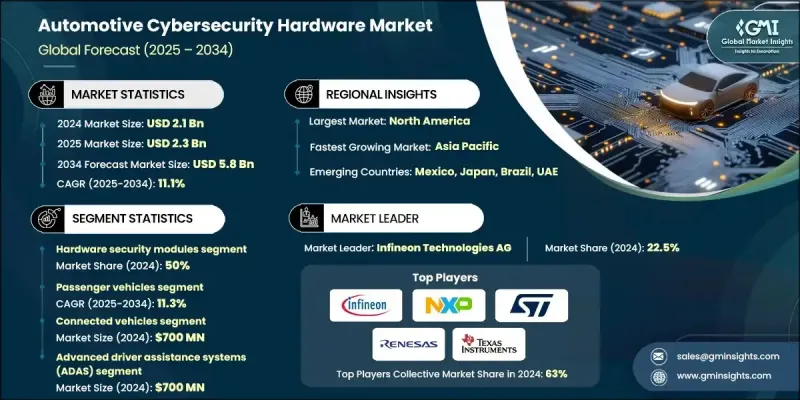
세계의 자동차 사이버 보안 하드웨어 시장은 2024년 21억 달러로 평가되었고, 2034년까지 연평균 복합 성장률(CAGR)은 11.1%를 나타낼 것으로 예측되며 58억 달러에 달할 전망입니다.
차량이 고도로 연결된 소프트웨어 정의 플랫폼으로 진화함에 따라 위협 환경도 크게 확대되었습니다. ECU, 센서, 디지털 콕핏, 텔레매틱스 시스템의 통합이 증가하면서 사이버 위협에 대한 취약성이 더욱 커졌습니다. 이에 대응하여 핵심 차량 기능을 보호하고 운영 무결성을 유지할 수 있는 하드웨어 기반 사이버 보안 시스템에 대한 수요가 급증하고 있습니다. OEM 및 1차 공급업체들은 데이터 유출, 무단 접근, 기능 장애를 방지하기 위해 보안 요소를 내장하고 있습니다. 중앙 집중식 차량 아키텍처, OTA 소프트웨어 업데이트, 자동차 사이버 보안 규정 준수 강화와 같은 트렌드로 시장이 가속화되고 있습니다. 연결성이 현대 모빌리티의 핵심이 되면서 사이버 보안 하드웨어는 안전하고 신뢰할 수 있는 운전 경험을 보장하는 데 중추적인 역할을 수행하고 있습니다.
시장 범위
시작 연도
2024년
예측 기간
2025-2034년
시작 금액
21억 달러
예측 금액
58억 달러
CAGR
11.1%
2024년 하드웨어 보안 모듈 부문은 50%의 점유율을 차지했으며, 2025년부터 2034년까지 연평균 10.8%의 성장률을 보일 것으로 예상됩니다. 이러한 모듈은 핵심 차량 시스템 내에서 키 관리, 암호화 처리 및 변조 방지 기능을 제공하는 기초 보안 구성 요소 역할을 합니다. ECU, 도메인 컨트롤러 및 연결된 플랫폼에 배포되어 안전한 통신, 인증된 소프트웨어 기능 및 실시간 사이버 방어 기능을 지원합니다. 자동차 제조업체들은 규제 요건을 충족하고 차량 네트워크에서 증가하는 사이버 보안 위험을 완화하기 위해 HSM에 점점 더 의존하고 있습니다.
승용차 부문은 2024년 82%의 점유율을 기록했으며, 2034년까지 연평균 11.3%의 성장률을 보일 것으로 예상됩니다. 이 부문의 성장은 전기차 및 하이브리드 모델을 포함한 일상 차량에 디지털 시스템이 광범위하게 통합되면서 촉진되고 있습니다. 보안 마이크로컨트롤러, HSM, 신뢰할 수 있는 하드웨어 요소는 이제 인포테인먼트 시스템, ADAS, V2X 연결성, OTA 업데이트 프레임워크의 표준 구성 요소입니다. 이러한 솔루션은 안전한 데이터 교환, 시스템 무결성, ISO/SAE 21434 및 UNECE WP.29와 같은 국제 표준 준수를 보장하여 차세대 자동차 플랫폼에 필수적입니다.
미국의 자동차 사이버 보안 하드웨어 시장은 2024년 81.1%의 점유율을 차지해 6억 1,000만 달러를 창출했습니다. 선진적인 자동차 생태계, 높은 전기차 보급률, 진화하는 규제로 인해 미국은 사이버보안 하드웨어의 강력한 수요 중심지입니다. 자동차 제조사들은 연결 및 자율주행 차량의 위협에 대응하기 위해 암호화 모듈과 고급 ECU를 도입하고 있습니다. 미국의 규제 추진력과 견고한 제조 기반은 상용 및 승용 차량 전반에 걸쳐 임베디드 하드웨어 보호 장치의 도입을 지속적으로 뒷받침하고 있습니다.
자동차 사이버 보안 하드웨어 시장에서 활동하는 주요 기업으로는 C2A Security, Infineon Technologies AG, STMicroelectronics N.V., Renesas Electronics, Microchip Technology, Analog Devices, NXP Semiconductors N.V., Texas Instruments, GuardKnox, Escrypt 등이 있습니다. 글로벌 자동차 사이버 보안 하드웨어 시장의 선도 기업들은 경쟁 우위 강화를 위해 보안 하드웨어 IP, 칩 레벨 암호화, 확장 가능한 플랫폼 아키텍처에 집중 투자하고 있습니다. 기업들은 중앙 집중식 차량 아키텍처 및 도메인 컨트롤러와 호환되는 HSM(HSM) 및 TPM(TPM)과 같은 통합 준비 모듈을 우선시하고 있습니다. OEM 및 1차 공급업체와의 협력을 통해 초기 설계 단계부터의 포함과 장기 공급 계약을 확보하는 데 도움이 됩니다.
목차
제1장 조사 방법과 범위
제2장 주요 요약
제3장 업계 인사이트
생태계 분석
공급자의 상황
이익률
비용 구조
각 단계에서의 부가가치
밸류체인에 영향을 주는 요인
혁신
업계에 미치는 영향요인
성장 촉진요인
차량 커넥티비티 확대
전기화 및 자율주행차 도입
강화된 규제 프레임워크
보안 하드웨어 모듈의 이용 증가
업계의 잠재적 억제요인 및 과제
높은 구현 및 통합 비용
복잡한 시스템 통합
시장 기회
AI 기반 보안 솔루션 채택
보안 OTA 업데이트 생태계 확장
증가하는 규제 준수 요구사항
클라우드 연결 보안 솔루션 통합
성장 가능성 분석
규제 상황
ISO 21434 사이버 보안 엔지니어링 표준
UN-R155 및 UN-R156의 규제 요건
SAE J3061 사이버 보안 가이드북
NIST 사이버 보안 프레임워크의 적응
지역별 규정 준수 및 인증 요건
Porter's Five Forces 분석
PESTEL 분석
기술과 혁신의 상황
암호화 성능 및 처리량 분석
보안 처리 지연 시간 및 실시간 처리 능력
위협 탐지 정확도 및 오탐률
전력 소비 및 효율성 지표
변조 방지 및 물리적 보안 평가
복잡성과 개발 시간의 통합
가격 동향
지역별
제품별
생산 통계
생산 거점
소비 허브
수출과 수입
코스트 내역 분석
특허 분석
지속가능성과 환경적 측면
지속가능한 실천
폐기물 감축 전략
생산에 있어서의 에너지 효율화
환경에 배려한 대처
탄소발자국에 관한 고려 사항
위험 평가 프레임워크
베스트 케이스 시나리오
프라이버시 및 데이터 보호 프레임워크 분석
시장의 성숙도와 보급 상황의 분석
자동차 데이터 프라이버시 요건
GDPR(EU 개인정보보호규정) 및 지역별 개인정보 보호 규정 준수
데이터 익명화 및 가명화 기술
동의 관리 및 사용자 제어
국경 간 데이터 전송 보안
위협 상황과 공격 벡터 분석
차량 공격 대상 영역의 매핑
일반적인 공격 벡터와 조사 기법
새로운 위협의 동향과 예측
업계의 인시던트 분석과 교훈
위협 인텔리전스와 정보 공유
프라이버시 및 데이터 보호 프레임워크 분석
자동차 데이터 프라이버시 요건
GDPR(EU 개인정보보호규정) 및 지역별 개인정보 보호 규정 준수
데이터 익명화 및 가명화 기술
동의 관리 및 사용자 제어
국경 간 데이터 전송 보안
제4장 경쟁 구도
소개
기업의 시장 점유율 분석
북미
유럽
아시아태평양
라틴아메리카
중동 및 아프리카
주요 시장 기업의 경쟁 분석
경쟁 포지셔닝 매트릭스
전략적 전망 매트릭스
주요 발전
합병 및 인수
제휴 및 협력관계
신제품 발매
확대계획과 자금조달
제5장 시장 추계 및 예측 : 하드웨어별(2021-2034년)
주요 동향
하드웨어 보안 모듈(HSM)
네트워크 보안 컨트롤러
방화벽 및 침입 감지 장치
보안 마이크로컨트롤러
암호화/복호 칩
제6장 시장 추계 및 예측 : 차량 연결 레벨별(2021-2034년)
주요 동향
커넥티드카
반자율 주행 차량
완전 자율 주행 차량
비연결 차량
제7장 시장 추계 및 예측 : 차량별(2021-2034년)
주요 동향
승용차
SUV
세단
해치백
상용차
소형 상용차(LCV)
중형 상용차(MCV)
대형 상용차(HCV)
제8장 시장 추계 및 예측 : 용도별(2021-2034년)
주요 동향
첨단 운전자 보조 시스템(ADAS)
인포테인먼트 및 텔레매틱스
파워트레인 및 섀시
차체 전자 및 편의 시스템
통신 시스템(V2X, OTA 업데이트)
기타
제9장 시장 추계 및 예측 : 판매 채널별(2021-2034년)
주요 동향
OEM
애프터마켓
제10장 시장 추계 및 예측 : 지역별(2021-2034년)
주요 동향
주요 동향
북미
미국
캐나다
유럽
영국
독일
프랑스
이탈리아
스페인
벨기에
네덜란드
스웨덴
아시아태평양
중국
중국
인도
일본
호주
싱가포르
한국
베트남
인도네시아
라틴아메리카
브라질
멕시코
아르헨티나
중동 및 아프리카
아랍에미리트(UAE)
남아프리카
사우디아라비아
제11장 기업 프로파일
세계 기업
Analog Devices
Blackberry
Infineon Technologies AG
Maxim Integrated Products
Microchip Technology
NXP Semiconductors
Qualcomm Technologies
Renesas Electronics Corporation
STMicroelectronics NV
Texas Instruments Incorporated
지역 기업
Aptiv PLC
BMW
Continental AG
Denso
Harman International
Mercedes-Benz
Robert Bosch
Tesla
신흥 기업
Argus Cyber Security
11.3.2. C2 A 보안
Escrypt
GuardKnox
Karamba Security
Upstream
HBR
영문 목차
영문목차
The Global Automotive Cybersecurity Hardware Market was valued at USD 2.1 Billion in 2024 and is estimated to grow at a CAGR of 11.1% to reach USD 5.8 Billion by 2034.
As vehicles evolve into highly connected, software-defined platforms, the threat landscape has expanded significantly. Increasing integration of ECUs, sensors, digital cockpits, and telematics systems has created greater vulnerabilities to cyber threats. In response, demand is surging for hardware-based cybersecurity systems that can secure critical vehicle functions and maintain operational integrity. OEMs and Tier-1 suppliers are embedding secure elements to prevent data breaches, unauthorized access, and functional disruptions. The market is accelerating due to trends like centralized vehicle architectures, OTA software updates, and tighter regulations around automotive cybersecurity compliance. As connectivity becomes a cornerstone of modern mobility, cybersecurity hardware is playing a pivotal role in ensuring safe and trusted driving experiences.
Market Scope
Start Year
2024
Forecast Year
2025-2034
Start Value
$2.1 Billion
Forecast Value
$5.8 Billion
CAGR
11.1%
In 2024, the hardware security modules segment held a 50% share and is projected to grow at a CAGR of 10.8% from 2025 to 2034. These modules act as foundational security components, delivering key management, cryptographic processing, and tamper resistance within core vehicle systems. Their deployment in ECUs, domain controllers, and connected platforms supports secure communication, authenticated software functions, and real-time cyber defense capabilities. Automakers increasingly rely on HSMs to meet regulatory mandates and mitigate rising cybersecurity risks in vehicle networks.
The passenger vehicles segment held an 82% share in 2024 and is expected to grow at a 11.3% CAGR through 2034. Growth in this segment is fueled by widespread integration of digital systems in everyday vehicles, including electric and hybrid models. Secure microcontrollers, HSMs, and trusted hardware elements are now standard components in infotainment systems, ADAS, V2X connectivity, and OTA update frameworks. These solutions ensure secure data exchange, system integrity, and alignment with international standards like ISO/SAE 21434 and UNECE WP.29, making them essential for next-gen automotive platforms.
US Automotive Cybersecurity Hardware Market held an 81.1% share and generated USD 610 million in 2024. With its advanced automotive ecosystem, high EV adoption rate, and evolving regulations, the US represents a strong demand center for cybersecurity hardware. Automakers are deploying cryptographic modules and advanced ECUs to address threats in connected and autonomous vehicles. The country's regulatory momentum and robust manufacturing base continue to support the rollout of embedded hardware protections across commercial and passenger fleets.
Key companies active in the Automotive Cybersecurity Hardware Market include C2A Security, Infineon Technologies AG, STMicroelectronics N.V., Renesas Electronics, Microchip Technology, Analog Devices, NXP Semiconductors N.V., Texas Instruments, GuardKnox, and Escrypt. Leading players in the Global Automotive Cybersecurity Hardware Market are heavily investing in secure hardware IP, chip-level cryptography, and scalable platform architectures to strengthen their competitive edge. Companies are prioritizing integration-ready modules such as HSMs and TPMs that are compatible with centralized vehicle architectures and domain controllers. Collaborations with OEMs and Tier-1 suppliers help ensure early design-phase inclusion and long-term supply agreements.
Table of Contents
Chapter 1 Methodology & Scope
1.1 Market scope and definition
1.2 Research design
1.2.1 Research approach
1.2.2 Data collection methods
1.3 Data mining sources
1.3.1 Regional/Country
1.4 Base estimates and calculations
1.4.1 Base year calculation
1.4.2 Key trends for market estimation
1.5 Primary research and validation
1.5.1 Primary sources
1.6 Forecast model
1.7 Research assumptions and limitations
Chapter 2 Executive Summary
2.1 Industry 360° synopsis, 2021 - 2034
2.2 Key market trends
2.2.1 Regional
2.2.2 Hardware
2.2.3 Vehicle connectivity level
2.2.4 Vehicle
2.2.5 Application
2.2.6 Sales Channel
2.3 TAM Analysis, 2025-2034
2.4 CXO perspectives: Strategic imperatives
2.4.1 Executive decision points
2.4.2 Critical success factors
2.5 Future outlook and strategic recommendations
Chapter 3 Industry Insights
3.1 Industry ecosystem analysis
3.1.1 Supplier Landscape
3.1.2 Profit Margin
3.1.3 Cost structure
3.1.4 Value addition at each stage
3.1.5 Factor affecting the value chain
3.1.6 Disruptions
3.2 Industry impact forces
3.2.1 Growth drivers
3.2.1.1 Growing vehicle connectivity
3.2.1.2 Electrification and autonomous vehicle adoption