자동차용 스핀트로닉스 기기 시장 : 기회, 성장 요인, 업계 동향 분석 및 예측(2025-2034년)
Spintronics Devices for Automotive Applications Market Opportunity, Growth Drivers, Industry Trend Analysis, and Forecast 2025 - 2034
상품코드:1871140
리서치사:Global Market Insights Inc.
발행일:2025년 10월
페이지 정보:영문 163 Pages
라이선스 & 가격 (부가세 별도)
ㅁ Add-on 가능: 고객의 요청에 따라 일정한 범위 내에서 Customization이 가능합니다. 자세한 사항은 문의해 주시기 바랍니다.
한글목차
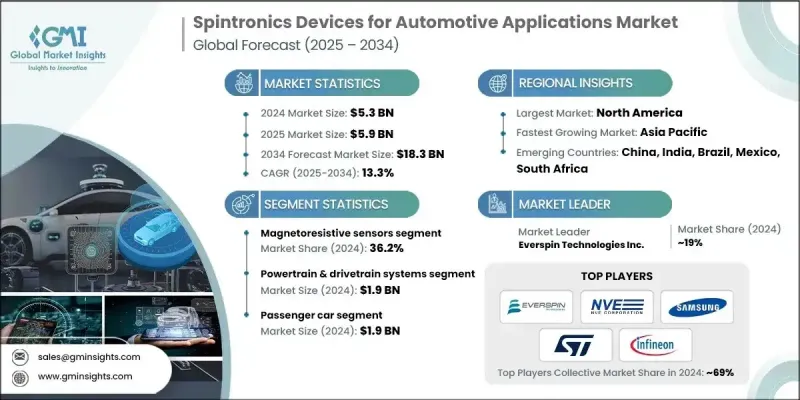
세계의 자동차용 스핀트로닉스 기기 시장은 2024년에 53억 달러로 평가되었고, 2034년까지 연평균 복합 성장률(CAGR)은 13.3%를 나타낼 것으로 예측되며 183억 달러에 달할 전망입니다.
이러한 성장은 주로 전기차 및 자율주행차의 보급 확대, 에너지 효율적인 전자 부품에 대한 수요 증가, 차량 안전 및 제어를 위한 자기 센서 기술의 지속적인 발전에 의해 주도되고 있습니다. 전력 소비 감소, 데이터 저장 용량 증대, 인포테인먼트 및 내비게이션 시스템 성능 향상에 대한 관심이 높아지면서 자동차용에서 스핀트로닉스 기술의 활용이 가속화되고 있습니다. 특히 전기차 및 하이브리드 모델을 중심으로 차량 내 첨단 전자 기기의 통합이 증가함에 따라 스핀트로닉스 기기에 대한 수요가 촉진되고 있습니다. 스핀트로닉스 기반 센서 및 메모리 솔루션은 더 빠른 데이터 처리, 낮은 에너지 소비, 우수한 자기 감지 기능을 제공합니다. 자동차 제조사들은 이러한 기술을 활용하여 전기 파워트레인, ADAS(첨단 운전자 보조 시스템), 배터리 관리 시스템 전반에 걸쳐 효율성, 신뢰성 및 성능을 향상시키고 있습니다. 지능형 차량 아키텍처의 채택 증가로 차세대 자동차 설계 및 기능을 지원하기 위한 스핀트로닉스 부품에 대한 수요가 더욱 촉진되고 있습니다.
시장 범위
시작 연도
2024년
예측 연도
2025-2034년
시작 금액
53억 달러
예측 금액
183억 달러
CAGR
13.3%
2024년 기준, 자기저항 센서가 36.2%의 점유율을 차지했습니다. 이 센서는 자기장 감지 효율성이 뛰어나 자동차 시스템의 정밀 제어를 가능하게 하여 높은 가치를 인정받고 있습니다. 다양한 온도와 작동 조건에서 민감도, 내구성 및 성능이 우수한 TMR 및 GMR과 같은 변형 제품이 선호되어 전기차, ADAS 및 자율 주행 시스템에 필수적입니다.
파워트레인 및 드라이브트레인 시스템 부문은 2024년 19억 달러를 창출했습니다. 스핀트로닉스 기기는 모터 제어 및 에너지 분배를 향상시켜 배터리 관리, 회생 제동 및 토크 시스템 전반에 걸쳐 성능을 개선합니다. MRAM 기술, 첨단 센서, AI 기반 제어 모듈의 통합은 자동차용에서 스핀트로닉스 부품의 정밀도, 신뢰성 및 반응성을 크게 향상시켰습니다.
미국의 자동차용 스핀트로닉스 기기 시장은 2024년 15억 달러로 평가되었습니다. 미국은 강력한 자동차 산업, 첨단 반도체 생태계, 상당한 연구 자금 지원 및 지원적인 규제 프레임워크로 인해 계속해서 시장을 주도하고 있습니다. 미국의 주요 자동차 제조사, 기술 공급업체 및 반도체 기업들은 혁신적인 스핀트로닉스 기기와 최첨단 센서 및 MRAM 솔루션의 탄탄한 파이프라인으로부터 혜택을 받고 있습니다.
자동차용 스핀트로닉스 기기 시장의 주요 기업으로는 도시바(Toshiba Corporation), 르네사스 일렉트로닉스(Renesas Electronics Corporation), 캐논(Canon Inc.), 웨스턴 디지털 테크놀로지스(Western Digital Technologies, Inc.), ST마이크로일렉트로닉스(STMicroelectronics N.V.), 마이크론 테크놀로지, 피코사 인터내셔널, 엔비이 코퍼레이션, 에버스핀 테크놀로지스, 스핀 메모리, 히타치, 퀄컴 테크놀로지스, 인텔, 삼성전자, 후지쯔, TDK, 비스테온, IBM, 인피니언 테크놀로지스 등이 있습니다. 자동차용 스핀트로닉스 기기 시장에서의 입지를 강화하기 위해 기업들은 자동차용에 최적화된 차세대 스핀트로닉스 센서 및 MRAM 기기 도입을 위한 연구 개발에 투자하고 있습니다. 글로벌 유통 및 통합 역량 확대를 위해 전략적 협력 및 파트너십이 구축되고 있습니다. 기업들은 또한 전기차 및 자율주행차 시스템을 포함한 진화하는 자동차 요구사항을 충족하기 위해 제품 포트폴리오를 다각화하고 있습니다.
목차
제1장 조사 방법과 범위
제2장 주요 요약
제3장 업계 인사이트
생태계 분석
업계에 미치는 영향요인
성장 촉진요인
전기자동차 및 하이브리드 자동차의 보급 확대
첨단 운전자 보조 시스템(ADAS)의 통합 확대
에너지 효율적이고 소형화된 자동차 전자 부품에 대한 수요
MRAM 및 TMR/GMR 센서의 기술 발전
업계의 잠재적 억제요인 및 과제
높은 개발 및 제조 비용
자동차용 스핀트로닉스 기기의 복잡성, 제공상의 과제 및 잠재적인 부작용
시장 기회
높은 제조 및 개발 비용
대규모 생산 인프라 부족
성장 가능성 분석
규제 상황
북미
미국
캐나다
유럽
아시아태평양
라틴아메리카
중동 및 아프리카
기술 상황
현재의 동향
신흥기술
파이프라인 분석
장래 시장 동향
Porter's Five Forces 분석
PESTEL 분석
제4장 경쟁 구도
소개
기업의 시장 점유율 분석
세계
북미
유럽
아시아태평양
라틴아메리카
중동 및 아프리카
기업 매트릭스 분석
주요 시장 기업의 경쟁 분석
경쟁 포지셔닝 매트릭스
주요 발전
합병 및 인수
제휴 및 협력
신제품 발매
사업 확대 계획
제5장 시장 추계 및 예측 : 기기 유형별(2021-2034년)
주요 동향
자기 저항 센서
이방성 자기저항(AMR) 센서
거대 자기저항(GMR) 센서
터널 자기저항(TMR) 센서
자기 랜덤 액세스 메모리(MRAM)
토글 MRAM
스핀 전이 토크 MRAM(STT-MRAM)
스핀 궤도 토크 MRAM(SOT-MRAM)
스핀 로직 기기
스핀 전계 효과 트랜지스터(Spin-FET)
자기 터널 접합 로직
올 스핀 로직 기기
스핀 기반 RF 및 발진기 기기
스핀 토크 발진기
스핀파 기기
제6장 시장 추계 및 예측 : 자동차 용도별(2021-2034년)
주요 동향
파워트레인 및 드라이브트레인 시스템
안전 및 ADAS 시스템
바디 및 쾌적성 시스템
기타
제7장 시장 추계 및 예측 : 최종 용도별(2021-2034년)
주요 동향
승용차
상용차
비도로용 차량
기타
제8장 시장 추계 및 예측 : 지역별(2021-2034년)
주요 동향
북미
미국
캐나다
유럽
독일
영국
프랑스
스페인
이탈리아
네덜란드
아시아태평양
중국
인도
일본
호주
한국
라틴아메리카
브라질
멕시코
아르헨티나
중동 및 아프리카
남아프리카
사우디아라비아
아랍에미리트(UAE)
제9장 기업 프로파일
NVE Corporation
Everspin Technologies Inc.
Crocus Technology Inc.
Spin Memory Inc.
IBM Corporation
Intel Corporation
Samsung Electronics Co., Ltd.
Toshiba Corporation
STMicroelectronics NV
Infineon Technologies AG
Qualcomm Technologies Inc.
Micron Technology, Inc.
Renesas Electronics Corporation
Hitachi Ltd.
Canon Inc.
Fujitsu Ltd.
Western Digital Technologies, Inc.
Visteon Corporation
Ficosa International SA
TDK Corporation
HBR
영문 목차
영문목차
The Global Spintronics Devices for Automotive Applications Market was valued at USD 5.3 Billion in 2024 and is estimated to grow at a CAGR of 13.3% to reach USD 18.3 Billion by 2034.
The growth is primarily driven by the rising adoption of electric and autonomous vehicles, the demand for energy-efficient electronic components, and continuous advancements in magnetic sensor technologies for vehicle safety and control. Increasing focus on reducing power consumption, enhancing data storage, and improving the performance of infotainment and navigation systems is accelerating the use of spintronics technology in automotive applications. The rising integration of advanced electronics in vehicles, particularly electric and hybrid models, is boosting demand for spintronics devices. Spintronics-based sensors and memory solutions deliver faster data processing, lower energy consumption, and superior magnetic sensing capabilities. Automakers are leveraging these technologies to enhance efficiency, reliability, and performance across electric powertrains, ADAS, and battery management systems. The growing adoption of intelligent vehicle architecture is further driving the need for spintronic components to support next-generation automotive design and functionality.
Market Scope
Start Year
2024
Forecast Year
2025-2034
Start Value
$5.3 Billion
Forecast Value
$18.3 Billion
CAGR
13.3%
In 2024, the magnetoresistive sensors held a 36.2% share. These sensors are highly valued for their efficiency in detecting magnetic fields, enabling precise control in automotive systems. Variants such as TMR and GMR are preferred due to their sensitivity, durability, and performance under diverse temperatures and operating conditions, making them essential for electric vehicles, ADAS, and autonomous driving systems.
The powertrain and drivetrain systems segment generated USD 1.9 Billion in 2024. Spintronics devices enhance motor control and energy distribution, improving performance across battery management, regenerative braking, and torque systems. The integration of MRAM technology, advanced sensors, and AI-based control modules has significantly increased the precision, reliability, and responsiveness of spintronic components in automotive applications.
U.S. Spintronics Devices for Automotive Applications Market was valued at USD 1.5 Billion in 2024. The country continues to dominate due to its strong automotive industry, advanced semiconductor ecosystem, substantial research funding, and supportive regulatory framework. Leading automakers, technology providers, and semiconductor companies in the U.S. benefit from a robust pipeline of innovative spintronic devices and state-of-the-art sensor and MRAM solutions.
Key players in the Global Spintronics Devices for Automotive Applications Market include Toshiba Corporation, Renesas Electronics Corporation, Canon Inc., Western Digital Technologies, Inc., STMicroelectronics N.V., Micron Technology, Inc., Ficosa International S.A., NVE Corporation, Everspin Technologies Inc., Spin Memory Inc., Hitachi Ltd., Qualcomm Technologies Inc., Intel Corporation, Samsung Electronics Co., Ltd., Fujitsu Ltd., TDK Corporation, Visteon Corporation, IBM Corporation, and Infineon Technologies AG. To strengthen Spintronics Devices for Automotive Applications Market presence, companies are investing in research and development to introduce next-generation spintronic sensors and MRAM devices optimized for automotive applications. Strategic collaborations and partnerships are being formed to expand global distribution and integration capabilities. Firms are also diversifying product portfolios to meet evolving automotive requirements, including electric and autonomous vehicle systems.
Table of Contents
Chapter 1 Methodology and Scope
1.1 Market scope and definition
1.2 Research design
1.2.1 Research approach
1.2.2 Data collection methods
1.3 Data mining sources
1.3.1 Global
1.3.2 Regional/Country
1.4 Base estimates and calculations
1.4.1 Base year calculation
1.4.2 Key trends for market estimation
1.5 Primary research and validation
1.5.1 Primary sources
1.6 Forecast model
1.7 Research assumptions and limitations
Chapter 2 Executive Summary
2.1 Industry 360° synopsis
2.2 Key market trends
2.2.1 Regional trends
2.2.2 Vector trends
2.2.3 Delivery method trends
2.2.4 Gene type trends
2.2.5 Indication trends
2.2.6 End Use trends
2.3 CXO perspectives: Strategic imperatives
2.3.1 Key decision points for industry executives
2.3.2 Critical success factors for market players
2.4 Future outlook and strategic recommendations
Chapter 3 Industry Insights
3.1 Industry ecosystem analysis
3.2 Industry impact forces
3.2.1 Growth drivers
3.2.1.1 Rising adoption of electric and hybrid vehicles.
3.2.1.2 Increasing integration of advanced driver-assistance systems (ADAS).
3.2.1.3 Demand for energy-efficient and compact automotive electronics.
3.2.1.4 Technological advancements in MRAM and TMR/GMR sensors.
3.2.2 Industry pitfalls and challenges
3.2.2.1 High development and manufacturing costs
3.2.2.2 Complexity of spintronics devices for automotive applications delivery and potential side effects
3.2.3 Market opportunities
3.2.3.1 High manufacturing and development costs.
3.2.3.2 Limited large-scale production infrastructure.
3.3 Growth potential analysis
3.4 Regulatory landscape
3.4.1 North America
3.4.1.1 U.S.
3.4.1.2 Canada
3.4.2 Europe
3.4.3 Asia Pacific
3.4.4 Latin America
3.4.5 Middle East and Africa
3.5 Technology landscape
3.5.1 Current trends
3.5.2 Emerging technologies
3.6 Pipeline analysis
3.7 Future market trends
3.8 Porter's analysis
3.9 PESTEL analysis
Chapter 4 Competitive Landscape, 2024
4.1 Introduction
4.2 Company market share analysis
4.2.1 Global
4.2.2 North America
4.2.3 Europe
4.2.4 Asia Pacific
4.2.5 Latin America
4.2.6 Middle East and Africa
4.3 Company matrix analysis
4.4 Competitive analysis of major market players
4.5 Competitive positioning matrix
4.6 Key developments
4.6.1 Merger and acquisition
4.6.2 Partnership and collaboration
4.6.3 New product launches
4.6.4 Expansion plans
Chapter 5 Market Estimates and Forecast, By Device Type, 2021 - 2034 ($ Bn)
5.1 Key trends
5.2 Magnetoresistive Sensors
5.2.1 Anisotropic Magnetoresistance (AMR) Sensors
5.2.2 Giant Magnetoresistance (GMR) Sensors
5.2.3 Tunneling Magnetoresistance (TMR) Sensors
5.3 Magnetic Random Access Memory (MRAM)
5.3.1 Toggle MRAM
5.3.2 Spin-Transfer Torque MRAM (STT-MRAM)
5.3.3 Spin-Orbit Torque MRAM (SOT-MRAM)
5.4 Spin Logic Devices
5.4.1 Spin Field-Effect Transistors (Spin-FETs)
5.4.2 Magnetic Tunnel Junction Logic
5.4.3 All-Spin Logic Devices
5.5 Spin-Based RF & Oscillator Devices
5.5.1 Spin-Torque Oscillators
5.5.2 Spin-Wave Devices
Chapter 6 Market Estimates and Forecast, By Automotive Application, 2021 - 2034 ($ Bn)
6.1 Key trends
6.2 Powertrain & drivetrain systems
6.3 Safety & ADAS systems
6.4 Body & comfort systems
6.5 Others
Chapter 7 Market Estimates and Forecast, By End Use, 2021 - 2034 ($ Bn)
7.1 Key trends
7.2 Passenger vehicles
7.3 Commercial vehicles
7.4 Off-Highway vehicles
7.5 Others
Chapter 8 Market Estimates and Forecast, By Region, 2021 - 2034 ($ Bn)