


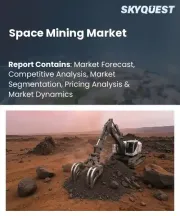
세계의 우주 채굴 시장 규모는 2024년에 22억 달러로 평가되며, 2025년 25억 8,000만 달러에서 2033년까지 91억 1,000만 달러로 성장할 전망입니다. 예측 기간(2026-2033년)의 CAGR은 17.1%로 예측됩니다.
우주 채굴 시장은 중요 광물에 대한 수요 증가와 우주기술의 발전을 배경으로 괄목할 만한 성장을 거듭하고 있습니다. 달 궤도 경제권의 확대와 더불어 민간 부문의 투자 증가와 정부 지원이 시장 역학을 촉진하고 있습니다. 주요 촉진요인으로는 전기자동차 및 재생에너지에 대한 첨단 기술에 대한 의존도 증가와 자원 안보에 대한 높은 관심을 들 수 있습니다. 달 표면 및 심우주 임무에서 현지 자원 활용(ISRU)에 대한 강조는 이러한 추세를 더욱 가속화하고 있습니다. 또한 재사용 가능한 발사 시스템, 자율 로봇 공학 및 AI 분야의 혁신은 운영상의 문제를 완화하고 있습니다. 그러나 막대한 자본 투자, 기술적 불확실성, 규제 모호성, 시장 수요의 변동성 등의 장벽은 시장의 빠른 침투를 저해할 수 있으며, 이해관계자들에게 과제와 기회를 동시에 가져다 줄 수 있습니다.
세계 우주 채굴 시장 성장 촉진요인
지속가능성과 환경보존에 대한 관심이 높아지면서 우주 채굴에 대한 관심이 크게 높아질 것으로 예측됩니다. 기존의 채굴 방식은 삼림파괴, 오염, 수자원 고갈, 사회 갈등을 유발하는 경우가 많습니다. 이러한 환경에 부담을 주는 활동을 지구 밖으로 옮김으로써 우주 채굴은 이러한 문제를 해결할 수 있는 현실적인 대안을 제시합니다. 전 세계에서 환경 규제가 강화되는 가운데, 우주 채굴은 자원 수요를 충족시키면서 생태계에 미치는 악영향을 줄일 수 있는 지원적 접근법으로 떠오르고 있습니다. 이 혁신적인 산업은 자원 채굴과 생태계 보존을 동시에 해결할 수 있는 혁신적인 솔루션으로 간주되며, 지구의 건강성을 유지하려는 인식이 높아진 것을 반영합니다.
세계 우주 채굴 시장 성장 억제요인
국제 우주법에는 명확하고 집행 가능한 규제가 부족하며, 그 모호함은 세계 우주 채굴 시장에 심각한 제약을 초래하고 있습니다. 천체에서 채굴된 자원의 소유권, 과세, 관리에 대한 불확실성은 우주 채굴 사업의 매력을 떨어뜨릴 수 있습니다. 또한 자원에 대한 권리 주장을 둘러싼 지정학적 분쟁의 잠재적 가능성은 또 다른 리스크를 야기합니다. 통일된 세계 프레임워크의 부재는 컴플라이언스를 복잡하게 만들고, 우주 채굴 관련 기업의 법적 취약성을 증가시켜 궁극적으로 시장 성장과 수요를 저해할 것입니다. 이러한 문제들은 급성장하고 있는 우주 자원 채굴 산업의 투자와 혁신에 대한 신중한 태도를 낳고 있습니다.
세계 우주 채굴 시장 동향
세계 우주 채굴 시장은 민간 부문 주도로의 변혁적 전환이 두드러지고 있으며, 상업 기업이 탐사 및 자원 채굴의 주도권을 장악하고 있습니다. 비용 효율적인 발사 서비스 및 위성 운영을 통한 우주 접근성 향상은 진입장벽을 크게 낮춰 다양한 기업 시장 진입을 촉진하고 있습니다. 또한 벤처 캐피탈과 국부펀드의 강력한 자금 지원은 혁신 환경을 강화하여 기술 및 운영 효율성의 획기적인 발전을 가능하게 합니다. 민간 기업이 확장 가능한 비즈니스 모델 개발에 집중하는 가운데, 우주 채굴 부문의 성장 궤도는 크게 확대될 것으로 예상되며, 업계의 미래 역학을 재구성할 준비가 되어 있습니다.
Global Space Mining Market size was valued at USD 2.2 Billion in 2024 and is poised to grow from USD 2.58 Billion in 2025 to USD 9.11 Billion by 2033, growing at a CAGR of 17.1% during the forecast period (2026-2033).
The global space mining market is experiencing significant growth driven by the increasing demand for critical minerals and advancements in space technologies. The expansion of the cislunar economy, coupled with rising investments from the private sector and government support, enhances market dynamics. Key drivers include the reliance on advanced technologies for electric vehicles and renewable energy, alongside a strong interest in resource security. An emphasis on in-situ resource utilization for lunar and deep-space missions further fuels this trend. Additionally, innovations in reusable launch systems, autonomous robotics, and AI are reducing operational challenges. However, barriers such as high capital investment, technological uncertainties, regulatory ambiguities, and market demand fluctuations may inhibit faster market penetration, presenting both challenges and opportunities for stakeholders.
Top-down and bottom-up approaches were used to estimate and validate the size of the Global Space Mining market and to estimate the size of various other dependent submarkets. The research methodology used to estimate the market size includes the following details: The key players in the market were identified through secondary research, and their market shares in the respective regions were determined through primary and secondary research. This entire procedure includes the study of the annual and financial reports of the top market players and extensive interviews for key insights from industry leaders such as CEOs, VPs, directors, and marketing executives. All percentage shares split, and breakdowns were determined using secondary sources and verified through Primary sources. All possible parameters that affect the markets covered in this research study have been accounted for, viewed in extensive detail, verified through primary research, and analyzed to get the final quantitative and qualitative data.
Global Space Mining Market Segments Analysis
Global Space Mining Market is segmented by Resource Type, Technology Type, Market Application, End User and region. Based on Resource Type, the market is segmented into Water Extraction and Mineral Extraction. Based on Technology Type, the market is segmented into Robotic Mining and Human-operated Systems. Based on Market Application, the market is segmented into In-situ Resource Utilization and Commercial Utilization. Based on End User, the market is segmented into Government Agencies and Private Companies. Based on region, the market is segmented into North America, Europe, Asia Pacific, Latin America and Middle East & Africa.
Driver of the Global Space Mining Market
The rising focus on sustainability and environmental conservation is expected to significantly enhance interest in space mining. Traditional mining practices often lead to deforestation, pollution, water depletion, and social strife. By shifting these environmentally taxing activities beyond Earth, space mining offers a viable alternative aimed at circumventing these challenges. As environmental regulations become increasingly stringent globally, space mining emerges as a supportive approach to fulfilling resource demands while mitigating ecological harm. This innovative industry is seen as a transformative solution that aligns resource extraction with ecological preservation, reflecting a growing consciousness towards maintaining planetary health.
Restraints in the Global Space Mining Market
The Global Space Mining market faces significant constraints due to ambiguities in international space law, which lacks clear and enforceable regulations. Uncertainties regarding the ownership, taxation, and management of resources extracted from celestial bodies can diminish the attractiveness of space mining ventures. Additionally, the potential for geopolitical conflicts over resource claims introduces further risks. The absence of unified global frameworks complicates compliance, increasing legal vulnerabilities for companies involved in space mining, ultimately hindering market growth and demand. These challenges create a cautious atmosphere for investment and innovation in the burgeoning space extraction industry.
Market Trends of the Global Space Mining Market
The Global Space Mining market is increasingly characterized by a transformative shift towards private sector leadership, as commercial entities take the helm in exploration and resource extraction. Enhanced access to space through cost-efficient launch services and satellite operations has significantly lowered barriers to entry, encouraging a diverse array of players to enter the market. Furthermore, robust financial backing from venture capitalists and sovereign funds is fortifying the innovation landscape, enabling groundbreaking advancements in technology and operational efficiency. As private companies focus on developing scalable business models, the trajectory of the space mining sector appears poised for substantial growth, reshaping the industry's future dynamics.