


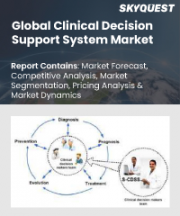
임상 의사결정 지원 시스템(CDSS) 시장 규모는 2024년에 22억 6,000만 달러로 평가되었고, 2025년 24억 3,000만 달러에서 2033년까지 44억 1,000만 달러로 성장할 전망이며, 예측 기간(2026년-2033년) CAGR은 7.7%를 보일 것으로 예측됩니다.
임상 의사결정 지원 시스템(CDSS) 시장은 환자 치료의 질을 향상시키는 신뢰할 수 있는 기술 솔루션에 대한 수요 증가를 배경으로 괄목할 만한 성장을 거듭하고 있습니다. 병원 및 의료시설에서는 전 세계 정부 주도의 노력과 FDA 등 기관의 엄격한 규제에 힘입어 정보시스템 도입이 가속화되고 있습니다. 이를 통해 제품의 무결성과 IT 및 사이버 보안 프로토콜 준수를 보장하기 위해 확립된 표준을 준수하도록 요구하고 있습니다. 코로나19 팬데믹은 의료진이 환자를 효과적으로 모니터링할 수 있는 정확한 진단 도구의 필요성을 가속화했습니다. COVID 위험 계산 도구(CORAL)를 포함한 CDSS 솔루션은 전자건강기록(EHR) 내 혁신적인 통합을 구현하여 의사의 워크플로우를 개선하고 있습니다. 또한, 사회적 거리두기의 필요성은 원격 환자 모니터링과 효율적인 건강 기록 관리를 가능하게 하는 CDSS 솔루션의 도입을 촉진하고 있습니다.
임상 의사결정 지원 시스템(CDSS) 시장 성장 촉진요인
유럽연합(EU) 보건부 장관들의 통합 e-헬스 영역 구축을 위한 협력은 역내 전자 건강 기록의 원활한 교환을 촉진하는 것을 목표로 하고 있습니다. 이 이니셔티브는 eHealth를 보다 광범위한 의료 전략에 통합하는 것의 중요성을 강조하고, 전자 건강 기록의 도입과 활용을 촉진할 것입니다. 결과적으로 이러한 정책은 세계 주요 시장에서 임상 의사결정 지원 시스템(CDSS)에 대한 수요 증가를 견인할 것으로 예측됩니다. 상호 운용 가능한 의료 정보 시스템의 강화는 환자 치료 개선에 도움을 줄 뿐만 아니라, CDSS를 현대 의료 서비스 제공에 필수적인 도구로 자리매김하여 궁극적으로 더 나은 임상 결과를 촉진할 수 있습니다.
임상 의사결정 지원 시스템(CDSS) 시장 성장 억제요인
임상 의사결정 지원 시스템(CDSS) 시장은 성장을 저해할 수 있는 몇 가지 과제에 직면해 있습니다. 큰 장벽 중 하나는 의료 조직이 이러한 시스템 도입 및 구현에 소극적이라는 점이며, 그 배경에는 자원 배분 및 기존 워크플로우와의 통합의 복잡성에 대한 우려를 이유로 들 수 있습니다. 또한, 기존 프로세스에 대한 잠재적인 혼란과 직원 교육에 따른 비용에 대한 우려는 이러한 기술 도입에 대한 의욕을 더욱 떨어뜨릴 수 있습니다. 그 결과, 의료 제공업체가 업무 체계의 변화에 신중한 환경에서는 임상 의사결정 지원 시스템의 광범위한 수용과 활용을 달성하기 어려울 수 있습니다.
임상 의사결정 지원 시스템(CDSS) 시장 동향
임상 의사결정지원시스템(CDSS) 시장에서는 CDSS 제공업체와 의료기관 간의 협력이 급증하는 두드러진 추세를 보이고 있습니다. 이러한 성장은 정부의 지원 강화와 전자건강기록(EHR)과의 통합을 촉진하는 적극적인 조치에 힘입어 환자 데이터에 대한 접근 효율화를 통해 임상적 효과를 높이고 있습니다. 또한, 의료보험법 및 메디케어법을 포함한 법적 프레임워크는 CDSS의 통합을 촉진하는 인센티브를 제공하여 의료시설 전반에 걸쳐 CDSS의 도입을 촉진하고 있습니다. 그 결과, 더 많은 의료기관이 첨단 CDSS 솔루션을 도입하고 있으며, 지속적인 혁신과 데이터 기반 지식이 환자 치료 결과와 업무 효율성을 향상시키는 환경을 조성하고 있습니다.
Clinical Decision Support System Market size was valued at USD 2.26 Billion in 2024 and is poised to grow from USD 2.43 Billion in 2025 to USD 4.41 Billion by 2033, growing at a CAGR of 7.7% during the forecast period (2026-2033).
The Clinical Decision Support System (CDSS) market is witnessing significant growth fueled by rising demand for reliable technological solutions that enhance patient care quality. Hospitals and healthcare facilities are increasingly adopting information systems, supported by global government initiatives and stringent regulations from organizations like the FDA. This necessitates adherence to established standards to ensure product integrity and compliance with IT and cybersecurity protocols. The COVID-19 pandemic accelerated the need for accurate diagnostic tools, enabling healthcare professionals to monitor patients effectively. CDSS solutions, including the COvid Risk cALculator (CORAL), exemplify innovative integration within electronic health records, enhancing workflow for physicians. Furthermore, the need for social distancing has driven the adoption of CDSS solutions that facilitate remote patient monitoring and efficient health record management.
Top-down and bottom-up approaches were used to estimate and validate the size of the Clinical Decision Support System market and to estimate the size of various other dependent submarkets. The research methodology used to estimate the market size includes the following details: The key players in the market were identified through secondary research, and their market shares in the respective regions were determined through primary and secondary research. This entire procedure includes the study of the annual and financial reports of the top market players and extensive interviews for key insights from industry leaders such as CEOs, VPs, directors, and marketing executives. All percentage shares split, and breakdowns were determined using secondary sources and verified through Primary sources. All possible parameters that affect the markets covered in this research study have been accounted for, viewed in extensive detail, verified through primary research, and analyzed to get the final quantitative and qualitative data.
Clinical Decision Support System Market Segments Analysis
Global Clinical Decision Support System Market is segmented by Component, Product, Type, Model, Delivery Mode, Application, Interactivity Level, Setting and region. Based on Component, the market is segmented into Services,Softwareand Hardware. Based on Product, the market is segmented into Integrated CDSS and Standalone CDSS. Based on Type, the market is segmented into Therapeutic CDSS and Diagnostic CDSS. Based on Model, the market is segmented into Knowledge-Based CDSS and Non-Knowledge-Based CDSS. Based on Delivery Mode, the market is segmented into On-Premise CDSS and Cloud-Based CDSS. Based on Application, the market is segmented into Conventional CDSS and Advanced CDSS. Based on Interactivity Level, the market is segmented into Active CDSS and Passive CDSS. Based on Setting, the market is segmented into Inpatient Settings and Ambulatory Care Settings. Based on region, the market is segmented into North America, Europe, Asia Pacific, Latin America and Middle East & Africa.
Driver of the Clinical Decision Support System Market
The collaborative effort among health ministers in the European Union to establish a unified eHealth area aims to facilitate the seamless exchange of electronic health records across the region. This initiative underscores the significance of integrating eHealth into broader healthcare strategies, thereby promoting the adoption and utilization of electronic health records. As a result, such policies are anticipated to drive increased demand for Clinical Decision Support Systems (CDSS) in key global markets. The enhancement of interoperable health information systems not only supports improved patient care but also positions CDSS as an essential tool in modern healthcare delivery, ultimately fostering better clinical outcomes.
Restraints in the Clinical Decision Support System Market
The clinical decision support systems market faces several challenges that could hinder its growth. A significant barrier is the reluctance of healthcare organizations to adopt and implement these systems, often stemming from concerns about resource allocation and the complexity of integration with existing workflows. Additionally, apprehensions regarding the potential disruption to established processes and the costs associated with training staff can further impede the enthusiasm for deploying these technologies. As a result, achieving widespread acceptance and utilization of clinical decision support systems may prove difficult in an environment where healthcare providers are cautious about changing their operational frameworks.
Market Trends of the Clinical Decision Support System Market
The Clinical Decision Support System (CDSS) market is witnessing a notable trend characterized by a surge in collaborations between CDSS providers and healthcare institutions. This growth is driven by the increasing government endorsement and proactive measures to facilitate the integration of CDSS with Electronic Health Records (EHR), enhancing clinical effectiveness by streamlining access to patient data. Furthermore, legislative frameworks, including the Health and Medicare Acts, incentivize the integration of CDSS, propelling its adoption across healthcare facilities. As a result, more healthcare organizations are embracing advanced CDSS solutions, fostering an environment where continuous innovation and data-driven insights lead to improved patient outcomes and operational efficiency.