Fc 및 당쇄 개변 항체 시장 : 업계 동향과 세계 예측 - 개변 유형별, 치료 유형별, 치료 영역별, 투여 경로별, 주요 지역별
Fc and Glycoengineered Antibodies Market : Industry Trends and Global Forecasts - Distribution by Type of Engineering, Type of Therapy, Therapeutic Area, Route of Administration and Key Geographical Regions
상품코드:1762535
리서치사:Roots Analysis
발행일:2025년 07월
페이지 정보:영문 293 Pages
라이선스 & 가격 (부가세 별도)
한글목차
Fc 및 당쇄 개변 항체 시장 : 개요
세계의 Fc 및 당쇄 개변 항체 시장 규모는 올해 388억 달러에 달했습니다. 이 시장은 2035년까지의 예측 기간 중 유리한 CAGR로 성장할 것으로 예측됩니다.
시장 세분화에서는 시장 규모와 기회 분석을 다음과 같은 매개 변수로 구분합니다.
수정 유형
Fc 변형 항체
당쇄 변형 항체
치료 유형
단독요법
병용요법
둘 다
치료 영역
자가면역질환
피부질환
종양학 질환
희귀질환
기타
투여 경로
정맥 투여
피하투여
근육내 투여
주요 지역
북미
유럽
아시아태평양
기타 지역
Fc 및 당쇄 변형 항체 시장 : 성장 및 동향
100개에 가까운 모노클로널 항체가 승인되고 550개 이상의 분자가 임상 파이프라인에 있는 상황에서 항체 기반 약리학적 개입은 바이오의약품 산업에서 가장 빠르게 성장하는 분야 중 하나가 되었습니다. 또한 항체 치료제 업계에서는 최근 수년간 Fc(Fragment Crystallization) 영역을 변형하여 개발된 인공 항체가 큰 관심을 받고 있습니다. 항체의 Fc 융합 단백질에서 당쇄공학 항체, 단백질 엔지니어링, 아이소유형-키메리즘 등의 변형은 항체 의존성 세포 세포독성(ADCC), 보체 의존성 세포독성(CDC), 항체 의존성 세포포식(ADCP) 활성, 분자 반감기 등 다양한 이펙터 기능을 강화하는 것으로 나타났습니다. 하는 것으로 나타났습니다. 또한 일부 Fc 변형 기술은 특정 경로에서 이펙터 기능을 억제할 수 있으며, 항암항체 개발을 위해 활발히 연구되고 있습니다.
이 분야에 대한 지속적인 연구 노력의 결과, 가즈바(만성 림프구성 백혈병 치료제)와 포테레지오(세자리 증후군 치료제)라는 두 가지 획기적인 약물이 탄생했습니다. 또한 Margenza, MONJUVI, SKYRIZI 등 여러 Fc변형 항체 제품도 지난 수년간 승인을 받았습니다. 최근에는 Epcolitamab이라는 이름의 Fc 변형 항체가 미만성 대세포 B세포 림프종 치료제로 승인되었습니다. 또한 개발 파이프라인에 있는 몇 가지 의약품도 있으며, 다양한 중소 제약사 및 대형 제약사가 연구를 진행하고 있습니다. 유망한 임상 결과와 현재 진행 중인 기술 개발로 인해 Fc 변형 항체 시장은 향후 10년간 놀라운 속도로 발전할 것으로 보입니다.
Fc 및 당쇄 변형 항체 시장 : 주요 인사이트
이 보고서는 Fc 및 당쇄 변형 항체 시장의 현황을 조사하고 업계의 잠재적인 성장 기회를 파악합니다. 이 보고서의 주요 조사 결과는 다음과 같습니다.
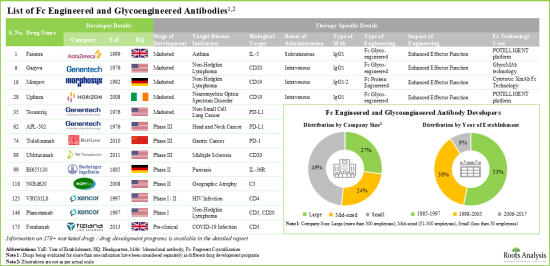
Fc항체 파이프라인에는 40개 이상의 시판 의약품과 131개의 의약품 개발 프로그램이 있으며, 주로 중견 및 대기업에서 개발 중입니다.
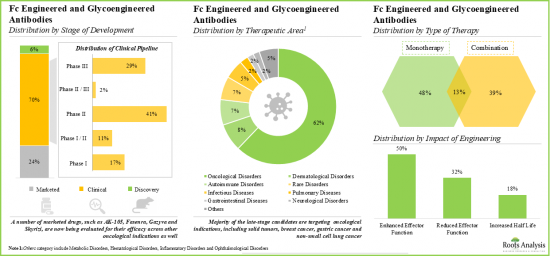
종양 질환을 표적으로 하는 중재의 대부분(62%)이 임상 개발 단계에 있으며, 이 중 항체의 대부분(81%)이 Fc 변형 항체입니다.
Fc 변형 항체 및 당쇄 변형 항체 분야에서는 지난 수년간 150건에 가까운 보조금이 수여되었으며, NIAID는 이러한 보조금 수여의 선두 기관으로 부상하고 있습니다.
Fc 변형 항체 및 당쇄 변형 항체 관련 지적재산권은 산업계와 비산업계 모두에서 특허를 출원하고 있으며, 시간이 지남에 따라 놀라운 속도로 성장하고 있습니다.
Fc 변형 항체 및 당쇄 변형 항체 평가를 위해 등록된 임상시험에서 다양한 지역에 걸쳐 약 50만 명의 피험자를 모집/등록하고 있습니다.
2016년 이후, 의약품 수탁제조 관련 제조 포트폴리오를 더욱 강화하기 위해 다양한 산업 및 비산업 분야의 참여 기업과 70건 이상의 계약을 체결했습니다.
유망한 개발 파이프라인에 힘입어 Fc 변형 항체 및 당쇄 변형 항체 시장은 향후 수년간 안정적인 속도로 성장할 것으로 예측됩니다.
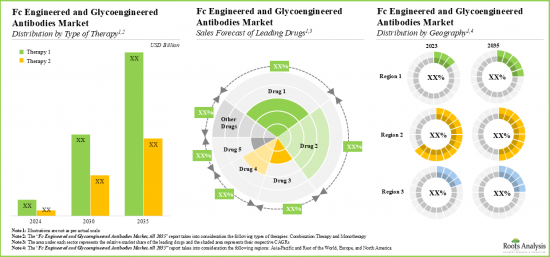
시판된 치료제와 후기 단계 치료제의 판매별 매출 측면에서 향후 기회는 전 세계 다양한 유형의 치료제에 잘 분산될 것으로 예측됩니다.
Fc 및 당쇄 변형 항체 시장 : 주요 부문
Fc 및 당쇄 변형 항체 시장에서 가장 큰 점유율을 차지하는 Fc 변형 항체 부문
Fc 변형 유형에 따라 시장은 Fc 변형 항체와 당쇄 변형 항체로 구분됩니다. 현재 세계 Fc 및 당쇄 변형 항체 시장에서 Fc 변형 항체 분야가 가장 큰 점유율을 차지하고 있습니다. 이러한 추세는 Fc 변형이 이펙터 기능을 강화하고 치료 효과를 향상시킨다는 사실로 인해 향후 수년간 변함없이 유지될 것으로 보입니다.
치료 유형별로 시장은 단독요법, 병용요법, 그리고 두 가지 모두로 분류됩니다. 현재, 단일 요법이 세계 Fc/당쇄 변형 항체 시장에서 가장 높은 비율을 차지하고 있지만, 이는 단일 요법과 관련된 몇 가지 장점, 예를 들어 규제 경로의 용이성, 잠재적 약물 상호 작용 감소, 비용 효율성 등의 장점 때문입니다.
치료 영역별로 보면 시장은 자가면역질환, 피부질환, 종양질환, 희귀질환, 기타 질환으로 구분됩니다. 현재 세계 Fc/당쇄 변형 항체 시장에서 가장 큰 점유율을 차지하고 있는 분야는 종양 질환 분야입니다. 그러나 자가면역질환 부문 시장은 예측 기간 중 더 높은 CAGR로 성장할 것으로 예측됩니다.
투여 경로에 따라 시장은 정맥 투여 경로, 피하 투여 경로, 근육내 투여 경로로 구분됩니다. 현재 세계 Fc/당쇄변형항체 시장은 정맥투여용 Fc/당쇄변형항체가 지배적입니다. 이는 정맥 투여를 통해 항체가 전신에 분포하여 치료 효과와 생체 이용률이 향상되기 때문입니다.
주요 지역별로 시장은 북미, 유럽, 아시아태평양, 기타 지역으로 구분됩니다. 현재 북미는 세계 Fc 항체 및 당쇄 변형 항체 시장을 독점하고 있으며, 가장 큰 매출 점유율을 차지하고 있습니다. 또한 아시아태평양 시장은 향후 더 높은 CAGR로 성장할 가능성이 높습니다.
Fc 및 당쇄 개변 항체 시장의 참여 기업 예
AbbVie
Akesobio
Alexion Pharmaceuticals
Amgen
AstraZeneca
Boehringer Ingelheim
Genentech
MacroGenics
MorphoSys
Kyowa Kirin
Xencor
목차
제1장 서문
제2장 조사 방법
제3장 경제적 및 기타 프로젝트 특유 고려 사항
챕터 개요
시장 역학
제4장 개요
챕터 개요
제5장 서론
챕터 개요
항체 구조
항체 개발의 역사적 연표
항체 아이소타입
항체의 작용기서
Fc 영역과 이펙터 기능
향후 전망
제6장 시장 구도
챕터 개요
Fc 개변 및 당쇄 개변 항체 : 전체적인 파이프라인
Fc 개변 및 당쇄 개변 항체 : 개발자의 전체적인 상황
제7장 기업 개요
챕터 개요
주요 Fc 및 당쇄 개변 항체 약제 개발 기업의 상세한 개요
AbbVie
Alexion Pharmaceuticals
AstraZeneca
Genentech
MacroGenics
Kyowa Kirin
기타 기업의 개요
Akeso Biopharma
Amgen
Boehringer Ingelheim
MorphoSys
Xemcor
제8장 임상시험 분석
챕터 개요
범위와 조사 방법
Fc 개변 항체 및 당쇄 개변 항체 : 임상시험 분석
제9장 파트너십과 협업
챕터 개요
파트너십 모델
Fc 개변 및 당쇄 개변 항체 : 파트너십과 협업
제10장 보조금 분석
챕터 개요
범위와 조사 방법
Fc 개변 항체 및 당쇄 개변 항체 : 보조금 분석
제11장 특허 분석
챕터 개요
범위와 조사 방법
Fc 개변 항체 및 당쇄 개변 항체 : 특허 분석
제12장 세계의 Fc 개변 및 당쇄 개변 항체 시장
챕터 개요
주요 전제와 조사 방법
세계의 Fc 개변 및 당쇄 개변 항체 시장, 역사적 동향(2019년 이후) 및 예측(-2035년)
주요 시장 세분화
제13장 Fc 개변 및 당쇄 개변 항체 시장(개변 유형별)
챕터 개요
주요 전제와 조사 방법
Fc 수식 및 당쇄수식 항체 시장 : 개변 유형별
데이터 삼각측량과 검증
제14장 Fc 개변 및 당쇄 개변 항체 시장(치료 유형별)
챕터 개요
주요 전제와 조사 방법
Fc 개변 및 당쇄 개변 항체 시장 : 치료 유형별
데이터 삼각측량과 검증
제15장 Fc 개변 및 당쇄 개변 항체 시장(치료 영역별)
챕터 개요
주요 전제와 조사 방법
Fc 개변 및 당쇄 개변 항체 시장 : 치료 영역별
데이터 삼각측량과 검증
제16장 Fc 개변 및 당쇄 개변 항체 시장(투여 경로별)
챕터 개요
주요 전제와 조사 방법
Fc 개변 및 당쇄 개변 항체 시장 : 투여 경로별
데이터 삼각측량과 검증
제17장 Fc 개변 및 당쇄 개변 항체 시장(주요 지역별)
챕터 개요
주요 전제와 조사 방법
Fc 개변 및 당쇄 개변 항체 시장 : 주요 지역별
데이터 삼각측량과 검증
제18장 Fc 개변 항체 및 당쇄 개변 항체 시장, 의약품 판매 예측
챕터 개요
주요 전제와 조사 방법
시판되고 있는 Fc 개변 및 당쇄 개변 항체 시장 : 판매 예측
제III상 Fc 개변 및 당쇄 개변 항체 시장 : 판매 예측
데이터 삼각측량과 검증
제19장 결론
제20장 부록 I : 표형식 데이터
제21장 부록 II : 기업 및 조직 리스트
KSA
영문 목차
영문목차
FC AND GLYCOENGINEERED ANTIBODIES MARKET: OVERVIEW
As per Roots Analysis, the global Fc and glycoengineered antibodies market is valued at USD 38.8 billion in the current year and is expected to grow at a lucrative CAGR during the forecast period, till 2035.
The market sizing and opportunity analysis has been segmented across the following parameters:
Type of Engineering
Fc Engineered Antibodies
Glycoengineered Antibodies
Type of Therapy
Monotherapy
Combination Therapy
Both
Therapeutic Area
Autoimmune Disorders
Dermatological Disorders
Oncological Disorders
Rare Diseases
Other Disorders
Route of Administration
Intravenous Route
Subcutaneous Route
Intramuscular Route
Key Geographical Regions
North America
Europe
Asia-Pacific
Rest of the World
FC AND GLYCOENGINEERED ANTIBODIES MARKET: GROWTH AND TRENDS
With close to 100 approved monoclonal antibodies, and over 550 molecules in the clinical pipeline, antibody based pharmacological interventions have become one of the fastest growing segments of the biopharmaceutical industry. Further, within the antibody therapeutics industry, engineered antibodies, developed by modifying the fragment crystallizable (Fc) region, have garnered significant interest over the past few years. The modifications, such as glycoengineered antibodies, protein engineering or isotype chimerism in the Fc fusion protein of an antibody have shown to augment the various effector functions, such as antibody-dependent cellular cytotoxicity (ADCC), complement-dependent cytotoxicity (CDC), antibody-dependent cellular phagocytosis (ADCP) activity and / or the half-life of the molecule. Moreover, several Fc engineering technologies enable the suppression of the effector functions in certain pathways and are being actively explored for development of anti-cancer antibodies.
The consistent research efforts in this domain have resulted into the emergence of two groundbreaking drugs, namely Gazyva (for Chronic Lymphocytic Leukemia) and POTELEGIO (for Sezary syndrome). Further, several other Fc engineered antibody products, including Margenza, MONJUVI and SKYRIZI have also received approval in the past few years. More recently, Fc engineered antibody, named Epcoritamab, received approval for the treatment of diffuse large B-cell lymphoma. Further, there are several drugs in the development pipeline, which are being investigated by various small and established pharmaceutical companies. With the promising clinical results coupled with ongoing technological developments, the market for Fc engineered antibodies is likely to evolve at a commendable pace over the next decade.
FC AND GLYCOENGINEERED ANTIBODIES MARKET: KEY INSIGHTS
The report delves into the current state of the Fc and glycoengineered antibodies market and identifies potential growth opportunities within industry. Some key findings from the report include:
Fc engineered antibodies pipeline features more than 40 marketed drugs, and 131 drug development programs intended for the treatment of various diseases; these are primarily developed by mid and large-sized players.
Majority (62%) of the interventions targeting oncological disorders are in clinical phase of development; of these, most (81%) of the antibodies are Fc engineered.
Close to 150 grants have been awarded in the past few years in the domain of Fc engineered and glycoengineered antibodies; NIAID emerged as the top funding institute for these grants.
Over time, the intellectual property related to Fc engineered and glycoengineered antibodies has grown at a commendable pace, with patents being filed by both industry and non-industry players.
Close to half a million patients have been recruited / enrolled in clinical trials registered for the evaluation of Fc engineered and glycoengineered antibodies, across different geographies.
Since 2016, more than 70 agreements have been inked by various industry and non-industry players, in order to further enhance their manufacturing portfolio related to pharmaceutical contract manufacturing.
Driven by the promising development pipeline, the market for Fc engineered and glycoengineered antibodies is likely to grow at a steady pace in the coming years.
In terms of revenues from the sales of marketed and late-stage therapies, the future opportunity is anticipated to be well dispersed across different types of therapy across the globe.
FC AND GLYCOENGINEERED ANTIBODIES MARKET: KEY SEGMENTS
Fc Engineered Antibodies Segment holds the Largest Share of the Fc and Glycoengineered Antibodies Market
Based on the type of Fc engineering, the market is segmented into Fc engineered antibodies and glycoengineered antibodies. At present, the Fc engineered antibodies segment holds the maximum share of the global Fc and glycoengineered antibodies market. This trend is likely to remain the same in the coming years owing to the fact that Fc engineering enhances effector functions, improving the therapeutic efficacy of the modality.
By Type of Therapy, Monotherapy Segment Accounts for the Largest Share of the Global Fc and Glycoengineered Antibodies Market
Based on the type of therapy, the market is segmented into monotherapy, combination therapy and both. Currently, the monotherapy segment captures the highest proportion of the global Fc and glycoengineered antibodies market owing to the several benefits associated with monotherapy, such as easy regulatory pathways, reduced potential drug interactions and cost effectiveness.
By Therapeutic Area, Autoimmune Disorders is the Fastest Growing Segment of the Global Fc and Glycoengineered Antibodies Market
Based on the therapeutic area, the market is segmented into autoimmune disorders, dermatological disorders, oncological disorders, rare diseases and other disorders. At present, the oncological disorders segment holds the maximum share of the global Fc and glycoengineered antibodies market. However, the market for autoimmune disorders segment is expected to grow at a higher CAGR during the forecasted period.
The Intravenous Route Segment Account for the Largest Share of the Global Fc and Glycoengineered Antibodies Market
Based on the route of administration, the market is segmented into intravenous route, subcutaneous route and intramuscular route of administration. Currently, the global Fc and glycoengineered antibodies market is dominated by the Fc and glycoengineered antibodies for intravenous route of administration. This is due to the fact that intravenous route provides complete systemic distribution of antibodies facilitating enhanced therapeutic efficacy and bioavailability.
North America Accounts for the Largest Share of the Market
Based on key geographical regions, the market is segmented into North America, Europe, Asia-Pacific and Rest of the World. Currently, North America dominates the global Fc and glycoengineered antibodies market and accounts for the largest revenue share. Further, the market Asia-Pacific is likely to grow at a higher CAGR in the coming future.
Example Players in the Fc and Glycoengineered Antibodies Market
AbbVie
Akesobio
Alexion Pharmaceuticals
Amgen
AstraZeneca
Boehringer Ingelheim
Genentech
MacroGenics
MorphoSys
Kyowa Kirin
Xencor
FC AND GLYCOENGINEERED ANTIBODIES MARKET: RESEARCH COVERAGE
Market Sizing and Opportunity Analysis: The report features an in-depth analysis of the global Fc and glycoengineered antibodies market, focusing on key market segments, including [A] type of engineering, [B] type of therapy, [C] therapeutic area, [D] route of administration and [E] key geographical regions.
Market Landscape: A comprehensive evaluation of Fc and glycoengineered antibodies, based on several relevant parameters, such as [A] phase of development, [B] type of engineering, [C] impact of engineering, [D] biological target, [E] type of therapy, [F] target disease indication, [G] therapeutic area, [H] route of administration and [I] popular Fc engineering technologies.
Company Profiles: In-depth profiles of key players that are currently involved in the development of Fc engineered antibodies, focusing on [A] overview of the company, [B] financial information (if available) [C] drug portfolio and [D] recent developments and an informed future outlook.
Clinical Trial Analysis: An insightful analysis of clinical trials related to Fc and glycoengineered antibodies, based on several parameters, such as [A] trial registration year, [B] trial status, [C] trial phase, [D] enrolled patient population, [E] type of sponsor, [F] most active industry players (in terms of number of trials conducted), [F] study design, [G] target indication and [H] key geographical regions.
Partnerships and Collaborations: An insightful analysis of the deals inked by stakeholders in this domain, based on several parameters, such as [A] year of partnership, [B] type of partnership, [C] type of engineering, [D] therapeutic area, [E] most active players (in terms of the number of partnerships signed) and [F] regional distribution of the companies involved in these agreements.
Grants Analysis: A comprehensive assessment of grants that have been awarded to research institutes for projects related to Fc and glycoengineered antibodies, based on various relevant parameters, such as [A] year of grant award, [B] amount awarded, [C] funding institute center, [D] support period, [E] type of grant application, [F] purpose of grant award, [G] activity code, [H] study section involved, [I] most popular NIH departments, [J] prominent program officers and [K] popular recipient organizations.
Patent Analysis: An in-depth analysis of patents filed / granted till date related to Fc and glycoengineering antibodies, based on various relevant parameters, such as [A] type of patent, [B] publication year, [C] application year, [D] type of applicant, [E] geographical location, [E] CPC symbols, [F] most active players and [G] patent valuation analysis.
KEY QUESTIONS ANSWERED IN THIS REPORT
How many companies are currently engaged in this market?
Which are the leading companies in this market?
What factors are likely to influence the evolution of this market?
What is the current and future market size?
What is the CAGR of this market?
How is the current and future market opportunity likely to be distributed across key market segments?
REASONS TO BUY THIS REPORT
The report provides a comprehensive market analysis, offering detailed revenue projections of the overall market and its specific sub-segments. This information is valuable to both established market leaders and emerging entrants.
Stakeholders can leverage the report to gain a deeper understanding of the competitive dynamics within the market. By analyzing the competitive landscape, businesses can make informed decisions to optimize their market positioning and develop effective go-to-market strategies.
The report offers stakeholders a comprehensive overview of the market, including key drivers, barriers, opportunities, and challenges. This information empowers stakeholders to stay abreast of market trends and make data-driven decisions to capitalize on growth prospects.
ADDITIONAL BENEFITS
Complimentary PPT Insights Packs
Complimentary Excel Data Packs for all Analytical Modules in the Report
15% Free Content Customization
Detailed Report Walkthrough Session with Research Team
Free Updated report if the report is 6-12 months old or older
TABLE OF CONTENTS
1. PREFACE
1.1. Introduction
1.2. Market Share Insights
1.3. Key Market Insights
1.4. Report Coverage
1.5. Key Questions Answered
1.6. Chapter Outlines
2 RESEARCH METHODOLOGY
2.1. Chapter Overview
2.2. Research Assumptions
2.3. Project Methodology
2.4. Forecast Methodology
2.5. Robust Quality Control
2.6. Key Considerations
2.6.1. Demographics
2.6.2. Economic Factors
2.6.3. Government Regulations
2.6.4. Supply Chain
2.6.5. COVID Impact / Related Factors
2.6.6. Market Access
2.6.7. Healthcare Policies
2.6.8. Industry Consolidation
2.7. Key Market Segmentations
3. ECONOMIC AND OTHER PROJECT SPECIFIC CONSIDERATIONS
3.1. Chapter Overview
3.2. Market Dynamics
3.2.1. Time Period
3.2.1.1. Historical Trends
3.2.1.2. Current and Forecasted Estimates
3.2.2. Currency Coverage
3.2.2.1. Major Currencies Affecting the Market
3.2.2.2. Impact of Currency Fluctuations on the Industry
3.2.2.3. Foreign Exchange Impact
3.2.2.4. Evaluation of Foreign Exchange Rates and Their Impact on Market
3.2.2.5. Strategies for Mitigating Foreign Exchange Risk
3.2.3. Recession
3.2.3.1. Historical Analysis of Past Recessions and Lessons Learnt
3.2.3.2. Assessment of Current Economic Conditions and Potential Impact on the Market
3.2.4. Inflation
3.2.4.1. Measurement and Analysis of Inflationary Pressures in the Economy
3.2.4.2. Potential Impact of Inflation on the Market Evolution
4. EXECUTIVE SUMMARY
4.1. Chapter Overview
5. INTRODUCTION
5.1. Chapter Overview
5.2. Structure of Antibodies
5.3. Historical Timeline of Antibody Development
5.4. Antibody Isotypes
5.5. Mechanism of Action of Antibodies
5.6. Fc Region and Effector Functions
5.6.1. Types of Fc Receptors
5.6.2. Engineering of the Fc Region
5.6.2.1. Glycoengineering
5.6.2.2. Protein Engineering
5.6.2.3. Isotype Chimerism
5.7. Future Perspective
6. MARKET LANDSCAPE
6.1. Chapter Overview
6.2. Fc Engineered and Glycoengineered Antibodies: Overall Pipeline
6.2.1. Analysis by Stage of Development
6.2.2. Analysis by Type of Antibody
6.2.3. Analysis by Type of Engineering
6.2.4. Analysis by Impact of Engineering
6.2.5. Analysis by Biological Target
6.2.6. Analysis by Type of Therapy
6.2.7. Analysis by Target Disease Indication
6.2.8. Analysis by Therapeutic Area
6.2.9. Analysis by Route of Administration
6.2.10. Popular Fc Engineering Technologies: Analysis by Number of Marketed Drugs and Development Programs
6.3. Fc Engineered and Glycoengineered Antibodies: Overall Developer Landscape
6.3.1. Analysis by Year of Establishment
6.3.2. Analysis by Company Size
6.3.3. Analysis by Location of Headquarters
6.3.4. Leading Developers: Analysis by Number of Drugs
7. COMPANY PROFILES
7.1. Chapter Overview
7.2. Detailed Company Profiles of Leading Fc Engineered and Glycoengineered Antibody Drug Developers
7.2.1. AbbVie
7.2.1.1. Company Overview
7.2.1.2. Financial Information
7.2.1.3. Drug Portfolio
7.2.1.3.1. Drug Profile: Skyrizi
7.2.1.4. Recent Developments and Future Outlook
7.2.2. Alexion Pharmaceuticals
7.2.2.1. Company Overview
7.2.2.2. Drug Portfolio
7.2.2.2.1. Drug Profile: Soliris
7.2.2.2.2. Drug Profile: Ultomiris
7.2.2.3. Recent Developments and Future Outlook
7.2.3. AstraZeneca
7.2.3.1. Company Overview
7.2.3.2. Financial Information
7.2.3.3. Drug Portfolio
7.2.3.3.1. Drug Profile: Beyfortus
7.2.3.3.2. Drug Profile: Imfinzi
7.2.3.3.3. Drug Profile: Fasenra
7.2.3.3.4. Drug Profile: Saphnelo
7.2.3.4. Recent Developments and Future Outlook
7.2.4. Genentech
7.2.4.1. Company Overview
7.2.4.2. Financial Information
7.2.4.3. Drug Portfolio
7.2.4.3.1. Drug Profile: Gazyva
7.2.4.3.2. Drug Profile: Ocrevus
7.2.4.3.3. Drug Profile: Tecentriq
7.2.4.4. Recent Developments and Future Outlook
7.2.5. MacroGenics
7.2.5.1. Company Overview
7.2.5.2. Financial Information
7.2.5.3. Drug Portfolio
7.2.5.3.1. Drug Profile: Margenza
7.2.5.3.2. Drug Profile: MGA-271
7.2.5.4. Recent Developments and Future Outlook
7.2.6. Kyowa Kirin
7.2.6.1. Company Overview
7.2.6.2. Financial Information
7.2.6.3. Drug Portfolio
7.2.6.3.1. Drug Profile: POTELIGEO
7.2.6.4. Recent Developments and Future Outlook
7.3. Short Company Profiles of Leading Fc Engineered and Glycoengineered Antibody Drug Developers
7.3.1. Akeso Biopharma
7.3.1.1. Company Overview
7.3.1.2. Drug Portfolio
7.3.1.2.1. Drug Profile: Penpulimab
7.3.2. Amgen
7.3.2.1. Company Overview
7.3.2.2. Drug Portfolio
7.3.2.2.1. Drug Profile: Bemarituzuman
7.3.2.2.2. Drug Profile: STEAP1 XmAb Antibody
7.3.2.2.3. Drug Profile: FPA157
7.3.3. Boehringer Ingelheim
7.3.3.1. Company Overview
7.3.3.2. Drug Portfolio
7.3.3.2.2. Drug Profile: Spesolimab
7.3.4. MorphoSys
7.3.4.1. Company Overview
7.3.4.2. Drug Portfolio
7.3.4.2.1. Drug Portfolio: Tafasitamab
7.3.5. Xemcor
7.3.5.1. Company Overview
7.3.5.2. Drug Portfolio
7.3.5.2.1. Drug Portfolio: Tidutamab
7.3.5.2.2. Drug Portfolio: XmAb22841
7.3.5.2.3. Drug Portfolio: XmAb23104
7.3.5.2.4. Drug Portfolio: Plamotamab
7.3.5.2.5. Drug Portfolio: Vibecotamab
7.3.5.2.6. Drug Portfolio: RO7310729
7.3.5.2.7. Drug Portfolio: XmAb20717
7.3.5.2.8. Drug Portfolio: XmAb819
7.3.5.2.9. Drug Portfolio: XmAb27564
7.3.5.2.10. Drug Portfolio: VRC01LS
8. CLINICAL TRIAL ANALYSIS
8.1. Chapter Overview
8.2. Scope and Methodology
8.3. Fc Engineered and Glycoengineered Antibodies: Clinical Trial Analysis
8.3.1. Analysis by Trial Registration Year
8.3.2. Analysis of Number of Patients Enrolled by Trial Registration Year
8.3.3. Analysis by Trial Phase
8.3.4. Analysis of Number of Patients Enrolled by Trial Phase
8.3.5. Analysis by Trial Registration Year and Trial Phase
8.3.6. Analysis by Trial Status
8.3.7. Analysis by Patient Gender
8.3.8. Analysis by Target Indication
8.3.9. Analysis by Study Design
8.3.9.1. Analysis by Type of Trial Masking
8.3.9.2. Analysis by Type of Intervention Model
8.3.9.3. Analysis by Type of Trial Purpose
8.3.9.4. Analysis by Design Allocation
8.3.10. Most Active Sponsor / Collaborator: Analysis by Number of Registered Trials
8.3.10.1. Analysis by Leading Industry Players
8.3.10.2. Analysis by Leading Non-Industry Players
8.3.11. Analysis by Geography
8.3.11.1. Analysis of Clinical Trials by Trial Status and Geography
8.3.11.2. Analysis of Patients Enrolled by Trial Status and Geography
9. PARTNERSHIPS AND COLLABORATIONS
9.1. Chapter Overview
9.2. Partnership Models
9.3. Fc Engineered and Glycoengineered Antibodies: Partnerships and Collaborations
9.3.1. Analysis by Year of Partnership
9.3.2. Analysis by Type of Partnership
9.3.3. Analysis by Year and Type of Partnership
9.3.4. Analysis by Type of Engineering
9.3.5. Analysis by Therapeutic Area
9.3.6. Most Active Players: Analysis by Number of Partnerships
9.3.7. Analysis by Geography
9.3.7.1. Intracontinental and Intercontinental Agreements
9.3.7.2. Local and International Agreements
10. GRANT ANALYSIS
10.1. Chapter Overview
10.2. Scope and Methodology
10.3. Fc Engineered and Glycoengineered Antibodies: Grant Analysis
10.3.1. Analysis by Year of Grant Award
10.3.2. Analysis by Amount Awarded
10.3.3. Analysis by Funding Institute Center
10.3.4. Analysis by Support Period
10.3.5. Analysis by Funding Institute Center and Support Period
10.3.6. Analysis by Type of Grant Application
10.3.7. Analysis by Purpose of Grant Award
10.3.8. Analysis by Activity Code
10.3.9. Analysis by Study Section Involved
10.3.10. Most Popular NIH Departments: Analysis by Number of Grants
10.3.10.1. Prominent Program Officers: Analysis By Number of Grants
10.3.10.2. Popular Recipient Organizations: Analysis by Number of Grants
10.3.10.3. Popular Recipient Organizations: Analysis by Grant Amount
10.3.11. Popular Recipient Organizations: Distribution by States in the US
11. PATENT ANALYSIS
11.1. Chapter Overview
11.2. Scope and Methodology
11.3. Fc Engineered and Glycoengineered Antibodies: Patent Analysis
11.3.1. Analysis by Patent Publication Year
11.3.2. Analysis by Patent Application Year
11.3.3. Analysis by Granted Patents and Patent Applications, Since 2019
11.3.4. Analysis by Patent Jurisdiction
11.3.5. Analysis by CPC Symbols
11.3.6. Analysis by Type of Applicant
11.3.7. Leading Industry Players: Analysis by Number of Patents
11.3.8. Leading Non-Industry Players: Analysis by Number of Patents
11.3.9. Leading Patent Assignees: Analysis by Number of Patents
11.3.10. Patent Benchmarking Analysis
11.3.10.1. Analysis by Patent Characteristics
11.3.11. Patent Valuation
11.3.12. Leading Patents by Number of Citations
12. GLOBAL Fc ENGINEERED AND GLYCOENGINEERED ANTIBODIES MARKET
12.1. Chapter Overview
12.2. Key Assumptions and Methodology
12.3. Global Fc Engineered and Glycoengineered Antibodies Market, Historical Trends (Since 2019) and Future Estimates (Till 2035)
12.3.1. Scenario Analysis
12.3.1.1. Conservative Scenario
12.3.1.2. Optimistic Scenario
12.4. Key Market Segmentations
13. Fc ENGINEERED AND GLYCOENGINEERED ANTIBODIES MARKET, BY TYPE OF ENGINEERING
13.1. Chapter Overview
13.2. Key Assumptions and Methodology
13.3. Fc Engineered and Glycoengineered Antibodies Market: Distribution by Type of Engineering
13.3.1. Fc Engineered Antibodies Market, Till 2035
13.3.2. Glycoengineered Antibodies Market, Till 2035
13.4. Data Triangulation and Validation
14. Fc ENGINEERED AND GLYCOENGINEERED ANTIBODIES MARKET, BY TYPE OF THERAPY
14.1. Chapter Overview
14.2. Key Assumptions and Methodology
14.3. Fc Engineered and Glycoengineered Antibodies Market: Distribution by Type of Therapy
14.3.1. Fc Engineered and Glycoengineered Market for Monotherapy, Till 2035
14.3.2. Fc Engineered and Glycoengineered Market for Combination Therapy, Till 2035
14.3.3. Fc Engineered and Glycoengineered Market for Both, Till 2035
14.4. Data Triangulation and Validation
15. Fc ENGINEERED AND GLYCOENGINEERED ANTIBODIES MARKET, BY THERAPEUTIC AREA
15.1. Chapter Overview
15.2. Key Assumptions and Methodology
15.3. Fc Engineered and Glycoengineered Antibodies Market: Distribution by Therapeutic Area
15.3.1. Fc Engineered and Glycoengineered Market for Oncological Disorders, Till 2035
15.3.2. Fc Engineered and Glycoengineered Market for Dermatological Disorders, Till 2035
15.3.3. Fc Engineered and Glycoengineered Market for Autoimmune Disorders, Till 2035
15.3.4. Fc Engineered and Glycoengineered Market for Rare Disorders, Till 2035
15.3.5. Fc Engineered and Glycoengineered Market for Other Disorders, Till 2035
15.4. Data Triangulation and Validation
16. Fc ENGINEERED AND GLYCOENGINEERED ANTIBODIES MARKET, BY ROUTE OF ADMINISTRATION
16.1. Chapter Overview
16.2. Key Assumptions and Methodology
16.3. Fc Engineered and Glycoengineered Antibodies Market: Distribution by Route of Administration
16.3.1. Fc Engineered and Glycoengineered Market for Intravenous Route, Till 2035
16.3.2. Fc Engineered and Glycoengineered Market for Subcutaneous Route, Till 2035
16.3.3. Fc Engineered and Glycoengineered Market for Intramuscular Route, Till 2035
16.4. Data Triangulation and Validation
17. Fc ENGINEERED AND GLYCOENGINEERED ANTIBODIES MARKET, BY KEY GEOGRAPHICAL REGIONS
17.1. Chapter Overview
17.2. Key Assumptions and Methodology
17.3. Fc Engineered and Glycoengineered Antibodies Market: Distribution by Key Geographical Regions
17.3.1. Fc Engineered and Glycoengineered Market in North America, Till 2035
17.3.2. Fc Engineered and Glycoengineered Market in Europe, Till 2035
17.3.3. Fc Engineered and Glycoengineered Market in Asia-Pacific, Till 2035
17.3.4. Fc Engineered and Glycoengineered Market in Rest of the World, Till 2035
17.4. Data Triangulation and Validation
18. Fc ENGINEEREDAND GLYCOENGINEERED ANTIBODIES MARKET, SALES FORECAST OF DRUGS
18.1. Chapter Overview
18.2. Key Assumptions and Methodology
18.3. Commercialized Fc Engineered and Glycoengineered Antibodies Market: Sales Forecast
18.3.1. AK-105 Sales Forecast
18.3.2. BeyfortusTM Sales Forecast
18.3.3. Briumvi(R) Sales Forecast
18.3.4. Fasenra(R) Sales Forecast
18.3.5. Gazyva(R) Sales Forecast
18.3.6. Imfinzi(R) Sales Forecast
18.3.7. Margenza Sales Forecast
18.3.8. Monjuvi(R) Sales Forecast
18.3.9. Ocrevus(R) Sales Forecast
18.3.10. POTELIGEO(R) Sales Forecast
18.3.11. Saphnelo(R) Sales Forecast
18.3.12. Skyrizi(R) Sales Forecast
18.3.13. Soliris(R) Sales Forecast
18.3.14. Tecentriq(R) Sales Forecast
18.3.15. Tislelizumab Sales Forecast
18.3.16. Tzield(R) Sales Forecast
18.3.17. Ultomiris(R) Sales Forecast
18.3.18. Uplizna(R) Sales Forecast
18.4. Phase III Fc Engineered and Glycoengineered Antibodies Market: Sales Forecast
18.4.1. Clazakizumab Sales Forecast
18.4.2. FPA144 Sales Forecast
18.4.3. Skyrizi Sales Forecast
18.4.4. TQ-B2450 Sales Forecast
18.4.5. Visterra Sales Forecast
18.5. Data Triangulation and Validation
19. CONCLUDING REMARKS
19.1. Chapter Overview
20 APPENDIX I: TABULATED DATA
21 APPENDIX II: LIST OF COMPANIES AND ORGANIZATIONS