표적 약물전달 기기 시장 - 제2판 : 업계 동향 및 세계 예측(-2035년) - 기기 유형별, 표적 장기별, 치료 유형별, 투여 경로별, 치료 분야별, 주요 지역별 예측
Targeted Drug Delivery Device Market - 2nd Edition: Industry Trends and Global Forecasts, till 2035 - Distribution by Type of Device, Target Organ, Type of Therapy Delivered, Route of Administration, Therapeutic Area, Key Geographical Regions Forecast
상품코드:1677741
리서치사:Roots Analysis
발행일:2025년 03월
페이지 정보:영문 275 Pages
라이선스 & 가격 (부가세 별도)
한글목차
전 세계 표적 약물전달 기기의 시장 규모는 2026년 4억 달러에서 2035년까지 21억 달러에 달할 것으로 예상되며, 2035년까지 예측 기간 동안 연평균 19.7%의 CAGR을 기록할 것으로 예상됩니다.
지난 수십 년 동안 제약 산업은 기존 의약품보다 생물학적 제제 사용으로 전환하고 있습니다. 이러한 추세는 세포생물학 및 약리학의 발전으로 인해 더 높은 효능과 큰 시장 개척 가능성을 가진 치료법 개발이 가능해졌기 때문입니다. 현재 심혈관질환, 종양질환, 신경질환 등 다양한 질환의 치료를 위해 1,000여 종의 세포-유전자 치료제가 개발 중에 있습니다. 또한 지난 10년간 폐암과 흑색종 치료를 위한 여러 면역치료제가 개발되었습니다.
생물학적 제제는 그 장점에도 불구하고 약물전달의 복잡성, 면역원성 우려 등 많은 문제를 안고 있습니다. 이러한 전신 독성을 피하기 위해 제한된 양의 약물을 투여하는 경우가 많으며, 그 결과 표적 장기에 도달하는 약물의 양은 소량이 됩니다. 또한, 약리학적인 관점에서 볼 때, 생물학적 제제는 일반적으로 제한된 시간 동안만 표적 부위에 머무르기 때문에 장기간에 걸친 약물전달을 통해 달성할 수 있는 최종 치료 효과가 감소합니다. 또한, 세포 치료와 같은 일부 치료법은 추가 치료 물질이나 보완적인 제품을 정기적으로 투여해야 하므로 이미 복잡한 침습적 투여 절차가 추가됩니다.
이러한 문제를 극복하기 위해 제약 업계는 치료 안전성 지수를 향상시키고 표적 부위로의 약물전달을 강화하기 위한 표적 약물전달 기기 개발에 집중하고 있습니다. 생물학적 제제의 표적 전달을 목적으로 하는 이러한 장치의 예로는 Extroducer 마이크로카테터, Helix 생물학적 치료 전달 시스템, ImmunoPulse IL-12, SmartFlow 신경심실 캐뉼라 등이 있습니다. 이러한 약물전달 기기는 치료 효과를 높이고 표적 부위에 생물학적 제제를 정확하게 전달할 수 있도록 도와줍니다.
바이오의약품 시장의 급속한 성장과 업계 이해 관계자들의 관심에 힘입어 이러한 표적 약물전달 기기의 채택이 꾸준히 증가하고 있습니다. 또한, 기술 발전으로 인해 이러한 장치의 개발이 증가할 것으로 예상되며, 향후 몇 년 동안 시장은 안정적인 성장을 이룰 것으로 예상됩니다.
세계의 표적 약물전달 기기 시장에 대해 조사했으며, 시장 개요와 함께 기기 종류별, 표적 장기별, 치료 유형별, 투여 경로별, 치료 분야별, 주요 지역별 동향, 시장에 진출한 기업 프로파일 등의 정보를 전해드립니다.
목차
섹션 I : 보고서 개요
제1장 서문
제2장 조사 방법
제3장 시장 역학
제4장 거시경제 지표
섹션 II : 정성적 인사이트
제5장 주요 요약
제6장 소개
섹션 III : 시장 개요
제7장 시장 상황
섹션 IV : 기업 개요
제8장 주요 기업 개요
분석 개요
Alcyone Therapeutics
BioCardia
ClearPint Neuro
Mercator MedSystems
Novartis
Smartwise
Key Winning Strategies
제9장 신흥 기업 기업 개요
분석 개요
Algorae Pharmaceuticals
Gloriana Therapeutics
Neurotech Pharmaceuticals
OncoSec Medical
PharmaCyte Biotech
PulseSight Therapeutics
Renishaw
Silexion Therapeutics
제5장 시장 동향
제10장 표적 약물전달 기기의 유망한 치료 분야
제11장 임상시험 분석
제12장 약제 후보
제6장 시장 기회 분석
제13장 시장에 대한 영향 분석 : 촉진요인, 억제요인, 기회, 과제
제14장 세계의 표적 약물전달 기기 시장
제15장 표적 약물전달 기기 시장, 기기 유형별
제16장 표적 약물전달 기기 시장, 표적 장기별
제17장 표적 약물전달 기기 시장, 치료 유형별
제18장 표적 약물전달 기기 시장, 투여 경로별
제19장 표적 약물전달 기기 시장, 치료 분야별
제20장 표적 약물전달 기기 시장, 주요 지역별
제21장 표적 약물전달 기기 시장, 주요 개발 기업별
제22장 표적 약물전달 기기 시장, 기기 매출 예측
제8장 기타 독점적 인사이트
제23장 결론
제24장 이그제큐티브 인사이트
제25장 부록 I : 표형식 데이터
제26장 부록 II : 기업 및 조직 리스트
ksm
영문 목차
영문목차
TARGETED DRUG DELIVERY DEVICE MARKET
As per Roots Analysis, the global targeted drug delivery device market size is estimated to grow from USD 0.4 billion in 2026 to USD 2.1 billion by 2035, at a CAGR of 19.7% during the forecast period, till 2035.
The opportunity for targeted drug delivery device market has been distributed across the following segments:
Type of Device
Cannula
Catheter
Others
Type of Organ
Brain
Breast
Eyes
Heart
Type of Therapy Delivered
Cell Therapy
Gene Therapy
Immunotherapy
Route of Administration
Intratumoral
Transendocardial
Others
Therapeutic Area
Cardiovascular Disorders
Oncological Disorders
Ophthalmic Disorders
Neurological Disorders
Key Geographical Regions
North America
Europe
Asia-Pacific
Leading Players
TARGETED DRUG DELIVERY DEVICE MARKET: GROWTH AND TRENDS
Over the past couple of decades, the pharmaceutical industry has been shifting towards the use of biologics over traditional drugs. This trend is fueled by the advancements in cell biology and pharmacology that enable the development of therapies with higher efficacy and significant market potential. Currently, 1,000 cell and gene therapies are under development for the treatment of various disorders, including cardiovascular disorders, oncological disorders, and neurological disorders. Moreover, in the past decade, several immunotherapies have been developed for treating lung cancer and melanoma.
Despite their benefits, biologics present a number of challenges, such as drug delivery-related complexities and immunogenicity concerns, which have been shown to result in systemic toxicity following therapy administration. To avoid such systemic toxic effects, a limited volume of drug is often administered, which results in a small amount of drug reaching the target organ. Further, from a pharmacological point of view, biologics typically remain at the target site for a limited time, thereby decreasing the final therapeutic effect that can be achieved through prolonged and controlled drug delivery. Moreover, some treatment options, such as cell therapies, require periodic administration of additional therapy materials or complementary products, thereby adding to the already complex invasive dosing procedures.
To overcome these challenges, the pharmaceutical industry is focusing on the development of targeted drug delivery devices aimed at improving the therapeutic safety index and enhancing the delivery of therapies to the targeted site. Examples of such devices intended for the targeted delivery of biologics include Extroducer microcatheter, Helix biotherapeutic delivery system, ImmunoPulse IL-12 and SmartFlow neuro ventricular cannula. These drug delivery devices offer enhanced therapeutic effects and enable precise delivery of biologics to the target site.
Driven by the rapid growth of the biopharmaceutical market and the interest of industry stakeholders, the adoption of these targeted drug delivery devices is steadily increasing. Moreover, owing to technological advancements, the development of such devices is expected to increase, positioning the market for steady growth in the forthcoming years.
TARGETED DRUG DELIVERY DEVICE MARKET: KEY INSIGHTS
The report delves into the current state of the targeted drug delivery device market and identifies potential growth opportunities within the industry. Some key findings from the report include:
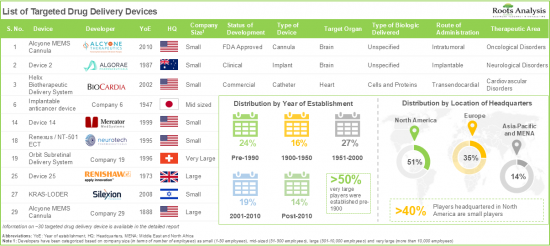
Presently, around 40 developers are engaged in the development of targeted drug delivery devices for various disorders; of these, more than 50% of players are headquartered in the US alone.
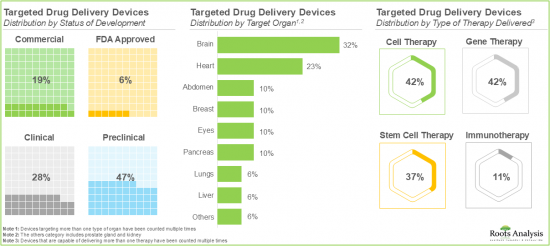
Over 30% of the devices are focused on delivering biologics directly to the brain, followed by the devices targeting the heart.
A sizeable proportion of trials, focused on the evaluation of stem cell and gene therapies that can be administered in combination with targeted drug delivery devices, are actively recruiting patients.
15 stem cell therapies and 8 gene therapies emerged as the most likely drug candidates for delivery via targeted drug delivery devices; notably, 60% of these therapies are currently in phase II of clinical development.
The growing demand for personalized medicines has emerged as a key driving factor supporting the rapid evolution of the targeted drug delivery device market.
The targeted drug delivery device market is likely to grow at a CAGR of 19.7% till 2035; majority of the market share is likely to be occupied by North America, followed by Europe.
TARGETED DRUG DELIVERY DEVICE MARKET: KEY SEGMENTS
Catheter is the Fastest Growing Segment of the Targeted Drug Delivery Device Market
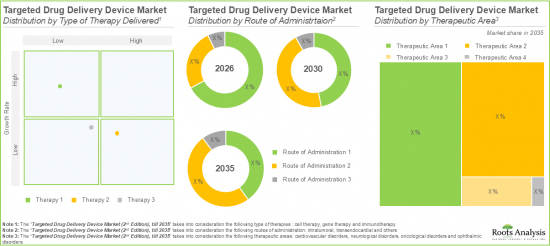
Based on the type of device, the global market for targeted drug delivery devices is segmented into cannulas, catheters and others. Currently, the majority share of the targeted drug delivery devices market is captured by the cannula segment. It is worth mentioning that the catheter segment is likely to grow at a higher CAGR in the coming years. This can be attributed to the ability of catheters to deliver drugs for extended periods, providing consistent treatment to patients with chronic disorders.
Targeted Drug Delivery Devices for Brain is Likely to Grow at a Relatively Faster Pace During the Forecast Period
Based on the type of organ, the global market value is segmented across brain, breast, eyes and heart. Whilst the devices focused on delivering biologics directly to the breast will be the primary driver of the overall market, it is worth highlighting that the market for devices delivering biologics to the brain is likely to grow at a relatively higher CAGR.
Intratumoral Segment is Likely to Hold the Largest Share of the Targeted Drug Delivery Device Market During the Forecast Period
Based on the route of administration, the global market is segmented into intratumoral, transendocardial and others. Currently, the intratumoral segment is likely to dominate and drive the overall market growth due to its ability to reduce the side effects of systemic circulation and restrict the exposure of highly toxic drugs to healthy tissues.
By Type Of Therapy Delivered, Immunotherapy Segment is Likely to Dominate the Market During the Forecast Period
Based on the type of therapy delivered, the global market for targeted drug delivery devices is distributed across cell therapy, gene therapy and immunotherapy. Currently, the immunotherapy market segment holds the largest market share due to the remarkable success of these therapies in targeting specific cells. However, the targeted drug delivery device market for gene therapy is expected to grow at a higher CAGR in the coming years.
Targeted Drug Delivery Devices Designed for Oncological Disorders are Likely to Dominate the Targeted Drug Delivery Device Market During the Forecast Period
Based on therapeutic area, the global targeted drug delivery device market is distributed across cardiovascular disorders, neurological disorders, oncological disorders and ophthalmic disorders. Whilst the targeted drug delivery devices designed for oncological disorders hold the majority of market share, it is worth noting that targeted drug delivery devices targeting cardiovascular disorders is likely to grow at a relatively higher CAGR during the forecast period.
North America Accounts for the Largest Share of the Market
Based on key geographical regions, the market is segmented into North America, Europe and Asia-Pacific. In the current scenario, North America is likely to capture the largest market share owing to the increasing prevalence of chronic diseases and advanced healthcare infrastructure in this region. However, the targeted drug delivery devices market in Europe is expected to grow at a higher CAGR during the forecast period.
Example Players in the Targeted Drug Delivery Devices Market
Alcyone Lifesciences
Algorae Pharmaceuticals
BioCradia
ClearPoint Neuro
Gloriana Therapeutics
Mercator MedSystems
Neurotech Pharmaceuticals
Novartis
OncoSec
PharmaCyte Biotech
PulseSight Therapeutics
Renishaw
Silexion Therapeutics
SmartCella
Primary Research Overview
The opinions and insights presented in this study were influenced by discussions conducted with multiple stakeholders. The research report features detailed transcripts of interviews held with the following industry stakeholders:
Founder and Chief Executive Officer, Small Company, US
Junior Business Developer, Small Company, France
Assistant Professor, Large Organization, US
Postdoctoral Associate, Large Organization, US
TARGETED DRUG DELIVERY DEVICES MARKET: RESEARCH COVERAGE
The report on targeted drug delivery devices features insights on various sections, including:
Market Sizing and Opportunity Analysis: An in-depth analysis of the targeted drug delivery devices market, focusing on key market segments, including [A] type of device, [B] target organ, [C] type of therapy delivered, [D] route of administration, [E] therapeutic area, [F] key geographical regions, and [G] leading players.
Market Impact Analysis: A thorough analysis of various factors, such as drivers, restraints, opportunities, and existing challenges that are likely to impact market growth.
Targeted Drug Delivery Device Providers Market Landscape: The report features an analysis of the players engaged in the development of targeted drug delivery devices, based on several relevant parameters, such as [A] year of establishment, [B] company size, [C] location of headquarters, [D] status of development, [E] type of device, [F] target organ, [G] type of therapy delivered, [H] route of administration and [I] target therapeutic area.
Company Profiles: Elaborate profiles of prominent players developing targeted drug delivery devices across various geographies, providing details on [A] company overview, [B] financial information (if available), [C] information on its device portfolio, [D] recent developments and [E] an informed future outlook.
Clinical Trial Analysis: A comprehensive assessment of clinical trials registered for evaluating the efficacy of targeted drug delivery devices, based on various relevant parameters, such as [A] trial registration year, [B] trial recruitment status, [C] trial phase, [D] study design, [E] type of sponsor / collaborator, [F] therapeutic area, [G] type of therapy delivered, [H] leading players and [I] geographical distribution of trials.
Likely Drug Candidates: An analysis of the drug candidates (stem cell and gene therapy) that are likely to be delivered by targeted drug delivery devices, based on several parameters, such as [A] phase of development and [B] therapeutic area.
Case Study: A detailed assessment of research activity in targeted drug delivery devices for promising therapeutic areas, namely neurological and cardiovascular disorders. Additionally, this section includes analysis of recent publications and grants awarded for these devices.
KEY QUESTIONS ANSWERED IN THIS REPORT
How many companies are currently engaged in this market?
Who are the leading companies in this market?
What factors are likely to influence the evolution of this market?
What is the current and future market size?
What is the CAGR of this market?
How is the current and future market opportunity likely to be distributed across key market segments?
What type of partnership models are commonly adopted by industry stakeholders?
What is the ongoing investment trend in this market?
What is the patent filing activity trend in the market?
REASONS TO BUY THIS REPORT
The report provides a comprehensive market analysis, offering detailed revenue projections of the overall market and its specific sub-segments. This information is valuable to both established market leaders and emerging entrants.
Stakeholders can leverage the report to gain a deeper understanding of the competitive dynamics within the market. By analyzing the competitive landscape, businesses can make informed decisions to optimize their market positioning and develop effective go-to-market strategies.
The report offers stakeholders a comprehensive overview of the market, including key drivers, barriers, opportunities, and challenges. This information empowers stakeholders to stay abreast of market trends and make data-driven decisions to capitalize on growth prospects.
ADDITIONAL BENEFITS
Complimentary PPT Insights Packs
Complimentary Excel Data Packs for all Analytical Modules in the Report
10% Free Content Customization
Detailed Report Walkthrough Session with Research Team
Free Updated report if the report is 6-12 months old or older
TABLE OF CONTENTS
SECTION I: REPORT OVERVIEW
1. PREFACE
1.1. Introduction
1.2. Market Share Insights
1.3. Key Market Insights
1.4. Report Coverage
1.5. Key Questions Answered
1.6. Chapter Outlines
2. RESEARCH METHODOLOGY
2.1. Chapter Overview
2.2. Research Assumptions
2.2.1. Market Landscape and Market Trends
2.2.2. Market Forecast and Opportunity Analysis
2.2.3. Comparative Analysis
2.3. Database Building
2.3.1. Data Collection
2.3.2. Data Validation
2.3.3. Data Analysis
2.4. Project Methodology
2.4.1. Secondary Research
2.4.1.1. Annual Reports
2.4.1.2. Academic Research Papers
2.4.1.3. Company Websites
2.4.1.4. Investor Presentations
2.4.1.5. Regulatory Filings
2.4.1.6. White Papers
2.4.1.7. Industry Publications
2.4.1.8. Conferences and Seminars
2.4.1.9. Government Portals
2.4.1.10. Media and Press Releases
2.4.1.11. Newsletters
2.4.1.12. Industry Databases
2.4.1.13. Roots Proprietary Databases
2.4.1.14. Paid Databases and Sources
2.4.1.15. Social Media Portals
2.4.1.16. Other Secondary Sources
2.4.2. Primary Research
2.4.2.1. Types of Primary Research
2.4.2.1.1. Qualitative Research
2.4.2.1.2. Quantitative Research
2.4.2.1.3. Hybrid Approach
2.4.2.2. Advantages of Primary Research
2.4.2.3. Techniques for Primary Research
2.4.2.3.1. Interviews
2.4.2.3.2. Surveys
2.4.2.3.3. Focus Groups
2.4.2.3.4. Observational Research
2.4.2.3.5. Social Media Interactions
2.4.2.4. Key Opinion Leaders Considered in Primary Research
2.4.2.4.1. Company Executives (CXOs)
2.4.2.4.2. Board of Directors
2.4.2.4.3. Company Presidents and Vice Presidents
2.4.2.4.4. Research and Development Heads
2.4.2.4.5. Technical Experts
2.4.2.4.6. Subject Matter Experts
2.4.2.4.7. Scientists
2.4.2.4.8. Doctors and Other Healthcare Providers
2.4.2.5. Ethics and Integrity
2.4.2.5.1. Research Ethics
2.4.2.5.2. Data Integrity
2.4.3. Analytical Tools and Databases
2.5. Robust Quality Control
3. MARKET DYNAMICS
3.1. Chapter Overview
3.2. Forecast Methodology
3.2.1. Top-down Approach
3.2.2. Bottom-up Approach
3.2.3. Hybrid Approach
3.3. Market Assessment Framework
3.3.1. Total Addressable Market (TAM)
3.3.2. Serviceable Addressable Market (SAM)
3.3.3. Serviceable Obtainable Market (SOM)
3.3.4. Currently Acquired Market (CAM)
3.4. Forecasting Tools and Techniques
3.4.1. Qualitative Forecasting
3.4.2. Correlation
3.4.3. Regression
3.4.4. Extrapolation
3.4.5. Convergence
3.4.6. Sensitivity Analysis
3.4.7. Scenario Planning
3.4.8. Data Visualization
3.4.9. Time Series Analysis
3.4.10. Forecast Error Analysis
3.5. Key Considerations
3.5.1. Demographics
3.5.2. Government Regulations
3.5.3. Reimbursement Scenarios
3.5.4. Market Access
3.5.5. Supply Chain
3.5.6. Industry Consolidation
3.5.7. Pandemic / Unforeseen Disruptions Impact
3.6. Limitations
4. MACRO-ECONOMIC INDICATORS
4.1. Chapter Overview
4.2. Market Dynamics
4.2.1. Time Period
4.2.1.1. Historical Trends
4.2.1.2. Current and Forecasted Estimates
4.2.2. Currency Coverage
4.2.2.1. Major Currencies Affecting the Market
4.2.2.2. Factors Affecting Currency Fluctuations on the Industry
4.2.2.3. Impact of Currency Fluctuations on the Industry
4.2.3. Foreign Currency Exchange Rate
4.2.3.1. Impact of Foreign Exchange Rate Volatility on the Market
4.2.3.2. Strategies for Mitigating Foreign Exchange Risk
4.2.4. Recession
4.2.4.1. Assessment of Current Economic Conditions and Potential Impact on the Market
4.2.4.2. Historical Analysis of Past Recessions and Lessons Learnt
4.2.5. Inflation
4.2.5.1. Measurement and Analysis of Inflationary Pressures in the Economy
4.2.5.2. Potential Impact of Inflation on the Market Evolution
4.2.6. Interest Rates
4.2.6.1. Interest Rates and Their Impact on the Market
4.2.6.2. Strategies for Managing Interest Rate Risk
4.2.7. Commodity Flow Analysis
4.2.7.1. Type of Commodity
4.2.7.2. Origins and Destinations
4.2.7.3. Values and Weights
4.2.7.4. Modes of Transportation
4.2.8. Global Trade Dynamics
4.2.8.1. Import Scenario
4.2.8.2. Export Scenario
4.2.8.3. Trade Policies
4.2.8.4. Strategies for Mitigating the Risks Associated with Trade Barriers
4.2.8.5. Impact of Trade Barriers on the Market
4.2.9. War Impact Analysis
4.2.9.1. Russian-Ukraine War
4.2.9.2. Israel-Hamas War
4.2.10. COVID Impact / Related Factors
4.2.10.1. Global Economic Impact
4.2.10.2. Industry-specific Impact
4.2.10.3. Government Response and Stimulus Measures
4.2.10.4. Future Outlook and Adaptation Strategies
4.2.11. Other Indicators
4.2.11.1. Fiscal Policy
4.2.11.2. Consumer Spending
4.2.11.3. Gross Domestic Product
4.2.11.4. Employment
4.2.11.5. Taxes
4.2.11.6. Stock Market Performance
4.2.11.7. Cross Border Dynamics
4.3. Conclusion
SECTION II: QUALITATIVE INSIGHTS
5. EXECUTIVE SUMMARY
6. INTRODUCTION
6.1. Chapter Overview
6.2. Overview of Drug Delivery Devices for Biologics
6.3. Route of Drug Administration
6.4. Challenges Associated with Delivery of Biologics
6.5. Need for Targeted Drug Delivery
6.6. Types of Targeted Delivery Devices of Biologics
6.7. Benefits of Targeted Delivery Devices of Biologics
6.8. Concluding Remarks
SECTION III: MARKET OVERVIEW
7. MARKET LANDSCAPE
7.1. Chapter Overview
7.2. Targeted Drug Delivery Devices for Biologics: Overall Market Landscape
7.2.1. Analysis by Status of Development
7.2.2. Analysis by Type of Device
7.2.3. Analysis by Target Organ
7.2.4. Analysis by Type of Biologic Delivered
7.2.5. Analysis by Type of Therapy Delivered
7.2.6. Analysis by Route of Administration
7.2.7. Analysis by Target Therapeutic Area
7.3. Targeted Drug Delivery Device Providers: Overall Market Landscape
7.3.1. Analysis by Year of Establishment
7.3.2. Analysis by Company Size
7.3.3. Analysis by Location of Headquarters
SECTION IV: COMPANY PROFILES
8. COMPANY PROFILES OF PROMINENT PLAYERS
8.1. Chapter Overview
8.2. Alcyone Therapeutics
8.2.1. Company Overview
8.2.2. Financial Information
8.2.3. Targeted Drug Delivery Device Portfolio
8.2.4. Recent Developments and Future Outlook
8.3. BioCardia
8.3.1. Company Overview
8.3.2. Financial Information
8.3.3. Targeted Drug Delivery Device Portfolio
8.3.4. Recent Developments and Future Outlook
8.4. ClearPint Neuro
8.4.1. Company Overview
8.4.2. Financial Information
8.4.3. Targeted Drug Delivery Device Portfolio
8.4.4. Recent Developments and Future Outlook
8.5. Mercator MedSystems
8.5.1. Company Overview
8.5.2. Financial Information
8.5.3. Targeted Drug Delivery Device Portfolio
8.5.4. Recent Developments and Future Outlook
8.6. Novartis
8.6.1. Company Overview
8.6.2. Financial Information
8.6.3. Targeted Drug Delivery Device Portfolio
8.6.4. Recent Developments and Future Outlook
8.7. Smartwise
8.7.1. Company Overview
8.7.2. Financial Information
8.7.3. Targeted Drug Delivery Device Portfolio
8.7.4. Recent Developments and Future Outlook
8.8. Key Winning Strategies
9. COMPANY PROFILES OF EMERGING PLAYERS
9.1. Chapter Overview
9.2. Algorae Pharmaceuticals
9.2.1. Company Overview
9.2.2. Targeted Drug Delivery Device Portfolio
9.3. Gloriana Therapeutics
9.3.1. Company Overview
9.3.2. Targeted Drug Delivery Device Portfolio
9.4. Neurotech Pharmaceuticals
9.4.1. Company Overview
9.4.2. Targeted Drug Delivery Device Portfolio
9.5. OncoSec Medical
9.5.1. Company Overview
9.5.2. Targeted Drug Delivery Device Portfolio
9.6. PharmaCyte Biotech
9.6.1. Company Overview
9.6.2. Device Portfolio
9.7. PulseSight Therapeutics
9.7.1. Company Overview
9.7.2. Targeted Drug Delivery Device Portfolio
9.8. Renishaw
9.8.1. Company Overview
9.8.2. Targeted Drug Delivery Device Portfolio
9.9. Silexion Therapeutics
9.9.1. Company Overview
9.9.2. Targeted Drug Delivery Device Portfolio
SECTION V: MARKET TRENDS
10. PROMISING THERAPEUTIC AREA FOR TARGETED DRUG DELIVERY DEVICES
10.1. Chapter Overview
10.2. Neurological Disorders
10.2.1. Stem Cell Therapies
10.2.1.1. Publication Analysis
10.2.1.1.1. Methodology
10.2.1.1.2. List of Publications
10.2.1.1.3. Analysis by Year of Publication
10.2.1.2. Grant Analysis
10.2.1.2.1. Methodology
10.2.1.2.2. List of Academic Grants
10.2.1.2.3. Analysis by Year of Grant Awarded
10.2.1.2.4. Analysis by Amount Awarded
10.2.2. Gene Therapies
10.2.2.1. Publication Analysis
10.2.2.1.1. Methodology
10.2.2.1.2. List of Publications
10.2.2.1.3. Analysis by Year of Publication
10.2.2.2. Grant Analysis
10.2.2.2.1. Methodology
10.2.2.2.2. List of Academic Grants
10.2.2.2.3. Analysis by Year of Grant Awarded
10.2.2.2.4. Analysis by Amount Awarded
10.3. Cardiovascular Disorders
10.3.1. Stem Cell Therapies
10.3.1.1. Publication Analysis
10.3.1.1.1. Methodology
10.3.1.1.2. List of Publications
10.3.1.1.3. Analysis by Year of Publication
10.3.1.2. Grant Analysis
10.3.1.2.1. Methodology
10.3.1.2.2. List of Academic Grants
10.3.1.2.3. Analysis by Year of Grant Awarded
10.3.1.2.4. Analysis by Amount Awarded
10.3.2. Gene Therapies
10.3.2.1. Publication Analysis
10.3.2.1.1. Methodology
10.3.2.1.2. List of Publications
10.3.2.1.3. Analysis by Year of Publication
10.3.2.2. Grant Analysis
10.3.2.2.1. Methodology
10.3.2.2.2. List of Academic Grants
10.3.2.2.3. Analysis by Year of Grant Awarded
10.3.2.2.4. Analysis by Amount Awarded
11. CLINICAL TRIAL ANALYSIS
11.1. Chapter Overview
11.2. Scope and Methodology
11.3. Targeted Drug Delivery Devices: Clinical Trial Analysis
11.3.1. Analysis by Trial Registration Year
11.3.2. Analysis by Trial Recruitment Status
11.3.3. Analysis of Enrolled Patient Population by Trial Registration Year
11.3.4. Analysis by Trial Registration Year and Trial Recruitment Status
11.3.5. Analysis by Trial Phase
11.3.6. Analysis of Enrolled Patient Population by Trial Phase
11.3.7. Analysis by Study Design
11.3.8. Analysis by Type of Sponsor / Collaborator
11.3.9. Analysis by Therapeutic Area
11.3.10. Analysis by Type of Therapy
11.3.11. Leading Players: Analysis by Number of Registered Trials
11.3.12. Analysis by Geography
11.3.13. Analysis by Trial Recruitment Status and Geography
11.3.14. Analysis of Enrolled Patient Population by Trial Recruitment Status and Geography
12. LIKELY DRUG CANDIDATES
12.1. Chapter Overview
12.2. Key Parameters and Scoring Criteria
12.3. Gene Therapy Drug Candidates
12.3.1. Most Likely Drug Candidates for Delivery Via Targeted Drug Delivery Device
12.3.2. Likely Drug Candidates for Delivery Via Targeted Drug Delivery Device
12.3.3. Less Likely Drug Candidates for Delivery Via Targeted Drug Delivery Device
12.3.4. Least Likely Drug Candidates for Delivery Via Targeted Drug Delivery Device
12.4. Stem Cell Therapy Drug Candidates
12.4.1. Most Likely Drug Candidates for Delivery Via Targeted Drug Delivery Device
12.4.2. Likely Drug Candidates for Delivery Via Targeted Drug Delivery Device
12.4.3. Less Likely Drug Candidates for Delivery Via Targeted Drug Delivery Device
12.4.4. Least Likely Drug Candidates for Delivery Via Targeted Drug Delivery Device
SECTION VI: MARKET OPPORTUNITY ANALYSIS
13. MARKET IMPACT ANALYSIS: DRIVERS, RESTRAINTS, OPPORTUNITIES AND CHALLENGES
13.1. Chapter Overview
13.2. Market Drivers
13.3. Market Restraints
13.4. Market Opportunities
13.5. Market Challenges
13.6. Conclusion
14. GLOBAL TARGETED DRUG DELIVERY DEVICE MARKET
14.1. Chapter Overview
14.2. Key Assumptions and Methodology
14.3. Global Targeted Drug Delivery Device Market, Forecasted Estimates (2026- 2035)
14.3.1. Scenario Analysis
14.3.2. Conservative Scenario
14.3.3. Optimistic Scenario
14.4. Key Market Segmentations
15. TARGETED DRUG DELIVERY DEVICE MARKET, BY TYPE OF DEVICE
15.1. Chapter Overview
15.2. Key Assumptions and Methodology
15.3. Targeted Drug Delivery Device Market: Distribution by Type of Device
15.3.1. Targeted Drug Delivery Device Market for Cannulas, Forecasted Estimates (Till 2035)
15.3.2. Targeted Drug Delivery Device Market for Catheters, Forecasted Estimates (Till 2035)
15.3.3. Targeted Drug Delivery Device Market for Other Devices, Forecasted Estimates (Till 2035)
15.4. Data Triangulation and Validation
16. TARGETED DRUG DELIVERY DEVICE MARKET, BY TARGET ORGAN
16.1. Chapter Overview
16.2. Key Assumptions and Methodology
16.3. Targeted Drug Delivery Market: Distribution by Target Organ
16.3.1. Targeted Drug Delivery Device Market for Breast, Forecasted Estimates (Till 2035)
16.3.2. Targeted Drug Delivery Device Market for Brain, Forecasted Estimates (Till 2035)
16.3.3. Targeted Drug Delivery Device Market for Heart, Forecasted Estimates (Till 2035)
16.3.4. Targeted Drug Delivery Device Market for Eyes, Forecasted Estimates (Till 2035)
16.4. Data Triangulation and Validation
17. TARGETED DRUG DELIVERY DEVICE MARKET, BY TYPE OF THERAPY DELIVERED
17.1. Chapter Overview
17.2. Key Assumptions and Methodology
17.3. Targeted Drug Delivery Market: Distribution by Type of Therapy Delivered
17.3.1. Targeted Drug Delivery Device Market for Immunotherapies, Forecasted Estimates (Till 2035)
17.3.2. Targeted Drug Delivery Device Market for Gene Therapies, Forecasted Estimates (Till 2035)
17.3.3. Targeted Drug Delivery Device Market for Cell Therapies, Forecasted Estimates (Till 2035)
17.4. Data Triangulation and Validation
18. TARGETED DRUG DELIVERY DEVICE MARKET, BY ROUTE OF ADMINISTRATION
18.1. Chapter Overview
18.2. Key Assumptions and Methodology
18.3. Targeted Drug Delivery Market: Distribution by Route of Administration
18.3.1. Targeted Drug Delivery Device Market for Intratumoral, Forecasted Estimates (Till 2035)
18.3.2. Targeted Drug Delivery Device Market for Transendocardial, Forecasted Estimates, (Till 2035)
18.3.3. Targeted Drug Delivery Device Market for Others, Forecasted Estimates (Till 2035)
18.4. Data Triangulation and Validation
19. TARGETED DRUG DELIVERY DEVICE MARKET, BY THERAPEUTIC AREA
19.1. Chapter Overview
19.2. Key Assumptions and Methodology
19.3. Targeted Drug Delivery Market: Distribution by Therapeutic Area
19.3.1. Targeted Drug Delivery Device Market for Oncological Disorders, Forecasted Estimates (Till 2035)
19.3.2. Targeted Drug Delivery Device Market for Cardiovascular Disorders, Forecasted Estimates (Till 2035)
19.3.3. Targeted Drug Delivery Device Market for Neurological Disorders, Forecasted Estimates (Till 2035)
19.3.4. Targeted Drug Delivery Device Market for Ophthalmic Disorders, Forecasted Estimates (Till 2035)
19.4. Data Triangulation and Validation
20. TARGETED DRUG DELIVERY DEVICE MARKET, BY KEY GEOGRAPHICAL REGIONS
20.1. Chapter Overview
20.2. Key Assumptions and Methodology
20.3. Targeted Drug Delivery Market: Distribution by Key Geographical Regions
20.3.1. Targeted Drug Delivery Device Market in North America, Forecasted Estimates (Till 2035)
20.3.2. Targeted Drug Delivery Device Market in Europe, Forecasted Estimates (Till 2035)
20.3.3. Targeted Drug Delivery Device Market in Asia-Pacific, Forecasted Estimates (Till 2035)
20.4. Market Dynamics Assessment
20.4.1. Penetration Growth (P-G) Matrix
20.4.2. Data Triangulation and Validation
21. TARGETED DRUG DELIVERY DEVICE MARKET, BY LEADING DEVELOPERS
21.1. Chapter Overview
21.2. Targeted Drug Delivery Device Market: Distribution by Leading Developers
22. TARGETED DRUG DELIVERY DEVICE MARKET, SALES FORECAST OF DEVICES
22.1. Chapter Overview
22.2. Key Assumptions and Methodology
22.3. Targeted Drug Delivery Devices Market for Biologics: Sales Forecast