



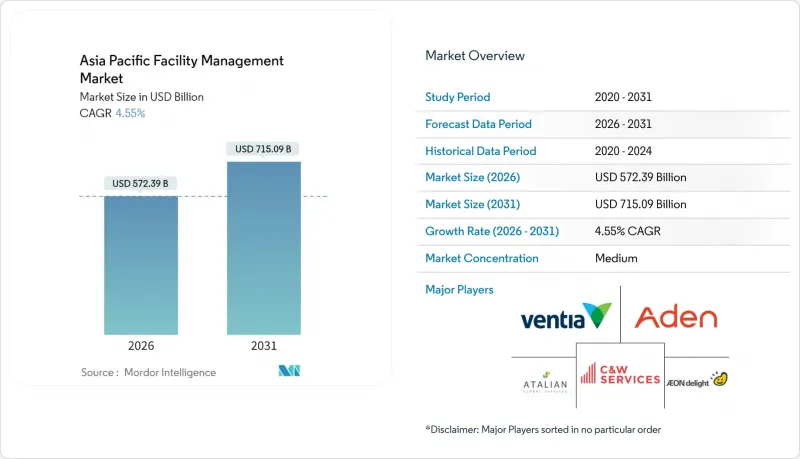
아시아태평양의 시설 관리 시장은 2025년에 5,474억 8,000만 달러로 평가되었으며, 2026년 5,723억 9,000만 달러에서 2031년까지 7,150억 9,000만 달러에 달할 것으로 예측됩니다.
예측 기간(2026-2031년) 동안 CAGR은 4.55%로 예상됩니다.
지역적 수요는 강화되는 ESG 규정 준수, 데이터센터의 급속한 확장, AI 기반 빌딩 관리 시스템 도입 확대에 힘입은 바 있습니다. 하드 서비스가 지출의 대부분을 차지하는 반면, 소프트 서비스는 테넌트가 업무 경험과 보안에 대한 우선순위를 높이면서 성장세를 보이고 있습니다. 업무의 복잡성 증가에 따라 아웃소싱은 꾸준히 확대되고 있지만, 공급망 비용의 인플레이션과 규제 불균등과 같은 거시적 역풍으로 인해 단기적인 확대는 억제되고 있습니다.
기업의 부동산 팀은 단편적인 사내 모델에서 규제, 디지털, 지속가능성 관련 전문 지식에 접근할 수 있는 통합적인 아웃소싱으로 전환하고 있습니다. CBRE는 2025년 1분기 시설 관리 부문의 순이익이 전년 동기 대비 16% 증가했으며, 주요 요인은 기술, 헬스케어, 생명과학 고객에 기인한 것으로 나타났다고 밝혔습니다. 통합 서비스 계약은 벤더 관리를 간소화하고 성과를 측정 가능한 성과로 연결합니다. ISS와 버클리의 5년 세계 계약 갱신은 지역을 초월한 번들형 서비스의 매력을 보여줍니다. 아웃소싱의 도입은 일본, 싱가포르 등 노동력이 부족한 시장에서 특히 두드러지게 나타나고 있습니다. 이들 시장에서는 노동력의 고령화로 인해 외부 기술 전문가의 가치가 높아지고 있습니다. 컴플라이언스 인증과 디지털로 추적 가능한 서비스 품질을 입증하는 현지 제공업체는 경쟁 우위를 확보할 수 있습니다. 중기적으로는 디지털 플랫폼을 통해 투명한 비용 벤치마킹이 가능해지고, 성과보상형 가격 책정 모델이 지원되면서 아웃소싱의 보급률이 높아질 것으로 예상됩니다.
각국 정부는 작업장 안전 관련 법규를 강화하고 있으며, 입주사들은 모니터링 및 교육 프로토콜을 업그레이드해야 합니다. 싱가포르에서는 2025년 시행되는 기계 및 가연성 분진 관련 규정으로 인해 컴플라이언스 요건이 강화되면서 실시간 위험 분석에 능통한 전문 시설 파트너에 대한 수요가 증가하고 있습니다. 유출 및 결로를 감지하는 하이브리드 바닥 습도 센서와 같은 AI 탑재 디바이스는 UnaBiz Singapore의 2024년 도입 사례에서 알 수 있듯이 시험 도입에서 주류로 전환되고 있습니다. 여러 지점을 보유한 기업들은 각 지역의 보고 규정을 준수하면서 관할권 간 데이터 표준화를 실현할 수 있는 통합 대시보드가 필요합니다. 성숙한 디지털 안전 솔루션을 제공하는 사업자는 예측 가능한 사고 예방을 통해 보험료와 다운타임 비용 절감에 기여할 수 있습니다. 직원들의 웰빙에 대한 관심이 높아짐에 따라 밀집된 도시형 캠퍼스에서는 출입 통제, 실내 공기질 센서, 스마트 피난 시스템에 대한 단계적 투자가 증가하고 있습니다.
스마트 빌딩을 위한 하드웨어, 소프트웨어 라이선스, 컴플라이언스 대응을 위한 초기 투자비용은 중간 규모의 건물에서 30만 달러를 초과하는 경우가 있어 중소형 건물 소유주에게 도입 장벽으로 작용하고 있습니다. 설비비 및 인건비 인플레이션으로 인해 투자 회수 기간은 더욱 길어집니다. 그러나 시범사업에서는 항상 두 자릿수 이상의 에너지 절감 효과가 입증되고 있습니다. 인도네시아 아즈빌(PT. Aspex Kumbong)의 도입 사례에서 알 수 있듯이, IoT 기반 예지보전을 통합하는 제조업체도 2-3년의 회수 기간에 직면하고 있습니다. 많은 테넌트들이 현금 흐름 관리를 위해 단계적으로 도입을 진행하지만, 부분적인 도입은 완전 통합 플랫폼의 시너지 효과를 제한할 수 있습니다. 성과 연동형 가격 책정이나 설비 서비스형 모델을 제공하는 사업자는 이 장벽을 완화할 수 있지만, 지역 중견-중소기업의 재정적 제약으로 인해 비용이 시장 확대의 가장 큰 억제요인으로 작용하고 있습니다.
소프트 서비스는 고용주가 직원 경험 지표를 중시하고 AI 지원 보안 컨시어지 및 청소 솔루션을 도입하면서 2031년까지 CAGR 6.05%를 기록할 것으로 예상됩니다. 아시아태평양 시설 관리 시장의 소프트 서비스 규모는 일상적인 청소에 로봇을 도입하고 헬프데스크 애플리케이션에 점유율 분석을 통합하는 등의 혜택을 누리고 있습니다. 비접촉식 방문자 관리 시스템 및 AI 기반 모니터링 시스템은 싱가포르, 도쿄, 시드니의 고급 오피스에서 입찰의 필수 요건이 되고 있습니다. 이와 함께 식단 분석 데이터를 조달 시스템과 연동하는 첨단 케이터링 플랫폼은 건강 증진에 힘쓰는 기업 캠퍼스에 보급이 확산되고 있습니다.
하드서비스는 2025년에도 55.72%의 매출 점유율을 유지하며, MEP(기계, 전기, 배관), HVAC(냉난방 환기), 소방시스템 등 핵심 인프라 유지보수가 이를 뒷받침하고 있습니다. 예측 분석은 새로운 부가가치 창출: 야마하 모터의 로봇 자동화(공장 인건비 60% 절감)와 같은 사용 사례를 통해 MEP 제공업체의 아시아태평양 시설 관리 시장 점유율이 강화되고 있습니다. 방콕의 세인트 레지스 호텔에서 시범운영을 통해 입증된 AI 최적화 냉각기는 9%의 에너지 절감 효과와 설비 수명 연장을 실현하여 건물주와 에너지 서비스 기업 모두로부터 주목을 받고 있습니다. 소방 시스템 업체들은 IoT 센서와 클라우드 대시보드를 결합하여 점검 기반 모델에서 실시간 위험 감소로 전환하고 있습니다.
The Asia Pacific facility management market was valued at USD 547.48 billion in 2025 and estimated to grow from USD 572.39 billion in 2026 to reach USD 715.09 billion by 2031, at a CAGR of 4.55% during the forecast period (2026-2031).
Regional demand is anchored in stricter ESG compliance, rapid data-center roll-outs, and the uptake of AI-enabled building operating systems. Hard services continue to dominate spend, yet soft services are gaining momentum as occupiers elevate workplace experience and security priorities. Outsourcing grows steadily on the back of rising operational complexity, while macro headwinds such as supply-chain cost inflation and uneven regulation temper near-term expansion.
Corporate real-estate teams are shifting from fragmented in-house models toward integrated outsourcing to access specialized regulatory, digital, and sustainability expertise. CBRE reported 16% year-on-year net-revenue growth in its facilities-management segment for Q1 2025, with technology, healthcare, and life-science clients as primary contributors. Integrated service contracts simplify vendor management and link performance to measurable outcomes, with the five-year renewal of ISS's global agreement with Barclays illustrating the appeal of bundled, cross-regional delivery. Outsourcing uptake is especially strong in labor-constrained markets such as Japan and Singapore, where aging workforces elevate the value of external technical specialists. Local providers that demonstrate compliance credentials and digitally traceable service quality are gaining competitive advantages. Over the medium term, outsourcing penetration is expected to climb as digital platforms enable transparent cost benchmarking and support pay-for-performance pricing models.
Governments are tightening workplace-safety statutes, compelling occupiers to upgrade monitoring and training protocols. Singapore's 2025 regulations on machinery and combustible dust have raised compliance thresholds, driving demand for specialist facility partners versed in real-time risk analytics. AI-enabled devices such as hybrid floor-wetness sensors that detect spills or condensation are moving from pilot to mainstream deployment, as demonstrated by UnaBiz Singapore's 2024 launch.Multisite corporates require unified dashboards that normalize data across jurisdictions while honoring local reporting rules. Providers with mature digital safety suites can deliver predictive incident prevention, lowering insurance premiums and downtime costs. The heightened focus on employee well-being fuels incremental spend on access control, indoor-air quality sensors, and smart-evacuation systems across dense urban campuses.
Up-front capital for smart-building hardware, software licenses, and compliance upgrades can exceed USD 300,000 for a mid-size property, creating adoption hurdles for small and mid-tier owners. Inflation in equipment and labor costs further stretches payback timelines, even though pilot projects regularly demonstrate double-digit energy reductions. Manufacturers integrating IoT-based predictive maintenance still face recovery periods of two to three years, as illustrated by Azbil Corporation's deployment at PT. Aspex Kumbong in Indonesia. Many occupiers sequence implementations in phases to manage cash flow, but partial roll-outs limit the synergy gains of fully integrated platforms. Providers that structure outcome-based pricing or equipment-as-a-service models can mitigate the barrier, yet balance-sheet limitations among regional SMEs keep cost as the most immediate drag on market expansion.
Other drivers and restraints analyzed in the detailed report include:
For complete list of drivers and restraints, kindly check the Table Of Contents.
Soft services generated faster expansion, recording a 6.05% CAGR through 2031 as employers elevate employee-experience metrics and deploy AI-assisted security, concierge, and cleaning solutions. The Asia Pacific facility management market size for soft services is benefiting from the rollout of robotics for routine cleaning and the integration of occupancy analytics into help-desk applications. Contactless visitor management and AI-based surveillance systems now form mandatory bid requirements in high-grade offices across Singapore, Tokyo, and Sydney. In parallel, advanced catering platforms that link dietary analytics to procurement systems are gaining popularity in corporate campuses looking to meet wellness commitments.
Hard services retained 55.72% revenue share in 2025, supported by critical infrastructure maintenance including MEP, HVAC, and fire-safety systems. Predictive analytics adds new value layers: the Asia Pacific facility management market share for MEP providers is reinforced by use cases such as Yamaha Motor's robotic automation, which has cut factory labor costs by 60%. AI-optimized chillers, exemplified by the St. Regis Bangkok pilot, showcase measurable 9% energy savings and extend equipment life cycles, drawing interest from both owners and energy-service companies. Fire-system vendors are bundling IoT sensors with cloud dashboards to transition from inspection-based models to real-time risk mitigation.
Asia-Pacific Facility Management Market Report is Segmented by Service Type (Hard Services, Soft Services), Offering Type (In-House, Outsourced), End-User Industry (Commercial, Hospitality, Institutional and Public Infrastructure, Healthcare, and More), and Geography (China, India, Japan, Korea, Indonesia, Thailand, Rest of Asia-Pacific). The Market Forecasts are Provided in Terms of Value (USD).