


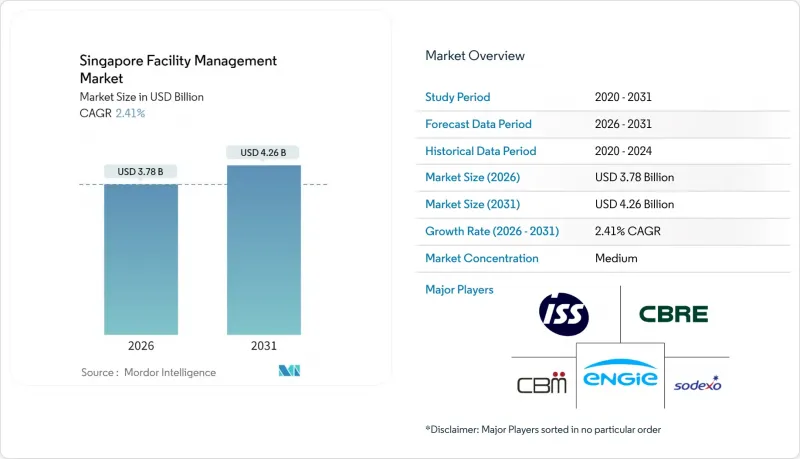
싱가포르의 시설 관리 시장은 2025년에 36억 9,000만 달러로 평가되었으며, 2026년 37억 8,000만 달러에서 2031년까지 42억 6,000만 달러에 달할 것으로 예측됩니다.
예측 기간(2026-2031년) 동안 CAGR은 2.41%로 예상됩니다.
싱가포르의 건축 환경은 이미 고도로 발달되어 있기 때문에 폭발적이라기보다는 꾸준한 성장세를 보이고 있습니다. 수요는 새로운 바닥 면적이 아닌 보다 스마트한 서비스 제공으로 옮겨가고 있습니다. 스마트네이션 계획에 따라 IoT 센서, 클라우드 대시보드, 데이터 기반 워크플로우가 광범위하게 도입되면서 서비스 계약의 형태가 변화하고 있습니다. 이에 따라 고객들은 보다 장기적인 성과 기반 계약으로 전환하고 있습니다. 외국인 노동자 수용 한도 축소와 임금 상승이 자동화를 촉진하는 한편, BCA 그린마크 플러스 규제 의무화로 에너지 절약형 개보수 투자가 가속화되고 있습니다. 고객이 하드웨어와 소프트웨어 서비스의 원활한 통합과 주요 성과 지표 달성을 보장하기를 원함에 따라, 경쟁은 가격 중심의 입찰에서 기술력 기반의 가치 제안으로 전환되고 있습니다.
조직은 핵심 수익원에 집중하기 위해 건물 운영 업무를 외부에 위탁하고 있습니다. 2020년 5월부터 공공부문의 모든 보안 계약은 '성과 기반 계약'을 준수해야 하며, 입찰자는 인력 공급이 아닌 기술력 증명을 요구받고 있습니다. Capital Land Integrated Commercial Trust의 사례는 아웃소싱이 확산되고 있음을 보여준다: 179억 달러 규모의 포트폴리오의 부동산 관리는 임대, 엔지니어링, 지속가능성 프로그램을 엔드투엔드(end-to-end) 운영하는 전문 자회사가 담당하고 있습니다. 관리하고 있습니다. 고급 분석 도구, 컴퓨터 비전을 통한 순회 모니터링, 예측 유지보수 도구 등 자체 개발로는 비용적으로 실현하기 어려운 기술에 대한 접근이 가능해 아웃소싱의 합리성을 더욱 강화하고 있습니다. 환경 공개 규제가 강화되면서 고객들은 탄소 보고서 작성에 대한 전문 지식도 외부 FM 파트너에게 의존하고 있습니다. 이러한 추세에 따라 싱가포르 시설 관리 시장에서는 서비스 제공업체에 대한 요구 수준이 높아지는 한편, 계약 범위와 계약 기간이 확대되고 있습니다.
싱가포르에서는 새로운 철도 노선이 속속 개통되고 있으며, 각 노선마다 장기적인 운영 및 유지보수(O&M) 의무가 수반됩니다. 육상교통청이 발주한 3억 5,520만 달러 규모의 마주역 토목 패키지, SBS 트랜짓과 RATP 데브 컨소시엄에 수여된 9년간의 주롱 지역선 운영 라이선스는 첫날부터 AI를 활용한 상태 모니터링이 요구됩니다. 따라서 자산 소유자는 통합 FM 파트너를 조기에 확보하여 선로변 시설, 역 구내 시설, 유동인구 분석에 정통한 벤더에게 수십 년 동안 수익원을 보장합니다. 이러한 파급효과는 신역 주변에 집적되는 상업시설, 오피스 빌딩, 주택 프로젝트에도 영향을 미치며, 통근자의 원활한 이동 경험을 보장하기 위해 통합된 빌딩 시스템이 요구되고 있습니다. 이 철도 중심의 개발 모델은 싱가포르 시설 관리 시장의 서비스 라인 다양화와 지역적 파급 성장을 뒷받침하는 기반이 되고 있습니다.
수백 개의 소규모 청소 및 경비업체가 계약 관리를 복잡하게 만들고 있습니다. 하청업체가 늘어날수록 도입 시간, 사이버 보안 리스크, 협업 리스크가 증가하기 때문에 대규모 소유주들은 공급업체를 통합해야 하는 상황에 처해 있습니다. 현재, 건설국(BCA)은 능력 기반 인증제도를 제공하고 있지만, 공공기관의 수용은 여전히 제한적입니다. 통합과 인증의 진전이 가속화되기 전까지는 싱가포르 시설 관리 시장의 효율화 진전을 저해하는 요인으로 작용할 것입니다.
싱가포르 시설 관리 시장에서 하드 서비스는 2025년 매출의 53.62%를 차지했습니다. 이는 습한 열대 기후에서 기계, 전기, 배관 시스템이 완벽하게 작동해야 하기 때문입니다. 소방안전 인증 및 엘리베이터 유지관리 기록에 대한 규제 의무가 기본적인 수요를 뒷받침하고 있습니다. 예지보전을 위한 움직임이 두드러지는데, 진동 및 온도 데이터를 분석하여 다운타임을 방지하는 그린마크 칠러 포털이 그 좋은 예입니다. 고객들은 사후 대응형 수리보다 라이프사이클 비용 최적화를 중시하는 경향이 강화되고 있으며, 성과 보증이 포함된 하드 FM 일괄 계약이 활성화되고 있습니다.
소프트 서비스는 CAGR 2.99%로 성장하고 있습니다. 성과연동형 계약으로 인해 가격 책정이 인원수에서 분리되었기 때문입니다. 보안성과 연동형 계약에서는 경비원이 드론, 영상 분석, 사고보고 앱을 활용하도록 의무화하여 인력 배치의 개념을 재정의하고 있습니다. 청소 업체는 실시간 품질 센서를 도입하고, 테넌트 참여 앱은 케이터링과 컨시어지 업무를 조정합니다. 소프트 서비스는 여전히 절대적인 금액으로 보면 하드 서비스보다 열세지만, 기술에 의한 회복은 싱가포르의 시설 관리 시장이 노동 집약적인 루틴에서 데이터 검증형 경험으로 진화하는 과정을 보여주고 있습니다.
2025년 기준 싱가포르 시설 관리 시장 규모의 62.98%를 아웃소싱이 차지하고 있습니다. 이는 고객이 컴플라이언스, 보증 관리, 지속가능성 보고를 일괄적으로 처리할 수 있는 전문 업체를 선호하기 때문입니다. 엔지니어링, 환경, 호스피탈리티 업무를 융합한 통합형 FM 계약이 주목받고 있으며, 캐피탈랜드는 리스, 기술, ESG 서비스를 단일 벤더의 책임 하에 제공하고 있습니다. 자동화된 발권 플랫폼과 SLA 대시보드는 성능의 투명성을 보장하며, 소유주들은 이를 위험 이전 메커니즘으로 점점 더 중요하게 여기고 있습니다.
2025년 기준 37.02%에 불과한 자체 운영형 서비스도 데이터센터 사업자 및 정부기관의 사이버 보안 및 중요 시스템에 대한 관리 강화로 인해 CAGR 3.88%로 확대될 것으로 예상됩니다. BCA 아카데미의 신설된 스마트 빌딩 커리큘럼은 디지털 트윈, IoT 사이버 보안, 고장 진단에 정통한 인증 기술자를 공급함으로써 이러한 변화를 뒷받침하고 있습니다. 또한, 오너가 분석과 전략을 유지하면서 현장 실행 업무를 아웃소싱하는 하이브리드 모델도 등장하고 있으며, 이는 싱가포르 시설 관리 시장의 미묘한 수요 패턴을 반영하고 있습니다.
The Singapore facility management market was valued at USD 3.69 billion in 2025 and estimated to grow from USD 3.78 billion in 2026 to reach USD 4.26 billion by 2031, at a CAGR of 2.41% during the forecast period (2026-2031).
Growth is steady rather than explosive because Singapore's built environment is already well-developed, so demand pivots toward smarter service delivery instead of new square footage. Widespread deployment of IoT sensors, cloud dashboards, and data-driven workflows under the Smart Nation program is reshaping service contracts, nudging customers toward longer-tenure, outcome-based agreements. Tighter foreign-worker quotas and escalating wages continue to push automation, while mandatory BCA Green Mark Plus rules accelerate investment in energy-efficient retrofits. Competition is shifting from price-led bidding to technology-rich value propositions as clients expect seamless hard and soft service integration with guaranteed key-performance outcomes.
Organizations are handing off building operations so they can focus on core revenue drivers. Since May 2020, every public-sector contract for security has had to comply with Security Outcome-Based Contracting, forcing bidders to prove technology capabilities rather than supply headcount. CapitaLand Integrated Commercial Trust illustrates how extensive outsourcing can become: property management for its USD 17.9 billion portfolio is handled by specialist subsidiaries that run leasing, engineering, and sustainability programs end-to-end. Access to advanced analytics, computer-vision patrols, and predictive maintenance tools that would be cost-prohibitive to build in-house further strengthens the outsourcing rationale. As environmental disclosure rules tighten, clients also rely on external FM partners for carbon-reporting expertise. Collectively, these dynamics raise the bar for service providers while expanding contract scope and duration within the Singapore facility management market.
Singapore is adding entire rail corridors, each embedding long-term O&M obligations. The Land Transport Authority's USD 355.2 million Maju station civil package for Cross Island Line Phase 2 and the nine-year Jurong Region Line operating license awarded to the SBS Transit and RATP Dev consortium require AI-driven condition monitoring from day one. Asset owners, therefore, lock in integrated FM partners early, guaranteeing multi-decade revenue streams for vendors proficient in track-side facilities, station utilities, and crowd-flow analytics. Knock-on effects spread to retail podiums, office towers, and residential projects clustered around new stations, all of which demand unified building systems to ensure a frictionless commuter experience. This rail-centric development model underpins service line diversification and regional spillover growth for the Singapore facility management market.
Hundreds of micro-scale cleaning and security firms make contract administration cumbersome. Each additional subcontractor adds onboarding time, cybersecurity exposure, and interface risk, prompting large owners to consolidate suppliers. BCA now offers competency-based accreditations, but public-agency acceptance remains partial. Until aggregation or certification gains speed, disparate standards will temper efficiency gains in the Singapore facility management market.
Other drivers and restraints analyzed in the detailed report include:
For complete list of drivers and restraints, kindly check the Table Of Contents.
Hard services represented 53.62% of 2025 revenue within the Singapore facility management market share because mechanical, electrical, and plumbing systems must operate flawlessly in a humid tropical climate. Regulatory obligations for fire-safety certifications and lift-maintenance logs sustain baseline demand. Momentum toward predictive analytics is palpable, exemplified by the Green Mark chiller portal that digests vibration and temperature data to prevent downtime. Clients increasingly value lifecycle-cost optimization over reactive fixes, prompting bundled hard-FM contracts with outcome guarantees.
Soft services are expanding at 2.99% CAGR as outcome-based contracting decouples pricing from headcount. Security Outcome-Based Contracting compels guards to use drones, video analytics, and incident-reporting apps, redefining manpower deployment. Cleaning vendors adopt real-time quality sensors, while tenant-engagement apps coordinate catering and concierge tasks. Although soft services still trail hard services in absolute value, their technology-enabled rebound illustrates how the Singapore facility management market evolves from labour-intensive routines to data-validated experiences.
Outsourcing held 62.98% of the Singapore facility management market size in 2025 because clients prefer one-stop specialists for compliance, warranty management, and sustainability reporting. Integrated FM contracts that fuse engineering, environmental, and hospitality tasks gain traction, with CapitaLand bundling leasing, technical, and ESG services under single-vendor accountability. Automated ticketing platforms and SLA dashboards lock in performance transparency, which owners increasingly treat as a risk-transfer mechanism.
In-house delivery, though just 37.02% in 2025, is forecast to grow 3.88% CAGR as data-center operators and government agencies seek tighter control over cybersecurity and critical systems. BCA Academy's new smart-building curricula underpin this shift by supplying certified engineers versed in digital twins, IoT cybersecurity, and fault diagnostics. Hybrid models are also emerging where owners retain analytics and strategy while outsourcing boots-on-ground execution, reflecting nuanced demand patterns in the Singapore facility management market.
The Singapore Facility Management Market Report is Segmented by Service Type (Hard Services, and Soft Services), Offering Type (In-House, and Outsourced [Single FM, Bundled FM, and Integrated FM]), End-User Industry (Commercial/Retail/Restaurants, Manufacturing/Industrial, and More), Facility Type (Commercial Buildings, Industrial Facilities, and More), and Geography. The Market Forecasts are Provided in Terms of Value (USD).