



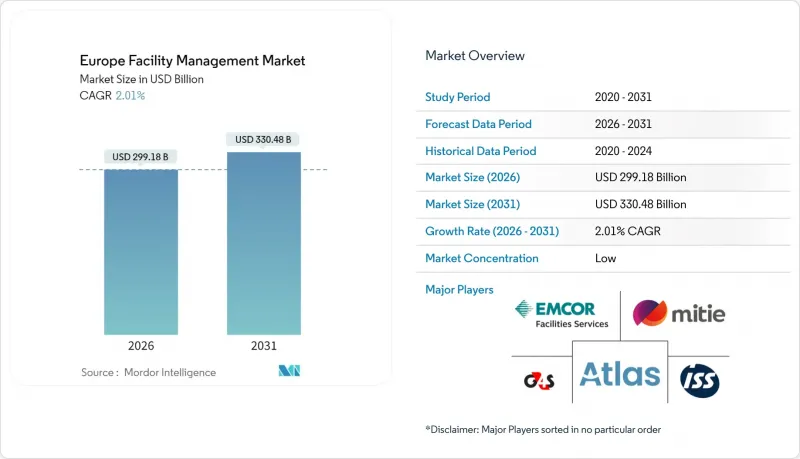
유럽의 시설 관리 시장 규모는 2026년에 2,991억 8,000만 달러로 추정되며, 2025년 2,932억 8,000만 달러에서 성장이 전망됩니다.
2031년에는 3,304억 8,000만 달러에 달할 것으로 예상되며, 2026년부터 2031년까지 CAGR 2.01%로 확대될 것으로 전망됩니다.
꾸준한 성장세는 비용 중심의 유지보수에서 데이터 기반 성능 서비스로의 전환, 강화되는 에너지 절약 규제, 공공 부문의 아웃소싱 확대 등을 반영하고 있습니다. 노후화된 건축 설비가 기계, 전기, 배관의 집중적인 유지보수를 필요로 하는 가운데, 하드서비스는 산업의 근간이 되고 있습니다. 한편, 건강-웰니스-체험을 중시하는 직장 환경을 배경으로 소프트 서비스가 가속화되고 있습니다. 러시아-우크라이나 분쟁 이후 에너지 가격 상승으로 인해 고객들은 시간-물량제 업무보다 최적화 계약을 선호하는 경향이 강해지고 있습니다. ESG 보고 규정과 디지털 기술의 복잡성으로 인해 전문성이 요구되는 가운데, 아웃소싱의 규모가 확대되고 있습니다. 테켐의 72억 달러 규모의 거래로 대표되는 사모펀드의 관심은 이 부문의 지속적인 수익 구조에 대한 믿음을 뒷받침합니다.
유럽의 건물 재고의 4분의 3은 50년 이상 된 건물로, 기술 유지보수와 에너지 효율화를 결합한 종합적인 리노베이션 프로그램에 대한 지속적인 수요가 발생하고 있습니다. 센트리카가 세인트 조지 대학병원과 체결한 15년 계약(연간 6,000톤의 이산화탄소 감축 및 110만 달러 절감)과 같은 성과 계약 모델은 개보수를 주축으로 한 시설 서비스의 재무적 타당성을 보여주고 있습니다. 독일과 프랑스의 포트폴리오는 넷 제로 에너지 건축 기준 강화에 따라 리노베이션 시 IoT 센서, 예지보전, 에너지 성능 분석을 통합해야 할 필요성이 가장 절실합니다. 유럽투자은행은 에너지 효율화를 위한 연간 자금 부족액을 1,850억 유로로 추산하고 있으며, 시설 서비스 제공업체는 자본 조달에 있어 중요한 중개자 역할을 하고 있습니다.
정부기관은 효율화 목표와 ESG 공시 의무를 달성하기 위해 복합서비스를 일괄적으로 외부 사업자에게 위탁하고 있습니다. 영국 노동연금부는 ISS와 연간 1억 7,500만 달러 규모의 7년 계약을 체결하고 청소, 급식, 시설 유지보수를 일원화하여 관리하고 있습니다. 북유럽과 독일 지자체도 이에 발맞춰 링컨셔 주의회와 VINCI Facilities사가 체결한 10년간의 프레임워크 계약에서 협력형 에너지 관리를 우선시하고 있습니다. 의료시설은 24시간 365일 운영, 감염 관리, 높은 에너지 소비의 공조설비 부하로 인해 전문적인 지원이 필요하기 때문에 특히 도입이 활발히 진행되고 있습니다.
인건비, 자재비, 에너지 비용 상승에 따라 고객은 계약 재협상을 진행하며 재량적 FM 지출을 억제하고 있습니다. CBRE의 조사에 따르면, 2023년 FM 예산을 증액한 조직은 35%였지만, 29%는 여전히 공급망 혼란을 가장 큰 위협으로 꼽았습니다. 소덱소의 유럽 사업은 의료 고객사들이 입찰을 연기함에 따라 2025년 상반기 유기적 성장률이 2.1%에 그쳤습니다. 가격 민감도가 높아 상품화를 촉진하는 남유럽과 동유럽 지역에서는 수익률 압박이 특히 심각합니다.
하드 서비스는 2025년 기준 유럽 시설 관리 시장의 61.05%를 차지했으며, 노후화된 건물 기반 전반에 걸쳐 MEP(기계전기설비), HVAC(공조설비), 소방안전 유지관리의 필요성이 부각되고 있습니다. 지속적인 개보수 활동으로 인해 업계 전체의 성장은 완만하지만, 하드 서비스 분야의 유럽 시설 관리 시장 규모는 지속적으로 확대되고 있습니다. 예측형 자산 관리는 설비 수명주기 연장 및 에너지 사용 규제에 대응하고자 하는 고객의 요구에 따라 보급이 확산되고 있습니다.
소프트 서비스는 규모는 작지만 직원 경험 전략에서 고급 청소, 컨시어지, 보안 패키지가 우선순위를 차지하면서 4.61%의 예측 CAGR을 달성할 것으로 예상됩니다. 하이브리드 업무의 확산으로 공간 예약, 유연한 케이터링, 비접촉식 출입 통제에 대한 수요가 증가하면서 기존 프론트 업무에 기술이 접목되고 있습니다. 방문자 수 분석과 같은 소프트 서비스 데이터가 에너지 알고리즘에 피드백되어 통합 기회를 창출하고, 공급자는 고객의 업무 계획에 더욱 깊이 관여하게 됩니다.
유럽 시설 관리 시장은 서비스 유형(하드 서비스 및 소프트 서비스), 제공 형태(사내 제공 및 아웃소싱), 최종사용자 산업(상업, 호텔, 공공 인프라 및 기관, 의료, 산업 및 프로세스, 기타 최종사용자 산업), 국가별로 세분화되어 있습니다. 시장 예측은 금액 기준(USD)으로 제시됩니다.
European Facility Management Market size in 2026 is estimated at USD 299.18 billion, growing from 2025 value of USD 293.28 billion with 2031 projections showing USD 330.48 billion, growing at 2.01% CAGR over 2026-2031.
A steady expansion reflects the sector's shift from cost-driven maintenance toward data-enabled performance services, tighter energy-efficiency mandates, and widening public-sector outsourcing. Hard services remain the industry's anchor as ageing building systems require intensive mechanical, electrical, and plumbing care, while soft services accelerate on the back of health, wellness, and experience-oriented workplaces. Rising energy prices since the Russia-Ukraine conflict have pushed clients to favor optimization contracts over time-and-materials tasks. Outsourcing gains scale as ESG reporting rules and digital-technology complexity demand specialized know-how. Private-equity interest, typified by Techem's USD 7.2 billion transaction, underlines confidence in the segment's recurring-revenue profile.
Three-quarters of the European building stock is more than 50 years old, creating sustained demand for comprehensive retrofit programmes that bundle technical maintenance with energy upgrades. Performance-contract models such as Centrica's 15-year deal at St George's University Hospitals, which cuts 6,000 tonnes of carbon and saves USD 1.1 million annually, illustrate the financial viability of retrofit-oriented facility services. German and French portfolios face the greatest urgency as Nearly-Zero-Energy Building standards tighten, pushing facility managers to integrate IoT sensors, predictive maintenance, and energy-performance analytics during refurbishments. The European Investment Bank estimates a EUR 185 billion yearly funding gap for energy efficiency, positioning facility service providers as key intermediaries for capital access.
Government departments are transferring multi-service bundles to external providers to meet efficiency targets and ESG disclosure obligations. The UK Department for Work and Pensions awarded ISS a seven-year contract worth USD 175 million per year, consolidating cleaning, catering, and technical maintenance under one roof. Nordic and German municipalities follow suit, evidenced by VINCI Facilities' decade-long framework with Lincolnshire County Council that prioritises collaborative energy management. Health-care estates are prominent adopters as 24/7 operations, infection control, and high-energy HVAC loads demand specialist support.
Rising labour, material, and energy inputs prompt clients to renegotiate contracts, curbing discretionary FM spend. CBRE notes that while 35% of organisations raised FM budgets in 2023, 29% still listed supply-chain disruption as the top threat. Sodexo's European business recorded only 2.1% organic growth for the first half of fiscal 2025 as healthcare clients delayed tenders. Margin pressure is acute in Southern and Eastern Europe, where price sensitivity drives commoditisation.
Other drivers and restraints analyzed in the detailed report include:
For complete list of drivers and restraints, kindly check the Table Of Contents.
Hard services hold 61.05% of the European facility management market in 2025, underlining the necessity of MEP, HVAC, and fire-safety upkeep across an ageing building base. Persistent retrofit activity keeps the European facility management market size for hard services expanding despite moderate industry growth. Predictive asset management gains traction as clients look to extend equipment life cycles and comply with energy-use regulations.
Soft services, though smaller, deliver a 4.61% forecast CAGR as employee-experience strategies prioritise advanced cleaning, concierge, and security packages. Hybrid work drives demand for space booking, flexible catering, and touchless access control, threading technology through traditional frontline functions. Integration opportunities arise where soft-service data, such as footfall analytics, feed back into energy algorithms, further embedding providers in client operational planning.
Europe Facility Management Market is Segmented by Service Type (Hard Services and Soft Services), Offering Type (In-House and Outsourced), End-User Industry (Commercial, Hospitality, Institutional and Public Infrastructure, Healthcare, Industrial and Process, and Other End-User Industries), and Country. The Market Forecasts are Provided in Terms of Value (USD).