



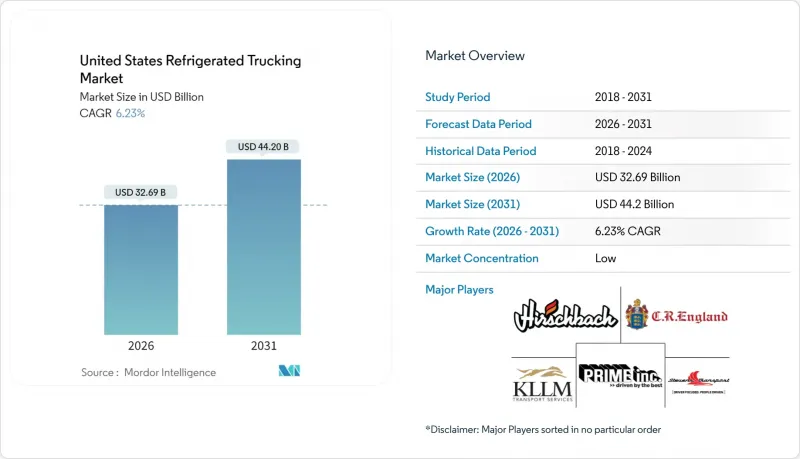
2026년 미국 냉장 트럭 운송 시장 규모는 326억 9,000만 달러로 추정되며, 2025년 307억 7,000만 달러에서 계속 성장하고 있습니다. 2031년에는 442억 달러에 달할 전망이며, 2026-2031년에 CAGR 6.23%로 확대할 전망입니다.
이러한 성장은 연중 내내 지속되는 신선식품에 대한 소비자 수요, 초저온 의약품 유통 확대, 배송 시간 단축에 따른 E-Commerce 식품 주문 증가 등 여러 요인이 복합적으로 작용한 결과입니다. 사업자는 제로에미션 규제에 대응하기 위해 전기식 운송용 냉동장치로 차량 업데이트를 진행하고 있으며, 인공지능을 활용한 배송 경로 최적화 플랫폼으로 공회전 비율과 식품 폐기 비용을 절감하고 있습니다. 대형 운송업체 간 통합으로 고가의 기술 투자 규모를 확대할 수 있는 반면, 라스트마일 배송망을 확보하기 위해서는 지역 전문 업체들의 분산형 네트워크가 여전히 필수적입니다. 특히 텍사스, 멕시코만 지역, 중서부 농업 비즈니스 회랑의 농업 비즈니스 회랑에서는 현대식 냉장 보관 시설에 대한 병행 투자가 네트워크 최적화를 위한 기반이 되고 있습니다.
식품안전현대화법(FSMA) 제204조는 2026년 1월부터 전면 시행되며, 운송업체는 FDA 지정 식품의 24시간 추적기록을 제출해야 합니다. 각 업체는 밴에 IoT 센서, 블록체인 기반 문서 관리 시스템, GPS 온도 프로브를 장착하여 폐기율을 30% 감소시키는 동시에 정시성을 25% 향상시키고 있습니다. 선도 도입 기업은 규제 준수를 의약품 운송업체를 위한 프리미엄 서비스로 제공합니다. 온도 편차가 발생하면 의약품 운송업체는 건당 7만 8,000달러의 리콜 비용을 부담해야 하기 때문입니다. 이 규제로 인해 추적성은 비용 중심에서 경쟁 차별화 요소로 변모할 것이며, 대응이 늦은 기업은 기술을 활용한 개조가 필요하거나 자금력을 갖춘 경쟁사에 의해 인수 대상이 될 것입니다.
2025년에는 E-Commerce를 통한 식료품 매출이 1조 2,400억 달러에 달할 것으로 예상되며, 라스트마일 활동이 물류비용의 약 50%를 차지할 것으로 전망됩니다. 소매업체들은 인구 밀집 지역에 가까운 자동화 냉장 허브에 10억 달러 이상을 투자하고 있습니다. 모듈식 냉장 패널을 통한 유연한 온도 구역 설정으로 운송업체는 신선식품, 유제품, 냉동제품을 같은 경로로 운송할 때에도 상호 오염을 방지할 수 있습니다. 혁신적인 로커와 휴대용 쿨링 토트는 최종 소비자가 배송 시간을 놓친 경우에도 제품의 품질을 유지하여 폐기 손실을 줄이고 브랜드 충성도를 강화합니다. 이러한 고빈도, 소량 배송에 대한 수요 증가로 미국 냉장 트럭 운송 시장, 특히 뉴욕, 로스앤젤레스, 시애틀 주변에서는 지역 전문 업체의 중요성이 커지고 있습니다.
공석은 총 24,043석에 달하며, 주당 9,550만 달러의 매출 기회 손실을 초래하고 있습니다. 냉장운송 업무는 온도관리, 위험물 취급 지식, 엄격한 납기관리가 요구되므로 드라이밴 업무에 비해 적격자 층이 좁아지고 있습니다. 냉장창고의 이직률은 대기시간에 대한 불만을 높이고, 이직률을 악화시키고 있습니다. FMCSA의 면제에 따라 운송사업자는 CDL(상업용 운전면허증) 소지자의 동반 없이 상업용 운전면허 취득자(상업용 운전면허 취득자)를 승차시킬 수 있지만, 안전에 대한 우려는 여전히 남아있습니다. 미국 냉장 트럭 운송 시장 전체에서 보상 향상과 스킬업 프로그램은 필수 조건이 되고 있습니다.
가공식품 분야는 2026-2031년 연평균 복합 성장률(CAGR) 7.02% 성장하며 미국 냉장 트럭 운송 시장에서 다른 분야를 능가할 것으로 예측됩니다. 육류, 해산물, 가금류 분야는 2025년 미국 냉장 트럭 운송 시장의 21.42%를 차지할 것으로 예상되며, 이는 콜드체인에 대한 의존도가 지속되고 있음을 보여줍니다.
현재 밀키트 공급업체와 냉동식품 브랜드는 SKU 단위의 온도 데이터를 요구하고 있으며, 이는 냉장실 및 통제된 분위기 포장에 대한 투자를 촉진하고 있습니다. 운송업체와 식품 가공업체가 협력하여 도크 도어에서 주변 온도 유입을 줄이기 위한 예냉 스테이징 절차가 확립되어 있습니다. 의료 및 의약품 운송업체는 생물제제를 위한 초저온 검증 레인을 활용하고, 원예 수출업체는 미국 농무부(USDA) 자금으로 백홀 운송을 개선하여 중서부 유통 거점으로 향하는 베리류와 엽채류의 보존 기간을 연장하고 있습니다. 트레일러 내부의 첨단 폴리머 라이닝은 유제품의 급격한 온도 변화를 허용하고, 제품별 보관 규정을 위반하지 않고도 혼합 적재에 대한 경제성을 실현합니다.
비컨테이너 냉동 트럭은 전용 하드웨어와 노선의 유연성으로 인해 2025년 기준 미국 냉장 트럭 운송 시장에서 85.45%의 점유율을 유지했습니다. 항만 당국이 충전소를 늘리고 운송업체가 철도와 트럭의 인계인수를 동기화하여 도어 투 도어 운송 시간을 단축함에 따라 컨테이너 냉장 운송량은 2026-2031년 연평균 복합 성장률(CAGR) 6.41%로 증가할 것으로 예측됩니다.
휴스턴 콜드포트의 315,101평방피트 규모의 시설과 포트 걸프포트의 7,300만 달러 규모의 확장으로 새로운 복합운송 중계 거점을 창출해 보관 거리를 단축하고 체선료 리스크를 줄일 수 있게 되었습니다. 리퍼 컨테이너에 내장된 IoT 센서 어레이는 충격, 습도, 위치를 추적하여 화주가 해상, 철도, 도로 부문 전반의 운송 품질을 검증할 수 있도록 지원합니다.
장거리 화물 운송은 2025년 매출 비중의 71.60%를 차지할 것으로 예상되며, 국내 횡단 농산물, 육류, 의약품 운송량 증가에 따라 2026-2031년 연평균 복합 성장률(CAGR) 6.54%로 가장 빠른 성장이 예상됩니다. 자율주행 시험운행은 애틀랜타-댈러스 구간에서 무사고 5만 마일을 달성하며 규제 승인 후 비용절감을 예고하고 있습니다.
장거리 대응 디젤-전기 하이브리드차량은 가혹한 사막 지역에서 자산 수명을 연장하고, 예지보전 플랫폼은 운송 중 압축기 마모를 터미널에 알려줍니다. 단거리 노선은 전기화의 혜택을 누리고 있지만, 배터리 밀도의 제약과 고속도로 충전 인프라의 부족으로 인해 2030년까지 장거리 디젤 운송은 미국 냉장 트럭 운송 시장의 대부분을 계속 지원할 것으로 예측됩니다.
The United States refrigerated trucking market size in 2026 is estimated at USD 32.69 billion, growing from 2025 value of USD 30.77 billion with 2031 projections showing USD 44.2 billion, growing at 6.23% CAGR over 2026-2031.
Growth stems from several converging forces: sustained consumer demand for year-round fresh food, expanding ultra-cold pharmaceutical distribution, and rising e-commerce grocery orders that shorten delivery windows. Operators are upgrading fleets with electric transport-refrigeration units to comply with zero-emission mandates, while artificial-intelligence routing platforms lower empty-mile ratios and spoilage costs. Consolidation among top carriers provides scale for expensive technology investments, yet a fragmented tail of regional specialists remains crucial for last-mile coverage. Parallel investment in modern cold-storage nodes underpins network optimization, especially in Texas, the Gulf Coast, and Midwest agribusiness corridors.
Section 204 of the Food Safety Modernization Act takes full effect in January 2026 and obliges carriers to furnish 24-hour traceability records for foods on the FDA's list. Fleets are outfitting vans with IoT sensors, blockchain-enabled documentation, and GPS temperature probes, cutting spoilage by 30% while lifting on-time performance by 25%. Early adopters market compliance as a premium service for pharma shippers, who face recall costs of USD 78,000 per incident when excursions occur. The regulation thereby transforms traceability from a cost center into a competitive differentiator, pushing laggards toward tech-enabled retrofits or acquisition by better-capitalized rivals.
E-commerce grocery receipts are set to total USD 1.24 trillion in 2025, with last-mile activity representing roughly 50% of logistics spend. Retailers are allocating more than USD 1 billion to automated cold-storage hubs positioned closer to dense urban clusters. Modular refrigeration panels enable flexible temperature zoning, letting carriers combine produce, dairy, and frozen SKUs on the same route without cross-contamination. Innovative lockers and portable cooling totes preserve integrity when end-consumers miss delivery windows, shrinking spoilage write-offs and reinforcing brand loyalty. Demand for high-frequency, low-volume drops thereby elevates regional specialists in the United States refrigerated trucking market, particularly around New York, Los Angeles, and Seattle.
Vacancies total 24,043 seats, costing USD 95.5 million weekly in forgone revenue. Reefer duties demand temperature checks, hazmat familiarity, and tighter appointment windows, narrowing the qualified labor pool relative to dry-van work. Cold-warehouse turnover elevates wait-time frustrations, worsening attrition. Although FMCSA exemptions let carriers seat commercial-learner-permit holders without CDL escorts, safety concerns remain. Enhanced compensation and upskilling programs are becoming table stakes across the United States refrigerated trucking market.
Other drivers and restraints analyzed in the detailed report include:
For complete list of drivers and restraints, kindly check the Table Of Contents.
Processed Food Products are expected to expand at a 7.02% CAGR (2026-2031), outstripping all other verticals in the United States refrigerated trucking market. Meats, Fish, and Poultry maintained a 21.42% United States refrigerated trucking market share in 2025, signifying continued reliance on uninterrupted cold-chain links.
Meal-kit providers and frozen entree brands now demand SKU-level temperature data, spurring investments in reefer compartmentalization and controlled-atmosphere packaging. Carrier collaboration with food processors yields pre-cool staging protocols that cut ambient ingress at dock doors. Healthcare and pharmaceutical shippers leverage ultra-cold validation lanes created for biologics, while horticultural exporters benefit from USDA-funded backhaul upgrades, extending shelf life for berries and leafy greens en route to Midwest distribution hubs. Advanced polymer linings inside trailers allow rapid temperature swings for dairy products, enabling mixed-load economics without violating product-specific storage rules.
Non-containerized reefers kept an 85.45% United States refrigerated trucking market share in 2025, owing to specialized hardware and lane flexibility. Containerized refrigerated flows are expected to grow at a 6.41% CAGR (2026-2031) as port authorities expand plug-in points, and carriers sync rail and truck hand-offs to shrink door-to-door transit times.
Houston ColdPort's 315,101 ft2 facility and Port Gulfport's USD 73 million expansion create new intermodal staging nodes that shorten drayage distance and slash demurrage risk. IoT-sensor arrays embedded in reefer containers track shock, humidity, and location, helping shippers validate integrity across marine-rail-road segments.
Long haul freight claims 71.60% of the revenue share in 2025 and is expected to grow the fastest at 6.54% CAGR (2026-2031) as cross-country produce, meat, and pharma volumes escalate. Autonomous pilots amassed 50,000 miles without accident on the Atlanta-Dallas lane, foreshadowing cost reductions once regulatory green lights emerge.
Extended-range diesel-electric hybrids prolong asset life in harsh desert corridors, while predictive maintenance platforms alert terminals to compressor wear mid-route. Short-haul lanes enjoy electrification gains, but battery-density constraints and sparse highway charging keep long-haul diesel viable through 2030, underpinning the bulk of the United States refrigerated trucking market.
The United States Refrigerated Trucking Market Report is Segmented by Application (Processed Food Products and More), Truckload Specification (Full-Truck-Load (FTL) and More), Containerization (Containerized and More), Distance (Long Haul and More), Goods Configuration (Fluid Goods and More), Destination (Domestic and International), and Temperature Type (Chilled and More). The Market Forecasts are Provided in Terms of Value (USD).