



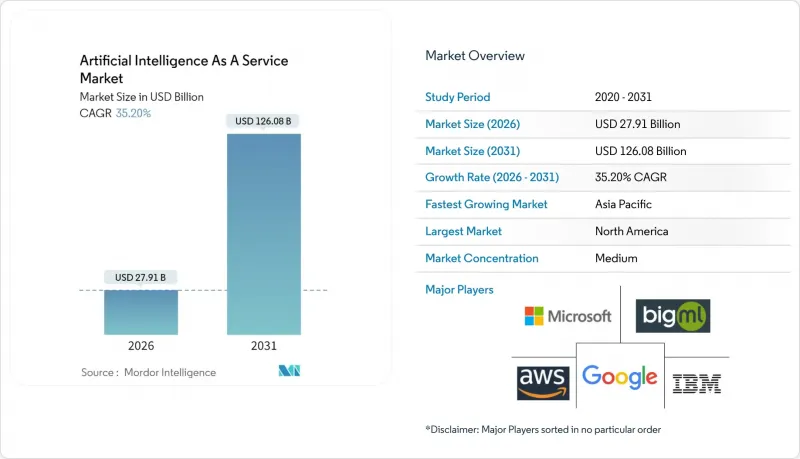
AIaaS(AI as a service) 시장은 2025년에 206억 4,000만 달러로 평가되며, 2026년 279억 1,000만 달러에서 2031년까지 1,260억 8,000만 달러에 달할 것으로 예측됩니다.
예측 기간(2026-2031년)의 CAGR은 35.20%로 예상됩니다.

파일럿 프로젝트에서 프로덕션 워크로드로의 빠른 전환이 이러한 성장을 촉진하고 있습니다. 기업은 고객 응대 시스템이나 백오피스 시스템에 생성형 AI API를 내장하고 있기 때문입니다. 구독형 가격 정책으로 중소기업의 진입장벽을 낮추는 한편, 맞춤형 AI 가속기는 추론 비용을 최대 80%까지 절감하여 공급자의 이익률 확대에 기여하고 있습니다. 일본의 650억 달러 규모의 AI 계획 등 정부의 경제 대책에 힘입어 하이퍼스케일 데이터센터 확장으로 단기적인 전력 제약에도 불구하고 연산 능력의 확대가 지속되고 있습니다. 이러한 요인들이 복합적으로 작용하여 AIaaS(인공지능 서비스) 시장은 산업 전반에 걸쳐 광범위하게 확산되고 있습니다.
기업은 이제 사후 분석보다 선견지명을 더 중요하게 여깁니다. AI 기반 분석을 도입한 제조업체는 61%의 매출 프리미엄을 달성하고, 공급망 최적화를 통해 물류 비용을 15% 절감했습니다. 의료 시스템은 방사선과 워크플로우 자동화를 통해 5년간 451%의 ROI를 달성했습니다. 은행들은 AI 예측 기술을 통해 부정행위 감지 정확도를 높이고, 2028년까지 1,700억 달러의 추가 매출을 올릴 수 있을 것으로 예상하고 있습니다. 실시간 데이터 수집과 자율적인 AI 시스템의 결합이 이러한 기세를 지원하고 있으며, 예측 분석을 AIaaS(인공지능 서비스) 시장의 성장 핵심 동력으로 자리매김하고 있습니다.
낮은 커미트먼트 가격 설정으로 기존의 진입장벽이 해소되었습니다. 전 세계 중소기업의 생성형 AI 툴 도입률은 18%에 달할 전망입니다. 미국에서는 4인 이하 기업의 AI 활용률이 1년 만에 4.6%에서 5.8%로 상승했습니다. Target은 400개 매장에 AI 직원 지원 툴을 도입하여 대규모 자본 지출 없이도 생산성을 향상시키는 등 실제적인 성과를 보이고 있습니다. AI를 자본 지출에서 운영 지출로 전환함으로써, 구독 플랫폼은 마이크로 기업 부문 전반에 걸쳐 AIaaS(인공지능 서비스형) 시장을 확장하고 있습니다.
AI 워크로드는 인프라 경제에 부담을 주고 있습니다. 데이터센터는 2030년까지 미국 전력 소비의 9%를 차지할 것으로 예측됩니다. AI의 에너지 수요는 2025년 비트코인 채굴을 넘어 23GW에 달할 것으로 예측됩니다. 포춘 2000대 기업의 47%가 현재 통제할 수 없는 비용을 줄이기 위해 On-Premise에서 생성형 AI를 개발하고 있습니다. 전력 가격 상승과 반도체 공급 부족으로 인해 단기적으로 저렴한 가격이 하락하여 AI as a Service 시장의 성장이 억제될 것으로 예측됩니다.
2025년 기준 퍼블릭 클라우드 제공은 77.35%의 점유율을 유지하며, AIaaS(AI as a service) 시장이 하이퍼스케일 인프라에 의존하는 구조를 확고히 하고 있습니다. 그러나 이사회의 엄격한 비용 관리 요구와 규제 당국의 데이터 거주성 보호 조치에 대한 압박으로 하이브리드 클라우드가 뚜렷한 성장 동력으로 부상하고 있으며, 2026-2031년 31.05%의 연평균 복합 성장률(CAGR)을 보일 것으로 예측됩니다. 현재 많은 포춘지 선정 2000대 기업은 대규모 모델 트레이닝은 클라우드에서 수행하고 추론 프로세싱은 On-Premise에서 수행함으로써 규모와 주권의 균형을 맞추고 있습니다.
하이브리드 도입은 조달 형태를 전환합니다. 의료기관은 클라우드 버스트 아키텍처를 채택하여 개인 식별이 가능한 의료 데이터를 로컬 서버에 보관하면서 모델 훈련에 탄력적인 컴퓨팅을 활용합니다. HIPAA 규정을 충족하면서도 가치 창출 시간을 단축할 수 있습니다. 제조업도 유사한 패턴을 모방하여 지연에 민감한 비전 작업에는 엣지 노드를 할당하고, 대량의 분석 처리는 지역 클라우드 영역으로 이동합니다. 컴플라이언스와 예산의 확실성이라는 두 가지 우선순위는 AI as a Service 시장 전망에서 하이브리드 모델을 계속 핵심으로 삼을 수 있는 요인입니다.
머신러닝 플랫폼은 2025년 매출의 41.30%를 차지했으나, AI 인프라 서비스는 42.9%의 연평균 복합 성장률(CAGR)로 더 빠르게 성장하고 있습니다. 이러한 변화로 인해 백본 워크로드용 AIaaS 시장 규모 확대에 있으며, 연산 최적화 클러스터와 네트워크 패브릭이 핵심으로 자리 잡고 있습니다. 커스텀 칩의 채택이 이러한 추세를 지원하고 있습니다. 구글의 TPU와 아마존의 Trainium은 가격 대비 성능을 몇 배나 향상시켰고, 고객들은 이러한 실리콘을 제공하는 업체를 선호하고 있습니다.
소프트웨어 계층도 함께 진화하고 있습니다. 관리형 배포 번들에서는 최적화된 커널과 오케스트레이션 툴을 결합하여 멀티 클라우드 스케일링을 용이하게 합니다. 벤더들은 자가 복구 기능, 자동 패치 적용, 성능 대시보드를 내장하여 운영 부하를 줄이고 있습니다. 이러한 강화된 조치들이 결합되어 기반 인프라와 개발자 생산성 간의 연결고리를 강화함으로써 AI as a Service 시장에서 이 부문의 매출 성장 궤도를 확고히 하고 있습니다.
AIaaS(AI as a service) 시장은 구축 모델(퍼블릭 클라우드, 프라이빗 클라우드, 하이브리드 클라우드), 서비스 유형(머신러닝 플랫폼 서비스, 인지 서비스(NLP, CV, 음성), 기타), 조직 규모(중소기업, 기타), 최종사용자 산업(은행, 금융서비스 및 보험(BFSI), 기타), 지역별로 세분화되어 있습니다. 최종사용자 산업(은행, 금융서비스 및 보험(BFSI), 기타), 지역별로 세분화되어 있습니다. 시장 규모 및 예측은 위의 모든 부문에 대해 금액(USD)으로 제공됩니다.
북미는 하이퍼스케일 데이터센터 설치 기반과 탄탄한 스타트업 생태계에 힘입어 2025년 전 세계 매출의 37.40%를 차지할 것으로 예측됩니다. 클라우드 대기업은 2025년 2,500억 달러 이상의 신규 용량을 약속했으나, 2030년까지 미국내 데이터센터의 전력 소비량이 국내 공급량의 9%에 달하고, 전력망 제약이 우려되고 있습니다. FTC의 클라우드-AI 제휴에 대한 조사도 경쟁의 경계를 재조정할 수 있습니다.
아시아태평양은 26.55%의 연평균 복합 성장률(CAGR)로 가장 빠르게 성장하고 있습니다. 일본은 AI와 반도체에 650억 달러의 예산을 책정했고, 소프트뱅크는 AI 기반에 9억 6,000만 달러를 투자했습니다. 중국 알리바바는 클라우드 모델 서비스에 3,800억 위안을 할당했고, 바이트댄스의 Volcano Engine은 국내 공개 모델 호출의 거의 절반을 처리하고 있습니다. 기업 조사에 따르면 아시아태평양 기업의 54%는 현재 AI의 장기적인 수익화를 목표로 하고 있으며, 이는 시범 운영 단계를 넘어선 진전을 보이고 있는 것으로 나타났습니다.
유럽은 AI 규제안에 따라 엄격한 감독과 혁신의 균형을 유지하면서 꾸준히 성장하고 있습니다. 중동 및 아프리카, 국가 주도 AI 전략 추진: UAE는 2030년까지 463억 3,000만 달러의 산업 가치 예상, 마이크로소프트는 G42에 15억 달러 투자. 사우디아라비아의 1,000억 달러 규모의 AI 펀드는 지역의 야심을 보여주며, GCC 기업의 75%가 생성 모델을 도입하여 세계 평균을 상회하고 있습니다. 저렴한 에너지 접근성과 적극적인 정책 프레임워크로 인해 이 지역은 유럽, 아프리카, 남아시아를 연결하는 가교 시장으로 자리매김하고 있으며, AI as a Service 시장의 발전에 중요한 역할을 하고 있습니다.
The Artificial Intelligence As A Service Market was valued at USD 20.64 billion in 2025 and estimated to grow from USD 27.91 billion in 2026 to reach USD 126.08 billion by 2031, at a CAGR of 35.20% during the forecast period (2026-2031).
Rapid migration from pilot projects to production workloads fuels this rise as enterprises embed generative-AI APIs in customer-facing and back-office systems. Subscription pricing lowers entry costs for small firms, while custom AI accelerators cut inference expenses by up to 80%, widening margins for providers. Government stimulus packages, such as Japan's USD 65 billion AI plan, add momentum, and hyperscale data-center build-outs keep compute capacity expanding despite near-term power constraints. Together, these forces push the Artificial Intelligence as a Service market toward broad, cross-industry penetration.
Enterprises now prize foresight over hindsight. Manufacturers using AI-driven analytics posted 61% revenue premiums, while supply-chain optimization shaved 15% off logistics costs. Healthcare systems gained 451% ROI over five years by automating radiology workflows. Banks boosted fraud-detection accuracy and see USD 170 billion additional profits by 2028 through AI forecasting. Real-time data ingestion plus agentic AI systems sustain this momentum, positioning predictive analytics as a core growth engine for the Artificial Intelligence as a Service market.
Low-commitment pricing dismantles historic entry barriers. Global SME adoption of generative-AI tools reached 18%. In the United States, AI usage among firms with four workers rose from 4.6% to 5.8% in a single year. Retailers illustrate practical returns: Target deployed AI employee-assistance tools across 400 stores to raise productivity without large capital outlays. By turning AI from capex to opex, subscription platforms broaden the Artificial Intelligence as a Service market across micro-enterprise segments.
AI workloads strain infrastructure economics. Data centers may draw 9% of the United States' electricity by 2030. AI energy needs are set to top Bitcoin mining in 2025, reaching 23 GW. Forty-seven percent of Fortune 2000 firms now develop generative AI on-premises to tame runaway bills. Rising power prices plus tight chip supply lower near-term affordability and clip growth in the Artificial Intelligence as a Service market.
Other drivers and restraints analyzed in the detailed report include:
For complete list of drivers and restraints, kindly check the Table Of Contents.
Public-cloud delivery retained 77.35% share in 2025, ensuring the Artificial Intelligence as a Service market remains anchored to hyperscale infrastructure. Hybrid cloud, however, is the clear growth engine, registering a 31.05% CAGR for 2026-2031 as boards demand tighter cost control and regulators press for data residency safeguards. Many Fortune 2000 firms now train large models in the cloud yet run inference on-premises, balancing scale with sovereignty.
Hybrid uptake redirects procurement. Hospitals adopt cloud-burst architectures to keep personally identifiable health data within local servers while exploiting elastic compute for model training, meeting HIPAA rules without losing time-to-value. Manufacturers mirror this pattern, reserving edge nodes for latency-sensitive vision tasks while pushing bulk analytics to regional cloud zones. The twin priorities of compliance and budget certainty thus keep hybrid models central to the Artificial Intelligence as a Service market outlook.
Machine-learning platforms supplied 41.30% of 2025 revenue, but AI infrastructure services are growing faster at 42.9% CAGR. This shift places compute-optimized clusters and networking fabrics at the heart of the Artificial Intelligence as a Service market size expansion for backbone workloads. Custom chip adoption underpins the trend: Google's TPUs and Amazon's Trainium deliver multi-fold price-performance gains, prompting clients to favor providers offering such silicon.
Software layers evolve in lockstep. Managed distribution bundles now pair optimized kernels with orchestration tooling to ease multi-cloud scaling. Vendors embed self-healing functions, automated patching, and performance dashboards to shrink operational toil. Together, these enhancements tighten the nexus between raw infrastructure and developer productivity, reinforcing the revenue trajectory in this segment of the Artificial Intelligence as a Service market.
The Artificial Intelligence As A Service Market is Segmented by Deployment Model (Public Cloud, Private Cloud, Hybrid Cloud), Service Type (Machine-Learning Platform Services, Cognitive Services (NLP, CV, Speech), and More), Organization Size (Small and Medium Enterprises, and More), End-User Industry (BFSI, and More), and Geography. The Market Sizes and Forecasts are Provided in Terms of Value (USD) for all the Above Segments.
North America held 37.40% of global revenue in 2025, buoyed by an installed base of hyperscale data centers and a deep startup ecosystem. Cloud majors pledged more than USD 250 billion in fresh capacity during 2025, yet grid constraints loom as US data-center power draw may hit 9% of national supply by 2030. FTC probes into cloud-AI pacts could also recalibrate competitive boundaries.
Asia-Pacific charts the fastest ascent with a 26.55% CAGR. Japan earmarked USD 65 billion for AI and chips, and SoftBank invested USD 960 million in a generative-AI backbone. China's Alibaba allocated 380 billion yuan to cloud model services, while ByteDance's Volcano Engine processed nearly half of the country's public model calls. Corporate surveys show 54% of APAC firms now target long-term AI payouts, signalling depth beyond pilot activity.
Europe grows steadily, balancing innovation with strict oversight under draft AI regulations. The Middle East and Africa ride sovereign-AI strategies: the UAE expects USD 46.33 billion in sector value by 2030 as Microsoft injects USD 1.5 billion into G42. Saudi Arabia's USD 100 billion AI fund underscores regional ambition, and 75% of GCC enterprises deploy generative models, eclipsing global averages. Access to affordable energy and proactive policy frameworks position the region as a bridge market linking Europe, Africa, and South-Asia for Artificial Intelligence as a Service market rollouts.