



자동차용 윤활유 시장은 2025년에 232억 3,000만 리터로 평가되며, 2026년 241억 리터에서 2031년까지 289억 9,000만 리터에 달할 것으로 예측됩니다. 예측 기간(2026-2031년)의 CAGR은 3.76%로 전망됩니다.
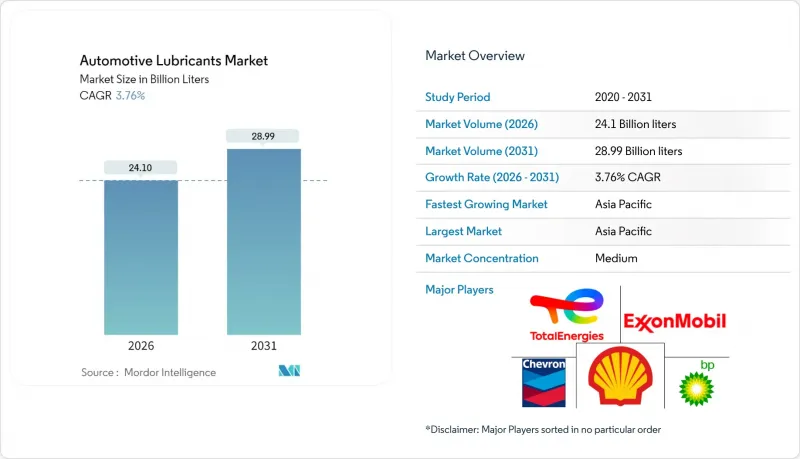
성장의 기반은 선진국의 차량 보유대수 고령화, 신흥 국가의 이륜차 및 상용차의 꾸준한 유입, 그리고 연비 향상과 오일 교환 주기 연장을 실현하는 프리미엄 합성유로의 산업 전환에 있습니다. 아시아태평양은 소유율 증가와 현지 제조 투자로 인해 핵심 수요 거점인 반면, 북미와 유럽은 애프터마켓 판매를 유지하기 위해 차량 수명 연장에 의존하고 있습니다. 경쟁의 강도는 중간 수준을 유지하고 있습니다. 쉘은 2024년 18년 연속 1위를 유지했으나, 지역별 블렌딩 업체들은 현지 생산 능력 강화와 맞춤형 배합을 통해 시장 점유율을 확대하고 있습니다. 전기자동차(EV) 보급 가속화(2024년 기준 중국내 EV 보급량 3,140만대)와 OEM 지정 장기 교체 주기 등의 역풍은 API SQ 규격과 이에 상응하는 저점도 합성유의 고단가화로 상쇄되고 있습니다.
차량 수명이 길어지면서 윤활유 수요 구조가 바뀌고 있습니다. 미국에서는 반도체 부족과 인플레이션으로 인해 차량 교체 속도가 느려지고, 차량 소유주들은 오일 교환 빈도를 늘리고 고품질 합성유에 대한 투자를 늘리고 있습니다. 유럽의 차량은 더 오래되어 평균 사용연수가 서유럽 18.1년, 동유럽 28.4년으로 길기 때문에 정비소에 들어오는 빈도가 증가하고, 차량 1대당 윤활유 소비량도 증가하고 있습니다. 노후화된 엔진은 실 열화, 열 스트레스, 오염에 시달리고 있으며, 이 모든 것이 오일 열화를 가속화하여 고품질 기유에 대한 수요를 불러일으키고 있습니다. 6-15년된 차량의 유지보수 비용은 1년 만에 514달러에서 537달러로 증가하여 차량 연식과 지출의 연관성을 강조하고 있습니다. 폐차율이 4.20%까지 하락하여 지난 20년 동안 가장 낮은 수준이며, 애프터마켓의 수입원이 장기화되고 있습니다. 소유주가 장기적인 보호와 총 소유 비용 절감을 추구하는 가운데, 고부가가치 합성유가 정비 공장의 주류가 되고 있습니다.
신흥 경제국은 성숙 시장에서의 EV 관련 물량 감소를 상쇄하고 있습니다. 중국의 자동차 보유량은 2024년 3,583만 대가 신규 등록되어 4억 5,300만 대에 달할 것으로 예측됩니다. 인도와 동남아시아에서는 도심의 교통체증 완화와 저렴한 이동수단에 대한 수요에 힘입어 이륜차 보유량이 급증하고 있습니다. E-Commerce 및 라스트 마일 배송 경로를 운행하는 상용차량은 주행거리가 길고, 오일 교환 빈도가 높습니다. 이들 지역의 국내 완성차 업체들은 현지 블렌딩 업체와 협력하여 다양한 연료 품질과 극한의 기후 조건에 대응하는 비용 효율적인 오일을 빠르게 개발하고 있습니다. 그 결과, 세계 경기 둔화 추세 속에서도 자동차 윤활유 시장은 지속적으로 확대되고 있습니다.
전기자동차(EV)의 보급으로 크랭크케이스 오일과 많은 구동계 유체가 서비스 메뉴에서 제외될 것입니다. 중국에서는 2024년 말 기준 3,140만 대의 신에너지 자동차가 운행되고 있으며, 이는 전년 대비 51.49% 증가한 수치입니다. 국제에너지기구(IEA)는 2030년까지 전 세계 전기자동차 보유량이 2억 5,000만 대를 돌파하여 석유 수요를 최대 430만 배럴/일 감축할 것으로 전망하고 있습니다. 그러나 EV는 새로운 틈새 시장을 창출하고 있습니다. 예를 들어 전기모터용 베어링용 에스테르, 유전체 냉각제, 고회전수와 전자기 호환성에 최적화된 기어 그리스 등이 있습니다. 공급업체의 과제는 양에서 가치로 전환되고 있습니다. 특수유체는 기존 엔진오일의 2-3배의 가격 프리미엄을 요구하기 때문입니다.
엔진오일은 스파크 점화 및 압축 점화 엔진의 보편적인 사용으로 인해 자동차 윤활유 시장을 지원하며 2025년 시장 규모의 58.24%를 차지할 것으로 예측됩니다. 경트럭과 오프로드 기계에서 대형 섬프 용량은 그 점유율을 더욱 확대하고 있습니다. 변속기 오일, 유압유, 기어 오일은 용도가 더 제한적이지만 수동 변속기, 습식 브레이크, 파워 스티어링 회로에는 여전히 필수적입니다. 그리스는 자동차 윤활유 시장 규모에서 차지하는 비중은 미미하지만, EV 전용 베어링 그리스(고회전수, 전기적 피트 현상 대응 필요) 수요 증가로 CAGR 4.12%로 가장 빠르게 성장하고 있습니다. 공급업체는 합성 에스테르와 폴리우레아 증점제를 혼합하여 전도성 제어 및 열 안정성을 실현하여 제품 믹스의 부가가치를 높였습니다.
API SQ 규격 오일의 보급과 함께 부문의 매출 구성이 합성유로 전환되고 있습니다. 0W-16 및 0W-12와 같은 초저점도 배합을 통해 OEM(Original Equipment Manufacturer)는 특히 일본과 유럽에서 차량 평균 CO2 배출량 목표를 달성할 수 있습니다. 중유 분야에서도 15W-40에서 5W-30으로의 전환은 연료비 절감을 위한 저점도, 고HTHS 블렌드에 대한 수요를 여실히 보여주고 있습니다. 점도 등급이 좁아짐에 따라 첨가제 패키지가 다양해졌습니다. 붕소 에스테르, 이황화몰리브덴, 무회계 세정제가 차세대 SKU의 핵심 기술로 자리매김하고 있습니다. 자동차 윤활유 시장은 단위 수량 감소와 단위당 이익률 향상 사이에서 균형을 유지하고 있습니다.
자동차 윤활유 시장 보고서는 제품 유형(엔진오일, 변속기 기어오일, 유압유, 그리스), 차종(승용차, 상용차, 오토바이), 지역(아시아태평양, 북미, 유럽, 남미, 중동 및 아프리카) 별로 분석되었습니다.
아시아태평양은 2025년 42.10%의 점유율로 자동차 윤활유 시장을 주도할 것이며, 2031년까지 연평균 4.10%의 성장률을 보일 것으로 예측됩니다. 중국에서만 4억 5,300만 대의 차량을 보유하고 있으며, 2024년에는 3,583만 대의 신규 등록을 기록할 것으로 예측됩니다. 거대한 공장 충진 수요와 거대한 시장이 결합하여 성장을 가속하고 있습니다. 아세안 각국 정부는 EV 조립 거점 육성에 주력하고 있으며, 태국의 동부 경제 회랑 계획에 따라 쉘은 태국내 그리스 생산 능력을 3배로 확대하여 지역 공급의 안정성을 확보했습니다. 베트남과 인도네시아의 오토바이 보급률이 70%를 넘어 오토바이 오일 수요를 지원하고 있습니다.
북미는 완만하지만 안정적인 성장에 기여하고 있습니다. 전기자동차 판매량은 연간 140만 대를 넘어설 것이지만, 운행 차량의 8% 미만에 불과하며, 2030년까지 내연기관차의 대규모 보유량이 유지될 것입니다. 자동차 제조업체들은 API SQ 규격의 합성유를 권장하고 있으며, 교체 주기가 1만 마일(약 1만 6천km)을 초과하므로 퀵루브 체인은 재고를 저점도 배합으로 업데이트하고 있습니다.
유럽에서는 신차 등록대수가 정체되어 있음에도 불구하고 18-28년된 자동차 차량이 윤활유 수요를 지탱하고 있습니다. 이 지역은 CO2 배출 규제에 대한 선구적인 대응으로 PSA, VW 508/509, ACEA C6 표준을 준수하는 0W-20 및 0W-16 오일의 채택을 촉진하고 있습니다. 최대 30,000km까지 연장된 서비스 간격은 프리미엄 등급 구매를 유도하여 판매량 감소를 일부 상쇄할 수 있습니다.
중동, 아프리카 및 남미는 현재 세계 전체 판매량에서 차지하는 비중은 작지만, 매우 큰 성장 여력을 가지고 있습니다. 비보에너지가 아프리카 23개국에서 자체 브랜드 윤활유를 확대하고, 쉘이 인도 라지 페트로를 인수한 것은 남남 경쟁의 추세를 잘 보여주고 있습니다. 인프라 개발, 농업기계화, 광업 프로젝트는 분진 및 고온 환경에 강한 유압유압유와 고부하 엔진오일에 대한 수요를 창출하고 있습니다.
The Automotive Lubricants Market was valued at 23.23 billion liters in 2025 and estimated to grow from 24.1 billion liters in 2026 to reach 28.99 billion liters by 2031, at a CAGR of 3.76% during the forecast period (2026-2031).
Growth is anchored by an aging global vehicle parc in developed regions, a steady influx of two-wheelers and commercial vehicles in emerging economies, and the sector's pivot toward premium synthetics that improve fuel economy and extend drain intervals. Asia-Pacific remains the core demand center thanks to rising ownership levels and local manufacturing investments, while North America and Europe rely on vehicle longevity to sustain aftermarket sales. Competitive intensity stays moderate: Shell led for the 18th straight year in 2024, but regional blenders gain ground through local capacity additions and tailored formulations. Headwinds such as accelerating electric-vehicle (EV) penetration-31.4 million units on Chinese roads in 2024-and OEM-specified long-drain intervals are mitigated by the higher unit values of API SQ and similar low-viscosity synthetics.
Vehicle longevity is reshaping lubricant demand profiles. Semiconductor shortages and inflation have slowed vehicle replacement rates in the US, prompting owners to increase oil-change frequency and invest in higher-quality synthetic oils. Europe's fleet is even older-18.1 years in the West and 28.4 years in the East-driving more workshop visits and raising per-vehicle lubricant consumption. Older engines suffer seal degradation, thermal stress, and contamination, all of which accelerate oil degradation and spur demand for premium base stocks. Maintenance outlays for vehicles aged 6-15 years rose from USD 514 to USD 537 in just one year, underscoring the link between age and spend. Scrappage has fallen to 4.20%, the lowest in two decades, prolonging aftermarket revenue streams. Higher-value synthetics now dominate service bays as owners seek extended protection and lower total cost of ownership.
Emerging economies offset EV-related volume erosion in mature markets. China's motor-vehicle stock reached 453 million units, supported by 35.83 million new registrations in 2024. Two-wheeler ownership continues to surge in India and Southeast Asia, propelled by urban congestion relief and affordable mobility. Commercial fleets running e-commerce and last-mile delivery routes accumulate higher mileage, boosting drain-frequency multiples. Domestic automakers in these regions collaborate with local blenders, allowing agile development of cost-effective oils tailored to varied fuel quality and climate extremes. As a result, the automotive lubricants market keeps expanding even amid global moderation.
EVs remove crankcase oils and many driveline fluids from service menus. China logged 31.4 million new-energy vehicles on its roads by end-2024, up 51.49% year-on-year. The IEA projects global stock could eclipse 250 million by 2030, cutting oil demand by up to 4.3 million bbl/d. Nonetheless, EVs introduce new niches: esters for e-motor bearings, dielectric coolants, and gear greases optimized for high RPM and electromagnetic compatibility. For suppliers, the challenge shifts from volume to value as specialized fluids command two-to-three-fold price premiums over conventional engine oil.
Other drivers and restraints analyzed in the detailed report include:
For complete list of drivers and restraints, kindly check the Table Of Contents.
Engine oil held 58.24% of 2025 volumes, anchoring the automotive lubricants market through ubiquitous use in spark-ignition and compression-ignition engines. Larger sump capacities in light trucks and off-highway machinery amplify its share. Transmission fluids, hydraulic oils, and gear oils serve narrower applications yet remain vital for manual boxes, wet brakes, and power-steering circuits. Greases, though just a fraction of the automotive lubricants market size, are the fastest riser at a 4.12% CAGR as EVs require dedicated bearing greases that handle high RPM and electrical pitting. Suppliers blend synthetic esters and polyurea thickeners to deliver conductivity control and thermal stability, elevating product mix value.
The segment's revenue mix swings toward synthetics as API SQ-compliant oils gain traction. Ultra-low viscosity formulations such as 0W-16 and 0W-12 enable OEMs to meet fleet-average CO2 targets, especially in Japan and Europe. Even within heavy-duty oils, the shift from 15W-40 to 5W-30 illustrates demand for thinner, high-HTHS blends that cut fuel costs. As viscosity grades narrow, additive packages diversify-boron esters, molybdenum disulfide, and ashless detergents become cornerstones in next-generation SKUs. The automotive lubricants market therefore balances declining unit volumes against richer per-unit margins.
The Automotive Lubricants Market Report is Segmented by Product Type (Engine Oil, Transmission and Gear Oil, Hydraulic Fluids, Greases), Vehicle Type (Passenger Vehicles, Commercial Vehicles, Motorcycles), and Geography (Asia-Pacific, North America, Europe, South America, Middle East and Africa).
Asia-Pacific dominated the automotive lubricants market with a 42.10% share in 2025 and is forecast to grow 4.10% per year through 2031. China alone hosts 453 million vehicles and recorded 35.83 million new registrations in 2024, pairing vast factory-fill demand with a colossal service marketplace. ASEAN governments nurture EV assembly hubs; Thailand's Eastern Economic Corridor plans drove Shell to triple Thai grease capacity, ensuring regional supply resilience. Two-wheeler penetration surpasses 70% of households in Vietnam and Indonesia, bolstering motorcycle-oil volumes.
North America contributes to stable if modest growth. EV sales exceed 1.40 million units annually yet remain below 8% of in-service vehicles, preserving a sizeable internal-combustion fleet through 2030. OEMs emphasize API SQ synthetics with drain intervals topping 10,000 miles, prompting quick-lube chains to upgrade inventories to low-viscosity formulations.
Europe's 18-28 year car fleet sustains lubricant demand despite flat new-car registrations. The continent pioneers CO2 cap compliance, spurring adoption of 0W-20 and 0W-16 oils backed by PSA, VW 508/509, and ACEA C6 specifications. Extended-service intervals of up to 30,000 km partially offset volume loss by encouraging premium-grade purchases.
The Middle East & Africa and South America jointly contribute a smaller share of the global volume today but deliver outsized upside. Vivo Energy's branded-lube expansion across 23 African nations and Shell's Raj Petro acquisition in India highlight a south-south competitive trend. Infrastructure build-out, agricultural mechanization, and mining projects generate demand for hydraulic fluids and heavy-duty engine oils resilient to dust and high ambient temperatures.