



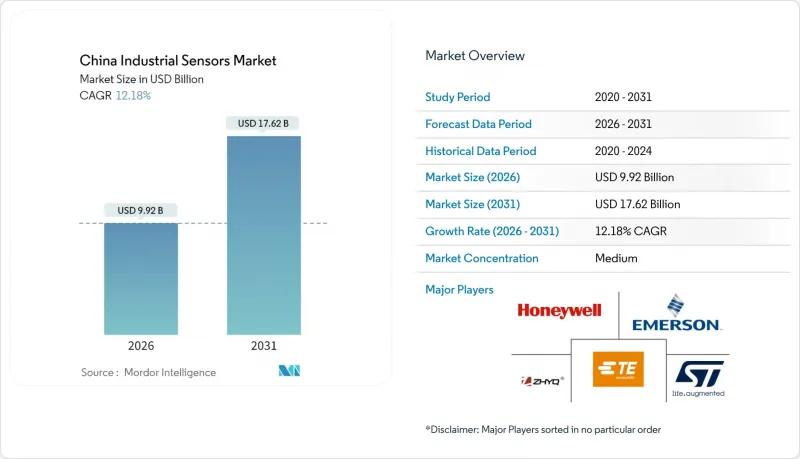
중국의 산업용 센서 시장은 2025년에 88억 4,000만 달러로 평가되며, 2026년 99억 2,000만 달러에서 2031년까지 176억 2,000만 달러에 달할 것으로 예측됩니다.
예측 기간(2026-2031년)의 CAGR은 12.18%로 예상됩니다.
이러한 성장세는 스마트 제조로의 전환, 국가 차원의 인더스트리 4.0 도입, 수입 의존도를 낮추기 위한 광범위한 현지화 인센티브 등을 반영하고 있습니다. 공장의 디지털화 예산은 총 지출의 15%를 센서 개조에 할당하는 추세이며, 사이버 보안법에 따른 엣지 프로세싱 의무화는 국산 기기 채택을 촉진하고 있습니다. 전기자동차(EV) 생산의 급증, 산업단지의 엄격한 탄소배출량 관리 규정, 그리고 확대되는 예지보전 프로그램은 자동차, 공정, 에너지 자산에 멀티센서의 보급을 더욱 촉진하고 있습니다. 경쟁 환경은 조달 규정 대응을 위해 생산을 현지화하는 외자 대기업과 인수합병 및 MEMS 업그레이드를 통해 가치 곡선을 상승시키는 국내 스타트업으로 인해 중간 정도의 분산 상태를 유지하고 있습니다.
공장에서는 독립적인 자동화 아일랜드에서 사내 AI 플랫폼으로 연속적인 데이터를 전송하는 통합 센서 네트워크로의 전환이 진행되고 있습니다. 스마트화 업그레이드를 위해 책정된 2,000억 위안의 공공 자금 중 약 15%가 센서에 할당되어 하드웨어, 연결성, 분석 구독을 번들로 묶은 일괄 계약의 물결을 일으키고 있습니다. 유럽과 미국 공장에서 흔히 볼 수 있는 단계적 개조와 달리 중국 제조업체는 종종 한 번의 셧다운 기간 중 전체 라인을 재장비하는 경우가 많습니다. 사이버 보안법의 엣지 컴퓨팅 조항은 현지에서의 데이터 처리를 의무화하고 있으며, 국내 생산 AI 지원 기기에 대한 수요를 촉진하고 있습니다.
베이징 당국이 센서를 '핵심 기술'로 분류하면서 연간 500억 위안 이상의 보조금, 세제 혜택, 토지 마련을 신속하게 지원받을 수 있게 되었습니다. 하이엔드 MEMS의 수입 의존도는 2024년 80% 이상에서 2027년 50% 미만으로 감소할 것으로 예측됩니다. 해외 주요 제조업체들은 현재 핵심 제조 공정을 중국 내로 통합하는 합작 사업을 진행 중이며, 기술 이전을 가속화하고 현지 인력의 역량을 확대하기 위해 노력하고 있습니다.
대만, 한국, 독일에서 주로 조달되는 첨단 MEMS 다이의 경우, 정밀 등급 공급의 70% 이상을 차지하고 있습니다. 2024년 반도체 부족시 리드타임이 26주까지 늘어나며, 완전 현지 조달품 대비 부품 원가가 35-40% 증가하여 원가 중시 분야에서의 가격 경쟁력이 떨어지고 있습니다.
압력 장치는 2025년 중국 산업용 센서 시장의 26.42%를 차지할 것으로 예상되며, 자동차 브레이크, 석유화학 파이프라인, 공조 제어 등 다분야에서의 보급이 두드러집니다. 주요 설비의 예측 유지보수 계획은 지속적인 압력 피드백 루프를 요구하므로 부문 매출은 꾸준히 증가할 것으로 예측됩니다. 가스 센서는 탄소 모니터링법에 힘입어 굴뚝, 배터리 공장, 폐가스 세정 장치에 첨단 전기화학 및 광음향 설계를 통합하여 13.56%의 연평균 복합 성장률(CAGR)로 가장 빠르게 성장할 것으로 예측됩니다. 온도 및 레벨 센서는 제약, 식품 가공, 수처리 분야에서 규제 요건에 따른 상세한 온도 및 충진 레벨 기록의 필요성으로 인해 안정적인 수주를 유지하고 있습니다. 유량 센서와 자기장 센서는 각각 스마트 시티의 수도망과 EV 모터 제어장치에 채택이 증가하고 있으며, 가속도 센서와 요율 센서는 국내 자동차 제조업체의 자율주행 연구개발 사이클에 통합되고 있습니다.
제품 구성은 개별 부품에서 압력, 온도, 진동 데이터를 단일 MEMS 스택에 통합한 패키지로 전환되고 있습니다. 공급업체는 설치 시간을 단축하고 버스 레벨 배선을 단순화하기 위해 자동화 공급업체와 함께 이러한 하이브리드 제품을 공동 설계하고 있습니다. 분석 기능의 구독을 번들로 제공함으로써 하드웨어와 서비스 매출의 경계가 더욱 모호해져 두 영역을 모두 장악하고 있는 기존 기업이 지속적인 우위를 점할 수 있게 되었습니다. 가스 감지 모듈 수요 증가에 따라 MEMS 다이 제조업체와 패키징 전문 기업과의 제휴가 진행되고 있습니다. 후자는 열악한 산업 환경에서도 취약한 구조를 봉입하는 기술을 보유하고 있습니다.
2025년, 자동차 라인은 중국 산업용 센서 시장 규모의 27.35%를 차지했습니다. 이는 중국의 독보적인 차량 조립량과 급속한 전동화 곡선을 반영합니다. 신에너지 자동차는 내연기관차 대비 약 2.5배의 센서를 탑재하고 있으며, 총 생산량이 감소하는 상황에서도 수요를 견인하고 있습니다. 배터리 열 관리, 고정밀 전류 모니터링, 자율주행용 관성측정장치(IMU)가 가장 고부가가치 틈새 시장을 형성하고 있습니다. 항공우주 및 방위 분야의 조달 수요는 민간 항공의 회복과 군사 예산의 확대에 따라 부활하고 있으며, 진동, 방사선, 극한의 온도에 견디는 견고한 압력 센서와 관성 장치에 대한 주문이 유입되고 있습니다.
의료 분야는 전국적인 병원의 디지털화와 고령화 사회에서의 원격 환자 모니터링의 발전으로 CAGR 14.18%로 확대되고 있습니다. 주입 펌프용 일회용 MEMS 압력 센서, 웨어러블 기기용 비침습적 광학 모듈, 마취 워크스테이션용 가스 센서 등이 임상 적용 범위의 확대를 상징합니다. 전자기기 및 반도체 제조 공장에서는 무진공 클린룸 모니터링을 위한 대규모 조달 프로그램이 진행 중입니다. 한편, 발전 사업자들은 태양광 및 풍력발전 설비와 계통 연계 장치에 감지 어레이를 통합하고 있습니다. 석유 및 가스, 식품 및 음료, 폐수 처리 분야에서는 센서 강화를 통한 안전 및 품질 프로토콜의 현대화가 진행되어 최종사용자 층을 보완하고 있습니다.
중국 산업용 센서 시장 보고서는 제품 유형(압력, 온도, 레벨 등), 최종사용자(자동차, 항공우주 및 군사, 화학 및 석유화학 등), 센싱 기술(MEMS, 비 MEMS 등), 폼팩터(개별 센서, 통합 모듈, 무선 스마트 노드), 지역별로 분류됩니다. 무선 스마트 노드), 지역별로 분류되어 있습니다. 시장 예측은 금액 기준(USD)으로 제공됩니다.
The China industrial sensors market was valued at USD 8.84 billion in 2025 and estimated to grow from USD 9.92 billion in 2026 to reach USD 17.62 billion by 2031, at a CAGR of 12.18% during the forecast period (2026-2031).
This momentum reflects the country's pivot toward smart manufacturing, its nationwide Industry 4.0 roll-outs, and wide-ranging localization incentives that reduce import exposure. Factory digitization budgets increasingly earmark 15% of total spending for sensor retrofits, while edge-processing mandates under the Cybersecurity Law favor domestically built devices. Surging electric-vehicle (EV) output, strict carbon accounting rules at industrial parks, and expansive predictive maintenance programs further raise multi-sensor penetration across automotive, process, and energy assets. Competitive dynamics remain moderately fragmented as foreign majors localize production to comply with procurement rules and domestic challengers ascend the value curve through mergers, acquisitions, and MEMS upgrades.
Factories are replacing stand-alone automation islands with unified sensor networks that stream continuous data to in-house AI platforms. Public funding of CNY 200 billion earmarked for smart upgrades reserves roughly 15% for sensors, creating a wave of bulk contracts that bundle hardware, connectivity, and analytics subscriptions. Unlike gradual retrofits common in Western plants, Chinese manufacturers often re-equip entire lines in a single shutdown window. Edge computing clauses in the Cybersecurity Law require local data processing, channeling demand toward domestically produced, AI-ready devices.
Beijing's classification of sensors as a "critical technology" unlocks subsidies, tax breaks, and fast-track land allotments worth more than CNY 50 billion in annual procurement volume. The import dependence for high-end MEMS is expected to decline from over 80% in 2024 to below 50% by 2027. Foreign leaders are now pursuing joint ventures that embed core fabrication stages within China, accelerating technology transfer and scaling local workforce capabilities.
Advanced MEMS dies, largely sourced from Taiwan, South Korea, and Germany, continue to account for more than 70% of the precision-grade supply. Lead times stretched to 26 weeks during the 2024 chip crunch, increasing the bill of materials by 35-40% compared to fully localized alternatives, and dampening price competitiveness in cost-sensitive sectors.
Other drivers and restraints analyzed in the detailed report include:
For complete list of drivers and restraints, kindly check the Table Of Contents.
Pressure devices claimed a 26.42% share of the Chinese industrial sensors market in 2025, underscoring their cross-sector ubiquity in automotive braking, petrochemical pipelines, and HVAC controls. Segment revenue is expected to climb steadily as predictive-maintenance schemes mandate continuous pressure feedback loops in critical assets. Gas sensors, driven by carbon-monitoring laws, are projected to deliver the swiftest ascent at a 13.56% CAGR, incorporating sophisticated electrochemical and photoacoustic designs into smokestacks, battery plants, and waste-gas scrubbers. Temperature and level sensors consistently sustain orders from pharmaceuticals, food processing, and water treatment, where regulatory regimes require granular thermal and fill-level logging. Flow and magnetic field sensors are experiencing rising allocations in smart-city water grids and EV motor controllers, respectively, while acceleration and yaw-rate units are being integrated into autonomous-driving R&D cycles among domestic OEMs.
The product mix is shifting from discrete components toward integrated packages that consolidate pressure, temperature, and vibration data in a single MEMS stack. Suppliers co-design these hybrids with automation vendors to shorten installation time and simplify bus-level wiring. Bundled analytics subscriptions further blur the line between hardware and service revenue, giving incumbents that master both domains an enduring advantage. The growing appeal of gas-sensing modules encourages partnerships between MEMS die makers and packaging specialists who can encapsulate fragile structures for harsh industrial atmospheres.
Automotive lines absorbed 27.35% of the Chinese industrial sensors market size in 2025, reflecting the nation's unrivaled vehicle assembly volume and its rapid electrification curve. New-energy vehicles embed roughly 2.5X more sensors than internal-combustion models, boosting demand even as total unit output plateaus. Battery thermal management, high-precision current monitoring, and inertial measurement units for autonomy represent the highest-value niches. Aerospace and defense procurements are reviving as commercial flights rebound and military budgets expand, channeling orders for ruggedized pressure and inertial devices that withstand vibration, radiation, and extreme temperatures.
Medical applications, advancing at a 14.18% CAGR, benefit from nationwide hospital digitization and remote-patient monitoring for an aging population. Disposable MEMS pressure sensors in infusion pumps, non-invasive optical modules in wearables, and gas sensors in anesthetic workstations illustrate a widening clinical scope. Electronics and semiconductor fabs continue sizable purchasing programs for particle-free clean-room monitoring, while power-generation utilities integrate sensing arrays across solar, wind, and grid-balancing equipment. Oil, gas, food, beverage, and wastewater sectors modernize with sensor-enhanced safety and quality protocols, rounding out the end-user spectrum.
The China Industrial Sensors Market Report is Segmented by Product Type (Pressure, Temperature, Level, and More), End User (Automotive, Aerospace and Military, Chemical and Petrochemical, and More), Sensing Technology (MEMS, Non-MEMS, and More), Form Factor (Discrete Sensors, Integrated Modules, and Wireless Smart Nodes), and Region. The Market Forecasts are Provided in Terms of Value USD.