



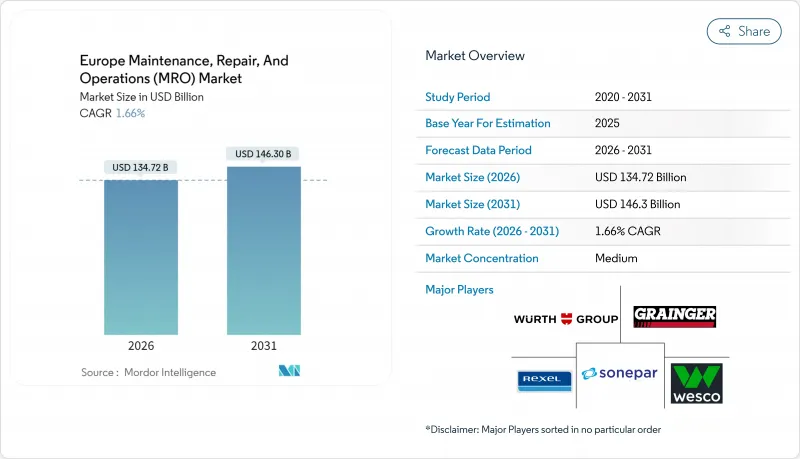
유럽의 MRO(유지보수, 수리 및 운영) 시장은 2025년에 1,325억 2,000만 달러로 평가되었고, 2026년 1,347억 2,000만 달러에서 2031년까지 1,463억 달러에 이를 것으로 예측되고 있습니다.
예측 기간(2026-2031년)의 CAGR은 1.66%로 예상됩니다.

성숙하면서도 꾸준히 확대되는 궤적은 의무화된 수리권 규정, 순환형 경제에 관한 법 규제, 그리고 지역의 다양한 산업기반 전체에서 데이터 구동형 보수 전략에 대한 의존도 상승에 기인하고 있습니다. 독일의 고급 자동화 보급, 유럽 그린딜 정책, 강화된 공급망 내성 프로그램은 통합 유지보수 솔루션에 대한 장기적인 수요를 뒷받침하고 있습니다. 급속한 디지털화는 기계, 전기 및 소프트웨어 지원을 단일 협력 서비스로 통합할 수 있는 서비스 제공업체들에게 경쟁의 중요성을 높입니다. 한편, 제조업자는 예산의 우선순위를 설비투자에서 운영경비로 이행시켜 외부서비스의 도입을 가속화함과 동시에 전문 벤더를 위한 새로운 수익원을 창출하고 있습니다. 마지막으로 엔터프라이즈 지속가능 경영 보고 지침(CSRD)에서 의무화된 지속가능성 공개는 수명주기 동안의 유지보수 문서화의 필요성을 높이고, 분석 기능을 갖춘 서비스 계약이 부각되고 있습니다.
사이버 레질리언스법은 연결 기기 제조업체에 대해, 기계에 지속적인 모니터링 기능을 탑재할 것을 의무화하고 있어, 사실상, 예지보전을 컴플라이언스 요건으로 하고 있습니다. 조기에 대응한 기업에서는 이미 예상 밖의 다운타임을 최대 50% 저감하고 있으며, 이 비용 절감책이 분석을 중시한 MRO 계약 수요를 더욱 자극하고 있습니다. 독일 정부는 인더스트리 4.0 도입 지원에 21억 유로(22억 6,000만 달러)를 공급하고 있으며, 그 중 40%가 예측 인프라에 배분되어 있습니다. 대기업 OEM 제조업체가 다운스트림 공급업체에 기계의 건전성 데이터 공유를 요구하는 경향이 강해지고 있는 가운데, 중규모 공장에서도 승인 벤더리스트에 머물기 위해서는 센서와 클라우드 기반의 분석 기술 도입이 필수가 되고 있습니다. 점진적인 규제가 2027년까지 계속되기 때문에 유럽의 MRO 시장은 성장을 지속하는 다년간의 단계적 투자 사이클의 혜택을 누리고 있습니다.
유럽의 공장은 기타 세계 지역에 비해 거의 전체 가동에 가까운 상태로 운영되고 있으며, 독일의 주요 공장에서는 종합 설비 효율(OEE)이 90%에 육박하고 있습니다. 팬데믹 동안 반도체 부족으로 인해 단일 기계 고장이 공급망 전체로 퍼질 위험이 밝혀지면서 그 중요성이 급격히 높아졌습니다. 자동차의 전동화에 따라 고전압 시스템과 배터리 처리의 복잡성이 더해져 폭스바겐 등 기업들은 전문적인 유지보수를 필요로 하는 전기이동성 인프라에 890억 유로(958억 달러)를 투입할 방침입니다. 체코와 폴란드의 수출업체도 독일의 벤치마크에 추종하여 가동시간 확보가 지역 전체의 우선 과제로 강화되고 있습니다. 이러한 동향에 의해 디지털 트윈, 스마트 센서, AI 구동형 진단 기술이 '있으면 좋은 것'에서 '경쟁상의 필수 요건'으로 진화하는 가운데 유럽의 MRO 시장에는 지속적인 투자가 집중되고 있습니다.
유럽에서는 2030년까지 최대 14만 5,000명의 추가 정비 기술자가 필요할 것으로 예측되며, 이에 따른 양성 비용은 14억 유로(15억 1,000만 달러)에 달할 전망입니다. 독일은 저명한 도제 제도를 갖고 있지만 4만 5,000명의 정비직이 채워지지 않았으며 가장 높은 부담을 겪고 있습니다. 항공 산업은 특히 심각한 영향을 받고 있습니다. 항공기 운영에는 긴 인증 프로세스가 필요하며, 경우에 따라 신입 사원이 중요한 업무를 담당할 수 있게 되기까지 2년 이상이 소요될 수도 있습니다. 인구동태의 현실도 문제를 악화시키고 있습니다. 현재 정비 작업자의 40%가 50세 이상이며, 후임 확보의 긴급성을 높이고 있습니다. 지속적인 인력 부족 현상은 서비스 가격 상승, 수리 지연, 유럽의 MRO 시장의 확대 속도 제한으로 이어지고 있습니다.
산업용 MRO는 유럽의 광범위한 제조 생태계와 정기적인 유지보수가 필요한 자동화 기술의 깊은 통합으로 2025년 수익의 45.88%를 차지했습니다. 유럽의 산업 플랜트용 MRO 시장의 규모는 시설의 현대화에 따라 완만한 성장을 계속하고 있지만, 재생에너지의 도입이나 스마트 공장으로의 개보수를 배경으로, 전기 부문이 보다 빠른 성장을 보이고 있습니다. 독일에서 전기자동차 충전 네트워크의 확충에서만 수천명의 기계적 및 디지털적 기준에 익숙한 고전압 기술자가 필요합니다. 공조설비(HVAC)와 빌딩 자동화 등의 시설 서비스는 안정적인 수익을 가져오지만, 수소전해장치의 유지보수와 같은 신흥 틈새 분야는 환경규제가 시장의 기술적 프론티어를 끊임없이 확대하고 있음을 보여주고 있습니다.
전기 설비의 MRO(유지보수, 수리 및 운영) 분야에서의 연평균 복합 성장률(CAGR) 2.69%은 센서의 광범위한 도입, 전력망의 디지털화, 재생에너지 자산에 대한 가동률 목표의 엄격화 등의 여러 동향에 뒷받침되고 있습니다. 태양광 발전소와 축전지 어레이가 네트워크에 연결됨에 따라 개폐 장치, 케이블 및 인버터의 예방 검사가 매우 중요합니다. 기계적 수리와 소프트웨어 업데이트를 결합한 하이브리드 서비스 계약은 인기를 얻고 있으며 기존의 부문 경계를 더욱 모호하게 만듭니다. 양 분야를 장악하는 기업은 확대하는 기술군 전체에서 단일 책임원을 요구하는 자산 소유자로부터 평균을 웃도는 점유율을 획득할 전망입니다.
예방보전 프로그램은 2025년 지출의 57.02%를 차지하였으며 유럽의 신뢰성 문화가 그 기반이 되고 있습니다. 그러나 예측 분석은 CAGR 6.82%로 확대되어 시장을 재편하고 있습니다. 실시간 데이터를 통해 운영자는 지표가 위험 임계값을 초과할 때만 작업을 계획할 수 있게 되어 예비 부품의 소비를 줄이고 보다 전략적인 업무로 노동력을 전환할 수 있게 되었습니다. BMW와 같은 조기 도입 기업은 비상 정지가 40% 감소한 것으로 보고되었으며, 이는 직접적인 이익률 향상과 공급망 신뢰성 강화로 이어지고 있습니다. 그 결과 센서, 클라우드 플랫폼 및 AI 모델에 할당되는 유럽의 MRO 시장의 규모는 해마다 확대되고 있습니다.
다만, 예지보전모델에서는 모든 고장을 예측할 수 없기 때문에 개량작업의 중요성은 여전히 높습니다. 터빈, 엔진, 로봇 셀이 예기치 않게 고장난 경우, 다운타임으로 인한 손실은 시간당 EUR 100,000(108,000 USD)을 초과할 수 있습니다. 공급업체는 현재 복잡한 수리 작업을 가속화하기 위해 증강현실(AR) 헤드셋을 도입하고 드론 검사를 통해 고층 빌딩과 해상 자산의 정지 시간을 단축하고 있습니다. 서비스 구성이 변화하는 가운데 데이터 구동 예측과 신속한 위기 관리 전환이 가능한 공급자는 예측 기술의 침투가 진행되더라도 수익원을 보호할 수 있을 것입니다.
The European MRO market was valued at USD 132.52 billion in 2025 and estimated to grow from USD 134.72 billion in 2026 to reach USD 146.3 billion by 2031, at a CAGR of 1.66% during the forecast period (2026-2031).
This mature yet steadily expanding trajectory stems from mandatory right-to-repair rules, circular economy legislation, and a growing reliance on data-driven maintenance strategies across the region's diversified industrial base. Germany's deep automation footprint, the European green-deal agenda, and heightened supply-chain resilience programs all reinforce long-term demand for integrated maintenance solutions. Rapid digitalization raises the competitive stakes for service providers who can merge mechanical, electrical, and software support into a single, coordinated offer. Meanwhile, manufacturers are shifting budget priorities from capital investments to operating expenses, accelerating the uptake of external services, and creating new revenue streams for specialized vendors. Finally, sustainability disclosures mandated by the Corporate Sustainability Reporting Directive (CSRD) intensify the requirement for life-cycle-oriented maintenance documentation, providing an extra boost to analytics-enabled service contracts.
The Cyber Resilience Act requires connected-equipment manufacturers to incorporate continuous monitoring into their machines, effectively making predictive maintenance a compliance requirement. Companies that comply early are already reducing unplanned downtime by up to 50%, a cost-saving measure that further stimulates demand for analytics-heavy MRO contracts. Germany's government reserves EUR 2.1 billion (USD 2.26 billion) to subsidize Industry 4.0 rollouts, with 40% of that package specifically allocated for predictive infrastructure. As large OEMs increasingly require downstream suppliers to share machine health data, even mid-sized plants must adopt sensors and cloud-based analytics to remain on approved vendor lists. As the phased regulation runs until 2027, the European MRO market benefits from a staggered, multi-year investment cycle that sustains growth.
Europe's factories operate closer to full capacity than most of their global peers, with leading German plants posting overall equipment effectiveness rates of nearly 90%. The stakes rose sharply after pandemic-era semiconductor shortages revealed how a single machine failure could ripple through entire supply networks. Automotive electrification now introduces high-voltage and battery-handling complexity, prompting firms such as Volkswagen to allocate EUR 89 billion (USD 95.8 billion) for electric-mobility infrastructure that requires specialized maintenance. Czech and Polish exporters are following suit to keep pace with German benchmarks, reinforcing the region-wide priority on uptime. These dynamics draw continuous spending into the European MRO market as digital twins, smart sensors, and AI-driven diagnostics evolve from a nice-to-have to a competitive imperative.
Europe is expected to require up to 145,000 additional maintenance technicians by 2030, resulting in a training expenditure of EUR 1.4 billion (USD 1.51 billion). Germany shoulders the heaviest burden, with 45,000 unfilled maintenance roles despite its renowned apprenticeship programs. Aviation is hit hardest because aircraft operations require lengthy certification processes; in some cases, recruits wait two years or more before they can sign off on critical tasks. The demographic reality compounds the issue: 40% of today's maintenance workforce is over 50, which raises the urgency of replacement. Persistent scarcity raises service prices, delays repairs, and restricts the speed at which the European MRO market can scale.
Other drivers and restraints analyzed in the detailed report include:
For complete list of drivers and restraints, kindly check the Table Of Contents.
Industrial MRO retained 45.88% of 2025 revenue owing to Europe's vast manufacturing ecosystem and the deep integration of automation technologies that demand regular servicing. The European MRO market size for industrial plants continues to grow modestly as facilities modernize; however, the electrical segment is growing faster, driven by renewable energy rollouts and smart factory retrofits. Germany's ramp-up of electric-vehicle charging networks alone calls for thousands of high-voltage technicians trained to both mechanical and digital standards. Although facility services like HVAC and building automation offer steady returns, emerging niches-such as the maintenance of hydrogen electrolyzers-illustrate how environmental legislation constantly extends the market's technical frontier.
Electrical MRO's 2.69% CAGR springs from converging trends: wider sensor deployment, grid digitalization, and stricter uptime targets for renewable assets. As more solar parks and battery-storage arrays connect to the network, preventive testing of switchgear, cables, and inverters becomes mission-critical. Hybrid service contracts, which combine mechanical fixes with software upgrades, are gaining favor, further blurring traditional category boundaries. Those who master both domains are poised to capture above-average wallet share from asset owners seeking single-source accountability across a growing array of technologies.
Preventive programs accounted for 57.02% of 2025 spending and remain the backbone of European reliability culture; yet, predictive analytics is rewriting the rulebook by growing at a 6.82% CAGR. Real-time data enables operators to schedule work only when indicators cross risk thresholds, thereby reducing spare parts consumption and freeing labor for more strategic tasks. Early adopters such as BMW report 40% fewer unscheduled stops, which translates into direct margin gains and stronger supply-chain credibility. Consequently, the European MRO market size allocated to sensors, cloud platforms, and AI models climbs each year.
Corrective tasks still matter because no predictive model can foresee every failure. When turbines, engines, or robotic cells break unexpectedly, downtime losses can exceed EUR 100,000 (USD 108,000) per hour. Vendors now deploy augmented-reality headsets to accelerate complex repairs, while drone inspection shrinks outage windows for high-rise or offshore assets. As the service mix shifts, providers who can pivot between data-driven forecasting and responsive crisis management will protect their revenue streams, even as predictive penetration deepens.
The Europe Maintenance, Repair, and Operations Market Report is Segmented by MRO Type (Industrial MRO, Electrical MRO, Facility MRO, Other MRO Types), Maintenance Type (Preventive, Predictive, Corrective), Sourcing Type (Internal MRO, External MRO), End-User Industry (Manufacturing, Aerospace, Automotive, Energy and Utilities, Others), and Geography. The Market Forecasts are Provided in Terms of Value (USD).