



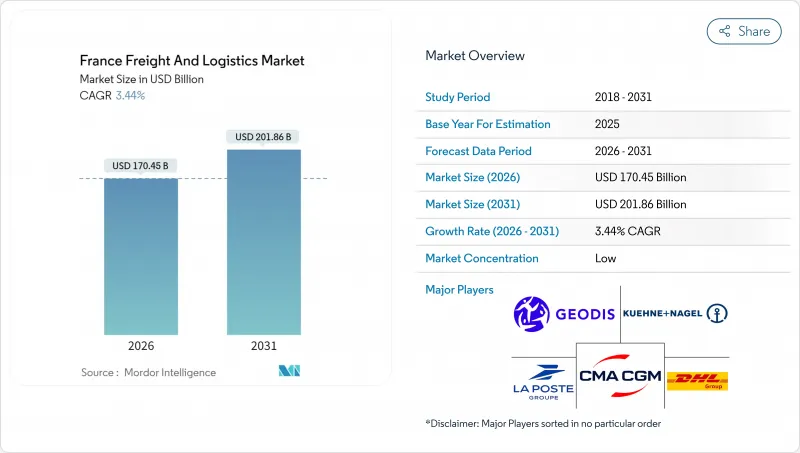
프랑스의 화물 및 물류 시장은 2025년 1,647억 8,000만 달러로 평가되었고, 2026년에 1,704억 5,000만 달러로 성장할 것으로 보입니다. 2026-2031년에 걸쳐 CAGR 3.44%로 성장이 예상되며, 2031년까지 2,000달러에 이를 것으로 예측됩니다.
지속적인 인프라 개선, 급증하는 전자상거래 소포 물동량, 그리고 종이 없는 통관 절차의 전면적 도입이 종합적으로 성장 궤도를 강화하고 있습니다. 정부의 20억 유로(22억 달러) 규모의 ‘Fonds vert’ 프로그램은 모든 운송 수단에 걸쳐 탈탄소화 프로젝트를 가속화하며, 신규 친환경 자산의 비용을 낮추는 직접 보조금과 세액 공제를 제공합니다. 합병 움직임?특히 CMA CGM의 52억 유로(57억 달러) 규모 볼로레 로지스틱스 인수?는 진정한 종단간 서비스를 제공할 수 있는 수직 통합형 공급업체를 창출합니다. 디지털 차량 텔레매틱스, 수소 취급 장비, AI 기반 위험 엔진은 자산 활용도를 높이는 동시에 배출량 발자국을 축소하여 ‘Fit-for-55’ 의무가 강화됨에 따라 경쟁 우위를 뒷받침합니다.
유럽연합 관세법(Union Customs Code)에 따른 전자 신고의 전면 도입으로 규정 준수 화물의 통관 시간이 최대 30% 단축되어 고부가가치 자동차 및 항공우주 공급망에 혜택을 주고 있습니다. AI 기반 위험 엔진은 선별적 검사를 가능하게 하여 부족한 국경 관리관을 복잡한 검사에 투입할 수 있게 하고, 칼레(Calais)와 르아브르(Le Havre)의 트럭 체류 시간을 단축합니다. 화물 운송업체들은 문서 작업 흐름이 원활해지고 중개 수수료가 낮아져 프랑스의 화물 및 물류 시장의 전반적인 경쟁력이 향상되었다고 보고합니다.
소비자들이 더 엄격한 배송 시간대를 요구함에 따라 2024년 국내 소포 물량은 전년 대비 20% 이상 증가했습니다. Chronopost와 같은 운영사들은 저공해 구역 규정을 준수하기 위해 도시형 마이크로 허브를 개설하고 화물 자전거 차량을 확대했습니다. 자동 분류 및 AI 경로 최적화로 정차 밀도가 개선되어 네트워크 복잡성이 증가함에도 소포당 비용을 억제하고 있습니다.
은퇴자가 신규 입사자를 초과함에 따라 2026년까지 운전직의 약 60%가 공석으로 남을 것으로 예상됩니다. 면허 취득 비용이 3,000유로(3,310달러)를 초과하여 젊은 지원자들의 의욕을 저하시키고 있습니다. 임금 인플레이션으로 마진이 축소되면서 소규모 차량 운영사들은 하도급을 하거나 사업을 접어야 했으며, 이는 프랑스의 화물 및 물류 산업의 경쟁 구도를 재편하고 있습니다.
2025년 프랑스의 화물 및 물류 시장 점유율에서 제조업이 31.21%를 차지했으며, 이는 자동차, 항공우주, 제약 산업이 고정밀 JIT(적시) 배송에 의존했기 때문입니다. 인바운드 시퀀싱과 공급업체 관리 재고(VMI)는 창고 체류 시간을 낮게 유지하여 정교한 IT 인터페이스를 보유한 공급업체에 유리합니다. 도매 및 소매 무역 부문은 2026-2031년 연평균 성장률(CAGR) 3.62%로 가장 빠르게 성장하며, 옴니채널 모델은 인구 밀집 지역 인근의 소규모 물류 센터를 선호합니다.
방위 분야의 재군비 지출에 의해 기밀 보관이나 호송 운송 수요가 지속되는 한편, 식량 안보의 우선도로부터 농산물, 식품의 운송량은 견조하게 추이합니다. 에너지 전환 정책으로 인해 화석 연료 운송이 감소하는 동안 프랑스의 화물 및 물류 시장 내 운송 경로의 수익 구조가 재구성되었습니다.
2025년 현재 화물 운송은 프랑스의 화물 및 물류 시장 규모의 59.58%를 차지했습니다. 이것은 중공업 흐름과 월경 무역에 대응하는 통합 도로, 철도, 해상 네트워크에 의해 지원됩니다. IoT 기반 차량 플랫폼은 공차 운행을 줄이고 자산 회전율을 높여 디젤 가격 상승 속에서도 마진을 유지합니다. 규모는 작지만 CEP(소포·택배) 부문이 2026-2031년 연평균 3.88% 성장률로 가장 빠르게 성장하며, 주요 도시의 당일 배송 기대를 반영합니다. 소비자와 가까운 곳으로 재고 재배치 수요가 증가하는 가운데, 화물 운송 대행은 관세 및 복합 운송 조정 측면에서 여전히 중요합니다.
엔드 투 엔드 가시성에 대한 고객의 요구로 인해 운송사들은 운송, 보관, 반품 서비스를 단일 계약으로 묶어 제공해야 합니다. 데이터 분석과 생태계 최적화 경로 설정을 마스터한 기업들이 치열한 프랑스의 화물 및 물류 시장에서 점유율을 확대하고 있습니다.
The France freight and logistics market is expected to grow from USD 164.78 billion in 2025 to USD 170.45 billion in 2026 and is forecast to reach USD 201.86 billion by 2031 at 3.44% CAGR over 2026-2031.
Sustained infrastructure upgrades, fast-rising e-commerce parcel flows, and full rollout of paperless customs procedures collectively reinforce the growth trajectory. The government's EUR 2 billion (USD 2.2 billion) Fonds vert program accelerates decarbonization projects across all modes, offering direct grants and tax credits that lower the cost of new green assets. Consolidation moves-most notably CMA CGM's EUR 5.2 billion (USD 5.7 billion) purchase of Bollore Logistics-create vertically integrated providers able to sell truly end-to-end services. Digital fleet telematics, hydrogen handling equipment, and AI-enabled risk engines raise asset utilization while shrinking emissions footprints, underpinning competitive advantage as Fit-for-55 obligations tighten.
Full deployment of electronic declarations under the Union Customs Code has cut clearance times for compliant cargo by up to 30%, benefiting high-value automotive and aerospace supply chains. AI-driven risk engines enable selective inspections, freeing scarce border officers for complex checks and reducing truck dwell times at Calais and Le Havre. Freight forwarders report smoother document workflows and lower brokerage fees, enhancing the overall competitiveness of the France freight and logistics market.
Domestic parcel flows grew more than 20% year-on-year in 2024 as consumers demanded tighter delivery windows; operators like Chronopost opened urban micro-hubs and expanded cargo-bike fleets to comply with low-emission zones. Automated sortation and AI route optimization improve stop density, keeping cost per parcel in check even as network complexity rises.
An estimated 60% of driving posts could remain vacant by 2026 as retirements outpace new entrants; licensing costs exceed EUR 3,000 (USD 3,310), discouraging younger applicants. Wage inflation erodes margins, forcing small fleets to subcontract or exit, reshaping the competitive fabric of the France freight and logistics industry.
Other drivers and restraints analyzed in the detailed report include:
For complete list of drivers and restraints, kindly check the Table Of Contents.
Manufacturing held 31.21% of the France freight and logistics market share in 2025 as automotive, aerospace, and pharmaceuticals depended on high-precision just-in-time deliveries. Inbound sequencing and vendor-managed inventory keep warehouse dwell times low, favoring providers with sophisticated IT interfaces. Wholesale and retail trade rises the fastest at 3.62% CAGR (2026-2031), with omnichannel models favoring micro-fulfillment locations near dense populations.
Defense re-armament spending sustains demand for classified storage and escorted convoys, while agri-food volumes stay resilient on food-security priorities. Energy-transition policies reduce fossil-fuel traffic, reshaping lane profitability within the France freight and logistics market.
Freight transport delivered 59.58% of the France freight and logistics market size in 2025, supported by integrated road-rail-sea networks that cater to heavy industrial flows and cross-border trade. IoT-enabled fleet platforms cut empty-running and boost asset turns, preserving margins as diesel prices rise. CEP, though smaller, is the fastest-growing slice, with a 3.88% CAGR between 2026-2031, reflecting same-day delivery expectations in major cities. Inventory repositioning closer to consumers fuels warehousing demand, while freight forwarding retains relevance for customs and multimodal coordination.
Customer pressure for end-to-end visibility compels providers to bundle transport, storage, and returns services into single contracts. Players that master data analytics and eco-optimized routing gain share in the fiercely contested France freight and logistics market.
The France Freight and Logistics Market Report is Segmented by End User Industry (Agriculture, Fishing, and Forestry, Construction, Manufacturing, Oil and Gas, Mining and Quarrying, Wholesale and Retail Trade, and Others) and by Logistics Function (Courier, Express, and Parcel (CEP), Freight Forwarding, Freight Transport, Warehousing and Storage, and Other Services). The Market Forecasts are Provided in Terms of Value (USD).