



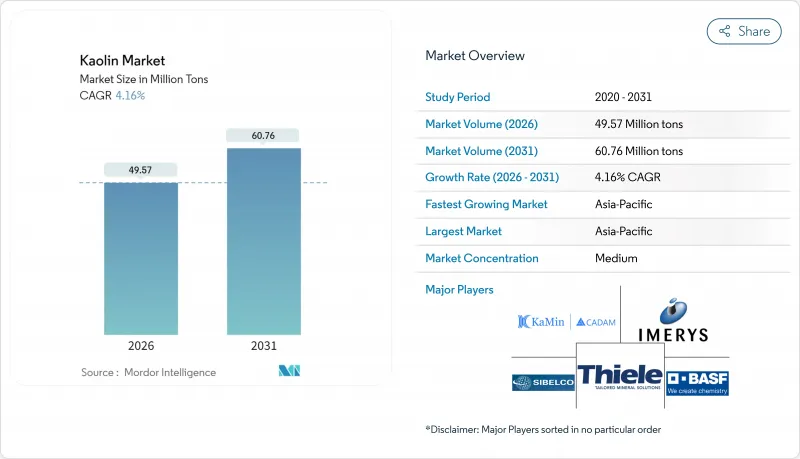
카올린 시장은 2025년 4,759만 톤에서 2026년에는 4,957만 톤으로 성장하여 2026-2031년에 걸쳐 CAGR 4.16%로 성장할 것으로 보이며, 2031년까지 6,076만 톤에 이를 것으로 예측되고 있습니다.
전통적인 세라믹스 분야에서 배터리 분리막, 특수 용지, 클린 라벨 화장품으로 수요가 확대되고 있으며, 이들 모두는 카올린의 밝은 백색도, 화학적 불활성, 낮은 전기 전도성을 높이 평가합니다. 아시아태평양 지역의 생산 능력 증설, 북미 및 유럽에서의 고급 포장재 등급 수요 증가, 전기차 배터리용 소성 제품에 대한 투자가 긍정적인 전망을 강화하고 있습니다. 통합 채굴, 에너지 효율적인 소성 공정, 응용 분야별 가공 기술을 보유한 생산업체들은 다년간 공급 계약을 확보하고 있습니다. 성숙 지역의 연료 가격 상승과 복잡한 광산 허가 절차로 인한 단기적 비용 압박이 전반적인 성장 추세를 다소 누그러뜨리고 있지만, 대부분의 최종 사용 부문은 가시적인 성능 우위를 제공하는 분야에서 계속해서 카올린으로 대체하고 있습니다.
중국, 인도, 베트남, 인도네시아에서 도시화와 주거 시설 업그레이드가 가속화되며 대규모 신규 타일 및 위생도기 생산이 촉진되고 있습니다. 국내 제조사들은 일관된 미적 기준을 달성하기 위해 고백도 카올린이 필요한 대형 포세린 패널 소성 능력을 갖춘 가마 규모를 확대하고 있습니다. 지역 제조업체들은 또한 투입 비용을 제한하고 납품 주기를 단축하기 위해 현지 공급망을 선호하여 광시, 푸젠, 구자라트 주의 카올린 광산과 장기 공급 계약을 체결하고 있습니다. 현대식 터널 가마 설계는 소성 균일성을 개선하지만 유변학 및 열 안정성에 대한 사양 기준을 높여 카올린 등급의 프리미엄화를 뒷받침합니다. 주택 착공 및 공공 인프라를 장려하는 정부 정책은 세라믹스 공급망을 더욱 견고히 하여 카올린 시장 전반에 걸쳐 꾸준한 수요 유입을 보장하고 있습니다.
브랜드 소유자들은 미표백 크라프트 외포장과 밝은 흰색 또는 파스텔 톤 내포장을 조합하여 전자상거래 택배를 차별화함으로써 언박싱 경험을 향상시키고 있습니다. 이 디자인 트렌드는 재활용성을 저해하지 않으면서 높은 불투명도를 제공하는 코팅 안료로서 초미세 카올린의 소비를 증가시킵니다. 제지 공장들은 블레이드 코터 섹션의 병목 현상을 해소하고 분산 시스템을 업그레이드하여 더 미세한 입자 분포를 처리하고 있습니다. 인터내셔널 페이퍼의 DS 스미스 인수 합의와 같은 통합 활동은 부가가치 포장 틈새 시장으로의 전략적 전환을 보여주며 특수 카올린 생산자와의 긴밀한 공급 관계를 강화합니다. 일관된 고휘도 등급을 조달하지 못하는 제지사는 수율 손실과 코팅 결함 위험에 직면하며, 이는 프리미엄 보드 생산에서 카올린의 핵심적 역할을 공고히 합니다.
소성 공정에서는 650℃에서 1,200℃의 온도가 필요하고, 연료비가 주요한 비용 요인이 됩니다. 유럽의 천연가스 가격은 2024년부터 2025년까지 급등했고, 지역 생산자의 현금 비용 곡선을 두 자리로 증가했습니다. 플래시 칼크스 및 로타 칼크스 소성 설계는 체류 시간을 최대 30% 단축하여 현열을 회수합니다만, 라인당 약 1,500만 달러에 육박하는 자본 예산이 도입을 통합형 대기업으로 한정하고 있습니다. 칼릭스사는 CO2 배출 강도를 30% 삭감하는 전력 구동 간접 소성의 파일럿 시험을 실시했지만, 상업 규모의 처리 능력은 현재도 평가 중입니다. 저비용 연료나 공정혁신이 없는 중소광산기업은 이익률의 압축 리스크에 직면하고 있어 카올린 시장에서의 통합이 촉진될 전망입니다.
2025년 가공 카올린은 카올린 시장의 69.35%를 차지하며, 고급 세라믹, 고광택 용지 및 공학용 폴리머 분야에서 필수적임을 입증했습니다. 선광 공정(선별, 자력분리, 부상, 화학적 표백)을 통해 ISO 90 이상의 밝기를 구현하고 이산화티타늄 및 철 불순물을 제거합니다. 최종 사용자는 이러한 특성으로 인해 원토에 비해 우수한 성능 기준을 반영하여 프리미엄 가격을 지불합니다. 가공 등급의 카올린 시장 규모는 배터리 분리막 코팅 및 에너지 효율적 건축에 사용되는 단열 모르타르 분야의 시장 침투 확대와 함께 성장할 것으로 전망됩니다.
아시아의 세라믹 클러스터가 현지 위탁 가공업체에 트리밍 및 미세 분쇄를 아웃소싱함에 따라 원료/미가공 점토는 2031년까지 연평균 4.72% 성장할 것으로 전망됩니다. 태국과 말레이시아의 생산자들은 물류 비용을 통제하기 위해 광상 근처에 기초 세척 공장을 함께 설치하고 있습니다. 지역 가공업체들이 기둥 부양법 및 고경사도 자기분리기에 투자함에 따라 원료 공급의 일부가 점차 반제품 및 완제품으로 전환되어 카올린 시장 내 가치 사슬 상향 이동이 강화될 전망입니다.
카올린 시장 보고서는 형태별(원시 카올린/가공 카올린), 등급별(수화 카올린, 소성 카올린, 박리 카올린, 기타), 용도(도자기, 시멘트, 종이, 내화물, 페인트 및 코팅, 플라스틱, 기타), 지역(아시아태평양, 북미, 유럽, 남미, 중동 및 아프리카)별로 시장 예측은 수량(톤) 기준으로 제공됩니다.
아시아태평양 지역은 2025년 카올린 시장의 42.55%를 차지했으며, 2031년까지 연평균 4.70%의 성장률을 기록할 전망입니다. 중국은 광둥성과 산둥성에 통합 타일 생산 거점을 구축하며 지역 수요를 주도하고 있으며, 인도는 모르비와 라자스탄에 위생도기 생산 클러스터를 확장하고 있습니다. 정부 인프라 프로그램과 꾸준한 수출 주문이 가마 가동률을 유지하여 수화 및 소성 등급에 대한 지속적인 수요를 보장합니다. 베트남과 인도네시아를 중심으로 한 동남아시아의 생산 능력 증가는 지역 내 교역을 심화시키고 아시아의 선도적 위치를 강화합니다.
북미는 성숙하면서도 기술적으로 선진적인 거점입니다. 미국에서는 2025년에 711만 톤의 카올린이 채굴되었으며, 대부분은 조지아의 백악기 퇴적층에서 생산되었습니다. 전지용 소성 카올린 공장에 대한 투자는 기존의 철도 및 항만 인프라를 활용해 중요 광물공급지내화를 서두르는 국내 기가팩토리를 목표로 하고 있습니다. 환경 규제에 따라 기본 조업 비용이 상승했기 때문에 생산자는 조업 허가를 유지하기 위해 재생식 열산화 장치와 폐 루프식 물 순환 시스템의 도입을 진행하고 있습니다.
유럽에서는 체코 공화국과 영국에 고순도 광상이 존재합니다. EU 배출량 거래제도 하에서의 탄소정책 강화에 의해 저에너지 가공법의 탐구가 가속화되고 있습니다. 생산자는 건조기의 부분 전기와 버너 라인에 바이오 매스 사용을 모색 중입니다. 특수 용도(고도 내화물, 여과재, 그린 시멘트)가 종래의 종이 수요의 감속을 상쇄하고 있습니다.
브라질을 중심으로 남미가 핵심 수출 거점으로 부상 중입니다. 핵심 광물 채굴에 대한 정부 인센티브와 대서양 해운로 근접성이 카올린의 국가 광산 생산 기여도를 뒷받침합니다. 바히아에 건설 중인 세계 최대 활성 점토 공장은 현지 고령토 원료를 활용해 저탄소 시멘트 첨가제를 생산할 예정입니다. 북미 및 유럽 시장에서의 경쟁력 있는 납품 비용 구조는 브라질의 전략적 중요성을 강화합니다.
중동 및 아프리카은 작은 규모의 성장을 계속하고 있습니다. 사우디아라비아의 「비전 2030」중공업 다각화 정책과 남아프리카공화국의 세라믹 타일 산업 확대 계획이 수요 증가를 뒷받침합니다. 모로코와 이집트는 백색 시멘트 및 내화물용 카올린 자원을 평가 중이며, 이는 향후 상류 부문 개발 가능성을 시사합니다. 제한된 국내 선광 능력으로 인해 중간 또는 완제품 등급 수입이 지속되며, 이는 카올린 시장 내 세계의 무역 흐름을 유지합니다.
The Kaolin Market market is expected to grow from 47.59 Million tons in 2025 to 49.57 Million tons in 2026 and is forecast to reach 60.76 Million tons by 2031 at 4.16% CAGR over 2026-2031.
Demand is widening from traditional ceramics into battery separators, specialty papers, and clean-label cosmetics, all of which prize kaolin's brightness, chemical inertness, and low electrical conductivity. Capacity additions in Asia Pacific, a push for premium packaging grades in North America and Europe, and investments in calcined products for electric-vehicle batteries are reinforcing the positive outlook. Producers with integrated mining, energy-efficient calcination, and application-specific processing technologies are securing multi-year supply agreements. Short-term cost pressure from rising fuel prices and complex mine-site permitting in mature regions is tempering the overall growth trajectory, yet most end-use segments continue to substitute toward kaolin where it offers demonstrable performance advantages.
Rising urbanization and residential upgrades are stimulating vast new tile and sanitary-ware output across China, India, Vietnam, and Indonesia. Domestic producers are scaling kilns capable of firing large-format porcelain panels that require high-whiteness kaolin to achieve consistent aesthetic standards. Regional manufacturers also favor local supply chains to limit input costs and shorten delivery cycles, spurring long-term offtake pacts with kaolin mines in Guangxi, Fujian, and Gujarat. Modern tunnel-kiln designs improve firing uniformity but raise specification thresholds for rheology and thermal stability, supporting the premiumization of kaolin grades. Governments encouraging housing starts and public infrastructure are further underpinning the ceramics pipeline, ensuring steady pull-through demand across the kaolin market.
Brand owners are differentiating e-commerce parcels with unbleached kraft outers paired with bright white or pastel inner liners that elevate the unboxing experience. This design trend increases the consumption of ultra-fine kaolin as a coating pigment that delivers high opacity without impairing recyclability. Paper mills are debottlenecking blade-coater sections and upgrading dispersion systems to handle finer particle distributions. Consolidation activities-such as International Paper's agreement to acquire DS Smith-demonstrate a strategic pivot toward value-added packaging niches and reinforce tight supply relationships with specialty kaolin producers. Mills unable to source consistent high-brightness grades risk yield losses and coating defects, cementing kaolin's central role in premium board production.
Calcination requires temperatures from 650 °C to 1 200 °C, making fuel costs a major input. European natural gas prices surged in 2024-2025, swelling cash-cost curves for regional producers by double digits. FlashCalx and RotaCalx firing designs cut residence time by up to 30% and recover sensible heat, yet capital budgets near USD 15 million per line limit adoption to integrated majors. Calix Limited has piloted electric-powered indirect calcination that reduces CO2 intensity by 30%, but commercial throughput remains under evaluation. Smaller miners without low-cost fuel or process innovation risk margin compression, encouraging consolidation within the kaolin market.
Other drivers and restraints analyzed in the detailed report include:
For complete list of drivers and restraints, kindly check the Table Of Contents.
Processed kaolin captured 69.35% of the kaolin market in 2025, underpinning its indispensability in premium ceramics, high-gloss papers, and engineered polymers. Beneficiation stages-screening, magnetic separation, flotation, and chemical bleaching-lift brightness above 90 ISO and pare down titania and iron impurities. End-users pay a premium for these attributes, reflecting the superior performance threshold relative to crude clay. The kaolin market size for processed grades is forecast to climb alongside deeper penetration in battery separator coatings and in thermal-insulation mortars used in energy-efficient construction.
Crude/unprocessed clay is projected to advance at 4.72% CAGR through 2031 thanks to ceramic clusters in Asia outsourcing trimming and micronizing to local toll processors. Producers in Thailand and Malaysia are co-locating rudimentary washing plants near deposits to control logistics costs. As regional processors invest in column flotation and high-gradient magnetic separators, a share of crude supply will progressively shift to semi-finished and finished material, reinforcing a gradual migration up the value chain within the kaolin market.
The Kaolin Market Report is Segmented by Form (Crude/Unprocessed Kaolin and Processed Kaolin), Grade (Hydrous Kaolin, Calcined Kaolin, Delaminated Kaolin, and Others), Application (Ceramics, Cement, Paper, Refractories, Paints and Coatings, Plastics, and Others) and Geography (Asia-Pacific, North America, Europe, South America, and Middle East and Africa). The Market Forecasts are Provided in Terms of Volume (tons).
Asia Pacific commanded 42.55% of the kaolin market in 2025 and is on track for 4.70% CAGR through 2031. China anchors regional demand with its integrated tile corridors in Guangdong and Shandong, while India scales sanitary-ware clusters in Morbi and Rajasthan. Government infrastructure programs and steady export orders sustain kiln utilization rates, ensuring consistent pull for hydrous and calcined grades. Southeast Asian capacity additions, notably in Vietnam and Indonesia, deepen intra-regional trade and reinforce Asia's leading position.
North America constitutes a mature yet technologically advanced hub. The United States mined 7.11 million tons of kaolin in 2025, largely from Georgia's Cretaceous deposits. Investments in battery-grade calcined kaolin plants leverage existing rail and port infrastructure, targeting domestic gigafactories eager to localize critical mineral supply. Environmental regulations elevate baseline operating costs, prompting producers to adopt regenerative thermal oxidizers and closed-loop water circuits to safeguard operating permits.
Europe offers high-purity reserves in the Czech Republic and United Kingdom. Tightening carbon policy under the EU Emissions Trading System accelerates the search for low-energy processing methods. Producers explore partial electrification of dryers and the use of biomass in burner lines. Specialty applications-advanced refractories, filtration media, and green cement-offset headwinds from conventional paper demand.
South America, led by Brazil, is emerging as a pivotal export base. Government incentives for critical mineral extraction and proximity to Atlantic shipping lanes underpin kaolin's contribution to national mining output. The world's largest activated clay plant under construction in Bahia will tap local kaolin feedstock to produce low-carbon cement additives. Competitive delivered-cost positions into North America and Europe reinforce Brazil's strategic relevance.
The Middle East and Africa remain smaller but growing. Saudi Arabia's Vision 2030 heavy-industrial diversification and South Africa's ceramic tile ambitions underpin incremental demand. Morocco and Egypt evaluate kaolin resources for white cement and refractories, hinting at future upstream development. Limited domestic beneficiation drives imports of intermediate or finished grades, sustaining global trade flows within the kaolin market.