



마이크로그린 시장은 2025년 30억 달러로 평가되었고, 2026년 33억 4,000만 달러에서 2031년까지 57억 1,000만 달러에 이를 것으로 예측됩니다.
예측기간(2026-2031년)의 CAGR은 11.32%로 예상됩니다.

지속적인 수요는 영양가가 높은 농산물을 요구하는 소비자, 고수량 실내 시스템으로의 전환을 진행하는 생산자, 신선한 식품 매장의 차별화를 도모하기 위해 프리미엄 마이크로그린 구색을 확충하는 소매 업체에 의해 뒷받침됩니다. 특정 품종이 성숙품에 비해 5-40배의 비타민 및 항산화물질 함량을 가진다는 사실을 뒷받침하는 과학적 발견에 의해 마이크로그린 시장은 기능성 식품 분야에서의 확고한 지위를 유지하고 있습니다. 기술의 융합도 성장을 뒷받침하고 있으며, AI 제어 LED 조명에 의한 레시피는 최대 32%의 에너지 절약을 실현하고, 수직형 재배 시스템은 야외 생산량의 최대 390배의 생산 밀도를 달성하고 있습니다. 공급망의 단축과 폐기물 저감을 도모하는 지역 밀착형 전략이 경제적 매력을 더욱 강화하고 있으며, 2026년에 예정되어 있는 월면 농업 시험은 지상에서의 정밀 재배 기술 개발의 촉매가 되고 있습니다. 종합적으로 볼 때, 마이크로그린 시장은 제어환경 농업 분야 전체를 뛰어넘는 성장을 계속해 향후 수년에 걸쳐 2자리대 성장을 유지할 전망입니다.
콩류 마이크로그린은 100g 당 80.45mg의 아스코르브산(비타민 C)을 공급하며 이는 성숙한 식물의 함량을 크게 초과합니다. 또한 8-21일의 성장주기로 연중 수확이 가능합니다. 미량 영양소 부족에 직면하는 도시 인구는 이러한 고농도 제품을 프리미엄 가치로 간주합니다. 의료 전문가는 예방 의료 예산에 맞는 기능성 식품을 추천할 때 마이크로그린을 점점 언급하고 있습니다. 고령화가 진행되는 인구구성은 입증된 영양에 투자할 의도가 있는 고객층을 확대하고 있습니다. 일상적인 섭취와 심혈관 기능 및 혈당 수치 개선과의 관련성을 보여주는 연구 결과는 건강 지향 구매층에서 반복 구매를 촉진하고 있습니다. 이러한 요인들이 더해 영양 옹호 동향을 형성하며 이는 마이크로그린 시장의 핵심입니다.
아랍에미리트(UAE)가 5년 이내에 500개 이상의 수직 농장을 전개하고자 하는 계획은 2030년까지 62억 달러의 성장 여지를 시사하고 있으며, 마이크로그린은 짧은 주기를 이용하여 주력 작물로 자리매김하고 있습니다. 네덜란드의 혁신기업인 PlantLab은 2024년 2천만 유로(2,000만 달러)의 자금 조달을 완료하여 유럽에서 생산 능력을 확대하였고 이는 투자자들이 확장 가능한 모델을 확신하고 있음을 뒷받침하고 있습니다. IoT 센서는 식물 수준에서 습도, CO2 농도, 기류를 조정하여 수확량의 안정성을 높이면서 인건비를 줄이고 있습니다. 신재생에너지 구동 냉각장치와 열교환 루프는 라이프사이클 비용을 개선하고 탄소 실적에 대한 우려에도 대응하고 있습니다. 식품 수송 거리의 단축을 목적으로 한 지자체의 우대조치가 도심부에서의 생산 경제성을 더욱 뒷받침하고 있습니다. 이러한 요소들이 더해 성숙 시장과 신흥 시장 양쪽에서 생산능력 확대의 견고한 기반을 구축하고 있습니다.
스프라우트 유래의 살모넬라균 및 대장균의 집단 발생은 규제 당국의 유사 생산 방법에 대한 인식에 영향을 미치고 있습니다. 그러나 1998년부터 2017년까지 마이크로그린 유래 질병에 대한 보고는 확인되지 않았습니다(extension.unr.edu). 2024년에 시행된 FDA의 유기농업규제 강화로 문서화된 위험 분석 계획과 로트 단위의 추적성이 의무화되어 컴플라이언스 비용이 증가하고 있습니다. 생산자는 현재 오염을 예방하기 위해 항균성 근군역 세정제와 UV-C 캐빈 터널을 도입하고 있습니다. GlobalGAP 및 SQF와 같은 인증은 소매 유통에 대한 실질적인 절차가 되었습니다. 농장 내 자동화는 인적 접촉점을 줄이고 과실 발생 가능성을 줄입니다. 게다가, 우주 공간에서의 작물 위생 프로토콜(초기에는 궤도 상의 영양막 재배 기술용으로 고안)이 지상 농장에 피드백되어 검증된 병원체 관리 수법을 제공합니다.
마이크로그린 시장 규모에서 브로콜리 마이크로그린은 2025년 수익의 27.45%를 차지했습니다. 이는 고가격대를 형성하는 총 페놀류 함유량(825.53mg GAE/100g)에 의해 뒷받침되었습니다. 루콜라는 14.70%의 점유율을 유지하였으며 요리사가 샐러드와 피자에 선호하는 매운 맛을 위한 수요로 뒷받침되었습니다. 래디쉬계는 21.10%를 차지하였고, 특히 수경재배 채널로 발아 속도를 높여 고밀도 재배를 가능하게 하고 있습니다.
바질 마이크로그린은 요리에서의 친숙함과 소매 고객이 즉시 인식하는 방향성의 강도를 반영하여 예측 CAGR 14.57%로 성장을 견인할 전망입니다. 양상추와 치커리는 12.55%의 점유율을 차지하였으며 처음 구입하는 소비자에게 부드러운 맛을 제공합니다. 회향, 완두콩, 시금초, 그리고 여전히 논란 가운데 있는 헴프 마이크로그린과 같은 특수 품목이 SKU의 다양성을 유지하고 새로운 시도를 뒷받침하고 있습니다. 지속적인 품종 개량과 종자 제조업체와의 연계에 의해 매 시즌 새로운 재배 사이클이 개시되어 소비자의 호기심을 유지하고 가격 안정성을 유지하고 있습니다.
2025년 실내 농장은 마이크로그린 시장의 45.30%를 차지했습니다. 이는 균일한 CO2 농도, 조명, 양분공급을 실현하는 기후제어실에 의해 뒷받침되었습니다. 이러한 환경은 식감이 균일하고 색조가 안정된 잎을 생산하고 SKU 수준에서 예측 가능성을 요구하는 소매업체에게 필수적입니다.
수직 농장은 평방 피트당 생산량을 증가시켜 2031년까지 19.74%라는 가장 높은 CAGR을 나타낼 전망입니다. 애리조나에 위치한 오토 스토어와 원포인트 원의 완전 자동화 시설에서는 트레이를 입방 격자 모양으로 배치하고 15일 후에 제품을 수확합니다. 이 방법은 야외 재배에 비해 95%의 절수를 실현하고 있습니다. 반투명 지붕 아래에 계층화된 타워를 쌓아 올리는 하이브리드 온실은 설비 투자 금액을 상쇄하기 때문에 중견 투자자에게 매력적입니다. 한편, 컨테이너형 농장은 식료품점의 창고나 캠퍼스 내 식당에서의 생산을 실현하여 라스트마일 과제를 줄입니다.
아시아태평양은 성장의 견인역으로 도시화와 소득 향상, 정부의 식량 안보 분위기 조성이 결합되어 2031년까지 연평균 복합 성장률(CAGR) 12.85%를 기록할 전망입니다. 중국의 1조 3,400억 달러 규모의 과일 및 채소 시장은 거대한 성장 여지를 제공하고 있으며, 상하이와 심천의 메가시티에서는 현재 수직 농장을 시가지에 배치해 수송 시간을 단축하는 파일럿 사업이 진행되고 있습니다. 싱가포르는 하이테크 실내 시설을 운영하여 마이크로그린을 말레이시아와 인도네시아에 수출하고 있으며, 나라를 지역의 혁신 거점으로 확립하고 있습니다. 호주는 가뭄과 염해에 대한 우려로 도시 주변 지역에서 태양광 발전 온실 클러스터를 지원하고 있습니다. 한편 인도의 방갈로르 지역에서는 호텔 체인용 저설비투자형 랙식 농장이 주류가 되고 있습니다.
북미는 2025년 시점에서 마이크로그린 시장 규모의 42.40%를 차지해 최대의 기여도를 유지했습니다. 이는 소매 분야에서의 침투가 진행되고 외식 산업 수요가 견조하다는 것을 반영합니다. AeroFarms, Gotham Greens, Bowery Farming 등의 사업자는 수천 곳의 점포에 제품을 공급하고 있으며, GoodLeaf는 새로운 자금 조달에 의해 캐나다 국내에서 2,700개 점포로 취급점을 확대했습니다. 멕시코는 전력 비용이 낮고 미국 바이어와 근접한 특성을 살려 크로스보더 병목 현상을 피하는 합작 공급 계약을 확보하고 있습니다. 유기농 수경 재배에 관한 지역 규제의 명확화는 프리미엄 포지셔닝을 뒷받침하고 있지만, 기준의 단편화가 주간 물류의 과제가 되고 있습니다. 유럽에서는 도시농업보조금과 탄소국경조정제도가 현지 생산을 뒷받침해 8.05%의 연평균 복합 성장률(CAGR)로 진전하고 있습니다. 네덜란드의 선도기업 플랜트랩은 완전 밀폐형 '식물 생산 유닛'의 개발을 실시 중이며, 독일에서는 재생에너지 크레딧이 온실 에너지 투입을 상쇄하고 있습니다. 이탈리아의 농장 직송 레스토랑에서는 마이크로그린을 곁들인 요리가 음식 관광객에게 호평을 받고 있습니다. 2025년부터 시행되는 EU 유기농 인증의 디지털화는 슈퍼마켓에 지역 내 조달을 촉진하는 소프트 무역 장벽이 될 수 있습니다. 한편, 중동에서는 국가기금자본이 동원되었으며 2024년 퓨어하베스트사는 기후 변화에 강한 시설 건설을 위해 1억 8,050만 달러를 조달하였습니다. 아프리카에서는 2차 도시로 콜드체인 회랑이 확대되고, 11.10%의 성장률로 시장 확대가 시작되고 있습니다.
The microgreens market was valued at USD 3.0 billion in 2025 and estimated to grow from USD 3.34 billion in 2026 to reach USD 5.71 billion by 2031, at a CAGR of 11.32% during the forecast period (2026-2031).
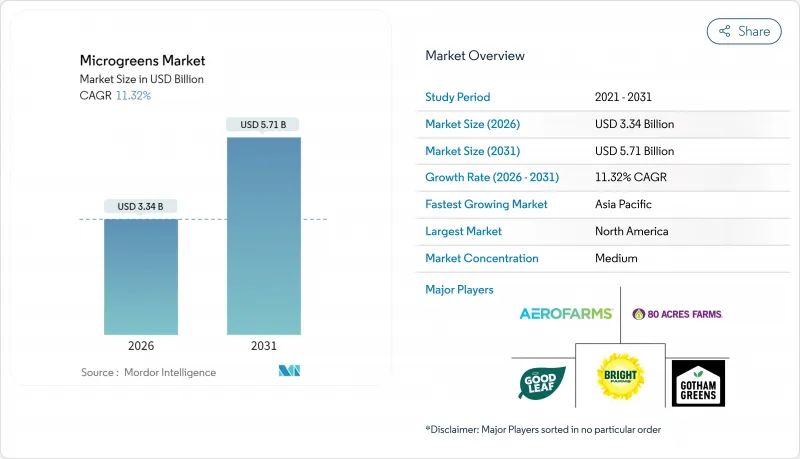
Sustained demand stems from consumers seeking nutrient-dense produce, producers upgrading to high-yield indoor systems, and retailers adding premium microgreen assortments to differentiate fresh-food aisles. Scientific evidence confirming that certain varieties hold 5-40 times the vitamin and antioxidant content of their mature counterparts keeps the microgreens market firmly positioned within functional foods. Technology convergence is another lift: AI-directed LED recipes are delivering energy savings close to 32% while vertical stacks achieve production densities up to 390-fold above field output. Localization strategies that shorten supply chains and reduce spoilage further reinforce the economic appeal, and lunar agriculture trials scheduled for 2026 are catalyzing new precision-growing tools for terrestrial use. Altogether, the microgreens market continues to outpace broader controlled-environment agriculture segments and is on track for another multi-year run of double-digit expansion.
Bean microgreens supply 80.45 mg/100 g of ascorbic acid-well above mature-plant levels-while their 8-21-day growth cycle supports year-round harvests. Urban dwellers facing micronutrient gaps view this concentration as worth a premium. Healthcare professionals increasingly cite microgreens when recommending functional foods that dovetail with preventive health budgets. Aging demographics magnify the pool of customers willing to invest in proven nutrition. Peer-reviewed links between routine intake and improved cardiovascular as well as glycemic markers spur repeat purchases among wellness-minded buyers. Together, these factors keep nutrition advocacy central to microgreens market messaging.
The UAE's plan to deploy more than 500 vertical farms inside five years signals a USD 6.2 billion upside by 2030, with microgreens positioned as anchor crops thanks to quick cycles. Dutch innovator PlantLab closed EUR 20 million (USD 20 million) in 2024 to widen European capacity, underscoring investor belief in scalable models. IoT sensors now adjust humidity, CO2, and airflow at the plant level, raising yield consistency while shrinking labor. Renewable-powered chillers and heat-exchange loops improve lifetime operating costs and answer carbon-footprint critiques. Municipal incentives that target food-miles reduction further tilt economics in favor of city-center production. Collectively, these inputs build a durable foundation for capacity expansion across both mature and emerging markets.
Sprout outbreaks of Salmonella and E. coli color regulators' perception of similar production methods, even though no microgreens illnesses were logged from 1998-2017 extension.unr.edu. The FDA's stronger organic enforcement, activated in 2024, adds documented hazard-analysis plans and lot-level traceability, raising compliance costs. Growers now deploy antimicrobial root-zone washes and UV-C cabin tunnels to pre-empt contamination. Certifications such as GlobalGAP and SQF have become de facto tickets to retail distribution. On-farm automation reduces human touchpoints, cutting the probability of lapses. In parallel, space-crop sanitation protocols-originally devised for nutrient film technique in orbit-feed back to earth farms, offering validated pathogen-control blueprints.
Other drivers and restraints analyzed in the detailed report include:
For complete list of drivers and restraints, kindly check the Table Of Contents.
Broccoli microgreens controlled 27.45% of 2025 revenue within the microgreens market size, buoyed by 825.53 mg GAE/100 g total phenolics that support premium price points. Arugula retains a 14.70% share, leveraging its peppery kick that chefs prize for salads and pizzas. Radish lines capture 21.10%, especially in hydroponic channels, where quick germination validates aggressive planting densities.
Basil microgreens headline growth with a forecast 14.57% CAGR, reflecting culinary familiarity and aromatic punch that retail shoppers recognize quickly. Lettuce and chicory add 12.55%, offering gentle flavors that help first-time buyers. Specialty entries, fennel, pea, sorrel, and the still-controversial hemp microgreen, keeping SKUs dynamic and inviting experimentation. Continuous breeding and seed-house collaborations open fresh cultivar cycles every season, keeping consumer curiosity alive and pricing resilient.
Indoor farms held 45.30% microgreens market share in 2025, anchored by climate-tight rooms that deliver uniform CO2, lighting, and nutrient flow. These conditions produce leaves with consistent texture and color, vital for retailers who demand SKU-level predictability.
Vertical farms promise the fastest 19.74% CAGR through 2031 by multiplying square-foot output. AutoStore and OnePointOne's fully robotic Arizona site packs trays into cubic lattices and snips product after 15 days, using 95% less water than field cultivation. Hybrid greenhouses that stack tiered towers beneath translucent roofing split the difference on capex, appealing to mid-tier investors. Meanwhile, container farms allow on-premise production at grocery backlots and campus food halls, shrinking last-mile challenges.
The Microgreens Market Report Segments the Industry Into Type (Broccoli, Lettuce and Chicory, Arugula, Basil, Fennel, and More), Farming (Indoor Farming, Vertical Farming, and More), Growth Medium (Peat Moss, Soil, Coconut Coir, and More), Distribution Channel (Hypermarkets/Supermarkets, Restaurants, and More) and Geography (North America, Europe, Asia-Pacific, and More). The Market Forecasts are Provided in Terms of Value (USD).
Asia-Pacific is the growth engine, logging a 12.85% CAGR through 2031 as urbanization and rising incomes align with government food-security grants. China's USD 1.34 trillion fruit-and-vegetable economy offers a vast runway, and megacity pilots in Shanghai and Shenzhen now place vertical farms within city blocks to slash travel time. Singapore operates high-tech indoor hubs that export microgreens to Malaysia and Indonesia, cementing the city-state as a regional innovation lab. Australia, spurred by drought and salinity concerns, backs solar-powered greenhouse clusters in peri-urban zones, while India's Bengaluru cluster champions low-capex rack farms aimed at hotel chains.
North America retained the largest contribution to the microgreens market size at 42.40% in 2025, reflecting mature retail penetration and robust food-service demand. Operators like AeroFarms, Gotham Greens, and Bowery Farming serve thousands of stores, and fresh financing helped GoodLeaf add 2,700 Canadian doors. Mexico leverages lower power costs and proximity to U.S. buyers, securing joint-venture supply agreements that bypass cross-border bottlenecks. Regional regulatory clarity on organic hydroponics supports premium positioning, although fragmented standards still challenge interstate logistics. Europe is advancing at an 8.05% CAGR on the back of urban-agriculture subsidies and carbon-border adjustments that favor local production. Dutch pioneers such as PlantLab iterate on fully enclosed "Plant Production Units," while Germany's renewable-energy credits offset greenhouse inputs. Italy's farm-to-table restaurants tout microgreens-topped dishes to culinary tourists. EU organic certificate digitization, active from 2025, may erect soft trade barriers that push supermarkets to source within the bloc. Elsewhere, the Middle East marshals sovereign-wealth capital, evidenced by a USD 180.5 million Pure Harvest raise in 2024 to build climate-tough facilities, and Africa is starting its 11.10% ascent as cold-chain corridors reach secondary cities.