


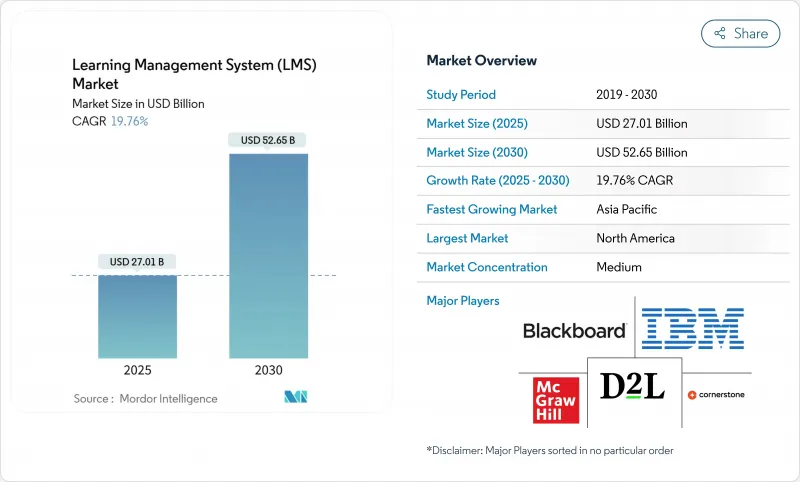
학습 관리 시스템(LMS) 시장의 2025년 시장 규모는 270억 1,000만 달러, 2030년에는 526억 5,000만 달러로 상승해 CAGR 19.76%를 나타낼 것으로 예측되고 있습니다.
각 분야의 기업은 복잡한 컴플라이언스 의무에 대응하면서 직원의 기술을 최신으로 유지하기 위해 AI를 활용한 개인화, 마이크로 자격인증, 모바일 학습에 투자하고 있습니다. 북미의 헬스케어와 금융 서비스 기업은 여전히 조기 도입 기업이지만, 아시아태평양의 제조 거점은 현재 디지털 학습을 측정 가능한 생산성 향상에 연결함으로써 수요 증가를 견인하고 있습니다. 기술 공급업체는 예측 분석, 세분화된 기술 검증, 일상적인 워크플로우에 교육을 통합하기 위한 로우코드 통합을 지원합니다. 동시에 SaaS 라이선스 수수료의 상승과 마일리지 연결 간의 갭이 예산에 민감한 부문을 억제하기 때문에 공급업체는 가격 및 컨텐츠 배포 최적화를 개선해야 합니다.
AI를 활용한 어댑티브 시스템은 난이도, 페이스 배분, 피드백을 실시간으로 조정하여 북미 대학의 시험 프로그램에서 코스 수료율을 40% 향상시켰습니다. 알고리즘이 작업에 걸리는 시간, 평가 점수, 클릭 스트림 데이터를 분석하여 학습 의욕의 저하를 예측하고 학습자를 궤도에 태우는 목표를 좁힌 개입을 실시합니다. 기업은 학습 목표를 주요 성과 평가 지표에 직접 연결하여 입문에 소요되는 시간을 단축하고 인증 자격 합격률을 높이기 위해 이 실천을 반영합니다. 설명 가능한 AI를 포함하는 공급업체는 인증 감사 시 알고리즘 결정을 옹호해야 하는 교육 관계자로부터 신뢰를 얻고 있습니다. 기능 세트가 성숙함에 따라 고객은 맞춤형 데이터 사이언스 프로젝트가 아닌 플러그 앤 플레이 추천 엔진을 기대하게 되어 중견 시장 구매자의 채택을 단순화합니다.
아시아태평양의 제조업은 급속한 자동화 사이클에 직면하여 로봇 공학, 품질 관리, 공급망 분석 등의 능력을 증명하는 한입 크기의 자격이 선호되고 있습니다. 설문조사에 따르면 고용자의 86%가 응모자를 평가할 때 마이크로 자격 증명이 유익하다고 평가하고 있으며, 노동자들은 이러한 배지를 점진적으로 쌓아 역동적인 스킬 포트폴리오를 만들고 있습니다. 블록체인 검증은 채용 관리자가 즉시 인증할 수 있는 변조 방지 기록을 보장하고 채용 사이클을 단축합니다. 임팩트의 증거가 확산됨에 따라 북미 전문가 단체는 배지와 지속 교육 크레딧을 매핑하기 시작하여 자격 증명 모델을 규제 직업으로 확장합니다.
유행원 구호를 위한 보조금이 감소하는 가운데, 학습자 1인당 정기적인 비용이 치솟고, 유치원에서 고등학교까지의 교육기관은 다년간의 LMS 계약을 검토할 필요가 있습니다. 학생 수 2만명의 지구에서는 2025년에 연간 갱신료가 14% 상승하는 것으로 보고되어 있으며, 정체되는 운영 예산을 상회하고 있습니다. 오픈소스의 대안으로 축발을 옮기는 곳도 있지만, 셀프 호스팅이나 유지 보수에 숨겨진 비용이 있다는 것을 알고, 현금 지출과 관리 부담의 트레이드 오프가 부각됩니다. 공급업체는 활성 사용자의 지표와 연계된 단계적 가격으로 대응하지만 투명성에 일관성이 없기 때문에 조달 주기가 장기화되고 있습니다.
2024년의 수익 점유율은 솔루션이 67%로 압도적이었으며, 학습 관리 시스템(LMS) 시장에서 플랫폼 라이선스의 중요성이 부각되었습니다. 그러나 서비스 부문은 21.3%의 연평균 복합 성장률(CAGR)을 나타낼 전망입니다. 핵심 플랫폼을 이미 도입한 조직은 현재 교육 설계 지원, 시스템 통합 및 분석 최적화를 요구하고 있습니다. 사례 연구에 따르면 공급망 기업은 컨텐츠 매핑을 전문 에이전시로 아웃소싱한 후 코스 개발을 30% 가속화했습니다. AI 기능이 보급됨에 따라 사내 팀은 알고리즘을 조정하기 위한 지침을 필요로 하며 전문 서비스 제공업체에 새로운 수익 풀이 열립니다. 서비스 분야의 학습 관리 시스템(LMS) 시장 규모는 2025년 81억 1,000만 달러에서 2030년에는 212억 달러로 확대될 것으로 예측됩니다.
솔루션 부서는 거의 평평합니다. 벤더는 상품화를 막기 위해 로우코드 워크플로우 빌더, API 마켓플레이스, 네이티브 비디오 프로덕션 스위트를 중첩합니다. 대규모 구매자는 여러 모듈(저작, 자격 증명, 고급 분석)을 예측 가능한 구독에 번들하는 기업 전체 계약을 협상합니다. 소규모 공급업체는 의료 및 제조 분야의 컴플라이언스 라이브러리가 포함된 수직 템플릿으로 차별화를 도모하고 있습니다. 그 결과, 조달팀은 현재 주요 라이선스 비용이 아니라 5년 단위로 총 소유 비용을 평가하고 있으며, 이 변화는 견고한 생태계 로드맵을 제시할 수 있는 공급업체에게 유리합니다.
클라우드 아키텍처는 2024년 학습 관리 시스템(LMS) 시장 전체의 수익의 70%를 차지했으며 CAGR 22.8%로 계속 확대되고 있습니다. 구매자는 자동 보안 패치, 탄력적인 스케일링 및 IT 오버헤드 감소를 결정적인 요인으로 꼽았습니다. 다국적 기업은 또한 유럽과 아시아의 개인 정보 보호 규정 준수를 단순화하는 지역별 데이터 거주 옵션을 높이 평가합니다. 클라우드 도입 학습 관리 시스템(LMS) 시장 규모는 2025년 189억 달러에서 2030년 434억 달러로 확대될 전망으로 On-Premise로의 전환이 가속화되고 있음을 뒷받침하고 있습니다.
On-Premise의 도입은 방위, 에너지, 공공 부문의 계정에 뿌리 깊게 남아 있으며, 기밀 보호 환경이 스파이 활동의 위험을 완화하고 있습니다. 이러한 조직에서도 사용자 경험과 애널리틱스를 현대화하기 위해 프라이빗 클라우드의 파일럿 테스트를 수행하는 경우가 늘고 있습니다. 공급업체는 민감한 평가 데이터를 로컬 서버에 보관하면서 컨텐츠 리포지토리를 동기화하는 하이브리드 아키텍처를 지원합니다. 그럼에도 불구하고 마켓플레이스의 기세는 매월 새로운 기능을 출시하고 레거시 스위트의 전형적인 연례 업그레이드 사이클을 초과하는 순수한 클라우드 디스랩터를 지원합니다.
북미는 첨단 연결성, 높은 SaaS 대응력, 헬스케어 및 금융에 있어서의 엄격한 컴플라이언스 틀에 힘입어 2024년 세계 매출의 36%를 차지했습니다. 대기업은 현재 최초 도입보다 AI 주도 최적화에 주력하고 있으며 예측형 인재 분석 애드온 수요에 박차를 가하고 있습니다. 노동력 재교육을 목표로 하는 연방 정부와 주 조성금은 커뮤니티 칼리지와 퇴역 군인 훈련 프로그램에서의 플랫폼 채용을 더욱 강화하고 있습니다. 그렇다고는 해도, 유치원아부터 고교생까지의 학구에서는 예산의 정사가 행해지고 있기 때문에 자금 조달 모델이 안정될 때까지는 단기적인 성장은 전망할 수 없습니다.
아시아태평양은 2030년까지 연평균 복합 성장률(CAGR) 24.5%를 나타낼 것으로 예측됩니다. 이는 인도의 디지털 인도계획과 중국의 메이드 인 차이나 2025 정책에 뒷받침된 것으로, 모두 산업의 근대화와 노동력의 스킬업을 연결하고 있습니다. 다국적 제조업체는 각 지역의 공장에서 통일된 트레이닝 기준을 의무화하고 있어, 현지화의 전문 지식을 가지는 벤더가 보상되는 국경을 넘은 LMS의 전개를 만들어 내고 있습니다. ASEAN 시장 전체의 은행 디지털화는 컴플라이언스 교육 라이선스를 더욱 강화하고 있습니다. 그러나 언어의 다양성과 데이터 프라이버시에 관한 법규의 다양성으로 인해 모듈식 도입 전략이 필요합니다.
유럽에서는 GDPR(EU 개인정보보호규정)에 대한 대응과 CPD 규칙이 세밀한 감사 흔적을 가진 플랫폼에 대한 수요를 유발하여 안정적인 확대를 보이고 있습니다. 정부는 LMS의 발판에 의존하는 디지털 실습생에게 자금을 제공하고, 기업은 인구통계학적 기술 부족을 해결하기 위해 학습 스위트를 인력 관리 시스템과 통합하고 있습니다. 중동에서는 GCC 이코노미가 평균을 뛰어넘는 성장을 이루고 있으며, 그곳에서는 국가변혁 아젠다가 디지털 스킬을 우선하고 있습니다. 아프리카에서는 도시 지역에서는 클라우드 LMS의 도입이 급속히 진행되고 있지만 농촌 지역에서는 연결성 문제로 인해 도입이 늦어지고 있습니다.
The learning management system market is valued at USD 27.01 billion in 2025 and is forecast to climb to USD 52.65 billion by 2030, advancing at a 19.76% CAGR.
Enterprises across sectors are investing in AI-powered personalization, micro-credentialing, and mobile learning to keep workforce skills current while meeting increasingly complex compliance mandates. North American healthcare and financial-services organizations remain early adopters, yet Asia-Pacific manufacturing hubs now drive incremental demand by linking digital learning to measurable productivity gains. Technology vendors are responding with predictive analytics, granular skills verification, and low-code integration to embed training into daily workflows. At the same time, rising SaaS licensing fees and last-mile connectivity gaps restrain budget-sensitive segments, forcing vendors to refine pricing tiers and content-delivery optimization.
AI-powered adaptive systems now tailor difficulty, pacing, and feedback in real time, delivering 40% higher course-completion rates for pilot programs in North American universities. Algorithms analyse time-on-task, assessment scores, and click-stream data to forecast disengagement and trigger targeted interventions that keep learners on track. Enterprises mirror this practice to reduce onboarding time and raise certification pass rates, tying learning objectives directly to key-performance indicators. Vendors that embed explainable AI build credibility with educators who must defend algorithmic decisions during accreditation audits. As feature sets mature, customers expect plug-and-play recommendation engines rather than bespoke data-science projects, simplifying adoption for mid-market buyers.
Asia-Pacific manufacturers face rapid automation cycles and therefore favour bite-sized certifications that prove competence in robotics, quality control, and supply-chain analytics. Surveys show 86% of employers rate micro-credentials as beneficial when evaluating applicants; workers progressively stack these badges to create dynamic skill portfolios. Blockchain verification ensures tamper-proof records that hiring managers can authenticate instantly, shortening recruitment cycles. As evidence of impact spreads, professional associations in North America begin mapping badges to continuing-education credits, extending the credentialing model into regulated professions.
Recurring per-learner fees escalate as pandemic relief subsidies taper, forcing K-12 districts to reassess multi-year LMS contracts. Districts with 20,000 students report annual renewals rising 14% in 2025, outpacing stagnant operating budgets. Some pivot to open-source alternatives yet discover hidden costs in self-hosting and maintenance, highlighting a trade-off between cash outlay and administrative burden. Vendors respond with tiered pricing tied to active user metrics, but transparency remains inconsistent, prolonging procurement cycles.
Other drivers and restraints analyzed in the detailed report include:
For complete list of drivers and restraints, kindly check the Table Of Contents.
Solutions generated a dominant 67% revenue share in 2024, underscoring the centrality of platform licences in the learning management system market. The Services segment, however, is racing ahead at a 21.3% CAGR. Organisations that have already deployed a core platform now seek instructional-design support, system integration, and analytics optimisation. Case studies show that supply-chain firms achieved 30% faster course development after outsourcing content mapping to specialist agencies. As AI features proliferate, in-house teams require guidance to calibrate algorithms, opening new revenue pools for professional-services providers. The learning management system market size for Services is projected to rise from USD 8.11 billion in 2025 to USD 21.2 billion by 2030.
The Solutions segment is hardly static. Vendors are layering low-code workflow builders, API marketplaces, and native video-production suites to stave off commoditisation. Larger buyers negotiate enterprise-wide contracts that bundle multiple modules-authoring, credentialing, and advanced analytics-into predictable subscription envelopes. Smaller vendors differentiate through vertical templates that ship with compliance libraries for health and manufacturing domains. Consequently, procurement teams now evaluate total cost of ownership over five-year horizons rather than headline licence fees, a shift that benefits suppliers able to present robust ecosystem roadmaps.
Cloud architectures held 70% share of total learning management system market revenue in 2024 and continue to expand at 22.8% CAGR. Buyers cite automatic security patches, elastic scaling, and reduced IT overhead as decisive factors. Multinational firms further value region-specific data-residency options that simplify privacy compliance in Europe and Asia. The learning management system market size for cloud deployments is poised to climb from USD 18.9 billion in 2025 to USD 43.4 billion by 2030, underscoring an accelerating on-premise migration wave.
On-premise implementations persist in defence, energy, and public-sector accounts where air-gapped environments mitigate espionage risks. Even these organisations increasingly test private-cloud pilots to modernise user experience and analytics. Vendors thus support hybrid architectures that synchronise content repositories while retaining sensitive assessment data on local servers. Marketplace momentum nevertheless favours pure-cloud disruptors that release new features monthly, outpacing annual upgrade cycles typical of legacy suites.
The Learning Management System Market is Segmented by Component (Solutions, Services), Deployment Mode (Cloud, On-Premise), Delivery Mode (Distance Learning, Instructor-Led Training), End-User Vertical (BFSI, Healthcare and Pharmaceuticals, Manufacturing, Retail and Consumer Goods, Educational Institutions, Government Agencies, Other End-User Verticals), and Geography. The Market Forecasts are Provided in Terms of Value (USD).
North America generated 36% of global revenue in 2024, supported by advanced connectivity, high SaaS readiness, and stringent compliance frameworks across healthcare and finance. Large enterprises now focus on AI-driven optimisation rather than first-time deployment, spurring demand for predictive talent analytics add-ons. Federal and state grants targeting workforce reskilling further buoy platform adoption in community colleges and veteran-training programmes. Nevertheless, budget scrutiny in K-12 districts tempers short-term growth until funding models stabilise.
Asia-Pacific is projected to grow at 24.5% CAGR through 2030, propelled by India's Digital India programme and China's Made in China 2025 policy, both of which tie industrial modernisation to workforce upskilling. Multinational manufacturers mandate uniform training standards across regional plants, creating cross-border LMS rollouts that reward vendors with localisation expertise. Banking digitalisation across ASEAN markets further drives compliance-training licences. Still, linguistic diversity and varied data-privacy statutes necessitate modular deployment strategies.
Europe exhibits stable expansion as GDPR compliance and CPD rules fuel demand for platforms with granular audit trails. Governments fund digital apprenticeships that rely on LMS scaffolding, while corporations integrate learning suites with talent-management systems to address demographic skill shortages. The Middle East experiences above-average growth in GCC economies where national-transformation agendas prioritise digital skills. Africa shows uneven progress; urban centres adopt cloud LMS rapidly whereas rural districts lag due to connectivity challenges.