자동차 산업의 빅데이터 : 시장 점유율 분석, 산업 동향 및 통계, 성장 예측(2025-2030년)
Big Data In The Automotive Industry - Market Share Analysis, Industry Trends & Statistics, Growth Forecasts (2025 - 2030)
상품코드:1690751
리서치사:Mordor Intelligence
발행일:2025년 03월
페이지 정보:영문
라이선스 & 가격 (부가세 별도)
ㅁ Add-on 가능: 고객의 요청에 따라 일정한 범위 내에서 Customization이 가능합니다. 자세한 사항은 문의해 주시기 바랍니다.
ㅁ 보고서에 따라 최신 정보로 업데이트하여 보내드립니다. 배송기일은 문의해 주시기 바랍니다.
한글목차
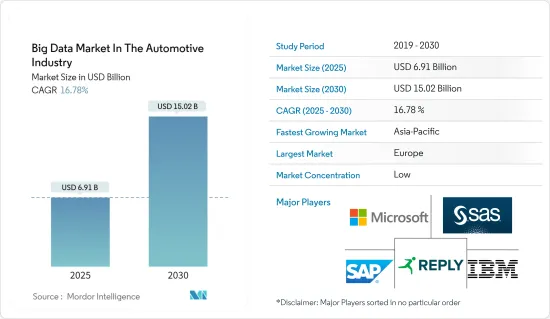
자동차 산업의 빅데이터 시장은 2025년 69억 1,000만 달러에서 2030년에는 150억 2,000만 달러로 성장할 것으로 예측되고, 예측 기간 중(2025-2030년) CAGR은 16.78%를 나타낼 것으로 전망됩니다.
자동차 산업은 센서부터 인공지능, 빅데이터 분석에 이르기까지 다양한 기술, 애플리케이션, 서비스를 도입하여 변화를 거듭하고 있으며, 이에 따라 새로운 기업이 꾸준히 유입되어 미래 자동차의 지속적인 진화를 이끌고 있습니다. 차량에서 생성된 데이터를 활용하려는 다양한 이해관계자들의 노력이 증가하고 커넥티드 카의 설치 기반이 증가하면서 시장 성장을 주도하고 있습니다.
주요 하이라이트
자동차 제조 업계는 빅데이터 분석을 통해 ERP 시스템에서 데이터를 수집하여 비즈니스의 여러 기능 단위와 공급망 구성원의 정보를 결합할 수 있습니다. 산업 IoT, 네트워크 시스템, M2M 통신의 등장으로 자동차 산업은 인더스트리 4.0을 향해 나아가고 있습니다.
소비자 가전 산업은 수요와 공급 요인에 크게 의존하고 있습니다. 빅데이터 분석의 사용은 이 산업을 크게 세분화하고 푸시 시장 전략 대신 풀 시장 전략으로 전환하는 데 큰 도움이 되었습니다.
또한 빅데이터 분석은 자동차 제조업체가 영업 및 마케팅 측면에서 효율성을 높이는 데 도움이 되었습니다.
OEM에게 데이터의 중요성은 점점 더 커지고 있습니다. 따라서 강력한 개인정보 보호 전략을 통해 일반 개인정보 보호 규정(GDPR)을 준수하는 것이 필수적입니다. 업계의 많은 사람들이 아직 기존 규정과 내부 정책에 익숙하지 않기 때문에 데이터 보호, 특히 GDPR의 세부 사항에 대한 분명한 인식이 필요합니다. 이는 대중과의 오해로 이어질 수 있습니다.
자동차 시장의 빅데이터 동향
제품 개발, 공급망 및 제조 부문이 주요 비중 차지
빅데이터는 현대의 기술 중심 기업 환경에서 제조업체의 생산성과 효율성을 높이는 핵심 동력 중 하나입니다.
자동차 업계는 제조, 마케팅, 공급망 등의 분야에서 데이터 분석을 도입하는 데 상당한 진전을 이뤘지만, 제품 자체 내에서 데이터를 생성하고 분석하는 데는 상대적으로 초기 단계에 머물러 있었습니다.
커넥티드 자동차는 사용자 경험에 큰 변화를 가져올 수 있습니다. AP 통신에 따르면 2023년까지 자동차 업계에서는 전 세계적으로 7,630만 대의 커넥티드 카가 생산될 것으로 예상하고 있습니다. 장비와 소프트웨어를 제공함으로써 클라우드에 연결하여 데이터를 생성하고 유용한 인사이트를 얻을 수 있습니다.
미국 최대 자동차 제조업체인 제너럴 모터스는 자동차 부문에서 빅데이터와 분석 활용의 선구자입니다. 오늘날 자동차에는 센서와 중앙 처리 장치(CPU)가 일반적입니다. 자동차 내 센서와 텔레매틱스를 중심으로 제너럴 모터스는 차량의 안전성과 신뢰성을 개선하는 동시에 많은 비용을 절감할 수 있었습니다.
예측 기간 동안 상당한 속도로 성장할 것으로 예상되는 아시아태평양 지역
모든 지역 중에서 아시아태평양 지역의 인구가 가장 많습니다. 아시아태평양 지역은 도시 인구 증가와 구매력 상승으로 인해 자동차 산업에서 가장 큰 시장 중 하나로 꼽히고 있습니다.
중국 기차공업협회(CAAM)에 따르면 2022년 4월에 중국에서 판매된 승용차는 약 96만 5,000대, 상용차는 약 21만 6,000대로, 이는 전월 대비 각각 48%와 42% 감소한 수치입니다.
기업들은 시장 점유율을 높이고, 다양한 시장에 진출하고, 제품군을 다양화하기 위해 여러 분야에서 입지를 강화하기 위해 협력하고 있습니다. 예를 들어, 2022년 6월 일본전신전화(NTT)와 도요타자동차는 데이터 수집 및 공유를 위한 커넥티드 카 개발을 위해 협력했습니다.
예를 들어 SG 홀딩스의 사가와 익스프레스는 모든 소형 배송 밴을 전기화한다는 목표의 일환으로 2021년 6월에 첫 전기 자동차 시제품을 선보였습니다. 이 차량은 도쿄의 스타트업 ASF와 협력하여 제작되었습니다. 일본 최대 배달 서비스인 이 회사는 2030년까지 전기자동차로 전환하여 연간 2만 8,000톤의 CO2 배출량을 삭감할 의향입니다.
자동차 산업의 빅데이터 개요
자동차 산업의 빅데이터 시장은 경쟁이 치열하고 많은 세계와 지역 진출기업으로 구성되어 있습니다.
2022년 3월 : National Instruments Corporation(NIC)에 의한 하인징거GmbH의 전자차량시스템 부문 인수가 공표되었습니다. 자동차 산업의 구성 요소 테스트와 관련하여 NI와 하인징거는 서로 매우 보완적인 역할을 합니다.
2022년 1월 : 북미 지역에서의 입지를 강화하기 위해 Reply SpA는 SAP 기술 기반 솔루션 자문 및 구축을 전문으로 하는 Enowa LLC를 인수한다고 발표했습니다. Enowa LLC는 SAP 기술을 활용하여 부가가치 서비스 및 클라우드 설계를 제공합니다.
기타 혜택
엑셀 형식 시장 예측(ME) 시트
3개월간의 애널리스트 지원
목차
제1장 서론
조사의 전제조건과 시장 정의
조사 범위
제2장 조사 방법
제3장 주요 요약
제4장 시장 인사이트
시장 개요
산업 밸류체인 분석
산업의 매력 - Porter's Five Forces 분석
공급기업의 협상력
구매자의 협상력
신규 참가업체의 위협
대체품의 위협
경쟁 기업간 경쟁 관계의 강도
COVID-19의 산업에 대한 영향 평가
제5장 시장 역학
시장 성장 촉진요인
차량 생성 데이터 활용에 대한 다양한 이해 관계자의 노력 증가
커넥티드카의 설치 대수 증가
시장의 과제
차량 데이터 보호에 대한 개인 정보 보호 문제 및 규제
제6장 시장 세분화
용도별
제품 개발, 공급망, 제조
OEM 보증, 애프터 세일즈, 딜러
커넥티드 차량 및 지능형 운송
판매, 마케팅, 기타
지역별
북미
유럽
아시아
호주 및 뉴질랜드
라틴아메리카
중동 및 아프리카
제7장 경쟁 구도
기업 프로파일
N-iX LTD
Future Processing Sp.zoo
Reply SpA(Data Reply)
Phocas Ltd
Positive Thinking Company
Qburst Technologies Private Limited
Monixo SAS
Allerin Tech Private Limited
Driver Design Studio Limited
Sight Machine Inc.
SAS Institute Inc.
IBM Corporation
SAP SE
Microsoft Corporation
National Instruments Corp.
제8장 투자 분석
제9장 시장 기회와 앞으로의 동향
HBR
영문 목차
영문목차
The Big Data Market In The Automotive Industry is expected to grow from USD 6.91 billion in 2025 to USD 15.02 billion by 2030, at a CAGR of 16.78% during the forecast period (2025-2030).
The automobile industry is being transformed by adopting technologies, applications, and services ranging from sensors to artificial intelligence to big data analysis; thus, the ecosystem is witnessing a steady influx of new players, resulting in the continuous evolution of the future car. Increasing efforts from various stakeholders in utilizing the vehicle-generated data coupled with a growing installed base of connected cars drive the market growth.
Key Highlights
Big data analytics allows the automobile manufacturing industry to collect data from ERP systems to combine information from multiple functional units of the business and the supply chain members. With the emergence of industry IoT, a networked system, and M2M communication, the automotive industry is positioning itself toward industry 4.0. Sensors, RFIDs, barcode readers, and robots are now standard on the industry's manufacturing floor. These devices have increased data generation points exponentially.
The consumer electronics industry is highly dependent on the demand and supply factors. The use of big data analytics helped this industry segment drastically and allowed it to switch to a pull market strategy instead of the push market strategy. With big data analytics, the industry is now more aware of consumer behavior patterns and may plan production based on these. A similar potential has been exposed in the automotive sector, with IoT evolutions and electronics components becoming an integral part of automobiles.
Furthermore, big data analytics helped automobile manufacturers boost their efficiency in terms of sales and marketing. It also improved its operations by aiding in the incorporation of utilities like predictive maintenance and service schedule. It also aided automotive vendors in streamlining the procurement process, making it more cost-efficient by analyzing the data for demand prediction.
Data is increasingly becoming crucial for OEMs. Therefore, it is essential to ensure that they comply with the General Data Protection Regulation (GDPR) through a strong privacy strategy. An evident appreciation for data protection, and in particular the details of the GDPR, are required, as many in the industry are not yet familiar with existing regulations and internal policies. This may lead to miscommunication with the public. Therefore, data protection law is important in connected and autonomous mobility because the breadth of data captured automatically is tremendous.
Big Data in Automotive Market Trends
Product Development, Supply Chain and Manufacturing Segment Accounts for a Major Share
Big data is one of the key drivers of productivity and efficiency for manufacturers in the contemporary technology-driven corporate climate. There has been a significant increase in the number of data points for the automobile industry due to the rapid adoption of sensors and connected devices, as well as the facilitation of machine-to-machine (M2M) communication.
While the car industry has made significant strides in adopting data analytics in areas such as manufacturing, marketing, and supply chain, the utilization of data generation and analysis within the product itself has been relatively nascent. However, with the increasing popularity of the Internet of Things (IoT) and advancements in computing, more cost-effective data collection methods are beginning to emerge.
A significant change in the user experience may result from connected automobiles. According to the Associated Press, by 2023, it is predicted that 76.3 million connected cars will be produced worldwide by the automobile industry. By offering gear and software, you can connect them to the cloud so they can generate data and gain useful insight. When automotive companies get access to real-time, on-the-road data, it speeds up product development and may revolutionize how they monitor performance, maintain product quality, and ensure safety.
The largest American automaker, General Motors, was a pioneer in the use of big data and analytics in the automotive sector. These days, sensors and central processing units (CPUs) in cars are the norm. With sensors and telematics within the automobile as its focus, General Motors can save a lot of money while also improving the safety and dependability of its vehicles. For instance, DataFlair claims that telematics is like a gold mine because it offers significant savings of up to USD 800 per vehicle.
Asia Pacific Segment is Expected to Grow at a Significant Rate Over the Forecast Period
Of all the regions, the Asia-Pacific has the largest population. Asia-Pacific is regarded as one of the biggest markets for the automotive industry due to the region's growing urban population and rising purchasing power.
Around 965,000 passenger cars and 216,000 commercial vehicles were sold in China in April 2022, according to the China Association of Automobile Manufacturers (CAAM); these figures reflect a 48% and a 42% reduction, respectively, from the previous month. Such massive vehicle sales are anticipated to present a growth opportunity for the sector under investigation.
Businesses are working together to grow their presence in numerous areas to increase their market share, penetrate diverse markets, and diversify their product offerings. For instance, in June 2022, Nippon Telegraph & Telephone (NTT) and Toyota Motor collaborated to develop connected cars to collect and share data. Yo Honma, the chief executive of NTT's data networking and data division, stated in an interview that the business would actively investigate mergers and acquisitions to hasten its drive into foreign markets. According to Honma, the company could spend as much as JPY 400 billion (USD 3 billion) on deals over the next four years.
For instance, Sagawa Express Co. of SG Holdings Co. debuted a prototype of its first electric vehicle in June 2021 as part of its goal to electrify all small delivery vans. This vehicle was constructed in collaboration with the Tokyo startup ASF. The biggest delivery service in the country intends to switch to electric vehicles by 2030 and reduce its CO2 emissions by 28,000 tonnes yearly. These changes should make it possible for the market under study to expand.
Big Data in Automotive Industry Overview
The big data market in the automotive industry is competitive and consists of many global and regional players. These players account for a considerable market share and focus on expanding their customer base. These vendors focus on research and development activities, strategic partnerships, and other organic and inorganic growth strategies to earn a competitive edge over the forecast period.
In March 2022, the purchase of Heinzinger GmbH's electronic vehicle systems division by National Instruments Corporation (NIC) was made public. The acquisition would increase NIC's capacity for electrification, battery testing, and sustainable energy while increasing its customer base. When it comes to testing automotive industry components, NI and Heinzinger play roles that are extremely complementary to one another. This allows for quick innovation to electrify vehicles and achieve vision zero.
In January 2022, to increase its footprint in North America, Reply SpA announced the acquisition of Enowa LLC, a business that specializes in advising and building solutions based on SAP technology. Enowa LLC uses SAP technology to provide value-added services and cloud design.
Additional Benefits:
The market estimate (ME) sheet in Excel format
3 months of analyst support
TABLE OF CONTENTS
1 INTRODUCTION
1.1 Study Assumptions and Market Definition
1.2 Scope of the Study
2 RESEARCH METHODOLOGY
3 EXECUTIVE SUMMARY
4 MARKET INSIGHTS
4.1 Market Overview
4.2 Industry Value Chain Analysis
4.3 Industry Attractiveness - Porter's Five Forces Analysis
4.3.1 Bargaining Power of Suppliers
4.3.2 Bargaining Power of Buyers
4.3.3 Threat of New Entrants
4.3.4 Threat of Substitutes
4.3.5 Intensity of Competitive Rivalry
4.4 Assessment of the Impact of COVID-19 on the Industry
5 MARKET DYNAMICS
5.1 Market Drivers
5.1.1 Increasing Efforts from Various Stakeholders in Utilizing the Vehicle Generated Data
5.1.2 Growing Installed-Base of Connected Cars
5.2 Market Challenges
5.2.1 Privacy Issues and Regulations on Vehicle Data Protection
6 MARKET SEGMENTATION
6.1 By Application
6.1.1 Product Development, Supply Chain and Manufacturing
6.1.2 OEM Warranty and Aftersales/Dealers
6.1.3 Connected Vehicle and Intelligent Transportation