일본의 자동차용 LED 조명 : 시장 점유율 분석, 산업 동향 및 통계, 성장 예측(2025-2030년)
Japan Automotive LED Lighting - Market Share Analysis, Industry Trends & Statistics, Growth Forecasts (2025 - 2030)
상품코드:1683952
리서치사:Mordor Intelligence
발행일:2025년 03월
페이지 정보:영문
라이선스 & 가격 (부가세 별도)
ㅁ Add-on 가능: 고객의 요청에 따라 일정한 범위 내에서 Customization이 가능합니다. 자세한 사항은 문의해 주시기 바랍니다.
ㅁ 보고서에 따라 최신 정보로 업데이트하여 보내드립니다. 배송기일은 문의해 주시기 바랍니다.
한글목차
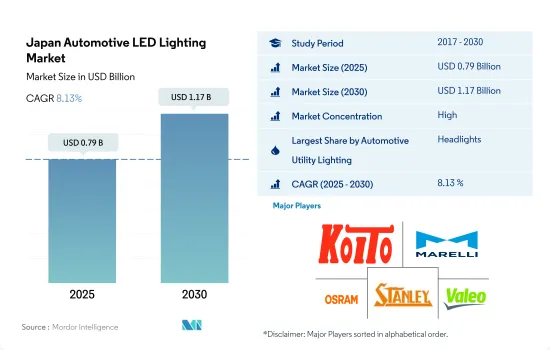
일본의 자동차용 LED 조명 시장 규모는 2025년에 7억 9,000만 달러에 달할 것으로 추정됩니다. 2030년에는 11억 7,000만 달러에 이를 것으로 예상되며, 예측기간(2025-2030년)의 CAGR은 8.13%를 나타낼 것으로 전망됩니다.
EV 수요 증가와 사고 건수 증가가 시장 성장 견인
금액 점유율에서는 2022년에 전조등이 점유율의 대부분을 차지한 다음 그 밖에 방향지시등이 뒤를 이었습니다. 예측 기간 동안 방향지시등, 후진등, 후미등, 정지등 시장 점유율은 변하지 않고 전조등은 약간 감소할 것으로 예상됩니다. 전조등의 DRL(데이터임 런닝 램프)과 프로젝터 라이트의 조합은 일본의 자동차 조명 시장에서 증가 동향 중 하나입니다.
수량 점유율에서는 2022년에는 방향지시등이 과반수를 차지한 다음 전조등이 뒤를 이었습니다. 방향지시등 시장 점유율은 변동이 적고 앞으로도 변하지 않을 것으로 예상됩니다. 방향지시등은 모든 유형의 자동차에서 작은 사고에서 큰 사고까지 영향을 받을 가능성이 높고 교체가 필요한 주요 부품입니다.
정부는 안전 기준을 제고함으로써 사고를 줄이는 것을 목표로 하고 있으며, 그 결과 자동 헤드 램프와 방향지시등 수요가 높아지고 있습니다. 예를 들어 일본 정부는 2025년까지 교통 관련 사망자를 2,000명 미만으로 줄이겠다는 목표를 내걸고 있습니다. 2022년 전국 교통사고 사망자 수는 2,610명으로 감소했으며 2021년부터 1% 감소했습니다.
사업 확대와 기술 혁신 측면에서 일본은 세계에서 중요한 자동차 생산국 중 하나입니다. 시장의 주요 자동차 제조업체는 시장에서 전기자동차의 확대에 주력하고 있습니다. 예를 들어, 2021년에는 신차 판매 대수에서 차지하는 전기자동차의 비율은 36.2%로 2019년의 35.2%, 2017년의 32.9%에서 증가했습니다. 따라서 NEV의 성장은 시장에서 LED의 침투를 증가시키는 것으로 보입니다.
일본의 자동차용 LED 조명 시장 동향
기술 업그레이드와 EV 수요 증가가 LED 조명 시장 성장을 견인
인도의 자동차 총 생산량은 2022년 941만대로, 2023년에는 965만대에 이르렀습니다. 일본의 자동차 공급업계는 COVID-19의 대유행에 의해 심각한 영향을 받았습니다. 닛산은 2020년 5월 하순에 세계 생산을 20% 절감할 방침이었습니다. 6월 일본의 판매 대수는 23%의 대폭 감소로 도요타가 가장 호조로 혼다, 닛산이 이에 이어졌습니다. 그 결과 중국 공장 폐쇄로 LED 조명 생산에 필요한 자동차 부품이 부족했습니다. 이 때문에 일본의 자동차용 LED 조명의 생산은 전반적으로 감소했습니다.
일본에는 도요타, 미쓰비시, 닛산, 야마하 발동기, 이스즈 자동차, 마쓰다, 렉서스 등 대기업 자동차 제조업체가 있습니다. 일본의 자동차산업은 커넥티비티, 전동화, 자율주행의 개발을 향하고 있습니다. CES 2017에서 도요타는 회사의 모빌리티의 미래상을 보여주는 "Concept-I"를 발표했습니다. 이 자동차에는 'Yui'라고 명명된 인공지능(AI) 헬퍼가 탑재되어 있어 LED 라이트나 소리를 통해 드라이버나 도로상의 다른 드라이버와 커뮤니케이션을 취합니다.
일본에서는 보다 저렴한 경차(가솔린차의 경우 엔진이 660cc 이하로 분류되는 자동차)가 EV시장 수요를 견인해 전기차 판매가 급증하고 있습니다. 에너지 효율이 높은 LED 라이트는 수요가 높아짐에 따라 EV에 탑재가 진행되고 있습니다. 또한 대시보드 스트립 조명 장식용 스트립 라이트에 LED 라이트가 사용되고 있기 때문에 다양한 스타일링의 자동차 실내 조명에도 LED 라이트의 사용이 증가하고 있습니다.
수입차 증가와 정부의 EV 구매 보조금이 LED 조명 시장 성장을 가속
2022년 기준 일본에는 28,546개의 충전소가 있었습니다. 2022년도 수입 전기차의 국내 판매 대수는 전년도 대비 65% 증가한 1만6,464대였습니다. 일본에서 판매된 승용차는 361만대로, 2022년도 중의 EV는 약 7만7,000대였습니다. 수입차의 EV 비율이 높은 것은 해외 제조업체가 일본의 라이벌 제조업체보다 폭넓은 상품을 제공하고 있는 것을 반영하고 있을 가능성이 있습니다. 일본의 자동차 제조업체는 일반적으로, 중국의 라이벌의 일부와 비교해, 전기자동차나 플러그인·하이브리드차의 도입이 늦어지고 있습니다. 저렴한 경차가 일본 전기자동차 판매를 선도하고 있습니다. 그러나 2022년도 일본의 신차승용차 판매 대수에서 차지하는 EV의 비율은 중국과 유럽의 약 20%에 비해 불과 2.1%에 불과한 수치였습니다.
일본 정부는 CEV 구매 보조금을 제공했습니다. 2021년 1대당 CEV 보조금의 상한액은 80만엔(7,200달러)이었습니다. 2023년 1월 일본 정부는 설치 비용을 줄이기 위해 출력 200kW 이상의 급속 충전소 안전 규칙을 완화할 계획을 발표했습니다. 그 과정에서 HPC는 50-200kW의 직류 충전소과 대등한 입장에 놓이게 됩니다.
일본의 자동차 제조업체인 스바루는 2022년 5월, 동국에 전기자동차 공장을 신설해, 2027년 이후에 조업을 개시한다고 발표했습니다. 일본 최초의 EV 전용 공장입니다. 신공장에 더해 현재 공장도 전기자동차를 일정 대수 생산할 수 있도록 개수할 예정으로 총 투자액은 약 2,500억엔(16억 8,000만 달러)을 전망하고 있습니다. 이와 같이 EV 수요 증가로 새로운 발전소의 개발·생산이 예상되어 자동차 LED 수요를 끌어올릴 것으로 예상됩니다.
일본의 자동차용 LED 조명 산업 개요
일본의 자동차용 LED 조명 시장은 상당히 통합되어 있으며 상위 5개사에서 108.03%를 차지하고 있습니다. 이 시장 주요 기업은 다음과 같습니다. KOITO MANUFACTURING, Marelli Holdings, OSRAM GmbH., Stanley Electric and Valeo(알파벳순 정렬).
기타 혜택
엑셀 형식 시장 예측(ME) 시트
3개월간의 애널리스트 서포트
목차
제1장 주요 요약과 주요 조사 결과
제2장 보고서 제안
제3장 소개
조사의 전제조건과 시장 정의
조사 범위
조사 방법
제4장 주요 산업 동향
자동차 생산 대수
인구
1인당 소득
자동차 대출 금리
충전소 수
자동차 보유 대수
LED 총 수입량
가구수
도로 네트워크
보급률
규제 프레임워크
일본
밸류체인과 유통채널 분석
제5장 시장 세분화
자동차용 유틸리티 조명
주간 주행등(DRL)
방향지시등
전조등
후진등
정지등
후미등
기타
자동차용 조명
이륜차
상용차
승용차
제6장 경쟁 구도
주요 전략 동향
시장 점유율 분석
기업 상황
기업 프로파일(세계 수준 개요, 시장 수준 개요, 주요 사업 부문, 재무, 직원 수, 주요 정보, 시장 순위, 시장 점유율, 제품 및 서비스, 최근 동향 분석 포함)
GRUPO ANTOLIN IRAUSA, SA
HELLA GmbH & Co. KGaA
KOITO MANUFACTURING CO., LTD.
Marelli Holdings Co., Ltd.
Nichia Corporation
OSRAM GmbH.
Signify(Philips)
Stanley Electric Co., Ltd.
Valeo
Varroc Group
제7장 CEO에 대한 주요 전략적 질문
제8장 부록
세계의 개요
개요
Five Forces 분석 프레임워크
세계의 밸류체인 분석
시장 역학(DROs)
정보원과 참고문헌
도표 일람
주요 인사이트
데이터 팩
용어집
KTH
영문 목차
영문목차
The Japan Automotive LED Lighting Market size is estimated at 0.79 billion USD in 2025, and is expected to reach 1.17 billion USD by 2030, growing at a CAGR of 8.13% during the forecast period (2025-2030).
Increasing demand for EVs and the increasing number of accidents are driving the growth of the market
In terms of value share, in 2022, headlights accounted for the majority of the share, followed by others and directional signal lights. The market share is expected to remain the same for directional signal lights, reversing lights, taillights, and stoplights during the forecast period, with a small reduction in headlights. The combination of DRLs (daytime running lamps) with projector lights in frontal illumination is one of the increasing trends in the Japanese automobile lighting market.
In terms of volume share, in 2022, directional signal lights accounted for the majority, followed by headlights and others. The market share is expected to remain the same with less fluctuation for these lights. Directional signal lights are the prime part that has a high probability of getting affected in minor to major accidents in all types of vehicles and require replacement.
The government aims to reduce accidents by increasing its safety standards, resulting in increasing demand for automated headlamps and directional signal lights. For instance, the Japanese government has set a goal of reducing traffic-related deaths to less than 2,000 by 2025. In 2022, the Traffic fatalities nationwide declined to 2,610, which is down by 1% from 2021.
In terms of expansion and innovations, Japan is one of the significant auto-producing nations in the world. The key automotive manufacturers in the market are focusing on expanding electric vehicles in the market. For instance, in 2021, new electric vehicles accounted for 36.2% of total new car sales, up from 35.2% in 2019 and 32.9% in 2017. Thus, the growth in NEV would increase the penetration of LED in the market.
Japan Automotive LED Lighting Market Trends
Technology upgradation and increasing demand for EVs drive the LED lighting market's growth
The total automobile vehicle production in India was 9.41 million units in 2022, and it is expected to reach 9.65 million units in 2023. The automotive supply industry in Japan was severely affected by the COVID-19 pandemic. Nissan intended to reduce global production by 20% in late May 2020. Sales in Japan fell drastically by 23% in June, with Toyota performing the best, followed by Honda and Nissan. As a result, the closure of Chinese factories led to a scarcity of the automobile components needed to produce LED lights. This led to a decline in Japan's overall manufacturing of car LED lighting.
Japan has major automotive manufacturers such as Toyota, Mitsubishi, Nissan, Yamaha Motor Company, Isuzu Motors Ltd, Mazda, and Lexus. Japan's auto industry is moving toward developing connectivity, electrification, and automated driving. At CES 2017, Toyota unveiled its Concept-I car to demonstrate the company's vision for the future of mobility. The vehicle has an artificial intelligence (AI) helper named 'Yui' that communicates with the driver and other drivers on the road via LED lights and sounds.
Sales of electric vehicles are rising rapidly in Japan, driven by cheaper "Kei" minicars (vehicles classified with engines of 660 cc or less in the case of gasoline models), which are driving the demand for the EV market. Due to their high energy efficiency, LED lights are becoming increasingly common in EVs as their demand rises. Due to the use of LED lights in strip lights for decorative purposes in dashboard strip lighting, the use of LED lights in interior lighting of vehicles in varied styling is also rising.
An increase in imported cars and government subsidies for the purchase of EVs drive the growth of the LED lighting market
As of 2022, there were 28,546 charging stations in Japan. The number of imported electric vehicles sold in the country during FY 2022 rose 65% from the previous year to 16,464 units. There were 3.61 million passenger cars sold in Japan, and about 77,000 were EVs during FY 2022. The higher EV percentage for imported cars may reflect the wider variety of products offered by foreign makers than their Japanese rivals. Japanese car manufacturers have generally been slow to adopt electric and plug-in hybrid vehicles compared to some of their Chinese rivals. Affordable Kei minicars lead Japan's electric vehicle sales. However, EVs accounted for only 2.1% of new passenger car sales in Japan in FY 2022 compared to roughly 20% in China and Europe.
The Japanese government offered subsidies to purchase CEVs. The maximum amount of the CEV subsidies given per vehicle in 2021 was JPY 800,000 (USD 7,200). In January 2023, the Japanese government announced the plan to ease safety rules for fast charging stations with more than 200 kW of power to reduce installation costs. In the process, HPCs will be placed on an equal footing with DC charging stations ranging from 50 to 200 kW.
Subaru, a Japanese automaker, declared in May 2022 that it would build a new electric vehicle plant in the country, starting operations after 2027. It would be the first EV-only factory in Japan. In addition to the new facility, the current plant will be retooled to produce a specific number of electric vehicles, with an anticipated total investment of about JPY 250 billion (USD 1.68 billion). Thus, the above instances are expected to lead to the development and production of new power stations owing to the growing demand for EVs, which, in turn, is expected to boost the demand for automotive LEDs.
Japan Automotive LED Lighting Industry Overview
The Japan Automotive LED Lighting Market is fairly consolidated, with the top five companies occupying 108.03%. The major players in this market are KOITO MANUFACTURING CO., LTD., Marelli Holdings Co., Ltd., OSRAM GmbH., Stanley Electric Co., Ltd. and Valeo (sorted alphabetically).
Additional Benefits:
The market estimate (ME) sheet in Excel format
3 months of analyst support
TABLE OF CONTENTS
1 EXECUTIVE SUMMARY & KEY FINDINGS
2 REPORT OFFERS
3 INTRODUCTION
3.1 Study Assumptions & Market Definition
3.2 Scope of the Study
3.3 Research Methodology
4 KEY INDUSTRY TRENDS
4.1 Automotive Production
4.2 Population
4.3 Per Capita Income
4.4 Interest Rate For Auto Loans
4.5 Number Of Charging Stations
4.6 Number Of Automobile On-road
4.7 Total Import Of Leds
4.8 # Of Households
4.9 Road Networks
4.10 Led Penetration
4.11 Regulatory Framework
4.11.1 Japan
4.12 Value Chain & Distribution Channel Analysis
5 MARKET SEGMENTATION (includes market size in Value in USD and Volume, Forecasts up to 2030 and analysis of growth prospects)
5.1 Automotive Utility Lighting
5.1.1 Daytime Running Lights (DRL)
5.1.2 Directional Signal Lights
5.1.3 Headlights
5.1.4 Reverse Light
5.1.5 Stop Light
5.1.6 Tail Light
5.1.7 Others
5.2 Automotive Vehicle Lighting
5.2.1 2 Wheelers
5.2.2 Commercial Vehicles
5.2.3 Passenger Cars
6 COMPETITIVE LANDSCAPE
6.1 Key Strategic Moves
6.2 Market Share Analysis
6.3 Company Landscape
6.4 Company Profiles (includes Global level Overview, Market level overview, Core Business Segments, Financials, Headcount, Key Information, Market Rank, Market Share, Products and Services, and analysis of Recent Developments)