중국의 전기자동차용 전지 제조 : 시장 점유율 분석, 산업 동향 및 통계, 성장 예측(2025-2030년)
China Electric Vehicle Battery Manufacturing - Market Share Analysis, Industry Trends & Statistics, Growth Forecasts (2025 - 2030)
상품코드:1636467
리서치사:Mordor Intelligence
발행일:2025년 01월
페이지 정보:영문
라이선스 & 가격 (부가세 별도)
ㅁ Add-on 가능: 고객의 요청에 따라 일정한 범위 내에서 Customization이 가능합니다. 자세한 사항은 문의해 주시기 바랍니다.
ㅁ 보고서에 따라 최신 정보로 업데이트하여 보내드립니다. 배송기일은 문의해 주시기 바랍니다.
한글목차
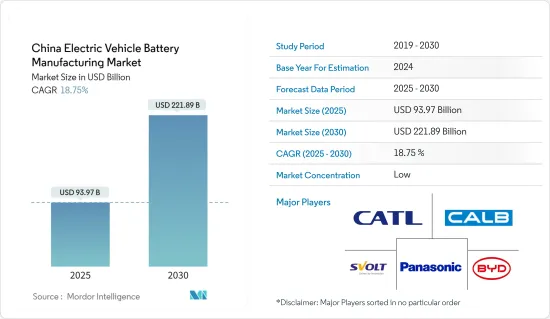
중국의 전기자동차 전지 제조 시장 규모는 2025년 939억 7,000만 달러로 추정되며, 예측 기간(2025-2030년)의 CAGR은 18.75%로, 2030년에는 2,218억 9,000만 달러에 이를 것으로 예측됩니다.
주요 하이라이트
장기적으로는 전지 생산 능력 향상을 위한 투자나 전지 원료 비용 저하 등의 요인이 예측 기간 중 중국 전기자동차 전지 제조 시장의 가장 큰 촉진요인 중 하나가 될 것으로 예상됩니다.
한편, 주요 전지 원료의 수입 의존도는 산업을 가격 변동이나 불균형 개발에 노출시키고, 이는 예측 기간 동안 중국 전기자동차 전지 제조 시장에 위협이 될 것입니다.
전기자동차에 대한 장기적인 목표는 계속되고 있으며 이는 미래 시장에 여러가지 기회를 만들 것으로 예상됩니다.
중국 전기자동차 전지 제조 시장 동향
시장을 독점하는 리튬 이온 전지 유형
높은 에너지 밀도와 긴 수명으로 알려진 리튬 이온 전지는 전기자동차 제조업체들에게 유력한 선택이 되었습니다. 이 기술은 효율적인 전기자동차 생산을 보장 할뿐만 아니라 소비자의 기대와 산업 기준을 모두 충족합니다.
EV의 보급과 전지의 자국 내 생산을 강화하기 위해, 중국 정부는 일련의 강력한 시책을 전개해 왔습니다. 신에너지자동차(NEV) 의무화와 같은 이니셔티브는 보조금이나 세제 우대조치와 함께 EV 부문의 급속한 확대를 가속하고 있습니다. 게다가 '메이드 인 차이나 2025' 이니셔티브는 선진 제조업의 세계적 선두주자로서의 지위를 확고히 하고자 하는 중국의 야심을 강조하고 있습니다.
이산화탄소 배출량을 줄이고 대기오염에 대한 노력을 추진하는 중국의 움직임은 EV 시장의 활황을 뒷받침하는 매우 중요한 동력이 되고 있습니다. 청정에너지 자동차를 지지하는 시책으로 내연기관에서 전기모빌리티로의 전환이 급속히 진행되고 있습니다. 세계 최대의 EV 시장인 중국에서 수요 급증을 뒷받침하고 있는 것은 도시화, 환경 의식의 고조, 엄격한 자동차 배기가스 규제이며 이들 모두가 자국산 전지의 필요성을 높이고 있습니다.
2024년 5월 중국은 전기차(EV)용 차세대 전지 기술 개발에 약 60억 위안(8억 4,500만 달러)을 투입할 예정입니다. 전고체 전지(ASSB)는 기존의 리튬 이온 전지(LIB)를 뛰어넘는 최첨단 기술로, 고체 전도성 전해질을 이용하여 안전성과 에너지 밀도를 높였습니다. EV용 전지의 선두주자인 CATL은 그 가능성을 인식하고 기술적 도약을 위해 정부의 지원을 받기 위해 노력하고 있습니다.
중국의 대규모 충전 인프라 개발은 자국의 전기자동차 보급에 매우 중요합니다. 이 전략적 투자는 EV 사용자에게 효율적인 충전 솔루션에 쉽게 액세스할 수 있도록 하여 EV 전지 수요를 더욱 확대합니다. 동시에 중국기업은 연구개발에 자원을 투입하여 전지기술의 개량과 생산비용 절감을 목표로 하고 있습니다. 국제 하이테크 기업과 연구기관과의 협업이 전지 제조에 있어서의 혁신의 기폭제가 되고 있습니다.
예를 들어 2024년 5월 국유기업 상하이 기차는 2025년까지 완전 고체 전지를 EV 브랜드에 통합하여 2026년 양산할 계획을 발표했습니다. 400Wh/kg 이상의 에너지 밀도를 자랑하는 이 전지는 최소 1,000km의 항속 거리를 약속합니다. 작년 6월에는 자국 내 EV 제조업체의 니오가 에너지 밀도 360Wh/kg, 항속 거리 1,044km라는 경이로운 기록을 달성한 고체 전지의 테스트에 성공하였습니다. 게다가 SAIC이 일부를 소유한 IM Motors는 4월에 IM L6 EV 모델을 발표했습니다. 이 모델은 130kWh의 전력을 가진 초고속 충전 고체 전지를 탑재하여 1,000km의 항속 거리와 900V의 초고속 충전 기능을 지원합니다.
중국은 900기가와트에 가까운 제조능력을 자랑하며 세계 전체의 77%라는 압도적인 점유율을 자랑합니다. 또한 세계 전지 제조업체 상위 10개 기업 중 6개는 중국이 차지하고 있습니다. 이러한 이점은 중국 내 채굴에서 차량 생산에 이르기까지 EV 공급망 전체를 종합적으로 통제함으로써 더욱 강화되고 있습니다. 세계 전기차 보유 대수의 절반 이상이 중국에 있으며, 2023년에 1705GWh로 기록된 중국의 리튬 이온 전지 셀 제조 능력은 2027년까지 6197GWh로 급증할 것으로 예측되고 있습니다.
이러한 개발과 투자를 고려하면 향후 수년간 리튬 이온 전지 수요 증가와 함께 동지역 전체에서 EV용 전지의 생산이 급증할 것으로 예상됩니다.
전지 생산 능력 강화를 위한 투자
중국은 전기자동차(EV) 수요 급증에 대응하기 위해 전략적으로 전지 생산능력을 강화하고 있으며 보조금 및 투자 우대 정책 등 정부의 이니셔티브로 자국 기업의 생산 능력 강화에 박차를 가하고 있습니다. 이러한 협조적인 노력으로 중국은 EV용 전지 제조의 세계적인 선두주자로서의 지위를 굳히면서 점점 확대되는 EV 시장을 위한 프리미엄 전지의 안정적인 공급을 보장하기 위해 노력하고 있습니다.
중국 전역에 새로운 전지 생산 공장이 설립되어 EV 전지 제조 시장을 뒷받침하고 있으며 CATL과 BYD와 같은 산업 선도기업은 생산을 확대하기 위해 최첨단 장비를 도입하고 있습니다. 첨단 기술을 도입한 이 최신 공장은 생산량과 효율성 향상을 보장하고 급증하는 국내외 EV 전지 수요를 충족시키는 중요한 요소가 되고 있습니다.
슬러리 믹서의 공개 입찰은 전지 생산 공정을 개선하는데 매우 중요한 역할을 합니다. 이 믹서는 전지 재료의 배합의 균일성을 보장하고 리튬 이온 전지의 품질과 성능에 직접 영향을 미칩니다. 이러한 중요한 믹서의 입찰을 공고함으로써 중국은 전지 제조 기술을 강화할 뿐만 아니라 EV 전지 시장 전체의 성장과 효율을 강화하고 산업의 신속한 확대를 뒷받침하고 있습니다.
예를 들어 2024년 6월 중국 전지 셀 제조업체인 Gotion High-tech는 10분 이하로 충전할 수 있는 획기적인 전기자동차용 전지를 발표해 세계적 리더인 CATL의 강력한 경쟁자로 자리매김했습니다. 이러한 고속 충전 기술 혁신은 충전 시간에 대한 소비자의 우려를 해결합니다. Gotion은 장거리 하이브리드 차량용 G-Current 전지 양산을 시작하는 한편 전기자동차용 전지 생산 라인도 건설중으로 연내에 양산을 개시할 예정입니다.
중국 정부는 EV 부문에 대한 지원을 견지하고 있으며 세제 우대 정책, 제조업체 및 소비자 보조금, 충전 인프라 강화 등의 조치를 시행하고 있습니다. 이러한 이니셔티브는 EV의 합리적인 가격과 편의성을 향상시키고, 보급률을 높이며, 나아가서는 전지 재료 수요를 증폭시키는 것을 목적으로 하고 있습니다. 전지 기술 혁신도 EV 상황을 바꾸고 있습니다. 예를 들어, BYD는 인산철 리튬(LFP) 전지와 같은 새로운 화학물질을 개척하고 있으며, 이 전지는 기존의 리튬 이온 전지보다 에너지 밀도가 약간 낮지만 안전하고 경제적입니다. 이러한 혁신은 EV를 보다 광범위한 시장에 보급하는 데 매우 중요합니다.
향후를 전망하면 중국의 EV용 전지 제조 시장은 강한 상승 궤도를 보이고 있습니다. 흔들리지 않는 정부 지원과 기술적 진보, 전략적 산업 협력을 통해 중국은 세계 EV 부문에서 우위를 유지할 것입니다. 주요 전지 제조업체의 끊임없는 생산 능력 확대는 지속가능성에 주력하면서 필수재에 대한 안정적인 수요를 가져오고 EV 전지 제조 부문의 급속한 상승을 뒷받침하고 있습니다.
중국의 리튬 이온 전지 생산 능력은 1.2 테라와트시(TWh)에 도달하였고 이는 세계의 76% 점유율을 차지합니다. 세계 전기자동차의 절반 이상이 중국 도로를 달리고 있기 때문에 이 생산 능력은 2030년까지 4.65TWh로 급증할 것으로 예상됩니다.
이러한 투자와 생산 확대는 리튬 이온 전지용량 수요를 증폭시킬 것으로 예상됩니다.
중국 전기자동차 전지 제조 산업 개요
중국의 전기자동차 전지 제조 시장은 양분화되어 있습니다. 동시장의 주요 기업(순서부동)은 BYD, Contemporary Amperex Technology Co.Limited, Panasonic Corporation, CALB(China Aviation Lithium Battery), SVOLT Energy Technology입니다.
기타 혜택
엑셀 형식 시장 예측(ME) 시트
3개월간의 애널리스트 서포트
목차
제1장 서론
조사 범위
시장의 정의
전제조건
제2장 주요 요약
제3장 조사 방법
제4장 시장 개요
서문
2029년까지 시장 규모와 수요 예측(단위 : 달러)
최근 동향과 개발
정부의 규제와 시책
시장 역학
촉진요인
전지 생산 능력 강화를 위한 투자
전지 원료 비용 저하
억제요인
주요 전지 재료의 수입 의존
공급망 분석
PESTLE 분석
투자 분석
제5장 시장 세분화
전지
리튬 이온
납축전지
니켈 수소 전지
기타
전지 형태
각형
파우치형
원통형
차량
승용차
상용차
기타
추진
전지 전기자동차
하이브리드 전기자동차
플러그인 하이브리드 전기자동차
제6장 경쟁 구도
M&A, 합작사업, 제휴, 협정
주요 기업의 전략
기업 개요
BYD Co. Ltd
Contemporary Amperex Technology Co. Limited
EnerSys
GS Yuasa Corporation
LG Chem Ltd
Exide Industries
Panasonic Corporation
CALB(China Aviation Lithium Battery)
SVOLT Energy Technology
EVE Energy
기타 유력 기업 목록
시장 순위 분석
제7장 시장 기회와 앞으로의 동향
전기차 장기 목표
CSM
영문 목차
영문목차
The China Electric Vehicle Battery Manufacturing Market size is estimated at USD 93.97 billion in 2025, and is expected to reach USD 221.89 billion by 2030, at a CAGR of 18.75% during the forecast period (2025-2030).
Key Highlights
Over the long term, factors such as investments to enhance the battery production capacity and a decline in the cost of battery raw materials are expected to be among the most significant drivers for the China Electric Vehicle Battery Manufacturing Market during the forecast period.
On the other hand, import dependency for key battery materials leaves the industry vulnerable to price fluctuations and imbalanced development. This poses a threat to the China Electric Vehicle Battery Manufacturing Market during the forecast period.
Nevertheless, continued Long-term ambitious targets for electric vehicles. This factor is expected to create several opportunities for the market in the future.
China Electric Vehicle Battery Manufacturing Market Trends
Lithium-ion Battery Type to Dominate the Market
Li-ion batteries, known for their high energy density and long life cycles, have become the go-to choice for EV manufacturers. This technology not only ensures the production of efficient electric vehicles but also meets both consumer expectations and industry benchmarks.
To bolster EV adoption and domestic battery production, the Chinese government has rolled out a series of robust policies. Initiatives like the New Energy Vehicle (NEV) mandate, alongside subsidies and tax incentives, are fueling the rapid expansion of the EV sector. Furthermore, the "Made in China 2025" initiative underscores China's ambition to cement its status as a global frontrunner in advanced manufacturing.
China's drive to cut carbon emissions and tackle air pollution is a pivotal force behind its booming EV market. With policies championing clean energy vehicles, the nation is witnessing a swift transition from internal combustion engines to electric mobility. As the globe's largest EV market, China's surging demand is propelled by urbanization, heightened environmental consciousness, and stringent vehicle emission regulations, all of which amplify the need for domestically produced batteries.
In May 2024, China is set to channel approximately CNY 6 billion (USD 845 million) into pioneering next-generation battery technologies for electric vehicles (EVs). All Solid State Batteries (ASSBs), a cutting-edge advancement over traditional lithium-ion batteries (LIBs), utilize a solid conductive electrolyte, enhancing safety and energy density. Recognizing their potential, EV battery titan CATL is poised to receive government backing for this technological leap.
China's expansive charging infrastructure development is pivotal for the country's electric vehicle adoption. This strategic investment guarantees EV users easy access to efficient charging solutions, further amplifying the demand for EV batteries. Concurrently, Chinese firms are pouring resources into R&D, aiming to refine battery technologies and curtail production costs. Collaborations with international tech giants and research entities are catalyzing innovations in battery manufacturing.
For example, in May 2024, state-owned SAIC announced plans to integrate full solid-state batteries into its EV brands by 2025, with mass production slated for 2026. Boasting an energy density exceeding 400Wh/kg, this battery promises a driving range of at least 1,000km. Last June, domestic EV maker Nio successfully tested a solid-state battery achieving a 360Wh/kg energy density and a remarkable 1,044km range. Additionally, IM Motors, partially owned by SAIC, revealed in April its IM L6 EV model, featuring an ultra-fast charging solid-state battery with 130kWh power, supporting a 1,000km range and 900V ultra-fast charging capability.
China dominates the global battery landscape, boasting a manufacturing capacity nearing 900 gigawatt-hours, which translates to a commanding 77% share of the worldwide total. Furthermore, six of the top ten battery manufacturers globally hail from China. This dominance is further reinforced by China's holistic control over the entire EV supply chain, from metal mining to vehicle production. With more than half of the world's electric vehicle fleet residing in China, the nation's lithium-ion battery cell manufacturing capacity, recorded at 1705 GWh in 2023, is projected to skyrocket to 6197 GWh by 2027.
Given these developments and investments, a surge in EV battery production across the region is anticipated, alongside a growing demand for lithium-ion batteries in the coming years.
Investments to Enhance the Battery Production Capacity
China is strategically ramping up its battery manufacturing capacity to cater to the surging demand for electric vehicles (EVs). Government initiatives, including subsidies and investment incentives, are spurring domestic companies to bolster their production capabilities. This concerted effort seeks to cement China's status as a global frontrunner in EV battery manufacturing, guaranteeing a consistent supply of premium batteries for the expanding EV market.
The establishment of new battery production plants throughout China is propelling the EV battery manufacturing market. Industry giants like CATL and BYD are rolling out cutting-edge facilities to amplify their production. These state-of-the-art plants, outfitted with advanced technologies, promise heightened output and efficiency-key factors in satisfying the surging domestic and international appetite for EV batteries.
Floating tenders for slurry mixers play a pivotal role in refining the battery production process. These mixers ensure uniformity in battery material blending, directly influencing the quality and performance of lithium-ion batteries. By soliciting tenders for these crucial mixers, China is not only enhancing its battery manufacturing technology but also bolstering the overall growth and efficiency of the EV battery market, fueling the industry's swift expansion.
For example, in June 2024, Gotion High-tech, a Chinese battery cell manufacturer, unveiled a groundbreaking electric vehicle battery capable of charging in under 10 minutes, positioning it as a formidable competitor to global leader CATL. This swift-charging innovation directly addresses consumer concerns about charging durations. Gotion has commenced mass production of its G-Current batteries, tailored for extended-range hybrids. Meanwhile, production lines for all-electric vehicle batteries are under construction, with mass production slated to kick off by year's end.
China's government remains steadfast in its support for the EV sector, rolling out measures like tax incentives, subsidies for manufacturers and consumers, and bolstering charging infrastructure. Such initiatives aim to enhance the affordability and convenience of EVs, driving up adoption rates and, in turn, amplifying the demand for battery materials. Battery technology innovations are also reshaping the landscape. For instance, BYD is pioneering new chemistries like lithium iron phosphate (LFP) batteries-safer and more economical, albeit with a marginally lower energy density than conventional lithium-ion counterparts. These breakthroughs are pivotal in making EVs more accessible to the broader market.
Looking ahead, China's EV battery manufacturing market is poised for a bullish trajectory. With unwavering government backing, technological strides, and strategic industry collaborations, China is set to uphold its dominance in the global EV arena. The relentless expansion of production capacities by leading battery manufacturers, coupled with a focus on sustainable practices, bodes well for a consistent demand for essential materials, propelling the swift ascent of the EV battery manufacturing sector.
China's lithium-ion battery manufacturing capacity stands at a staggering 1.2 terawatt hours (TWh), commanding a robust 76 percent share of the global landscape. With more than half of the world's electric vehicles gracing Chinese roads, projections indicate this capacity will surge to 4.65 TWh by 2030.
Such investments and production expansions are set to amplify the demand for lithium-ion battery capacity.
China Electric Vehicle Battery Manufacturing Industry Overview
The China Electric Vehicle Battery Manufacturing Market is semi-fragmented. Some of the key players in this market (in no particular order) are BYD Co. Ltd., Contemporary Amperex Technology Co. Limited, Panasonic Corporation, CALB (China Aviation Lithium Battery), and SVOLT Energy Technology.
Additional Benefits:
The market estimate (ME) sheet in Excel format
3 months of analyst support
TABLE OF CONTENTS
1 INTRODUCTION
1.1 Scope of the Study
1.2 Market Definition
1.3 Study Assumptions
2 EXECUTIVE SUMMARY
3 RESEARCH METHODOLOGY
4 MARKET OVERVIEW
4.1 Introduction
4.2 Market Size and Demand Forecast in USD, till 2029
4.3 Recent Trends and Developments
4.4 Government Policies and Regulations
4.5 Market Dynamics
4.5.1 Drivers
4.5.1.1 Investments to Enhance the battery production capacity
4.5.1.2 Decline in cost of battery raw materials
4.5.2 Restraints
4.5.2.1 Import Dependency for Key Battery Material
4.6 Supply Chain Analysis
4.7 PESTLE ANALYSIS
4.8 Investment Analysis
5 MARKET SEGMENTATION
5.1 Battery
5.1.1 Lithium-ion
5.1.2 Lead-Acid
5.1.3 Nickel Metal Hydride Battery
5.1.4 Others
5.2 Battery Form
5.2.1 Prismatic
5.2.2 Pouch
5.2.3 Cylindrical
5.3 Vehicle
5.3.1 Passenger Cars
5.3.2 Commercial Vehicles
5.3.3 Others
5.4 Propulsion
5.4.1 Battery Electric Vehicle
5.4.2 Hybrid Electric Vehicle
5.4.3 Plug-in Hybrid Electric Vehicle
6 COMPETITIVE LANDSCAPE
6.1 Mergers and Acquisitions, Joint Ventures, Collaborations, and Agreements
6.2 Strategies Adopted by Leading Players
6.3 Company Profiles
6.3.1 BYD Co. Ltd
6.3.2 Contemporary Amperex Technology Co. Limited
6.3.3 EnerSys
6.3.4 GS Yuasa Corporation
6.3.5 LG Chem Ltd
6.3.6 Exide Industries
6.3.7 Panasonic Corporation
6.3.8 CALB (China Aviation Lithium Battery)
6.3.9 SVOLT Energy Technology
6.3.10 EVE Energy
6.4 List of Other Prominent Companies
6.5 Market Ranking Analysis
7 MARKET OPPORTUNITIES AND FUTURE TRENDS
7.1 Long-term ambitious targets for electric vehicles