인도의 빅데이터 기술 및 서비스 : 시장 점유율 분석, 산업 동향 및 통계, 성장 전망(2025-2030년)
India Big Data Technology & Service - Market Share Analysis, Industry Trends & Statistics, Growth Forecasts (2025 - 2030)
상품코드:1627132
리서치사:Mordor Intelligence
발행일:2025년 01월
페이지 정보:영문
라이선스 & 가격 (부가세 별도)
ㅁ Add-on 가능: 고객의 요청에 따라 일정한 범위 내에서 Customization이 가능합니다. 자세한 사항은 문의해 주시기 바랍니다.
ㅁ 보고서에 따라 최신 정보로 업데이트하여 보내드립니다. 배송기일은 문의해 주시기 바랍니다.
한글목차
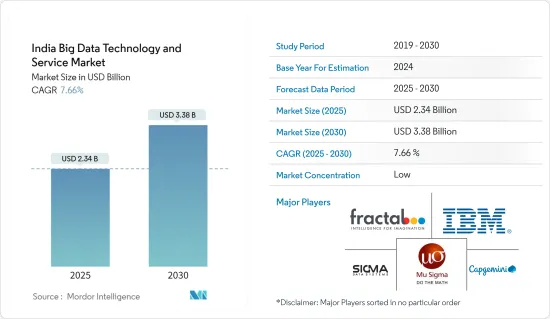
인도의 빅데이터 기술 서비스 시장 규모는 2025년 23억 4,000만 달러로 추정되며, 예측 기간(2025-2030년) 동안 7.66%의 연평균 복합 성장률(CAGR)로 2030년에는 33억 8,000만 달러에 달할 것으로 예상됩니다.
인도에서는 지난 몇 년동안 수많은 대기업과 중소기업이 진출하면서 빅데이터와 AI 생태계가 급성장하고 있습니다. 따라서 인도는 앞으로 더 많은 이용 사례와 데이터 과학자들에게 더 큰 비즈니스 기회를 제공함으로써 세계 최대 규모의 빅데이터 분석 시장이 될 것으로 예상됩니다.
주요 하이라이트
다양한 비즈니스 프로세스에서 적절한 인력과 자원의 부족으로 인해 분석 및 기타 디지털 솔루션의 도입이 증가하고 있습니다. 이러한 솔루션은 BFSI, 소매, 통신 등의 산업에서도 성장세를 보이고 있습니다. 인더스트리 4.0 시대에 데이터 분석은 특히 인공지능, 머신러닝, IoT 및 자동화와 관련하여 보다 지속 가능한 제조 공정을 위한 핵심 기술이 될 것으로 보입니다.
예를 들어, 소매업의 경우, 실적 부진을 유발하는 요인을 파악하거나 정확한 매출 예측을 위한 진단 분석 능력이 부족하여 불안정한 매출 실적에 시달리고 있는 것으로 관찰되고 있습니다. 이러한 상황에서 제조업체는 사내에 데이터 분석 팀을 육성할 시간도, 예산도 없습니다. 따라서, 실용적인 데이터 기반 통찰력을 얻기 위해 분석 아웃소싱을 활용하게 됩니다.
방대한 데이터 생성으로 인해 기업들은 고객 세분화, 각 부문의 선호도 이해, 행동 변화 대응, 서비스 개인화 등의 인사이트가 필요하게 되었습니다. 또한, 인터넷 사용 증가로 인해 조직은 방대한 양의 정형 및 비정형 데이터를 활용할 수 있게 되었습니다. 이러한 이점으로 인해 다국적 기업과 대기업들은 빅데이터를 분석하여 실질적인 통찰력을 얻고자 합니다.
빅데이터 분석을 통해 자동차 제조 부문은 여러 ERP 시스템에서 데이터를 수집하고 공급망의 여러 기능 단위와 비즈니스 구성원의 정보를 결합할 수 있으며, IoT와 M2M 통신의 출현으로 자동차 산업은 인더스트리 4.0을 위한 준비를 하고 있습니다. 준비하고 있습니다. 센서, 바코드 리더기, RFID, 로봇은 산업 제조 현장에서 표준이 되고 있습니다.
인도 산업계는 소비자의 행동 패턴을 더 잘 인식하고 이를 바탕으로 생산 계획을 세울 수 있으며, IoT의 발전과 전자 부품이 자동차에 필수적인 요소로 자리 잡으면서 자동차 부문에서도 비슷한 잠재력이 드러나고 있습니다.
또한 이 지역에서는 빅데이터 생태계를 강화하기 위한 투자가 급증하고 있습니다. 예를 들어, 2022년 1월 프랙탈 애널리틱스(Fractal Analytics Limited)는 사모펀드인 TPG 캐피탈 아시아(TPG Capital Asia)로부터 3억 6,000만 달러의 투자를 유치해 뮤 시그마(Mu Sigma)에 이어 인도에서 두 번째 유니콘 2022가 되었습니다. 분석 부문에서 뮤 시그마에 이어 인도에서 두 번째 유니콘 기업이 되었습니다. 또한 프랙탈은 클라우드, 데이터, 엔지니어링 및 AI 분야의 마이크로소프트 골드 컨설팅 파트너인 닐 애널리틱스(Neil Analytics)를 인수하여 태평양 북서부, 캐나다 및 인도에서 입지를 강화했습니다.
또한 2022년 4월 인도 국방부는 인공지능(AI), 첨단 영상 처리, 센서 시스템, 빅데이터 분석, 자율 무인 시스템, 안전한 통신 시스템 등의 솔루션을 제공할 수 있는 스타트업에 자금을 지원한다고 발표했습니다.
또한, 코로나19 위기가 산업 전반에 걸쳐 도전을 가져온 소프트웨어 기업들은 수요가 많은 기술에 더 집중하고 고객에게 서비스를 제공하기 위한 혁신적인 방법을 모색하고 있습니다. 그 결과 기술 지출이 감소했습니다. 인공지능(AI)과 빅데이터의 채택은 2020년 전체 IT 지출이 크게 감소하고 하드웨어에 심각한 영향을 미치고 소프트웨어 및 서비스 비즈니스가 둔화되는 것을 통해 성장할 수 있도록 설정되어 있었습니다. 코로나19 사태 초기 인도 정부는 무료 앱 'Aarogya Setu'(Aarogya Setu, 건강의 다리)를 출시하여 휴대폰 기록, 인공지능, 빅데이터를 수집하여 코로나19에 감염되었을 가능성이 있는 개인을 식별하는 데 도움을 주었습니다.
인도의 빅데이터 기술 시장 동향
BFSI 부문이 시장 성장을 견인할 것으로 예상
은행은 고객의 수입과 지출에 대한 광범위한 정보를 가지고 있습니다. 이 정보는 고객의 결제와 특정 기간 동안 계좌에 들어온 돈에 관한 것입니다. 금융기관은 이 데이터를 분석하여 고객의 급여가 증가했는지 감소했는지, 어떤 수입원이 더 안정적인지, 얼마를 사용했는지, 특정 거래를 위해 어떤 채널을 사용했는지 등을 판단할 수 있습니다. 데이터 분석을 통해 은행은 위험을 평가하고, 대출 여부를 결정하고, 고객이 이익을 받는 데 관심이 있는지, 투자에 관심이 있는지 여부를 판단할 수 있습니다.
India Brand Equity Foundation(IBEF)에 따르면, 인도에는 44개의 외국계 은행, 12개의 국영 은행, 22개의 민간 은행이 은행 면허를 취득했습니다. 또한 9만 6,000개 이상의 농촌 협동조합 은행이 있습니다. 또한, 광범위한 리스크 관리 시스템 개발은 금융 기업에게 매우 중요합니다. 리스크 관리를 철저히 하지 않으면 수익에 큰 타격을 입을 수 있기 때문입니다. 치열한 경쟁에서 살아남고 수익을 극대화하기 위해 기업은 끊임없이 새로운 아이디어를 혁신해야 합니다. 빅데이터 분석은 기업이 위험을 즉시 감지하고 잠재적인 사기로부터 고객을 보호할 수 있도록 도와줍니다.
인도 전자정보기술부(MeitY)에 따르면 2022-2023 회계연도에 인도의 디지털 결제는 전년 대비 45% 증가했으며, 2022-23년에는 1,346억 2,000만 루피(미화 16억 2,170만 달러), 2023-2024년에는 1,166억 루피(미화 1,464억 5,000만 달러)(14억 451만 달러)의 디지털 결제 거래가 있었습니다. 이러한 방대한 디지털 거래는 빅데이터 서비스에 대한 수요를 촉진할 것으로 보입니다.
지난 6월, 델리 국영은행은 부정행위에 대응하고, 결제를 중단할 수 있는 스트레스 고객을 식별하고, 데이터 분석을 통해 금융기관이 경쟁에서 한발 앞서 나갈 수 있도록 전문 분석팀을 구성할 것을 요구했습니다. 재무부는 모든 은행에 중요한 내부 및 외부 자원을 선정하고 새로운 수직적 통합에 참여할 것을 요청했습니다. 이를 통해 사기 및 부실채권 축적을 면밀히 모니터링하고 효율성을 높이기 위한 통찰력을 얻을 수 있을 것으로 보입니다.
통신-IT 부문이 큰 시장 점유율을 차지할 것으로 예상
빅데이터 기술의 성장은 블록체인, IoT, AI, 클라우드 컴퓨팅과 같은 신기술에도 기인합니다. 이러한 기술들은 인도에서 필요한 빅데이터 서비스를 촉진하고 있습니다.
최근 국내 빅데이터 서비스 제공업체가 증가하고 있는데, 림바이크, 지스퀘어, 테크밴티지, 블루피컨설팅, SIBIA 애널리틱스 등이 최근 몇년사이 등장한 몇 안 되는 업체들입니다. 또한, 정부의 데이터 현지화 정책으로 인해 데이터 현지화 정책으로 인해 진출기업 수가 증가한 것도 한 몫을 했습니다.
인도는 현재 세계 주요 빅데이터 분석 시장 중 하나이며, NASSCOM은 인도를 세계 3대 분석 시장 중 하나로 만들겠다는 목표를 세웠으며, NASSCOM은 인도의 분석 산업이 2025년까지 160억 달러에 달할 것으로 예상하고 있습니다. 이는 전 세계 분석 시장의 32%를 차지할 수 있다는 것을 의미합니다. 이 시나리오는 인도의 빅 데이터 분석 범위에 엄청난 기회를 반영합니다. 인도는 기술적으로 숙련되고 영어를 구사하는 인구의 자원 풀이 많기 때문에 빅데이터 분석 산업에서 높은 성장세를 보이고 있습니다.
노키아의 'India Mobile Broadband Index 2023' 보고서에 따르면, 2022년 사용자 1인당 월평균 데이터 소비량은 19.5기가바이트, 2021년 17기가바이트, 2020년 13.5기가바이트에 이어 2022년에도 19.5기가바이트가 될 것으로 예상됩니다. 전례 없는 데이터 소비량 증가는 이 방대한 자원을 저장하고 관리할 데이터센터의 필요성을 낳았고, 코로나19에 따른 전국적인 봉쇄 조치로 인해 재택근무, 온라인 교육, 레크리에이션으로 인해 데이터 사용량이 더욱 증가했습니다.
또한, 국내 통신 산업은 여러 기업의 진입으로 인해 강력한 성장을 이루고 있습니다. 예를 들어, 2022년 7월에는 억만장자 가우탐 아다니(Gautam Adani)의 그룹이 통신 주파수 확보 경쟁에 참여하여 공항부터 전력, 데이터센터까지 사업을 지원하는 사설 네트워크 구축에 사용할 것이라고 밝혔습니다.
인도의 빅데이터 기술 산업 개요
인도의 빅데이터 기술 및 서비스 시장 경쟁 구도은 여전히 경쟁이 치열하고 단편적입니다. 이는 주로 데이터 혁명에 빠르게 뛰어들 수 있었던 기존 IT 서비스 산업이 존재하기 때문입니다. 기존 진입자 외에도 많은 신생기업과 중견기업이 다양한 최종 사용자의 수직적 빅데이터 수요를 충족시키는 데 특화되어 있습니다. 최근 동향은 다음과 같습니다.
2022년 10월, Capgemini는 마이크로소프트와의 협력을 발표하며 세계 최초의 클라우드 네이티브, 서버리스, Azure 기반 디지털 트윈 플랫폼인 ReflectIOD(ReflectIOD)를 발표했습니다. 이 플랫폼은 Azure 제품군의 향상된 아키텍처와 기술 구성요소를 활용하여 조직의 운영 및 유지보수 효율성을 혁신하고, 지능형 산업을 실현하며, 지속 가능한 비즈니스 가치를 창출할 수 있도록 지원합니다.
2024년 1월, GenepoweRx가 AI 빅데이터 분석 및 신약개발 플랫폼을 발표했습니다. 우팔리 K&H 맞춤의료 클리닉의 진단 부문인 GenepoweRx는 독창적인 인공지능(AI) 플랫폼인 GeneConnectRx를 도입했습니다. 개인 맞춤형 의료의 획기적인 발전을 통해 의료 전문가들은 각 환자의 고유한 유전적 구성에 따라 치료를 조정할 수 있게 됩니다.
기타 혜택
엑셀 형식 시장 예측(ME) 시트
3개월간의 애널리스트 지원
목차
제1장 서론
조사의 전제조건과 시장 정의
조사 범위
제2장 조사 방법
제3장 주요 요약
제4장 시장 역학
제5장 시장 인사이트
시장 개요
산업 밸류체인 분석
산업 매력 - Porter의 Five Forces 분석
공급 기업의 교섭력
바이어의 교섭력
신규 진출업체의 위협
대체품의 위협
경쟁 기업간 경쟁 관계
COVID-19가 산업 에코시스템에 미치는 영향
제6장 시장 역학
시장 성장 촉진요인
시장 성장 억제요인
제7장 시장 세분화
유형별
솔루션
서비스(매니지드)
조직 규모별
중소기업
대기업
산업별
은행/금융서비스/보험(BFSI)
소매
통신 및 IT
미디어 및 엔터테인먼트
의료
기타
제8장 경쟁 구도
기업 개요
Mu Sigma Business Solutions Pvt. Ltd.
IBM Corporation
Sigma Data Systems
Capgemini SE
Fractal Analytics Limited
SAS Institute Inc.
WNS(Holdings) Ltd.
Wipro Ltd.
TIBCO Software Inc.
Infosys Ltd.
제9장 투자 분석
제10장 시장 기회와 향후 동향
LSH
영문 목차
영문목차
The India Big Data Technology & Service Market size is estimated at USD 2.34 billion in 2025, and is expected to reach USD 3.38 billion by 2030, at a CAGR of 7.66% during the forecast period (2025-2030).
In India, there has been a proliferation in the Big Data and AI ecosystem, with numerous large and small players entering in the past few years. Thus, the country is expected to become one of the world's largest Big Data Analytics markets, with better use cases and significant opportunities for data scientists in the future.
Key Highlights
The shortage of the right talent and resources for various business processes has led to the adoption of analytics and other digital solutions. These solutions are also witnessing growth in industries such as BFSI, Retail, Telecom, and many more. In the Industry 4.0 era, data analytics would be a key skill for more sustainable manufacturing processes, especially concerning artificial intelligence, machine learning, IoT, and automation.
Retailers, for instance, are observed suffering from unstable sales performance, lacking the capability of diagnostic analytics to identify what triggers poor performance or make accurate sales forecasts. At such a moment, the manufacturer lacks the time and budget to grow an in-house data analytics team. Therefore, they turn to analytics outsourcing to gain actionable and data-driven insight.
The generation of a huge amount of data has led companies to seek insights such as customer segmentation, understanding the preferences under each segment, staying updated with changes in behavior, and personalization of services. Additionally, due to the rise in internet usage, an enormous amount of structured and unstructured data is available to organizations. Such benefits have led multinational and large companies to analyze their big data for actionable insights.
Big data analytics allows the automobile manufacturing sector to collect data from multiple ERP systems to further combine information from several functional units of the supply chain and business members. With the emergence of IoT and M2M communication, the automotive industry is positioning itself toward Industry 4.0 ready. Sensors, barcode readers, RFIDs, and robots are becoming standard on the industry's manufacturing floor.
The Indian industries are more aware of consumer behavior patterns and can plan production based on these. A similar potential has been exposed in the automotive sector, with IoT evolutions and electronics components becoming integral to automobiles.
Additionally, the region is witnessing an upsurge in investments for enhancing its big data ecosystem. For instance, in January 2022, Fractal Analytics Limited became the second unicorn 2022 with an investment of USD 360 million from TPG Capital Asia, a private equity firm. After Mu Sigma, this is the second firm in India in the pure-play analytics space to get unicorn status. Further, Fractal acquired Neal Analytics, a cloud, data, engineering, and AI Microsoft Gold consulting partner, to help the company strengthen its presence in the Pacific Northwest, Canada, and India.
Further, in April 2022, the Defence Ministry of India announced that it would fund startups that can provide solutions to Artificial Intelligence (AI), advanced imaging, sensor systems, big data analytics, autonomous unmanned systems, and secured communication systems, among other technologies.
Further, software companies are intensifying their focus on in-demand technologies and exploring innovative ways to serve their clients even as the COVID-19 crisis created challenges across industries. It led to a reduction in technology spending. The adoption of artificial intelligence (AI) and big data was set to grow through the overall IT spending dropped significantly in 2020, with a severe impact on hardware and a slowdown in the software and services business. In the initial stage of the pandemic, the Government of India launched a free app, the Aarogya Setu, or Bridge to Health, to harvest mobile phone records, artificial intelligence, and big data to help identify individuals potentially exposed to COVID-19.
India Big Data Technology Market Trends
The BFSI Segment is Expected to Drive the Market's Growth
Banks have extensive information about the earnings and expenses of their customers. This information relates to their payments and the money that entered their accounts over a specific time frame. A financial institution can analyze this data to determine whether a client's salary has increased or decreased, which sources of revenue have been more consistent, how much money was spent, and which channels the client utilized to conduct certain transactions. By analyzing the data, banks can assess risks, decide whether to extend loans, and determine whether a client is more interested in receiving benefits or making investments.
According to the Indian Brand Equity Foundation (IBEF), 44 foreign banks, 12 public banks, and 22 private banks have banking licenses in India. Moreover, there are over 96,000 rural cooperative banks. Furthermore, developing an extensive risk management system is crucial for financial firms. They will experience a significant loss of revenue if they don't practice thorough risk management. To survive in the competitive world and maximize earnings, businesses must continuously innovate new ideas. Big data analysis aids businesses in detecting dangers instantly and, of course, safeguards customers from potential fraud.
According to the Ministry of Electronics and IT (MeitY), In India, digital payments rose 45% yearly (YoY) during the fiscal year (FY) 2022-2023. This period saw INR 13,462 crore(USD 1621.7million) digital payment transactions in (FY) 2022-23, and INR 11,660 crore (USD 1404.51 million) in till december 2023 for FY 2023-2024. Such huge digital transactions will drive the demand for big data services.
In June 2022, Delhi State-run banks were expected to have specialized analytics teams to combat frauds, identify stressed customers who might stop making payments, and assist the lenders in staying ahead of the competition through data analysis. The finance ministry requested that all banks select important internal and external resources to join the new vertical. This would give them insights to enhance efficiency while closely monitoring scams and accumulating bad loans.
The Telecommunication and IT Sector is Expected to Hold a Major Market Share
The growth of Big Data technologies could also be attributed to emerging technologies, like Blockchain, IoT, AI, and cloud computing. These technologies have provided the push for the necessary big data services in India.
There has been an increase in the number of big data service providers in the country recently. Lymbyc, G Square, TechVantage, BluePiConsulting, and SIBIA Analytics are a few firms that have come up in recent years. Furthermore, the increase in the number of players was also attributed to the government's data localization policy.
India is currently among the world's major big data analytics markets, and NASSCOM has set the target of making the country one of the top three. NASSCOM has predicted that the Indian analytics industry is expected to reach USD 16 billion by 2025. This means that it may account for 32% of the analytics market worldwide. This scenario reflects tremendous opportunities for the scope of big data analytics in India. India is witnessing high growth in the big data analytics industry due to its large resource pool of technically skilled, English-speaking population.
In 2022, according to Nokia's India Mobile Broadband Index 2023 report, the average monthly data consumption per user was 19.5 gigabytes, which was 17 gigabytes in 2021 and 13.5 gigabytes in 2020. The unprecedented growth of data consumption created the need for data centers to store and maintain this vast resource. The data usage increased further due to work from home, online education, and recreation in the backdrop of the COVID-19-led nationwide lockdown.
Further, the telecom industry in the country is witnessing robust growth due to the entry of several players. For instance, in July 2022, Billionaire Gautam Adani's group confirmed its entry into the race to acquire telecom spectrum, which it said would be used to create a private network to support its businesses from airports to power and data centers.
India Big Data Technology Industry Overview
The competitive landscape of India's Big Data Technology and Services market remains highly competitive and fragmented. This is primarily because of the presence of a well-established IT services industry that has been able to leap into the data revolution quickly. In addition to the established players, a number of startups and mid-sized companies specialize in catering to the Big Data needs of the world across various End-User verticals. Some of the recent developments are as follows:-
In October 2022. Capgemini announced its collaboration with Microsoft to deliver a first-of-its-kind, cloud-native, serverless Azure-based digital twin platform called ReflectIOD. The platform was to leverage the Azure suite's enhanced architecture and technological components to help transform an organization's operations and maintenance efficiency, enabling intelligent industry and driving sustainable business value.
In January 2024, AI big data analytics and drug discovery platform is launched by GenepoweRx. The diagnostic division of Uppaluri K&H Personalized Medicine Clinic, GenepoweRx, has introduced GeneConnectRx, an inventive artifical intelligence (AI) platform. Healthcare professionals will now be able to tailor therapies based on each patient's unique genetic composition due to this groundbreaking advancement in personalized medicine.
Additional Benefits:
The market estimate (ME) sheet in Excel format
3 months of analyst support
TABLE OF CONTENTS
1 INTRODUCTION
1.1 Study Assumptions and Market Definition
1.2 Scope of the Study
2 RESEARCH METHODOLOGY
3 EXECUTIVE SUMMARY
4 MARKET DYNAMICS
5 MARKET INSIGHT
5.1 Market Overview
5.2 Industry Value Chain Analysis
5.3 Industry Attractiveness - Porter's Five Forces Analysis
5.3.1 Bargaining Power of Suppliers
5.3.2 Bargaining Power of Buyers
5.3.3 Threat of New Entrants
5.3.4 Threat of Substitutes
5.3.5 Intensity of Competitive Rivalry
5.4 Impact of COVID-19 on the Industry Ecosystem
6 MARKET DYNAMICS
6.1 Market Drivers
6.1.1 Reduction in Cost of Implementation will act as a Driver
6.1.2 Increasing Number of Connected Devices
6.2 Market Restraints
6.2.1 Structural Barriers and Decentralized Systems act as a Restraint