임상 헬스케어 IT : 시장 점유율 분석, 산업 동향 및 통계, 성장 예측(2024-2029년)
Clinical Healthcare IT - Market Share Analysis, Industry Trends & Statistics, Growth Forecasts (2024 - 2029)
상품코드:1549967
리서치사:Mordor Intelligence
발행일:2024년 09월
페이지 정보:영문
라이선스 & 가격 (부가세 별도)
ㅁ Add-on 가능: 고객의 요청에 따라 일정한 범위 내에서 Customization이 가능합니다. 자세한 사항은 문의해 주시기 바랍니다.
ㅁ 보고서에 따라 최신 정보로 업데이트하여 보내드립니다. 배송기일은 문의해 주시기 바랍니다.
한글목차
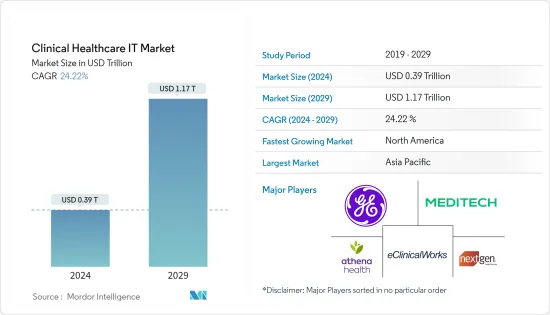
임상 헬스케어 IT 시장 규모는 2024년 3,900억 달러로 추정되며, 2029년에는 1조 1,700억 달러에 달할 것으로 예상되며, 예측 기간(2024-2029년) 동안 24.22%의 CAGR로 성장할 것으로 예상됩니다.
주요 하이라이트
지난 몇 년 동안 헬스케어 분야는 세계 디지털 혁신, COVID-19 사태, 인구 통계학적 변화, 환자 수요 증가 등 수많은 도전에 직면해 왔습니다. Morgan Stanley에 따르면, 헬스케어 분야에서 인공지능과 머신러닝에 투입되는 비용은 2022년 5.5%에서 2024년 약 10.5%를 넘어설 것으로 예상됩니다. 헬스케어 분야에서의 AI는 환자와의 소통부터 수술 보조, 신약 개발까지 거의 모든 분야에 혜택을 가져다 줄 수 있습니다.
국립 의학 도서관은 약 75%의 병원이 모바일 앱에 대한 액세스를 제공한다고 밝혔으며, 이는 mHealth(모바일 헬스)가 의료 분야에서 점점 더 많은 역할을하고 있음을 보여줍니다. 주요 Google Play 및 AppStore 플랫폼에서 사용할 수있는 모바일 건강(mHealth) 앱은 96,000 개가 넘으며 그 종류는 원격의료 앱을 포함하여 방대합니다. 미국 원격의료협회에 따르면, 미국 병원의 약 76%가 비디오 및 기타 기술을 사용하여 환자와 연결하고 의사와 상담하고 있습니다.
커넥티드 디지털 도구는 환자와 의료 서비스 제공자를 지원하고 치료의 연속성을 간소화함으로써 커넥티드 케어에서 중요한 역할을 합니다. 디지털 치료, 질병 검진, 환자 교육/훈련, 치료 탐색은 디지털 도구를 통해 개선될 수 있습니다. 웨어러블 기기는 현재 환자의 바이탈(혈압, A1C 등)을 실시간으로 모니터링하고 환자의 의료진에게 측정값을 전송할 수 있습니다. 또한, GenAI는 보험사에게 청구 관리 및 업무 효율화를 가져다 줄 수 있으며, GenAI 챗봇은 헬스케어 고객 서비스 업무에서 환자와의 인간과 같은 대화를 생성할 수 있습니다.
헬스케어 기술의 가장 큰 과제 중 하나는 상호운용성입니다. 연방 정부의 의료 의무화의 일환으로, 조직은 환자 데이터를 안전하게 유지하면서 의료진과 신속하게 공유할 수 있어야 합니다.
COVID-19 팬데믹은 재택 서비스 및 가상 진료에 대한 수요 증가를 포함하여 고비용의 급성기 및 급성기 이후 시설에서 저비용의 독립형 및 비급성기 시설로 진료의 이동을 가속화했습니다. 팬데믹은 헬스케어 분야에서 IoMT의 기능을 비약적으로 확장시켰습니다. 이번 호에서는 IoT, 인공지능 등 의료 서비스 개선에 활용되고 있는 최신 기술을 살펴봅니다.
임상 헬스케어 IT 시장 동향
전자건강기록(EHR)이 큰 성장세를 보일 것으로 전망
전자 의료 기록(EHR)은 환자 데이터의 중앙 저장소 역할을하여 정보 관리 프로세스를 효과적으로 효율화하는 의료 기술의 최신 트렌드입니다. 구글 클라우드의 조사에 따르면, 의사의 약 59%는 상호 운용성이 향상되면 고위험 환자를 더 빨리 파악할 수 있다고 생각하며, 95%는 상호 운용성이 향상되면 환자의 예후가 더 좋아질 것으로 생각한다고 답했습니다.
Kaiser Family Foundation에 따르면, 약 45%의 환자가 EHR 시스템 도입으로 의료의 질이 향상되었다고 응답했으며, 의료의 질이 떨어졌다고 응답한 환자는 약 6%에 불과했습니다.
앞으로 1년 동안 EHR 개발자와 IT 전문가들은 상호운용성 정책을 준수하기 위해 EHR 시스템을 지속적으로 업데이트할 것으로 보입니다. 2023년 8월 1일, CMS는 2024 회계연도의 메디케어 입원환자 예상 지불 시스템 요율을 3.1% 순증한다고 발표하여 EHR 시스템을 효과적으로 사용하고 품질 측정 데이터를 유지하는 병원과 진료소에 혜택을 주기로 했습니다.
eClinicalWorks와 같은 제공업체는 85만 명 이상의 의료진이 EHR 기술을 사용하고 있으며, 헬스케어 부문에 큰 영향을 미치고 있습니다. eClinicalWorks의 EHR 솔루션은 미국에서 널리 채택되어 13만 개 이상의 진료소에 서비스를 제공하고 있습니다.
Canadian Institute for Health Information에 따르면, 검사 결과에 전자적으로 접근할 수 있는 의사의 비율은 약 77%였습니다. 지역 클리닉의 EHR 도입률은 57%까지 상승했습니다. 캐나다는 EHR 이니셔티브를 포함한 디지털 건강 프로젝트에 20억 캐나다 달러 이상을 투자했습니다.
또한 AI 알고리즘은 EHR 데이터를 분석하여 패턴과 추세를 파악하여 의료 서비스 제공자가 워크플로우를 간소화하고, 문서화 정확도를 개선하고, 임상적 의사결정을 강화할 수 있도록 돕습니다. 예를 들어, 주요 EHR 소프트웨어 시스템 중 하나인 Epic EHR은 Microsoft의 Azure OpenAI 서비스를 사용하여 AI를 소프트웨어에 통합했습니다. 또 다른 EHR 소프트웨어 제공업체인 올스크립츠(Allscripts)는 Azure OpenAI의 GPT-4를 사용하여 개인화된 환자 관리 기능을 갖춘 EHR 시스템을 구축했습니다. 이 통합을 통해 의사는 개인화 된 치료 계획을 수립하고 환자의 참여를 유도하고 더 나은 치료 효과를 달성 할 수 있습니다.
아시아태평양은 큰 성장을 이룰 것으로 전망
아시아태평양은 세계 헬스케어 분야의 급속한 기술 혁신에 대한 준비가 되어 있습니다. 또한, 인도와 같이 인구가 많은 국가가 가장 큰 수혜를 입을 것으로 예상되며, Invest India에 따르면 향후 10년간 National Digital Health Blueprint는 헬스케어 부문에 2,000억 달러 이상의 경제적 가치를 창출할 수 있을 것으로 예상됩니다. 가능성이 있습니다.
National Health Authority는 인도의 디지털 건강 생태계에서 디지털 의료 기록 작성을 촉진하는 의료 서비스 제공자 및 기타 이해관계자에게 인센티브를 제공하고 있으며, 10병상 이상의 의료 시설, 진단 센터, HMIS(Health Management Information System) 및 LIMS(Health Management Information System) 등 디지털 솔루션 제공자에게 최대 4,000만 루피(약 500만 달러)를 제공하고 있습니다. Health Management Information System), LIMS 등 디지털 솔루션 제공업체에 최대 4,000만 인도 루피(약 50만 달러)가 지원됩니다. 이는 Ayushman Bharat Health 계정에 연결된 디지털 의료 기록의 수에 따라 제공됩니다.
한국의 보건의료 상황은 의료 IT 도입에 매우 적극적입니다. 모든 3차 병원은 이미 이러한 기술을 도입하여 EMR 시스템을 활용하여 환자 데이터를 디지털화하고, 임상 이미지를 디지털로 저장하여 AI가 추가로 분석할 수 있도록 하고 있습니다. 또한 정부는 2025년까지 약 18개의 스마트 병원을 설립할 계획으로 의료 IT 솔루션 제공업체에 큰 비즈니스 기회를 제공하고 있습니다.
싱가포르의 전략적 지리적 위치, 강력한 정보 기술 인프라, 정부의 강력한 지원으로 인한 혁신에 유리한 환경은 싱가포르가 아시아태평양의 디지털 헬스케어 허브로서 이상적인 목적지가 되고 있습니다. 슈퍼컴퓨팅 센터 및 엔비디아(Nvidia)와 협력하여 SGH 캠퍼스에서 슈퍼컴퓨터를 개발하고 있습니다. 이 슈퍼컴퓨터는 AI 전문 지식을 갖추고 있으며, 연구자들이 임상 결과를 개선하기 위해 더 많은 혁신을 개발하는 데 도움이 될 것으로 보입니다.
아시아 국가들은 디지털 인프라에 대한 투자가 증가하고 있으며, 임상 의료에 대한 수요가 확대될 것으로 예상됩니다.
임상 헬스케어 IT 산업 개요
임상 헬스케어 IT 시장은 세분화되어 있고, 수많은 경쟁사 및 경쟁 기술이 존재하기 때문에 기업 간 경쟁이 치열합니다. 또한, 혁신을 중시하는 대기업의 인수 및 제휴도 예상됩니다. GE헬스케어, Athenahealth, NextGen헬스케어 등을 예로 들 수 있습니다.
2024년 3월 스탠포드 메디슨과 마이크로소프트는 스탠포드 메디슨의 임상의에게 대화형, 앰비언트, 생성형 AI를 제공하는 Nuance Dragon Ambient eXperience Copilot(DAX)의 전사적 출시를 발표했습니다. Copilot)의 전사적 출시를 발표했습니다.
2024년 3월 프로비던스와 마이크로소프트는 헬스케어 분야의 AI 혁신을 가속화하기 위한 전략적 협력을 발표하고, 마이크로소프트 클라우드 포 헬스케어(Microsoft Cloud for Healthcare)와 애저(Azure)를 표준 플랫폼으로 활용해 상호운용성 향상, 임상적 인사이트 생성, 치료 제공 강화를 위한 AI 기반 애플리케이션 제공에 주력합니다. 상호운용성 향상, 임상적 인사이트 생성, 의료 서비스 제공을 강화하기 위한 AI 기반 애플리케이션 제공에 집중합니다.
기타 혜택
엑셀 형식의 시장 예측(ME) 시트
3개월간의 애널리스트 지원
목차
제1장 소개
조사 가정과 시장 정의
조사 범위
제2장 조사 방법
제3장 주요 요약
제4장 시장 인사이트
시장 개요
업계의 매력 - Porter's Five Forces 분석
구매자/소비자의 협상력
공급 기업의 교섭력
신규 참여업체의 위협
대체품의 위협
경쟁 기업 간의 경쟁 관계
생태계 분석
규제 상황에 관한 인사이트
거시경제 시나리오와 동향 평가
제5장 시장 역학
시장 성장 촉진요인
복잡한 헬스케어 데이터세트와 AI 및 ML 구현
클라우드 기반 전개 증가
시장 성장 억제요인
상호운용성과 신흥 프랙티스 표준화의 결여
시장의 통합과 통합 플랫폼으로의 이동
시장 기회
1인당 헬스케어 지출이 증가하는 신흥 경제국
헬스케어의 AI와 IoT 채용 증가
새로운 사용 사례와 연구
제6장 시장 세분화
소프트웨어별
전자의무기록
실험실 정보 관리 시스템(LIMS)
원격의료와 원격 건강
영상 보존 통신 소프트웨어(PACS)
전산화된 공급자 주문 입력(CPOE)
기타(청구, 환자 포털, 전자처방전)
최종사용자별
정부·공중위생
민간 병원·진단 센터
지역별
북미
미국
캐나다
유럽
독일
영국
프랑스
이탈리아
아시아태평양
중국
일본
인도
한국
라틴아메리카
브라질
아르헨티나
멕시코
중동 및 아프리카
아랍에미리트
사우디아라비아
남아프리카공화국
제7장 경쟁 상황
기업 개요
Cognizant Technology Solutions Corporation
GE Healthcare
Athenahealth
Medical Information Technology Inc.
Clinicea
NextGen Healthcare
Veradigm LLC
eClinicalWorks
Epic Systems Corporation
Oracle Corporation
제8장 시장 향후 전망과 기회
ksm
영문 목차
영문목차
The Clinical Healthcare IT Market size is estimated at USD 0.39 trillion in 2024, and is expected to reach USD 1.17 trillion by 2029, growing at a CAGR of 24.22% during the forecast period (2024-2029).
Key Highlights
Over the past few years, the healthcare sector has faced numerous challenges, including the worldwide digital transformation, the COVID-19 pandemic, significant demographic shifts, and growing patient demands. According to Morgan Stanley, the costs dedicated to artificial intelligence and machine learning in the healthcare sector are expected to surpass around 10.5% in 2024, up from 5.5% in 2022. AI in healthcare can benefit almost everything, from communication with patients to assisting with surgeries and creating new pharmaceuticals.
The National Library of Medicine stated that around 75% of hospitals offered mobile app access, indicating mHealth's growing role in medicine. With over 96,000 mobile health (mHealth) apps available on major Google Play and AppStore platforms, their variety is vast, including telehealth apps. According to the American Telemedicine Association, around 76% of US hospitals connect with patients and consult practitioners using video and other technology.
Connected digital tools play a significant role in connected care by assisting patients and providers in streamlining the care continuum. Digital therapeutics, disease screening, patient education/training, and care navigation can be improved using digital tools. Wearable devices can now monitor a patient's vitals (blood pressure, A1C, etc.) in real time and send readings to a patient's provider. Further, GenAI can provide efficiency benefits for insurers in billing management and operations, and GenAI chatbots can produce human-like interactions for patients in healthcare customer service tasks.
One of the biggest challenges of technology in healthcare is interoperability. As part of federal healthcare mandates, organizations must be able to keep patient data secure while also sharing it quickly with care teams.
The COVID-19 pandemic accelerated care movement from high-cost acute and post-acute sites to lower-cost freestanding and non-acute sites, including increased demand for home-based services and virtual care. The pandemic helped expand the function of IoMT in healthcare at an exponential rate. The volume provides an overview of modern technologies used to improve healthcare, such as IoT, artificial intelligence, and others.
Clinical Healthcare IT Market Trends
Electronic Health Record (EHR) is Expected to Witness Significant Growth
An electronic health record (EHR) is the current trend in healthcare technology, serving as a centralized repository for patient data and effectively streamlining the information management process. A Google Cloud study found that around 59% of doctors think that better interoperability helps them quickly figure out which patients are at high risk, while 95% agree that improved interoperability would make patient outcomes better.
According to the Kaiser Family Foundation, approximately 45% of patients reported that the quality of care had increased due to EHR system adoption, with only around 6% reporting a decline in the quality of care.
In the upcoming year, EHR developers and IT specialists will continue to ensure that they update EHR systems to comply with interoperability policies. On August 1, 2023, CMS announced a 3.1% net increase in Medicare inpatient prospective payment system rates for fiscal year 2024, benefiting hospitals and clinics that effectively use EHR systems and maintain quality measurement data.
Providers such as eClinicalWorks substantially impact the healthcare sector, with over 850,000 healthcare professionals utilizing EHR technology. Their EHR solutions are widely adopted in the United States, serving more than 130,000 medical practices.
As per the Canadian Institute for Health Information, the percentage of physicians with electronic access to lab results was around 77%. The EHR adoption rates in community practices increased to 57%. Canada invested over CAD 2 billion in digital health projects, including EHR initiatives.
Moreover, AI algorithms can analyze EHR data to identify patterns and trends, helping healthcare providers streamline workflows, improve documentation accuracy, and enhance clinical decision-making. For example, Epic EHR, one of the leading Electronic Health Records software systems, integrated the AI into its software using Microsoft's Azure OpenAI service. Another EHR software provider, Allscripts, used Azure OpenAI's GPT-4 to create an EHR system with personalized patient care capabilities. The integration assists physicians in creating personalized treatment plans, encouraging patient engagement, and achieving better treatment effectiveness.
Asia-Pacific is Expected to Witness Significant Growth
Asia-Pacific is ready for rapid technological changes in global healthcare. Moreover, a country like India, which has such a vast population, might benefit the most. As per Invest India, over the next 10 years, the National Digital Health Blueprint can unlock the incremental economic value of over USD 200 billion for the healthcare sector.
The National Health Authority is providing incentives to healthcare providers and other stakeholders in India's digital health ecosystem who are promoting the creation of digital health records. Up to INR 40 million (nearly USD 500,000) will be made available to ten or more-bed health facilities, diagnostic centers, and digital solutions providers, such as HMIS (Health Management Information System) and LIMS. It will be provided based on the number of digital health records created and linked to the Ayushman Bharat Health Account.
South Korea's healthcare landscape is highly receptive to the adoption of health IT. All tertiary hospitals have already embraced these technologies, utilizing the EMR systems to digitize patient data and store clinical images digitally, which AI further analyses. Moreover, the government plans to establish around 18 smart hospitals by 2025, offering substantial opportunities to health IT solution providers.
Singapore's strategic geographical location, strong information technology infrastructure, and favorable climate for innovation due to strong government support make it an ideal destination for a digital healthcare hub in the Asia-Pacific region. As of March 2022, SingHealth partnered with the National Supercomputing Centre and Nvidia to develop a supercomputer at the SGH campus. This supercomputer has expertise in AI and will help researchers develop more innovations to improve clinical outcomes.
With increasing investments in digital infrastructure in Asian countries, the demand for clinical healthcare is expected to grow.
Clinical Healthcare IT Industry Overview
The clinical healthcare IT market is fragmented, with numerous competitors and competing technologies that provide intense rivalry among the players. Further, acquisitions and collaborations of large companies are expected, focusing on innovation. Some of the players include GE Healthcare, Athenahealth, and NextGen Healthcare.
March 2024: Stanford Medicine and Microsoft announced the enterprise-wide deployment of Nuance Dragon Ambient eXperience Copilot (DAX Copilot), providing conversational, ambient, and generative AI to Stanford Medicine's clinicians.
March 2024: Providence and Microsoft announced a strategic collaboration aimed at accelerating AI innovation in healthcare. Leveraging Microsoft Cloud for Healthcare and Azure as a standard platform, the collaboration focuses on delivering AI-powered applications to improve interoperability, generate clinical insights, and enhance care delivery.
Additional Benefits:
The market estimate (ME) sheet in Excel format
3 months of analyst support
TABLE OF CONTENTS
1 INTRODUCTION
1.1 Study Assumptions and Market Definition
1.2 Scope of the Study
2 RESEARCH METHODOLOGY
3 EXECUTIVE SUMMARY
4 MARKET INSIGHTS
4.1 Market Overview
4.2 Industry Attractiveness - Porter's Five Forces Analysis
4.2.1 Bargaining Power of Buyers/Consumers
4.2.2 Bargaining Power of Suppliers
4.2.3 Threat of New Entrants
4.2.4 Threat of Substitute
4.2.5 Intensity of Competitive Rivalry
4.3 Industry Ecosystem Analysis
4.4 Insights on the regulatory landscape
4.5 Assessment of macro-economic scenarios and trends
5 MARKET DYNAMICS
5.1 Market Drivers
5.1.1 Complex Healthcare Datasets and Implementation of AI and ML
5.1.2 Increase in Cloud-based Deployment
5.2 Market Restraints
5.2.1 Interoperability & Lack of Standardization of Emerging Practices
5.2.2 Market Consolidation and Shift Toward Integrated Platform
5.3 Market Opportunities
5.3.1 Emerging Economies with Increasing Per Capita Healthcare Expenditures
5.3.2 Rising Adoption of AI and IoT in Healthcare
5.4 Emerging Use Cases and Studies
6 MARKET SEGMENTATION
6.1 By Software
6.1.1 Electronic Health Records
6.1.2 Lab Information Management System (LIMS)
6.1.3 Telemedicine and Telehealth
6.1.4 Picture Archiving and Communication Software (PACS)
6.1.5 Computerized Provider Order Entry (CPOE)
6.1.6 Others (Billing, Patient Portals, and E-prescriptions)