


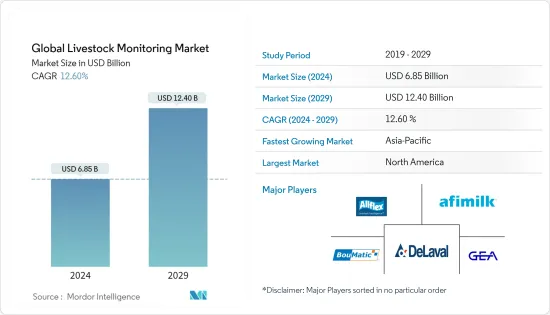
세계 가축 모니터링 시장 규모는 2024년 68억 5,000만 달러로 추정되고, 2029년까지 124억 달러에 이를 것으로 예측되며, 예측 기간 동안 복합 연간 성장률(CAGR) 12.60%로 성장할 전망입니다

COVID-19는 생산 산업뿐만 아니라 축산업에도 큰 영향을 미칩니다. COVID-19 감염의 전국적인 확산을 억제하기 위해 정부가 부과한 제한은 축산업계에 중대한 영향을 미치고, 동물사료공급망을 차단하고, 축산 서비스를 저하시키고, 질병 발견 지연 포함하는 동물 보건 서비스를 제한합니다. 그리고 치료. 예를 들어, 2020년 국립 생명공학센터에 따르면 COVID-19 감염의 발생으로 인도 유제품 산업은 적어도 신형 코로나 바이러스 감염의 영향으로 국내 총 수요가 약 25-30% 감소했기 때문에 큰 타격을 받았다고 합니다. 락다운부터 첫 달, 즉 2020년 3월 25일 이후. 또한, 코로나 바이러스의 확산을 억제하기 위해 정부는 국경을 봉쇄하여 차량의 이동을 제한했으며, 국경 지역의 고객에게 우유의 수송을 더욱 방해했습니다.
시장 확대는 암소의 머리 수가 증가하고 짐승 공통 감염의 발생률이 증가하는 것 외에도 가축 모니터링 관리와 관련된 상당한 비용 절감으로 인한 가축 모니터링 기술 채택 증가로 인한 것입니다. 지난 수십년동안 전 세계에서 가축의 수가 증가하고 있습니다. 예를 들어(2021년)에는 인도, 브라질, 중국이 세계 소 재고의 65% 이상을 차지했습니다. 또한 선진국에서는 동물감시장치가 일반적으로 되어 가축의 실시간 감시가 가능하게 되었습니다. 시장 확대를 추진하는 주요 요인으로는 실시간 모니터링과 질병의 조기 진단에 대한 주목 증가, 가축 모니터링에서 IoT와 AI의 사용 확대, 세계 식육 수요 증가 등이 있습니다. 예를 들어 Allflex Livestock Intelligence는 2021년 10월에 지능형 SenseHub 모니터링 귀 태그의 향상된 버전을 출시했습니다. 여기에는 집단 환경에서 개별 동물의 검출을 지원하는 다기능 LED가 탑재되어 있습니다. 모든 연령대의 젖소와 육우의 미묘한 번식력과 반추 행동 패턴을 추적하여 발정기에 있는지 또는 추가 치료 및 치료가 필요한지 여부를 결정합니다.
또한 제품 라인과 혁신에 중점을 둔 시장 진출기업 간의 치열한 경쟁은 가축 관리의 미래에 영향을 미칩니다. 예를 들어 2020년 3월 미국에 본사를 둔 CattleEye는 AI를 활용한 가축 관리 플랫폼을 도입했습니다. 이 플랫폼을 사용하는 사용자는 암소와 건강, 사료 및 환경의 삶의 상태를 확인하고 생산성을 향상시킬 수 있습니다.
가금류 제품의 매일 소비량 증가는 이 부문의 성장을 가속하는 중요한 요소입니다. Statista에 따르면 2021년 세계 고기 소비량은 두 배가 되었고 2020년에는 3억 2,400만 톤에 달했습니다. 경제협력개발기구가 발표한 데이터에 따르면 2021년에도 가금육이 식육생산 성장의 주요 원동력이 될 것입니다. 과거 10 년보다 느린 속도는 무엇입니까. 게다가 2030년까지 전 세계적으로 3억 7,167만 5,000톤의 고기가 소비될 것으로 추정됩니다.
북미는 예측 기간 동안 시장에서 큰 점유율을 차지할 것으로 예상됩니다. 이는 첨단 기술 개발과 닭고기 제품의 소비량 증가로 인한 것입니다. 경제협력개발기구가 2021년에 발표한 데이터에 따르면 북미에서는 2030년까지 48,602천cwe의 고기가 소비되고, 그 중 미국에서는 44,949천cwe, 캐나다에서는 3,653천cwe를 차지할 것으로 추정되고 있습니다. 유엔 식량농업기관(UNFAO)에 따르면 미국은 세계 최대의 닭고기 생산국이며 2021년에는 2,040만 톤의 육계육을 생산할 것으로 추정됩니다. 게다가 인수 공통 감염의 만연으로 인해 질병 동물을 감시하는 기술에 대한 수요가 증가하고 북미 시장을 견인할 것으로 예상됩니다.
세계 가축 모니터링 시장은 많은 선수들이 존재하고 적당한 경쟁이 계속되고 있습니다. 그 결과 기업은 지속가능성을 보장하기 위한 고급 모니터링 시스템과 센서 개발, 비용 절감, 혁신에 중점을 둘 것입니다. 주요 기업로는 Allflex Livestock Intelligence, Afimilk Ltd., DeLaval, GEA Farm Technologies, BouMatic 등이 있습니다.
The Global Livestock Monitoring Market size is estimated at USD 6.85 billion in 2024, and is expected to reach USD 12.40 billion by 2029, growing at a CAGR of 12.60% during the forecast period (2024-2029).
COVID-19 has majorly impacted the livestock industry as well as the production industries. The restrictions imposed by the government to control the spread of COVID-19 among the nation have had a significant impact on the livestock industry, interrupting the supply chain for animal feed, lowering animal husbandry services, and limiting animal health services including delays in illness detection and treatment. For instance, According to the National Center for Biotechnology Center, 2020, with the incidence of COVID-19, the dairy industry in India has suffered significantly due to the reduced overall demand of about 25-30% in the country, at least during the first one month after the lockdown, that is, since March 25, 2020. In addition, to control the spread of coronavirus, the government has sealed the borders to restrict vehicle mobility which further hampered the transfer of milk to customers in the border regions.
The market's expansion can be ascribed to an increase in the cow population, increased incidences of zoonotic diseases, as well as the increasing adoption of livestock monitoring technologies, as there is substantial cost-saving associated with livestock monitoring management. The livestock population has been increasing over the past few decades globally. For instance, India, Brazil, and China accounted for over 65% of the global cattle inventory in 2021. In addition, animal monitoring devices have become more common in industrialized nations, allowing for real-time monitoring of livestock. Some of the primary drivers driving market expansion include a growing focus on real-time monitoring and early illness diagnosis, expanding usage of IoT and AI for livestock monitoring, and rising worldwide demand for meat. For instance, In October 2021, Allflex Livestock Intelligence launched an enhanced version of its intelligent SenseHub monitoring ear tag, which will have a multi-function LED to aid in the detection of individual animals in a group environment. It keeps track of delicate fertility and rumination behavioral patterns in dairy and beef cattle of all ages to determine whether they are in heat or require additional care or treatment.
Furthermore, fierce competition among market participants, with a strong focus on product lines and innovations, is influencing the future of livestock management. For instance, in March 2020, the United States-based CattleEye introduced an AI-backed livestock management platform. Users with this platform would be able to identify cows and living conditions of their health, feed, and environment to improve productivity.
The increased daily consumption of poultry products is a crucial factor driving this segment's growth. According to Statista, 2021, The global consumption of meat has doubled, reaching 324 million metric tons in 2020. According to the data published by the Organization for Economic Cooperation and Development, in 2021, poultry meat will remain the key driver of meat production growth, albeit at a slower rate than in the previous decade. In addition, it is estimated that 371,675 kt of meat consumed by 2030, worldwide.
North America is expected to have a significant share of the market in the forecast period. This is due to the high technological developments and increased consumption of poultry products. According to the data published by Organization for Economic Cooperation and Development, in 2021, it has been estimated that 48,602 kt cwe meat will be consumed by 2030 in North America, accounting for 44,949 kt cwe in the United States and 3,653 cwe in Canada. According to the Food and Agriculture Organization of the United Nations (UNFAO), the United States is the largest producer of chicken meat in the world, estimated to produce 20.4 million metric tons of broiler meat in 2021. In addition, the prevalence of zoonotic diseases has fueled the demand for technology to monitor sick animals, which is anticipated to drive the North American market.
The global livestock monitoring market is moderately competitive with the presence of many players. As a result, players focus on developing advanced monitoring systems and sensors, cost reduction, and innovation to ensure sustainability. Some of the major players are Allflex Livestock Intelligence, Afimilk Ltd., DeLaval, GEA Farm Technologies, and BouMatic.