


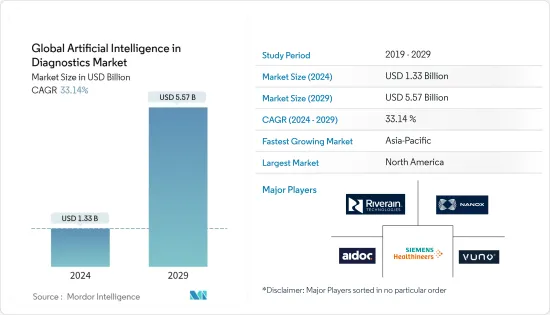
세계의 진단용 AI(인공지능) 시장 규모는 2024년에 13억 3,000만 달러로 추정되고 2029년까지 55억 7,000만 달러에 달할 것으로 예측되고 있으며, 예측 기간(2024-2029년) 중 33.14%의 CAGR로 성장합니다.
COVID-19는 의료 시스템, 특히 진단에 큰 영향을 미치고 있습니다. 전 세계 봉쇄 조치로 인해 대중의 이동이 감소하여 진단 산업에 영향을 미쳤습니다. 또한 COVID-19는 세계 경제에 영향을 미쳤을 뿐만 아니라 전 세계 병원의 COVID-19 외 환자들을 위한 일반적인 병원 의료 기능에도 큰 영향을 미쳤습니다. 그러나 전 세계에서 영상 진단에 대한 수요가 증가함에 따라 진단용 AI 도입에 대한 수요도 증가하고 있습니다. 2021년 4월에 발표된 'COVID-19 진단을 위한 AI: 과제와 전망' 기사에 따르면 진단을 포함한 의료 시스템의 다양한 수준에서 AI가 도입되고 있습니다. 특히 현재와 같은 팬데믹 상황에서 AI 알고리즘은 COVID-19 환자의 신속한 진단에 필수적입니다.
또한 진단부터 의약품 개발, 질병 전파 예측, 인구 감시 및 모니터링에 이르기까지 AI 툴은 전염병의 깊이와 복잡성에 대처하기 위해 채택되었습니다. 2021년 4월 'Nature Public Health Emergency Collection'지에 게재된 'COVID-19 팬데믹 대응을 위한 AI의 역할'이라는 제목의 연구는 시간적 단계적 방법을 제안했습니다. 여기에는 AI가 어떻게 작동하는지에 대한 최근 연구 조사를 소개하고, AI가 어떻게 작동하는지 조사하는 것이 포함됩니다. 사회와 의료 시스템을 관찰하고 행동하며 다양한 유형의 데이터를 보고합니다. 따라서 SARS-CoV-2 환자 진단을 위한 AI 툴의 도입은 대유행 단계 전반에 걸쳐 중요한 역할을 수행하여 시장 성장을 가속했습니다.
또한 의료 영상 분야의 AI 툴에 대한 수요 증가, 방사선과 의사의 부담 경감에 대한 관심 증가, AI 기반 기술 도입을 촉진하기 위한 정부의 구상, AI 기반 스타트업에 대한 자금 조달 증가 등의 요인이 예상됩니다. 시장 성장을 빠르게 강화할 것입니다.
이미징 기기에 AI를 통합하면 진단을 개선할 수 있으며, 이는 예측 기간 중 전체 시장 성장을 가속할 것으로 예상됩니다. 예를 들어 2021년 12월 미국 의사협회 저널에 게재된 '다기관 연구를 통한 인체 결절 검출 정확도에 대한 AI 기반 흉부 엑스레이 모델'이라는 제목의 기사에서 AI 알고리즘이 검출 향상과 관련이 있다고 보고했습니다.
또한 전 세계에서 AI 스타트업에 대한 자금 지원이 증가함에 따라 영상 진단 분야에 AI를 도입하려는 수요가 증가하고 있습니다. 예를 들어 2022년 3월 4,000만 달러의 투자를 유치한 헬스케어 기업 Qure.ai(Qure)는 의료 영상 진단에 AI를 적용하고 있습니다. Qure.ai(Qure.ai)는 이 자금을 통해 특히 미국과 유럽에서 세계 입지를 확대하고 개선하며, 응급 및 지역 진단용 제품 개발을 가속화할 것이라고 밝혔습니다. 따라서 이러한 자금 조달은 시장 성장에 기여할 것으로 예상됩니다.
따라서 앞서 언급한 요인으로 인해 조사 대상 시장은 분석 기간 중 성장할 것으로 예상됩니다. 그러나 숙련된 AI 인력 부족과 의료 소프트웨어에 대한 모호한 규제 지침은 시장 성장을 억제할 것으로 예상됩니다.
엑스레이 부문은 예측 기간 중 큰 시장 점유율을 차지할 것으로 예상됩니다. 엑스레이는 대부분의 영상의학과에서 시행되는 가장 일반적인 영상 검사이기 때문에 AI가 기존 엑스레이 사진(엑스레이 이미지)의 분류 및 해석을 지원할 수 있는 가능성은 특히 중요합니다. 엑스레이에 AI를 도입하면 효율성, 정확성, 접근성, 워크플로우를 개선하고 시간을 단축하며 품질과 환자 안전을 향상시킬 수 있습니다. 이러한 장점은 엑스레이 분야에서 AI에 대한 수요를 증가시켜 예측 기간 중 이 부문의 성장을 가속할 것으로 예상됩니다.
또한 2021년 8월에 발표된 "이 알고리즘은 엑스레이를 보고 어떤 식으로든 인종을 감지한다"라는 제목의 기사에서 최근 시장 관계자들이 엑스레이를 해석하고 상태를 식별하기 위해 AI 소프트웨어를 만드는 데 많은 비용을 지출하고 있다고 밝혔습니다. 폐종양의 경우와 같이 의사가 때때로 검사하는 경우도 있습니다. 또한 위에서 언급했듯이 이러한 알고리즘은 임상의가 찾지 않는 스캔의 일부 데이터 포인트를 감지 할 수 있습니다. 이러한 개발과 엑스레이에 AI를 더 많이 통합하는 것은 부문의 성장을 가속할 것으로 예상됩니다.
또한 업계 기업의 제품 출시가 증가하면서 이 분야의 성장을 가속할 것으로 예상됩니다. 예를 들어 후지필름이 개발한 AI를 활용한 흉부 엑스레이 검사 프로그램 'CXR-AID'는 일본 의약품의료기기종합기구(PMDA)의 인증을 받아 2021년 8월부터 일본에서도 사용할 수 있게 됩니다. 루닛의 AI 기술을 활용해 만든 CXR-AID는 엑스레이 영상에서 흉부 결절, 경화, 기흉 등 중대한 이상 소견을 인식할 수 있습니다.
따라서 위의 요인으로 인해 이 부문은 분석 기간 중 성장할 것으로 예상됩니다.
북미 진단 시장에서 AI의 사용은 의료 시스템에서 첨단 기술의 사용 증가와 국내 만성질환의 부담 증가에 의해 촉진되고 있습니다.
예를 들어 미국암협회가 2022년 1월에 발표한 'Cancer Facts and Figures 2022'에 따르면 2022년에는 약 190만 명의 새로운 암 환자가 진단될 것으로 예상되며, 그 중 전립선암이 186,670명, 폐암이 169,870명으로 그 뒤를 이을 것으로 추정됩니다. 으로 추정됩니다. 여성 유방암은 144,490건입니다. 암 발병률 증가와 다른 만성질환의 심각한 부담으로 인해 정확한 진단과 치료에 대한 수요가 증가하고 있습니다. 이는 조기 진단 목적으로 AI의 채택을 증가시켜 궁극적으로 시장 성장을 가속할 수 있습니다.
또한 캐나다 정부가 2021년 11월에 발표한 통계에 따르면 2021년에 약 229,200명의 캐나다인이 암 진단을 받을 것으로 예상되며, 전립선암은 2021년에 전체 암 진단의 46%를 차지할 것으로 예상되며, 전립선암은 계속해서 가장 많이 진단되는 암으로 예상됩니다. 같은 자료에 따르면 여성 8명 중 1명은 일생 중 어느 시점에 유방암에 걸릴 것이라고 합니다. 따라서 암 환자 수가 증가함에 따라 조기 진단에 대한 수요도 증가하여 예측 기간 중 진단용 AI에 대한 수요가 증가할 것입니다.
일부 시장 참여자들은 전략적 구상을 실행하여 시장 성장에 기여하고 있습니다. 예를 들어 2021년 12월 로슈는 유방암을 위해 개발된 세 가지 AI 기반 딥러닝 이미지 분석 연구 사용 전용(RUO) 알고리즘을 도입했습니다. 또한 2022년 4월, 벤더 중립적인 AI 플랫폼인 Arterys는 강력한 Cardio AI 임상 용도을 위한 몇 가지 새로운 모듈과 딥러닝을 기반으로 한 추가(8번째) 식품의약국(FDA) AI 승인을 발표했습니다.
따라서 앞서 언급한 요인들은 북미의 예측 기간 중 시장 성장에 기여할 수 있습니다.
진단용 AI 시장은 적당한 경쟁이 존재하며, 몇몇 주요 기업으로 구성되어 있습니다. 현재 시장을 독점하고 있는 기업으로는 Siemens Healthineers, Nanox Imaging LTD(Zebra Medical Vision, Inc.), Riverain Technologies, Vuno, Inc. Analytics, Imagen Technologies, Digital Diagnostics, Inc., GE Healthcare, AliveCor, Enlitic, InformAI 등이 있습니다.
The Global Artificial Intelligence in Diagnostics Market size is estimated at USD 1.33 billion in 2024, and is expected to reach USD 5.57 billion by 2029, growing at a CAGR of 33.14% during the forecast period (2024-2029).
The COVID-19 pandemic has significantly impacted the healthcare system, particularly diagnostics. The lockdown measures worldwide decreased public mobility and impacted the diagnostic industry. Moreover, the COVID-19 pandemic not only affected the global economy but also greatly impacted the functioning of general hospital care for non-COVID-19 patients in hospitals across the globe. However, with the increasing demand for diagnostic imaging procedures globally, the demand for implementing artificial intelligence in diagnostics is also increasing. According to the article "Artificial intelligence in the diagnosis of COVID-19: challenges and perspectives," published in April 2021, at different levels of the healthcare system, including diagnosis, artificial intelligence (AI) has been implemented. Particularly during the current pandemic, AI algorithms are crucial for the quick diagnosis of COVID-19 patients.
Additionally, AI tools were employed to handle the pandemic's depth and complexity, from diagnosis to drug development, disease transmission prediction, and population monitoring and surveillance. A study titled "The Role of Artificial Intelligence in Fighting the COVID-19 Pandemic," published in the Journal of "Nature Public Health Emergency Collection" in April 2021, proposed a temporal step method, which includes presenting recent research investigations, examining how AI observes and acts on society and the healthcare system, and reporting various data types. Hence, the deployment of AI tools in diagnosing patients with SARS-CoV-2 played a substantial role throughout the pandemic phase, thereby augmenting the market growth.
Furthermore, factors such as increasing demand for AI tools in the medical imaging field and rising focus on reducing the workload of radiologists, government initiatives to increase the adoption of AI-based technologies, and growth in funding for AI-based start-ups are anticipated to bolster the growth of the market shortly.
Incorporating artificial intelligence into imaging devices may improve the diagnosis, which is expected to aid the overall market growth during the forecast period. For instance, the Journal of the American Medical Association article titled "An Artificial Intelligence-Based Chest X-ray Model on Human Nodule Detection Accuracy from a Multicenter Study," published in December 2021, reported that an artificial intelligence algorithm was associated with improved detection of pulmonary nodules on chest radiographs compared with unaided interpretation for different levels of detection difficulty and readers with different experience. The research articles stated that artificial intelligence could be a promising technology for medical imaging shortly.
Moreover, factors such as increasing funding for AI start-ups globally are increasing the demand for increasing incorporation of AI in the diagnostic imaging modalities. For instance, in March 2022, Qure.ai (Qure), a health-tech business raising USD 40 million in fundraising, employs artificial intelligence (AI) for medical imaging diagnostics. The company further declared that it would utilize the funding to broaden and improve its global presence, particularly in the United States and Europe, and accelerate the development of products for critical care and community diagnostics. Therefore, such fundraising is anticipated to contribute to market growth.
Thus, owing to the aforementioned factors, the market studied is anticipated to grow over the analysis period. However, the lack of a skilled AI workforce and ambiguous regulatory guidelines for medical software is expected to restrain the market's growth.
The X-rays segment is expected to garner a significant market share during the forecast period. Since X-rays are the most common imaging test performed in most radiology departments, the potential for artificial intelligence (AI) to aid with the triage and interpretation of traditional radiographs (X-ray images) is particularly significant. Incorporating AI in X-rays enhances its efficiency, accuracy, ease of access, and workflow, reducing time and increasing quality and patient safety. These advantages are expected to increase the demand for AI in X-rays, boosting the segment's growth during the forecast period.
Additionally, the article titled "These Algorithms Look at X-Rays-and Somehow Detect Your Race," published in August 2021, stated that recently market players are heavily spending on innovations to create artificial intelligence software that interprets x-rays and for identifying conditions that doctors occasionally check, such as in the case of lung tumors. Additionally, as mentioned above, these algorithms can detect several data points on these scans that clinicians don't look for. Such developments and the growing incorporation of AI in X-rays are anticipated to drive segment growth.
Furthermore, the increase in product launches by the industry players is anticipated to drive the segment's growth. For instance, in August 2021, CXR-AID, a chest X-ray program powered by artificial intelligence (AI) developed by Fujifilm, will be made available in Japan after receiving certification from the Pharmaceuticals and Medical Devices Agency (PMDA). CXR-AID, which was created utilizing Lunit's AI technology, can recognize significant abnormal findings from X-ray images, such as chest nodules, consolidation, and pneumothorax.
Thus, owing to the abovementioned factors, the segment is expected to grow over the analysis period.
The use of artificial intelligence in the diagnostics market in North America is being driven by the increasing use of advanced technology in healthcare systems and the rising burden of chronic diseases in the country.
For instance, according to Cancer Facts and Figures 2022 published in January 2022 by the American Cancer Society, an estimated 1.9 million new cancer cases will be diagnosed in 2022, among which prostate cancer is estimated to be 186,670, followed by 169,870 cases of lung cancer, and 144,490 cases of female breast cancer. The increased prevalence of cancer and the high burden of other chronic diseases increase the demand for accurate diagnosis and treatment. This is likely to increase the adoption of AI for early diagnosis purposes, ultimately boosting the market growth.
Furthermore, according to statistics published by the Government of Canada and released in November 2021, about 229,200 Canadians were diagnosed with cancer in 2021, and prostate cancer is expected to remain the most diagnosed cancer, accounting for 46% of all cancer diagnoses in 2021. According to the same source, breast cancer affects one out of every eight women at some point in their lives. Thus, as the number of cancer cases rises, so does the demand for early diagnosis, driving demand for AI in diagnostics over the projection period.
Several market players are engaged in implementing strategic initiatives, contributing to the market's growth. For instance, in December 2021, Roche introduced three artificial intelligence (AI)-based, deep learning image analysis Research Use Only (RUO) algorithms developed for breast cancer. In addition, in April 2022, Arterys, the vendor-neutral AI platform, launched several new modules to its robust Cardio AI clinical application and an additional (eighth) Food and Drug Administration (FDA) AI clearance based on deep learning.
Therefore, the factors mentioned earlier will likely contribute to market growth over the forecast period in the North American region.
The Artificial Intelligence in Diagnostics Market is moderately competitive and consists of several major players. Some of the companies which are currently dominating the market are Siemens Healthineers, Nanox Imaging LTD (Zebra Medical Vision, Inc.), Riverain Technologies, Vuno, Inc., Aidoc, Neural Analytics, Imagen Technologies, Digital Diagnostics, Inc., GE Healthcare, AliveCor Inc., Enlitic, and InformAI.