



세계의 군용 마이크로그리드 시장은 2025년에 25억 달러로 평가되었으며, 2035년까지 CAGR 17.2%로 성장하여 137억 달러에 달할 것으로 예측됩니다.
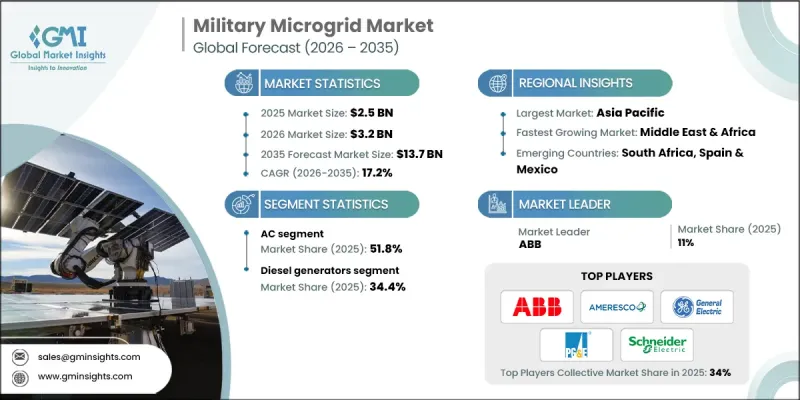
이러한 성장은 전력망의 불안정성, 사이버 위험, 물리적 위협에 노출된 환경에서 미션 크리티컬한 방어 작전을 지원하기 위한 중단 없는 안전한 전력에 대한 수요 증가에 의해 주도되고 있습니다. 특히 외딴 지역이나 고위험 지역에서는 기존의 연료 물류가 비싸고 불안정하기 때문에 군사 시설에서는 자율적으로 운영 가능한 에너지 시스템의 필요성이 증가하고 있습니다. 마이크로그리드는 중앙집중식 전력망에 대한 의존도를 낮추면서 지역에 기반한 강력한 전력을 공급함으로써 이러한 과제에 대응할 수 있습니다. 다양한 에너지원을 통합하고 가혹한 조건에서도 운영 연속성을 유지할 수 있는 능력으로 인해 현대 국방 인프라의 핵심 구성요소로 자리 잡았습니다. 군용 마이크로그리드는 자율적으로 또는 메인 그리드와 연계하여 운영할 수 있는 자급자족형 에너지 네트워크 역할을 합니다. 재생에너지, 에너지 저장, 재래식 발전을 결합하여 에너지 안보 강화, 연료 소비 감소, 즉각적인 대응력 향상을 실현합니다. 첨단 제어 플랫폼, 실시간 에너지 관리, AI 기반 최적화 도구의 도입 확대로 확장성, 성능, 효율성이 더욱 향상되어 세계 시장 침투가 가속화되고 있습니다.
| 시장 범위 | |
|---|---|
| 시작 연도 | 2025년 |
| 예측 연도 | 2026-2035 |
| 개시 금액 | 25억 달러 |
| 예측 금액 | 137억 달러 |
| CAGR | 17.2% |
직류 부문은 높은 효율성과 군사 시설에 도입된 재생에너지 발전 시스템 및 에너지 저장 시스템과의 높은 호환성으로 인해 2035년까지 연평균 17%의 성장률을 보일 것으로 예상됩니다. 직류 기반 아키텍처는 에너지 변환 손실을 줄이고 민감한 방어 장비에 안정적인 전력 공급을 제공합니다. 지속가능성 목표를 지원하면서 연료 기반 발전에 대한 의존도를 낮출 수 있기 때문에 외딴 지역이나 분쟁 지역에서 운영되는 시설에 특히 적합합니다.
천연가스 부문은 배출 프로파일의 우위, 비용 우위, 안정적인 연료 공급을 바탕으로 2035년까지 연평균 16.5%의 성장률을 기록할 것으로 예상됩니다. 천연가스 발전은 지속적인 전력 공급을 지원하면서 재생에너지와 효과적으로 통합할 수 있으며, 운영 신뢰성을 손상시키지 않으면서도 국방 시설의 탄소 강도를 낮출 수 있습니다. 이러한 전환은 군 시설 전반의 에너지 효율을 향상시키면서 보다 광범위한 지속가능성 목표에 부합하는 것입니다.
미국 군사 마이크로그리드 시장은 2025년 81.6%의 점유율을 차지하며 2035년까지 6억 7,000만 달러 규모로 성장할 것으로 예상됩니다. 시장 확대의 배경에는 송전망 장애, 사이버 공격, 자연재해로 인한 혼란으로부터 방어 작전을 보호하는 '에너지 회복탄력성'에 대한 강한 집중이 있습니다. 지속적인 제도적 지원과 장기적인 인프라 투자가 도입을 촉진하고 있으며, 군사시설에서는 외부 전력망에 의존하지 않고 임무 연속성과 인프라 보안을 보장하는 자율형 에너지 시스템 도입이 우선시되고 있습니다.
The Global Military Microgrid Market was valued at USD 2.5 billion in 2025 and is estimated to grow at a CAGR of 17.2% to reach USD 13.7 billion by 2035.
Growth is driven by the increasing need for uninterrupted and secure power to support mission-critical defense operations in environments exposed to grid instability, cyber risks, and physical threats. Military installations increasingly require energy systems that can operate independently, particularly in remote or high-risk locations where traditional fuel logistics are costly and unreliable. Microgrids address these challenges by delivering localized, resilient power while reducing dependence on centralized grids. Their ability to integrate diverse energy sources and maintain operational continuity under extreme conditions has made them a core component of modern defense infrastructure. A military microgrid functions as a self-sufficient energy network capable of operating autonomously or in coordination with the main grid. By combining renewable energy, energy storage, and conventional generation, these systems enhance energy security, reduce fuel consumption, and improve readiness. Rising adoption of advanced control platforms, real-time energy management, and AI-driven optimization tools is further improving scalability, performance, and efficiency, accelerating global market penetration.
| Market Scope | |
|---|---|
| Start Year | 2025 |
| Forecast Year | 2026-2035 |
| Start Value | $2.5 Billion |
| Forecast Value | $13.7 Billion |
| CAGR | 17.2% |
The direct current segment is expected to grow at a CAGR of 17% through 2035, supported by its high efficiency and strong compatibility with renewable generation and energy storage systems deployed at military facilities. DC-based architectures reduce energy conversion losses and provide stable power delivery for sensitive defense equipment. Their ability to support sustainability objectives while lowering reliance on fuel-based generation makes them particularly suitable for installations operating in remote or contested environments.
The natural gas segment is forecast to grow at a CAGR of 16.5% by 2035, driven by favorable emissions profiles, cost advantages, and reliable fuel availability. Natural gas-based generation supports continuous power delivery while integrating effectively with renewable energy sources, enabling defense facilities to lower carbon intensity without compromising operational reliability. This transition aligns with broader sustainability goals while enhancing energy efficiency across military installations.
United States Military Microgrid Market held 81.6% share in 2025 and is projected to generate USD 670 million by 2035. Market expansion is fueled by a strong focus on energy resilience to protect defense operations from disruptions caused by grid failures, cyber incidents, or environmental events. Continued institutional backing and long-term infrastructure investment are reinforcing adoption, as military facilities prioritize autonomous energy systems that ensure mission continuity and infrastructure security without reliance on external grids.
Key companies operating in the Global Military Microgrid Market include Siemens, Schneider Electric, ABB, General Electric, Eaton Corporation, Ameresco, Lockheed Martin, Black & Veatch, Burns & McDonnell, PowerSecure, S&C Electric Company, AES Corporation, PG&E, and Critical Loop. Companies active in the military microgrid market are strengthening their market position through technology integration, long-term contracting, and solution customization. Leading players are investing in advanced control systems, AI-enabled energy management platforms, and modular microgrid architectures to improve flexibility and reliability. Strategic collaboration with defense agencies and infrastructure developers enables tailored system design aligned with mission requirements. Firms are also expanding service capabilities across installation, maintenance, and lifecycle management to secure recurring revenue. Emphasis on cybersecurity, system redundancy, and resilience engineering is enhancing value propositions.