Industrial Pasteurizers Market Opportunity, Growth Drivers, Industry Trend Analysis, and Forecast 2026 - 2035
상품코드:1928949
리서치사:Global Market Insights Inc.
발행일:2026년 01월
페이지 정보:영문 250 Pages
라이선스 & 가격 (부가세 별도)
ㅁ Add-on 가능: 고객의 요청에 따라 일정한 범위 내에서 Customization이 가능합니다. 자세한 사항은 문의해 주시기 바랍니다.
한글목차
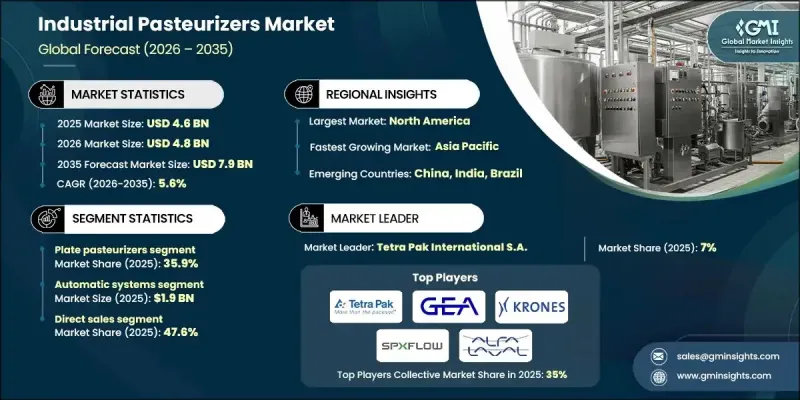
세계의 산업용 저온살균기 시장은 2025년에 46억 달러로 평가되었고, 2035년까지 연평균 복합 성장률(CAGR) 5.6%로 성장하여 79억 달러에 이를 것으로 예측됩니다.
시장 확대는 식품 안전, 업무 효율성, 지속 가능한 가공 방식에 대한 인식이 높아짐에 따라 뒷받침되고 있습니다. 주요 제조업체 간의 통합 활동이 증가하고 있는 것도 경쟁 환경에 영향을 미치고 있으며, 합병과 인수합병을 통해 혁신 역량이 강화되고 제품 라인업이 확대되고 있습니다. 동시에 기존의 수동 가열 처리 공정은 비효율적이고 환경 부하가 높은 것으로 간주되는 경향이 점점 더 커지고 있습니다. 첨단 열 회수 및 재생 시스템을 통해 에너지 사용량을 최소화하고 환경 부하를 줄일 수 있다는 점에서 현대식 열처리 솔루션이 선호되는 추세입니다. 이러한 기술은 액체 식품 생산 산업 전반에 걸쳐 채택되고 있는 지속가능성 목표와 밀접하게 일치합니다. 북미에서는 자동화 액체 처리 및 무균 충전 장비에 대한 수요가 지속적으로 증가하고 있으며, 유럽 및 아시아태평양의 일부 지역에서는 식음료 인프라에 대한 투자가 증가하여 현지 시장에서 산업용 멸균 장비의 상업적 타당성이 향상되고 있습니다.
시장 범위
개시 연도
2025년
예측 연도
2026-2035년
개시 연도 가치
46억 달러
예측 금액
79억 달러
CAGR
5.6%
판형 살균기 부문은 2025년 35.9%의 점유율을 차지할 것으로 예측됩니다. 이러한 시스템은 특히 액체 식품 생산 환경에서 효율적인 열 전달을 유지하고 에너지 소비를 줄이면서 대량의 처리량을 처리할 수 있는 능력으로 인해 널리 채택되고 있습니다.
자동 살균 시스템 부문은 2025년 42.3%의 점유율을 차지하며 19억 달러의 수익을 창출할 것으로 예측됩니다. 자동화는 처리 능력 향상, 작업 안전성 향상, 노동력 의존도 감소로 이어지기 때문에 점점 더 선호되고 있습니다. 첨단 제어 기술을 통해 시스템의 정확성과 신뢰성을 향상시켜 규제 산업에서 엄격한 품질 및 안전 기준을 준수할 수 있도록 지원합니다.
미국 산업용 저온살균기 시장은 자동화 식품 가공에 대한 강력한 투자와 프리미엄 음료 생산 확대에 힘입어 2035년까지 연평균 복합 성장률(CAGR) 5.8%를 유지할 것으로 예측됩니다. 살균 장비는 자동화 된 고속 처리 솔루션의 도입이 증가하고 있는 대규모 유제품 유통 네트워크에서 중요한 역할을 하고 있습니다.
목차
제1장 조사 방법과 범위
제2장 주요 요약
제3장 업계 인사이트
생태계 분석
공급업체 상황
이익률
각 단계 부가가치
밸류체인에 영향을 미치는 요인
업계에 대한 영향요인
성장 촉진요인
클린 라벨 및 기능성 음료 급증
엄격한 식품 안전기준 및 FSMA 규제
지속가능성과 열효율
업계의 잠재적 리스크&과제
초기 설비투자비용이 높고, 투자 회수기간이 길다
기존 시설 개보수 복잡성
기회
디지털 트윈과 실시간 감시
하이브리드 및 모듈러식 살균 장비
성장 가능성 분석
향후 시장 동향
기술과 혁신 동향
현재 기술 동향
신기술
가격 동향
지역별
유형별
규제 상황
규격 및 컴플라이언스 요건
지역별 규제 구조
인증 기준
Porter의 Five Forces 분석
PESTEL 분석
제4장 경쟁 구도
서론
기업의 시장 점유율 분석
지역별
기업 매트릭스 분석
주요 시장 기업의 경쟁 분석
경쟁 포지셔닝 매트릭스
주요 발전
인수합병(M&A)
제휴 및 협업
신제품 발매
확대 계획
제5장 시장 추산·예측 : 제품 유형별, 2022-2035
플레이트식 살균 장비
터널식 살균 장비
배치식 살균 장비
HTST(고온 단시간) 시스템
기타
제6장 시장 추산·예측 : 조작별, 2022-2035
수동
반자동
자동
제7장 시장 추산·예측 : 기술별, 2022-2035
전기식 살균 장비
가스식 살균 장비
증기 살균 장비
제8장 시장 추산·예측 : 용량별, 2022-2035
1000리터 미만
1000-5000리터
5000리터 이상
제9장 시장 추산·예측 : 용도별, 2022-2035
유제품 산업
우유·크림
치즈 생산
요구르트 제조
아이스크림 가공
음료 업계
주류
무알코올 음료
식품 가공
기타(의약품, 반려동물사료 등)
제10장 시장 추산·예측 : 유통 채널별, 2022-2035
직접
간접
제11장 시장 추산·예측 : 지역별, 2022-2035
북미
미국
캐나다
유럽
독일
영국
프랑스
이탈리아
스페인
아시아태평양
중국
일본
인도
호주
한국
라틴아메리카
브라질
멕시코
아르헨티나
중동 및 아프리카
남아프리카공화국
사우디아라비아
아랍에미리트(UAE)
제12장 기업 개요
Alfa Laval AB
Dion Engineering
Feldmeier Equipment, Inc.
GEA Group AG
Hiperbaric
HRS Heat Exchangers
IDMC Limited
JBT Corporation
KHS Group
Krones AG
Milkron GmbH
Paul Mueller Company
Sidel
SPX FLOW, Inc.
Tetra Pak International S.A.
LSH
영문 목차
영문목차
The Global Industrial Pasteurizers Market was valued at USD 4.6 billion in 2025 and is estimated to grow at a CAGR of 5.6% to reach USD 7.9 billion by 2035.
Market expansion is supported by rising awareness around food safety, operational efficiency, and sustainable processing practices. Growing consolidation activity among leading manufacturers is also influencing the competitive landscape, as mergers and acquisitions are strengthening innovation capabilities and expanding product offerings. At the same time, traditional manual heat treatment processes are increasingly viewed as inefficient and environmentally burdensome. Modern thermal processing solutions are gaining preference due to their ability to minimize energy usage and reduce environmental impact through advanced heat recovery and regenerative systems. These technologies align closely with the sustainability goals adopted across the liquid food production industry. Demand for automated liquid processing and aseptic filling facilities continues to rise in North America, while increasing investments in food and beverage infrastructure across Europe and parts of the Asia Pacific region are improving the commercial viability of industrial pasteurization equipment in local markets.
Market Scope
Start Year
2025
Forecast Year
2026-2035
Start Value
$4.6 Billion
Forecast Value
$7.9 Billion
CAGR
5.6%
The plate-based pasteurizers segment held 35.9% share in 2025. These systems remain widely adopted due to their ability to handle large processing volumes while maintaining efficient heat transfer and reduced energy consumption, particularly in liquid food production environments.
The automatic pasteurization systems segment accounted for 42.3% share in 2025 and generated USD 1.9 billion. Automation is increasingly favored as it enhances throughput, improves operational safety, and lowers labor dependency. Advanced control technologies are improving system accuracy and reliability, supporting compliance with strict quality and safety standards across regulated industries.
U.S. Industrial Pasteurizers Market held 5.8% CAGR through 2035, supported by strong investments in automated food processing and the expansion of premium beverage production. Pasteurization equipment plays a critical role in large-scale dairy distribution networks, where automated high-speed processing solutions are seeing increased adoption.
Leading companies active in the Global Industrial Pasteurizers Market include Tetra Pak International S.A., GEA Group AG, Alfa Laval AB, SPX FLOW, Inc., Krones AG, Sidel, JBT Corporation, KHS Group, Paul Mueller Company, Feldmeier Equipment, Inc., Milkron GmbH, HRS Heat Exchangers, IDMC Limited, Dion Engineering, and Hiperbaric. Companies operating in the Industrial Pasteurizers Market are reinforcing their market positions through technology upgrades, strategic partnerships, and portfolio diversification. Manufacturers are investing in energy-efficient designs and automation-ready systems to meet evolving customer requirements. Expansion into emerging markets and localized manufacturing strategies are helping improve market reach and cost competitiveness. Continuous investment in research and development is enabling companies to enhance system performance, reliability, and compliance with food safety standards.
Table of Contents
Chapter 1 Methodology and Scope
1.1 Market scope and definition
1.2 Research design
1.2.1 Research approach
1.2.2 Data collection methods
1.3 Data mining sources
1.3.1 Global
1.3.2 Regional/Country
1.4 Base estimates and calculations
1.4.1 Base year calculation
1.4.2 Key trends for market estimation
1.5 Primary research and validation
1.5.1 Primary sources
1.6 Forecast model
1.7 Research assumptions and limitations
Chapter 2 Executive Summary
2.1 Industry 3600 synopsis
2.2 Key market trends
2.2.1 Regional
2.2.2 Product type
2.2.3 Operation
2.2.4 Technology
2.2.5 Capacity
2.2.6 Application
2.2.7 Distribution channel
2.3 CXO perspectives: Strategic imperatives
2.3.1 Key decision points for industry executives
2.3.2 Critical success factors for market players
2.4 Future outlook and strategic recommendations
Chapter 3 Industry Insights
3.1 Industry ecosystem analysis
3.1.1 Supplier landscape
3.1.2 Profit margin
3.1.3 Value addition at each stage
3.1.4 Factor affecting the value chain
3.2 Industry impact forces
3.2.1 Growth drivers
3.2.1.1 Surge in clean-label and functional beverages
3.2.1.2 Strict food safety and FSMA regulations
3.2.1.3 Sustainability and thermal efficiency
3.2.2 Industry pitfalls & challenges
3.2.2.1 High initial CAPEX & long ROI
3.2.2.2 Complexity of retrofitting legacy sites
3.2.3 Opportunities
3.2.3.1 Digital twins and real-time monitoring
3.2.3.2 Hybrid and modular pasteurization units
3.3 Growth potential analysis
3.4 Future market trends
3.5 Technology and innovation landscape
3.5.1 Current technological trends
3.5.2 Emerging technologies
3.6 Price trends
3.6.1 By region
3.6.2 By type
3.7 Regulatory landscape
3.7.1 Standards and compliance requirements
3.7.2 Regional regulatory frameworks
3.7.3 Certification standards
3.8 Porter';s analysis
3.9 PESTEL analysis
Chapter 4 Competitive Landscape, 2025
4.1 Introduction
4.2 Company market share analysis
4.2.1 By region
4.2.1.1 North America
4.2.1.2 Europe
4.2.1.3 Asia Pacific
4.2.1.4 Latin America
4.2.1.5 Middle East and Africa
4.3 Company matrix analysis
4.4 Competitive analysis of major market players
4.5 Competitive positioning matrix
4.6 Key developments
4.6.1 Mergers & acquisitions
4.6.2 Partnerships & collaborations
4.6.3 New product launches
4.6.4 Expansion plans
Chapter 5 Market Estimates and Forecast, By Product Type, 2022 - 2035 (USD Billion) (Thousand Units)
5.1 Key trends
5.2 Plate pasteurizers
5.3 Tunnel pasteurizers
5.4 Batch pasteurizers
5.5 HTST (high temperature short time) systems
5.6 Others
Chapter 6 Market Estimates and Forecast, By Operation, 2022 - 2035 (USD Billion) (Thousand Units)
6.1 Key trends
6.2 Manual
6.3 Semi-automatic
6.4 Automatic
Chapter 7 Market Estimates and Forecast, By Technology, 2022 - 2035 (USD Billion) (Thousand Units)
7.1 Key trends
7.2 Electric pasteurizers
7.3 Gas pasteurizers
7.4 Steam pasteurizers
Chapter 8 Market Estimates and Forecast, By Capacity, 2022 - 2035 (USD Billion) (Thousand Units)
8.1 Key trends
8.2 Below 1000 litres
8.3 Between 1000-5000 litres
8.4 Above 5000 litres
Chapter 9 Market Estimates and Forecast, By Application, 2022 - 2035 (USD Billion) (Thousand Units)
9.1 Key trends
9.2 Dairy industry
9.2.1 Milk and cream
9.2.2 Cheese production
9.2.3 Yogurt manufacturing
9.2.4 Ice cream processing
9.3 Beverage industry
9.3.1 Alcoholic beverage
9.3.2 Non-Alcoholic beverage
9.4 Food processing
9.5 Others (pharmaceuticals, pet food, etc.)
Chapter 10 Market Estimates and Forecast, By Distribution Channel, 2022 - 2035 (USD Billion) (Thousand Units)
10.1 Key trends
10.2 Direct
10.3 Indirect
Chapter 11 Market Estimates and Forecast, By Region, 2022 - 2035 (USD Billion) (Thousand Units)