Non-Alcoholic Beer Market Opportunity, Growth Drivers, Industry Trend Analysis, and Forecast 2026 - 2035
상품코드:1913410
리서치사:Global Market Insights Inc.
발행일:2025년 12월
페이지 정보:영문 210 Pages
라이선스 & 가격 (부가세 별도)
ㅁ Add-on 가능: 고객의 요청에 따라 일정한 범위 내에서 Customization이 가능합니다. 자세한 사항은 문의해 주시기 바랍니다.
한글목차
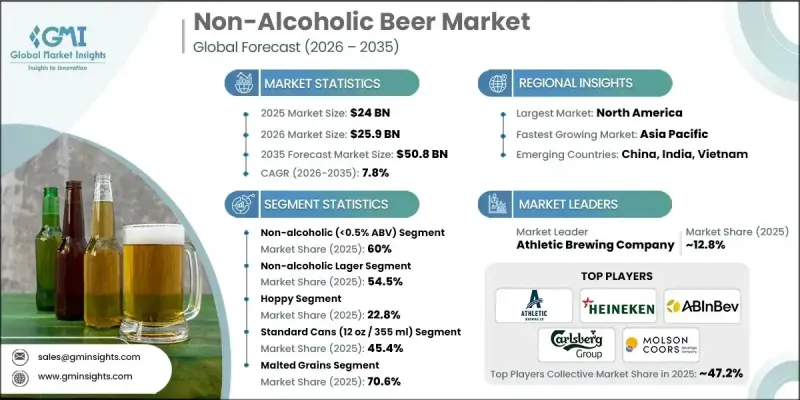
세계의 무알코올 맥주 시장은 2025년 240억 달러로 평가되었으며, 2035년까지 연평균 복합 성장률(CAGR) 7.8%로 성장하여 508억 달러에 이를 것으로 예측됩니다.
무알코올 맥주는 알코올 프리(0% ABV), 논알코올(0.5% ABV), 저알코올(0.5%-2.5% ABV) 종류를 포함하여 세계 음료 업계에서 주목할만한 부문이 되고 있습니다. 이 음료는 건강 지향 소비자, 지정 운전자, 알코올의 영향을 받지 않고 진짜 맥주의 맛을 요구하는 이들에게 대응하고 있습니다. 시장은 라거와 IPA에서 밀 맥주, 스타우트, 특수 양조 맥주에 이르기까지 다양한, 최소 또는 제로 알코올로 진정한 풍미 경험을 제공합니다. 성장은 건강 의식 증가, 라이프 스타일 선호의 변화, 프리미엄과 혁신적인 양조 옵션에 대한 소비자 관심에 의해 견인되고 있습니다. 진공 증류, 역삼투, 발효 정지 기술 등의 양조 기술의 진보에 의해 생산자는 맛과 향기를 향상시킬 수 있어, 무알코올 맥주에 대한 수용성을 높여, 기존의 회의적인 견해를 줄이고 있습니다.
시장 범위
시작 연도
2025년
예측 연도
2026-2035년
시작 규모
240억 달러
예측 금액
508억 달러
CAGR
7.8%
논알코올(알코올 도수 0.5%) 부문은 2025년 60%의 점유율을 차지했고, 2035년까지 연평균 복합 성장률(CAGR)7.6%를 보일 것으로 예측됩니다. 이 부문은 정통 맥주의 맛과 최소한의 알코올을 양립시켜 전통적인 맥주에 가장 가까운 음료 경험을 제공하는 법적 논알코올 기준을 충족합니다. 확립된 양조 기술은 완전 무알코올 제품보다 맛의 복잡성, 입맛, 향기를 더 잘 유지합니다.
무알코올 라거 부문은 2025년 54.5%의 점유율을 차지했며 2035년까지 연평균 복합 성장률(CAGR) 7.6%를 보일 것으로 예측됩니다. 세계적인 매력, 깔끔한 맛, 온화한 쓴 맛, 부드러운 뒷맛이, 무알코올 카테고리에서 신규 및 기존 소비자로부터 선호되는 이유가 되고 있습니다.
미국의 무알코올 맥주 시장은 2025년 64억 달러 규모에 이르렀습니다. 건강 의식의 고조, 소버큐리어스(절주 지향) 운동 주류화, 혁신을 중시하는 활기찬 크래프트 양조 문화에 의해 북미 시장을 견인하고 있습니다. 밀레니엄 세대와 Z세대 소비자가 의식적인 음주를 중시하고 프리미엄 크래프트 제품을 채용하는 것, 또한 무알코올 맥주를 라이프 스타일의 선택지로 자리매김하는 마케팅이 지속적인 수요를 견인하고 있습니다.
목차
제1장 조사 방법과 범위
제2장 주요 요약
제3장 업계 인사이트
생태계 분석
공급자의 상황
이익률
각 단계에서의 부가가치
밸류체인에 영향을 주는 요인
혁신
업계에 미치는 영향요인
성장 요인
업계의 잠재적 위험 및 과제
시장 기회
성장 가능성 분석
규제 상황
북미
유럽
아시아태평양
라틴아메리카
중동 및 아프리카
Porter's Five Forces 분석
PESTEL 분석
기술과 혁신 동향
현재의 기술 동향
신흥기술
가격 동향
지역별
알코올 도수별
미래 시장 동향
기술과 혁신 동향
현재의 기술 동향
신흥기술
특허 동향
무역 통계(HS코드)(참고 : 무역 통계는 주요 국가에서만 제공됨)
주요 수입국
주요 수출국
지속가능성과 환경면
지속가능한 대처
폐기물 감축 전략
생산에서의 에너지 효율
환경에 배려한 대처
탄소발자국 고려
제4장 경쟁 구도
소개
기업의 시장 점유율 분석
지역별
북미
유럽
아시아태평양
라틴아메리카
중동 및 아프리카
기업 매트릭스 분석
주요 시장 기업의 경쟁 분석
경쟁 포지셔닝 매트릭스
주요 발전
인수합병
제휴 및 협업
신제품 발매
확대 계획
제5장 시장 추계 및 예측 : 알코올 도수별, 2022-2035년
무알코올 음료(0% ABV)
논알코올 음료(0.5% 미만 ABV)
저알코올 음료(0.5-2.5% ABV)
제6장 시장 추계 및 예측 : 맥주 스타일별, 2022-2035년
무알코올 라거
무알코올 IPA
무알코올 밀 맥주
무알코올 스타우트 alc 포터
무알코올 라이트 비어
무알코올 골든 및 블론드 에일
무알코올 코퍼 및 앰버에일
무알코올 사워 비어
무알코올 고제
기타
제7장 시장 추계 및 예측 : 풍미 프로파일별, 2022-2035년
감귤류
홉
맥아계
소나무 및 수지
커피 및 로스트
과일계
꿀
빵 및 곡물
기타
제8장 시장 추계 및 예측 : 포장 유형별, 2022-2035년
표준 캔(12온스/355밀리리터)
대형 캔(19.2온스/568밀리리터)
유리병
케그 및 드래프트
기타
제9장 시장 추계 및 예측 : 재료별, 2022-2035년
맥아
홉
효모
효소
제10장 시장 추계 및 예측 : 유통 채널별, 2022-2035년
오프 트레이드(소매점)
슈퍼마켓 및 하이퍼마켓
편의점
전문점
온라인 소매 및 전자상거래
기타
온트레이드(HORECA)
소비자에게 직접 판매
기타
제11장 시장 추계 및 예측 : 지역별, 2022-2035년
북미
미국
캐나다
유럽
독일
영국
프랑스
스페인
이탈리아
기타 유럽
아시아태평양
중국
인도
일본
호주
한국
기타 아시아태평양
라틴아메리카
브라질
멕시코
아르헨티나
기타 라틴아메리카
중동 및 아프리카
사우디아라비아
남아프리카
아랍에미리트(UAE)
기타 중동 및 아프리카
제12장 기업 프로파일
Athletic Brewing Company
Heineken NV
Anheuser-Busch InBev
Carlsberg Group
Molson Coors
Clausthaler/Radeberger Group
BrewDog
Partake Brewing
Bravus Brewing Company
Nirvana Brewery
Big Drop Brewing Co.
Erdinger Alkoholfrei
WellBeing Brewing
Gruvi
Surreal Brewing Company
Hairless Dog Brewing
Mikkeller
Infinite Session
Rightside Brewing
JHS
영문 목차
영문목차
The Global Non-Alcoholic Beer Market was valued at USD 24 billion in 2025 and is estimated to grow at a CAGR of 7.8% to reach USD 50.8 billion by 2035.
Non-alcoholic beer, including alcohol-free (0% ABV), non-alcoholic (0.5% ABV), and low-alcohol (0.5% to 2.5% ABV) varieties, has become a notable segment in the global beverage industry. These beverages cater to health-conscious consumers, designated drivers, and those seeking the authentic taste of beer without alcohol's effects. The market spans multiple beer styles, from lagers and IPAs to wheat beers, stouts, and specialty brews, delivering genuine flavor experiences with minimal or no alcohol. Growth is driven by increasing health awareness, changing lifestyle preferences, and consumer interest in premium, innovative brewing options. Advancements in brewing technology, including vacuum distillation, reverse osmosis, and arrested fermentation, allow producers to improve taste and aroma, enhancing acceptance and reducing historical skepticism around non-alcoholic beers.
Market Scope
Start Year
2025
Forecast Year
2026-2035
Start Value
$24 Billion
Forecast Value
$50.8 Billion
CAGR
7.8%
The Non-alcoholic (0.5% ABV) segment held a 60% share in 2025 and is expected to grow at a CAGR of 7.6% through 2035. This segment balances authentic beer flavor with minimal alcohol, aligning with legal non-alcoholic standards while delivering a drinking experience closest to traditional beer. Established brewing techniques preserve flavor complexity, mouthfeel, and aroma better than fully alcohol-free alternatives.
The non-alcoholic lager segment accounted for a 54.5% share in 2025 and is forecast to grow at a CAGR of 7.6% through 2035. Its global appeal, clean taste, mild bitterness, and smooth finish make it a preferred choice for new and existing consumers in the non-alcoholic category.
U.S. Non-Alcoholic Beer Market was valued at USD 6.4 billion in 2025. The country leads North America's market due to strong health and wellness awareness, the mainstream adoption of the sober-curious movement, and a vibrant craft brewing culture that embraces innovation. Millennials and Gen Z consumers' emphasis on mindful drinking, premium craft product adoption, and marketing that positions non-alcoholic beer as a lifestyle choice drives sustained demand.
Major players in the Global Non-Alcoholic Beer Market include Athletic Brewing Company, Heineken N.V., Anheuser-Busch InBev, Carlsberg Group, Molson Coors, Clausthaler/Radeberger Group, BrewDog, Partake Brewing, Bravus Brewing Company, Nirvana Brewery, Big Drop Brewing Co., Erdinger Alkoholfrei, WellBeing Brewing, Gruvi, Surreal Brewing Company, Hairless Dog Brewing, Mikkeller, Infinite Session, and Rightside Brewing. Companies in the Non-Alcoholic Beer Market strengthen their position through strategies such as investing in advanced brewing technologies to enhance taste, aroma, and mouthfeel. They expand product portfolios across multiple ABV categories and beer styles to attract diverse consumer segments. Geographic expansion into emerging markets and urban centers helps tap growing health-conscious populations. Marketing campaigns focus on lifestyle branding, emphasizing wellness, mindful drinking, and premium craft experiences. Partnerships with distributors, retailers, and e-commerce platforms ensure wider availability, while collaborations with influencers and event sponsorships increase brand visibility.
Table of Contents
Chapter 1 Methodology & Scope
1.1 Market scope and definition
1.2 Research design
1.2.1 Research approach
1.2.2 Data collection methods
1.3 Data mining sources
1.3.1 Global
1.3.2 Regional/Country
1.4 Base estimates and calculations
1.4.1 Base year calculation
1.4.2 Key trends for market estimation
1.5 Primary research and validation
1.5.1 Primary sources
1.6 Forecast model
1.7 Research assumptions and limitations
Chapter 2 Executive Summary
2.1 Industry 3600 synopsis
2.2 Key market trends
2.2.1 Alcohol content
2.2.2 Beer style
2.2.3 Flavor profile
2.2.4 Packaging type
2.2.5 Material
2.2.6 Distribution channel
2.2.7 Regional
2.3 TAM Analysis, 2025-2035
2.4 CXO perspectives: Strategic imperatives
2.4.1 Executive decision points
2.4.2 Critical success factors
2.5 Future outlook and strategic recommendations
Chapter 3 Industry Insights
3.1 Industry ecosystem analysis
3.1.1 Supplier landscape
3.1.2 Profit margin
3.1.3 Value addition at each stage
3.1.4 Factor affecting the value chain
3.1.5 Disruptions
3.2 Industry impact forces
3.2.1 Growth drivers
3.2.2 Industry pitfalls and challenges
3.2.3 Market opportunities
3.3 Growth potential analysis
3.4 Regulatory landscape
3.4.1 North America
3.4.2 Europe
3.4.3 Asia Pacific
3.4.4 Latin America
3.4.5 Middle East & Africa
3.5 Porter's analysis
3.6 PESTEL analysis
3.7 Technology and innovation landscape
3.7.1 Current technological trends
3.7.2 Emerging technologies
3.8 Price trends
3.8.1 By region
3.8.2 By alcohol content
3.9 Future market trends
3.10 Technology and innovation landscape
3.10.1 Current technological trends
3.10.2 Emerging technologies
3.11 Patent landscape
3.12 Trade statistics (HS code) ( Note: the trade statistics will be provided for key countries only)
3.12.1 Major importing countries
3.12.2 Major exporting countries
3.13 Sustainability and environmental aspects
3.13.1 Sustainable practices
3.13.2 Waste reduction strategies
3.13.3 Energy efficiency in production
3.13.4 Eco-friendly initiatives
3.14 Carbon footprint consideration
Chapter 4 Competitive Landscape, 2025
4.1 Introduction
4.2 Company market share analysis
4.2.1 By region
4.2.1.1 North America
4.2.1.2 Europe
4.2.1.3 Asia Pacific
4.2.1.4 LATAM
4.2.1.5 MEA
4.3 Company matrix analysis
4.4 Competitive analysis of major market players
4.5 Competitive positioning matrix
4.6 Key developments
4.6.1 Mergers & acquisitions
4.6.2 Partnerships & collaborations
4.6.3 New product launches
4.6.4 Expansion plans
Chapter 5 Market Estimates and Forecast, By Alcohol Content, 2022-2035 (USD Billion) (Million Liters)
5.1 Key trends
5.2 Alcohol-free (0% ABV)
5.3 Non-alcoholic (<0.5% ABV)
5.4 Low alcohol (0.5% to 2.5% ABV)
Chapter 6 Market Estimates and Forecast, By Beer Style, 2022-2035 (USD Billion) (Million Liters)
6.1 Key trends
6.2 Non-alcoholic lager
6.3 Non-alcoholic IPA
6.4 Non-alcoholic wheat beer
6.5 Non-alcoholic stout & porter
6.6 Non-alcoholic light beer
6.7 Non-alcoholic golden & blonde ale
6.8 Non-alcoholic copper & amber ale
6.9 Non-alcoholic sour beer
6.10 Non-alcoholic gose
6.11 Others
Chapter 7 Market Estimates and Forecast, By Flavor Profile, 2022-2035 (USD Billion) (Million Liters)
7.1 Key trends
7.2 Citrus
7.3 Hoppy
7.4 Malt-forward
7.5 Pine & resinous
7.6 Coffee & roasted
7.7 Fruit-forward
7.8 Honey
7.9 Bread & grain
7.10 Others
Chapter 8 Market Estimates and Forecast, By Packaging Type, 2022-2035 (USD Billion) (Million Liters)
8.1 Key trends
8.2 Standard cans (12 oz / 355 ml)
8.3 Tall cans (19.2 oz / 568 ml)
8.4 Glass bottles
8.5 Kegs & draft
8.6 Others
Chapter 9 Market Estimates and Forecast, By Material, 2022-2035 (USD Billion) (Million Liters)
9.1 Key trends
9.2 Malted grains
9.3 Hops
9.4 Yeasts
9.5 Enzymes
Chapter 10 Market Estimates and Forecast, By Distribution Channel, 2022-2035 (USD Billion) (Million Liters)
10.1 Off-trade (Retail)
10.1.1 Supermarkets & Hypermarkets
10.1.2 Convenience Stores
10.1.3 Specialty Beverage Stores
10.1.4 Online Retail / E-Commerce
10.1.5 Other
10.2 On-trade (HORECA)
10.3 Direct-to-consumer
10.4 Others
Chapter 11 Market Estimates and Forecast, By Region, 2022-2035 (USD Billion) (Million Liters)