자동차용 타이어 인플레이터 시장 : 기회, 성장 요인, 산업 동향 분석 및 예측(2026-2035년)
Automotive Tire Inflator Market Opportunity, Growth Drivers, Industry Trend Analysis, and Forecast 2026 - 2035
상품코드:1913398
리서치사:Global Market Insights Inc.
발행일:2025년 12월
페이지 정보:영문 225 Pages
라이선스 & 가격 (부가세 별도)
ㅁ Add-on 가능: 고객의 요청에 따라 일정한 범위 내에서 Customization이 가능합니다. 자세한 사항은 문의해 주시기 바랍니다.
한글목차
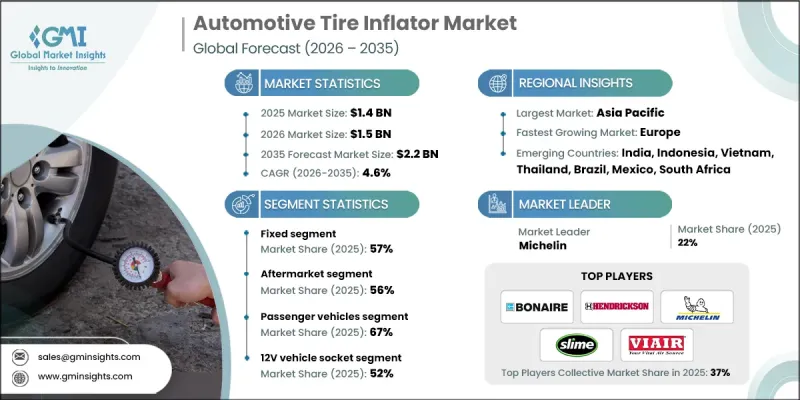
세계의 자동차용 타이어 인플레이터 시장은 2025년 14억 달러로 평가되었으며, 2035년까지 연평균 복합 성장률(CAGR) 4.6%로 성장하여 22억 달러에 이를 것으로 예측됩니다.
자동차용 타이어 인플레이터는 적절한 타이어 공기압을 유지하는데 중요한 역할을 하며, 이는 차량의 효율성, 운전 안전성 및 종합적인 성능을 직접적으로 지원합니다. 이 시장에는 차량 전원 소켓, 충전식 배터리 시스템 또는 직접 전기 연결을 통해 작동하도록 설계된 거치형 및 휴대용 솔루션이 모두 포함됩니다. 제품 라인업은 기본 공기 주입 장치에서 자동화된 압력 조절 및 모니터링 기능을 갖춘 디지털 제어 시스템에 이르기까지 다양합니다. 기술 발전으로 시장은 재구성되어 디지털 인터페이스, 자동 종료 기능, 지능형 압력 제어가 사용 편의성과 정확성을 향상시킵니다. 성장 동향은 교환 수요가 주류 성숙시장에, 차량소유 대수 증가가 새로운 기회를 창출하는 발전도상 지역과의 대비를 반영하고 있습니다. 소비자의 기대 변화, 안전 기준 강화, 소매 채널의 디지털화 진전이 구매 행동에 영향을 미치고 있습니다. 이러한 요인들이 결합되어 세계 자동차 생태계 전반에 걸쳐 제품 혁신, 접근성 및 보급을 계속 재정의하고 있습니다.
시장 범위
시작 연도
2025년
예측 기간
2026-2035년
시작 규모
14억 달러
시장 규모 예측
22억 달러
CAGR
4.6%
거치형 인플레이터 부문은 2025년에 57%의 점유율을 차지했고, 2026년부터 2035년까지 4.2%의 연평균 복합 성장률(CAGR)을 보일 것으로 예측되고 있습니다. 이러한 시스템은 지속적이고 대용량의 사용을 가정하여 설계되었으며 전문적이고 산업적인 환경에 일반적으로 설치됩니다. 전력 제한 없이 안정적인 성능을 발휘하고, 가혹한 운용 요구에 견디는 능력이 시장에서 주도적인 지위를 지지하고 있습니다.
애프터마켓 부문은 2025년 56%의 점유율을 차지했으며, 2035년까지 가장 높은 4.8%의 연평균 복합 성장률(CAGR)을 보일 것으로 예측됩니다. 교환 단위 및 제품 업그레이드에 대한 소비자의 강한 수요와 온라인 판매 채널의 확대가 지속적으로 성장을 이끌고 있습니다. 이 부문은 기능 향상, 휴대성 향상 또는 다중 차량용 추가 팽창기를 요구하는 사용자를 지원합니다.
중국의 자동차용 타이어 인플레이터 시장은 2025년에 38%의 점유율을 차지해 5억 4,170만 달러의 규모가 되었습니다. 지역적 주도적 지위는 자동차 소유 대수 증가, 자동차 액세서리에 대한 소비자 지출 확대, 소매 네트워크 확대, 신흥 경제국의 차량 케어 의식 증가에 의해 지원되고 있습니다.
목차
제1장 분석 방법과 범위
제2장 주요 요약
제3장 업계 인사이트
업계의 생태계 분석
공급자의 상황
이익률 분석
비용 구조
각 단계에서의 부가가치
밸류체인에 영향을 주는 요인
혁신
업계에 미치는 영향요인
성장 요인
타이어 안전성에 대한 의식의 고조
휴대형 및 컴팩트 솔루션에 대한 수요
어드벤처 및 오프로드 활동 증가
자동차 소유 대수 증가에 따라 타이어 인플레이터 수요 증가
전자상거래 성장으로 제품 가용성과 시장 도달 범위 향상
업계의 잠재적 위험과 과제
첨단 모델의 높은 초기 높이
대체 타이어 수리 솔루션 경쟁 구도
시장 기회
스마트하고 디지털한 타이어 인플레이터 수요 증가
무선 및 충전식 인플레이터의 보급 확대
신흥 시장에서의 자동차 판매 증가
예비 타이어 비탑재 차량에 OEM 적합
전자상거래 및 소비자용 직접 판매 채널 확대
성장 가능성 분석
규제 상황
Porter's Five Forces 분석
PESTEL 분석
기술과 혁신 동향
현재의 기술 동향
신흥기술
생산 통계
생산 거점
소비 거점
수출입
가격 분석
지역별
제품별
비용 내역 분석
특허 분석
지속가능성과 환경면
지속가능한 대처
폐기물 감축 전략
생산에서의 에너지 효율
환경에 배려한 대처
탄소발자국에 관한 고려 사항
전망과 투자 기회
제4장 경쟁 구도
소개
기업별 시장 점유율 분석
북미
유럽
아시아태평양
라틴아메리카
중동 및 아프리카
주요 기업의 경쟁 분석
경쟁 포지셔닝 매트릭스
전략적 전망 매트릭스
주요 동향
기업 인수합병(M&A)
사업 제휴 및 협력
신제품 발매
사업 확대 계획과 자금 조달
제5장 시장의 추정 및 예측 : 제품별(2022-2035년)
거치형
휴대형
제6장 시장의 추정 및 예측 : 차량별(2022-2035년)
승용차
해치백
세단
SUV
상용차
소형 상용차(LCV)
중형 상용차(MCV)
대형 상용차(HCV)
이륜차
전기자동차
오프로드 차량(ATV/UTV)
제7장 시장의 추정 및 예측 : 판매 채널별(2022-2035년)
OEM
거치형
휴대형
애프터마켓
거치형
휴대형
제8장 시장의 추정 및 예측 : 용도별(2022-2035년)
가정용
상업용
산업용
제9장 시장의 추정 및 예측 : 컴포넌트별(2022-2035년)
ECU
컴프레서
압력 센서
기타
제10장 시장의 추정 및 예측 : 전원별(2022-2035년)
12V 차내 소켓
충전식 전지(리튬 이온)
직류 전원
기타
제11장 시장의 추정 및 예측 : 지역별(2022-2035년)
북미
미국
캐나다
유럽
독일
영국
프랑스
이탈리아
스페인
러시아
북유럽 국가
베네룩스 국가
아시아태평양
중국
인도
일본
호주
한국
싱가포르
태국
인도네시아
베트남
라틴아메리카
브라질
멕시코
아르헨티나
콜롬비아
중동 및 아프리카
남아프리카
사우디아라비아
아랍에미리트(UAE)
제12장 기업 프로파일
국제적 기업
Berkshire Hathaway
BLACK DECKER
CRAFTSMAN
ITW Global Tire Repair
Marmon Holdings
MAT Industries
Michelin
Slime
STEMCO Products
VIAIR
지역 기업
Airtec
BONAIRE Industries
Coido
Guangzhou Meitun Electronic Commerce
Hendrickson USA
Kensun
Nova Gas Techniques
Pressure Systems International
PressureGuard
TIRETEK
신흥기업
Alpha Catalyst Consulting
Alto Ride
Kstar New Energy
Stealth Electric Outboards
TEMO
JHS
영문 목차
영문목차
The Global Automotive Tire Inflator Market was valued at USD 1.4 billion in 2025 and is estimated to grow at a CAGR of 4.6% to reach USD 2.2 billion by 2035.
Automotive tire inflators play an essential role in maintaining correct tire pressure, which directly supports vehicle efficiency, driving safety, and overall performance. The market includes both stationary and portable solutions designed to operate through vehicle power outlets, rechargeable battery systems, or direct electrical connections. Product offerings range from basic air inflation units to digitally controlled systems equipped with automated pressure regulation and monitoring capabilities. Technological progress has reshaped the market, with digital interfaces, automated shut-off functions, and intelligent pressure control improving usability and accuracy. Growth trends reflect a contrast between mature markets, where replacement demand is dominant, and developing regions, where rising vehicle ownership continues to create new opportunities. Shifting consumer expectations, tighter safety standards, and the increasing digitization of retail channels are influencing purchasing behavior. Together, these factors continue to redefine product innovation, accessibility, and adoption across global automotive ecosystems.
Market Scope
Start Year
2025
Forecast Year
2026-2035
Start Value
$1.4 Billion
Forecast Value
$2.2 Billion
CAGR
4.6%
The fixed inflator segment accounted for 57% share in 2025 and is projected to grow at a CAGR of 4.2% from 2026 to 2035. These systems are designed for continuous, high-capacity usage and are commonly installed in professional and industrial environments. Their ability to deliver consistent performance without power limitations and withstand heavy operational demands supports their leading market position.
The aftermarket segment held 56% share in 2025 and is expected to grow at the fastest CAGR of 4.8% through 2035. Strong consumer demand for replacement units and product upgrades, combined with the expansion of online sales channels, continues to drive growth. This segment serves users seeking improved functionality, portability, or additional inflators for multiple vehicles.
China Automotive Tire Inflator Market held a 38% share in 2025, generating USD 541.7 million. Regional leadership is supported by rising vehicle ownership, increasing consumer spending on automotive accessories, expanding retail networks, and growing awareness of vehicle care across emerging economies.
Key companies active in the Global Automotive Tire Inflator Market include Michelin, VIAIR, Slime, ITW Global Tire Repair, Kensun, Marmon Holdings, BONAIRE Industries, Hendrickson USA, TIRETEK, and Guangzhou Meitun Electronic Commerce. Companies operating in the Global Automotive Tire Inflator Market strengthen their competitive position through continuous product innovation and portfolio expansion. Manufacturers focus on integrating digital controls, smart sensors, and automated features to improve accuracy and ease of use. Expanding presence across online and offline distribution channels helps brands reach a wider customer base. Strategic pricing across basic and premium product lines supports diverse consumer needs. Firms also emphasize product durability and compliance with safety standards to build long-term trust. Partnerships with automotive retailers and investments in brand visibility further enhance market penetration.
Table of Contents
Chapter 1 Methodology
1.1 Market scope and definition
1.2 Research design
1.2.1 Research approach
1.2.2 Data collection methods
1.3 Data mining sources
1.3.1 Global
1.3.2 Regional/Country
1.4 Base estimates and calculations
1.4.1 Base year calculation
1.4.2 Key trends for market estimation
1.5 Primary research and validation
1.5.1 Primary sources
1.6 Forecast model
1.7 Research assumptions and limitations
Chapter 2 Executive Summary
2.1 Industry 3600 synopsis, 2022 - 2035
2.2 Key market trends
2.2.1 Regional
2.2.2 Product
2.2.3 Vehicles
2.2.4 Application
2.2.5 Power Source
2.2.6 Component
2.2.7 Sales Channel
2.3 TAM Analysis, 2026-2035
2.4 CXO perspectives: Strategic imperatives
2.4.1 Executive decision points
2.4.2 Critical success factors
2.5 Future outlook and strategic recommendations
Chapter 3 Industry Insights
3.1 Industry ecosystem analysis
3.1.1 Supplier landscape
3.1.2 Profit margin analysis
3.1.3 Cost structure
3.1.4 Value addition at each stage
3.1.5 Factor affecting the value chain
3.1.6 Disruptions
3.2 Industry impact forces
3.2.1.1 Growth drivers
3.2.1.2 Rising awareness about tire safety
3.2.1.3 Demand for portable and compact solutions
3.2.1.4 Rise in adventure and off-road activities
3.2.1.5 Rising vehicle ownership is increasing demand for tire inflators
3.2.1.6 Growth of e-commerce is improving product availability and market reach
3.2.2 Industry pitfalls and challenges
3.2.2.1 High initial cost of advanced models
3.2.2.2 Competition of alternative tire repair solutions
3.2.3 Market opportunities
3.2.3.1 Rising demand for smart and digital tire inflators
3.2.3.2 Growing adoption of cordless and rechargeable inflators
3.2.3.3 Increasing vehicle sales in emerging markets
3.2.3.4 OEM fitment in vehicles without spare tires
3.2.3.5 Expansion of e-commerce and direct-to-consumer channels